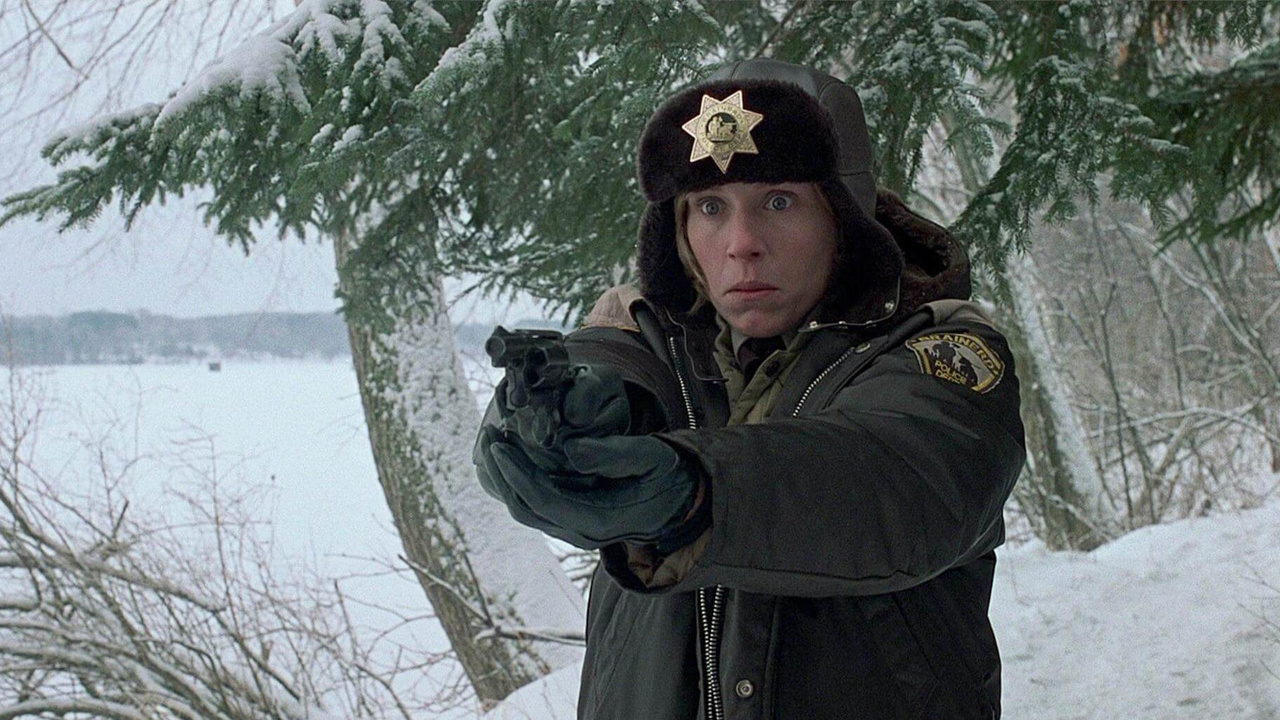
Director: Joel Coen · Cinematographer: Roger Deakins · Composer: Carter Burwell · Screenplay: Joel Coen, Ethan Coen · Editor: Roderick Jaynes (pseudonym for Joel and Ethan Coen) · Production Design: Rick Heinrichs · Key Cast: Frances McDormand (Marge Gunderson), William H. Macy (Jerry Lundegaard), Steve Buscemi (Carl Showalter), Peter Stormare (Gaear Grimsrud), Harve Presnell (Wade Gustafson) · Runtime: 98 minutes · Studio: PolyGram Filmed Entertainment / Working Title Films · Budget: $6.5 million · Box Office: $60.6 million (worldwide)
1. “This Is a True Story”
It isn’t.
The opening title card of Fargo reads: “THIS IS A TRUE STORY. The events depicted in this film took place in Minnesota in 1987. At the request of the survivors, the names have been changed. Out of respect for the dead, the rest has been told exactly as it occurred.”
Every sentence is a lie. There were no survivors who requested name changes. There was no single event in 1987 that the film depicts. The Coens later admitted they based the script loosely on scattered criminal incidents, none of which involved a kidnapping scheme by a car salesman, none of which culminated in a wood chipper, and none of which took place in this configuration. The title card is fiction presented as fact, and it is the first joke the film tells, though most audiences do not realize they are laughing at it.
The card matters because it establishes the film’s relationship to truth, which is the same relationship the film’s characters have to truth: casual, self-serving, and utterly sincere in its dishonesty. Jerry Lundegaard lies to everyone he meets with the wide-eyed conviction of a man who believes his own stories. Carl Showalter lies compulsively, even when honesty would serve him better. Marge Gunderson is the only major character who does not lie, and her honesty is so total, so unperformative, that it reads as a kind of superpower. The title card places the audience in the same position as Jerry’s victims: we believe what we are told because it is presented with authority, and we do not check.
Joel Coen explained the choice simply: “If an audience believes that something’s based on a real event, it gives you permission to do things they might otherwise not accept.” He was talking about the film’s tonal shifts, the way it swings from comedy to violence without warning, but the principle runs deeper. The “true story” card lowers the audience’s defenses. It makes the grotesque feel documentary. It turns the wood chipper from a punchline into a police report. The lie at the beginning licenses everything that follows.
2. Roger Deakins and the Terrifying Beauty of Nothing
The opening image of Fargo is a car towing another car through a blizzard. The screen is almost entirely white. The vehicles emerge from the void slowly, like figures developing on photographic paper, and the effect is both beautiful and deeply wrong. Snow, in most films, connotes purity, stillness, Christmas. In Fargo, it connotes erasure. The landscape is not empty. It is actively emptying, swallowing roads and buildings and people into a whiteness that does not care about any of them.
Roger Deakins, shooting on location in Minnesota and North Dakota during the winter of 1995, faced a problem that became an aesthetic: the winter was unusually warm, and there was almost no snow. The production had to manufacture or truck in snow for many scenes. The irony is that the finished film feels overwhelmed by whiteness, as though the landscape has won the argument. Deakins achieved this partly through framing: he shoots the Minnesota plains in wide, flat compositions that emphasize the horizon line and reduce human figures to specks against an undifferentiated field. The people in these shots are not dwarfed by mountains or forests, which would be conventionally dramatic. They are dwarfed by nothing. The void is the threat.
Deakins and the Coens made a deliberate decision to use almost no camera movement for the exterior shots. The wide shots are locked down, static, as indifferent to the events unfolding within them as the landscape itself. When the camera does move, it is inside: tracking through the corridors of Wade’s car dealership, following Marge through the Radisson lobby, circling Jerry as his lies tighten around him. The contrast creates a spatial argument about where agency exists. Outside, in the white void, nothing you do matters. Inside, in the cluttered, overheated rooms of Minnesota’s service economy, every gesture counts.
Two sequences defined Deakins’s career thinking. The night car chase, where headlights provide the only illumination in a field of snow and darkness, was an experiment in how little light a scene could survive on. Deakins would later cite this sequence as formative for his work on The Assassination of Jesse James. The opening credits sequence, shot during an actual blizzard the crew happened to catch while filming in a different location, was captured by a second unit while Deakins, Joel, and Ethan were all shooting interiors elsewhere. They were not even present for the image that would become the film’s most iconic.
3. Marge Gunderson and the Radical Power of Decency
Marge Gunderson arrives thirty-three minutes into the film, and her entrance is one of the great structural surprises in American cinema. She is asleep in bed with her husband, Norm. She is seven months pregnant. The phone rings. She rolls over. She gets up, puts on her uniform, scrapes the ice off her police cruiser, and drives to a crime scene. She vomits from morning sickness. She examines the bodies. She reconstructs the sequence of events with calm, methodical precision. Within five minutes of her arrival, she has figured out more about the case than any character in the film knows.
Frances McDormand, who is married to Joel Coen, won the Academy Award for this performance, and it deserved every molecule of recognition it received. What McDormand does with Marge is not flashy. It is the opposite of flashy. She plays a woman who is good at her job, loves her husband, looks forward to having a baby, and cannot understand why people do terrible things to each other. This sounds simple. It is not simple at all. In a film populated by liars, schemers, and killers, Marge is the only character who means exactly what she says, and McDormand plays this sincerity without a trace of sanctimony.
The accent helps. The Coens grew up in St. Louis Park, a suburb of Minneapolis, and they write the Minnesota dialect with the precision of people who heard it every day for eighteen years and then left. The “oh yahs” and “you betchas” and the rising interrogative that turns statements into questions are not mockery. They are documentation. McDormand mastered the cadence so thoroughly that it became inseparable from the character’s moral authority. Marge speaks in a voice that sounds friendly and slightly foolish, and she is the smartest person in every room she enters. The accent is a disguise she does not know she is wearing: it makes criminals underestimate her, which is the last mistake several of them make.
The Mike Yanagita scene remains the film’s most debated sequence. Marge meets an old high school classmate for dinner. He tells her a sad story about his wife. The story turns out to be a lie. The scene seems like a digression, a cul-de-sac in the narrative, but its function is precise: it is the moment that recalibrates Marge’s understanding of the case. Until Mike lies to her, Marge has been taking people at their word. After she discovers his deception, she returns to Jerry’s dealership with new suspicion. The scene teaches Marge, and the audience, that ordinary-looking people lie with extraordinary conviction. It is the film’s thesis compressed into a single lunch.
4. William H. Macy and the Architecture of a Wince
William H. Macy did not audition for the role of Jerry Lundegaard. He demanded it. After the Coens initially considered him for a smaller part, Macy flew to New York uninvited, walked into the audition, and told them: “I’m going to get this part. I want this role.” Ethan Coen later said they did not realize what a difficult acting challenge Jerry represented until they watched Macy solve it.
The difficulty is tonal. Jerry is a villain. He hires men to kidnap his own wife. The kidnapping results in multiple deaths, including his wife’s. And yet Macy plays him as a man so pathetic, so transparently terrible at deception, so clearly in over his head, that the audience’s primary response is not anger but discomfort. Watching Jerry try to lie is like watching someone fail a driving test in real time. You know the crash is coming. You can see exactly when it will happen. And there is nothing you can do except wince.
Macy’s technique is physical. Jerry stammers. He rubs his face. He adjusts his glasses. He smiles at inappropriate moments, a reflex so ingrained it fires even when the situation demands gravity. His body is in a constant state of barely suppressed panic, and Macy never lets the panic resolve into catharsis. Jerry does not break down. He does not confess. He does not have the dramatic moment of self-awareness that a more conventional screenplay would provide. He just keeps lying, poorly, to people who are increasingly skeptical, and the gap between his performance and reality widens until it becomes a kind of slapstick.
The Coens wrote Jerry as a character who is “a fascinating mix of the completely ingenuous and the utterly deceitful.” Macy found the key to this paradox: Jerry is not a good liar who sometimes fails. He is a terrible liar who believes he is a good one. The self-deception is more complete than the deception of others. Jerry has constructed an internal narrative in which he is a smart man executing a clever plan, and no amount of evidence to the contrary can shake his faith in this story. He is, in this sense, the “true story” title card made flesh.
5. Carter Burwell’s Hymn for the Frozen and the Lost
Carter Burwell has scored every Coen brothers film except O Brother, Where Art Thou?, and his work on Fargo is among the quietest and most devastating things he has ever written. The main theme is based on “Den bortkomne sauen” (“The Lost Sheep”), a Norwegian folk hymn, arranged for strings and played with a simplicity that borders on devotional.
The choice is both obvious and profound. Minnesota’s Scandinavian heritage is a running joke in the film: the accents, the cuisine, the relentless politeness that masks a deep provincial suspicion of anything unfamiliar. A Norwegian hymn about a lost sheep is thematically perfect for a story about characters who have wandered so far from decency that they cannot find their way back. But Burwell does not play the theme for irony. He plays it straight. The music is beautiful. It aches. It floats over scenes of mundane horror with the serenity of something that has made its peace with human failure.
The score is used sparingly. Long stretches of the film play without any music at all, relying on diegetic sound: the crunch of snow, the hum of a car engine, the scrape of an ice scraper on a windshield. When the score does appear, it arrives like weather, a change in atmospheric pressure that tells you something has shifted even before you can identify what. The most powerful deployment is over the film’s wide exterior shots, where the hymn and the white void combine into something that feels less like a film score than like a prayer offered to an indifferent landscape.
6. The Coens’ Minnesota: Noir in a Snow Globe
The Coen brothers grew up in St. Louis Park, Minnesota, and their relationship with their home state is the relationship most sharp observers have with the places they come from: intimate, affectionate, and unsparing. Fargo is a film made by people who know exactly what the inside of a Best Western in Brainerd looks like, who understand the social mechanics of a Rotary Club lunch, who can reproduce the rhythm of a conversation at a Perkins restaurant with the accuracy of a court stenographer.
The genius of setting a noir in this environment is that it violates every expectation the genre carries. Noir belongs in cities. It belongs in shadows. It belongs in rain-slicked streets and smoky bars and the kind of dangerous beauty that makes crime look glamorous. Fargo offers none of this. Its criminals meet in a bar called the King of Clubs in northeast Minneapolis. Its femme fatale is a kidnapped housewife. Its detective is a pregnant police chief who eats at Arby’s. The visual palette is not black and grey but white and tan, the colors of snowdrifts and wood paneling and institutional carpet. Crime, in the Coens’ Minnesota, is not glamorous. It is stupid, messy, and profoundly unglamorous, and the film’s refusal to stylize it is both its funniest joke and its most moral position.
This anti-noir sensibility produces the film’s most celebrated image: the wood chipper. Peter Stormare’s Gaear Grimsrud, a man of almost no words and limitless capacity for violence, disposes of a body by feeding it feet-first into an industrial wood chipper on the shores of a frozen lake. The scene is horrifying and absurd in equal measure. It is shot in a wide, static composition that makes the act look less like a dramatic climax and more like a chore. Grimsrud is bored. The machine does what machines do. The red spray against the white snow is the film’s only use of vivid color, and it functions the way a period at the end of a sentence functions: final, unambiguous, and somehow smaller than what preceded it.
7. A Quiet Masterpiece That Knows Exactly What It Is
Fargo is a 9/10 film. It does not aspire to the cosmic ambition of the Coens’ later No Country for Old Men, which this site has already covered, nor does it reach for the baroque invention of their best comedies. It aspires to something rarer: total control of tone across ninety-eight minutes, without a single scene that feels misplaced, a single performance that feels misjudged, or a single edit that arrives a beat too early or too late. It is a machine, and the machine runs perfectly.
The score of 9 rather than 10 reflects a considered judgment about scale. Fargo is a perfect small film. It does everything it sets out to do and nothing it does not. But the Coens deliberately constrain themselves here, choosing precision over ambition, and that constraint, while admirable, places a ceiling on the film’s emotional reach. Marge Gunderson is one of the great characters in American cinema, but the film around her is not interested in the depth of her inner life. Her marriage to Norm, her pregnancy, her bedrock decency: these are presented as givens, not explored as mysteries. The film uses Marge’s goodness as a dramatic tool rather than as a subject, and this is a legitimate artistic choice, but it means that Fargo moves you less than the greatest films can.
What it does instead is something almost no other film does as well: it makes you laugh at horror and then makes you wonder why you laughed. The tonal calibration is so exact that the comedy never cancels the violence and the violence never cancels the comedy. Both exist simultaneously, like two weather systems occupying the same sky, and the discomfort of holding both in your mind at once is the experience the Coens are engineering. Fargo is not a dark comedy. It is a comedy and a tragedy sharing a body.
Gene Siskel and Roger Ebert both named it the best film of 1996. It won the Palme d’Or runner-up at Cannes (Joel Coen took the Prix de la mise en scene) and two Academy Awards. It was selected for preservation in the National Film Registry in 2006. It spawned a television series that ran for five seasons. None of this recognition is surprising. What is surprising is how modestly the film wears its achievements. It never raises its voice. It never insists on its own importance. It just keeps scraping the ice off the windshield and driving to work.
8. The Coens as Cartographers of American Failure
By 1996, Joel and Ethan Coen had made six films: Blood Simple, Raising Arizona, Miller’s Crossing, Barton Fink, The Hudsucker Proxy, and Fargo. Each one occupied a different genre, a different region of America, a different tonal register. But they shared a preoccupation that Fargo brought into its sharpest focus: the gap between what Americans think they deserve and what they are willing to do to get it.
Jerry Lundegaard is the Coens’ most concentrated expression of this theme. He is a man of modest abilities and immodest wants. He works at his father-in-law’s car dealership, which means he has a job because of someone else’s money and a wife because of someone else’s tolerance. His scheme to kidnap his own wife and collect ransom from her father is not motivated by poverty or desperation in any absolute sense. It is motivated by humiliation. Jerry wants to be the kind of man who does not need his father-in-law’s permission, and the only plan he can conceive to achieve this independence involves crime, violence, and the exploitation of the person closest to him.
The Coens would return to this territory repeatedly. Llewelyn Moss in No Country for Old Men finds a suitcase of money and cannot walk away from it. Larry Gopnik in A Serious Man watches his life collapse and cannot understand why. Llewyn Davis in Inside Llewyn Davis plays beautiful music and cannot make a living. The pattern is consistent: American characters pursuing versions of the American dream through means that guarantee their own destruction. Fargo is the purest iteration because Jerry’s plan is so transparently doomed from the first frame that the only question is how badly things will go, not whether they will go badly.
9. “And It’s a Beautiful Day”: Marge, Norm, and the Stubborn Case for Ordinary Life
The film’s final scene is not about crime. It is about stamps.
Marge lies in bed with Norm after the case is closed. He tells her that the Postal Service has selected his painting of a mallard for a three-cent stamp. He is disappointed because another painter won the twenty-nine-cent stamp. Marge reminds him that people still need three-cent stamps. They settle into bed. She is two months from her due date. Outside, the snow has stopped.
This scene is often described as an epilogue, but it is the point of the entire film. Everything Fargo has shown you, the kidnapping, the murders, the wood chipper, the cascade of lies, has been a portrait of what happens when people want more than their lives contain. Marge and Norm want exactly what they have: each other, a baby on the way, a warm bed, a painting on a stamp. Their contentment is not naivety. It is a philosophical position. It is the film’s answer to Jerry’s question, the question that drives every Coen brothers protagonist off a cliff: “What if I could have more?”
The three-cent stamp is the answer. You do not need the twenty-nine-cent stamp. You need the thing that makes up the difference. The scene is funny and touching and, if you have been paying attention, devastating, because it arrives after ninety minutes of watching people destroy themselves and each other in pursuit of money they did not need, and it says, with the quietest possible authority, that the alternative was always available. Decency was always an option. Nobody took it except Marge.
10. Rewatch Through the Windshield: What the Snow Was Hiding
Do not watch the criminals on your second viewing. Watch Jerry.
Track every lie he tells, and track his face in the half-second after he tells it. Macy performs a micro-expression after each deception: a flicker of something that is not quite guilt and not quite satisfaction but a mixture of both, the face of a man who has just gotten away with something and knows, on some level, that he has not. These flickers are invisible on first viewing because the plot carries you forward too quickly to notice them. On a second pass, they become the film’s primary text: a portrait of self-deception rendered in twitches.
Listen to the accents as music rather than as comedy. The Minnesota dialect in Fargo has a melodic quality that the Coens and their actors exploit with the precision of composers. The rising inflection at the end of declarative sentences, the elongated vowels, the way “oh” becomes a two-syllable word with its own internal drama: these patterns create a rhythm that lulls the listener into a state of comfort, which is exactly when the violence arrives. The accents are not funny because they are strange. They are funny because they are warm, and warmth is the last thing you expect in a story about kidnapping and murder.
Notice the color red. Deakins and production designer Rick Heinrichs use red sparingly, so that when it appears, it registers with the force of an alarm. The tail lights of Jerry’s car in the opening scene. The blood on the snow at the highway crime scene. The spray from the wood chipper. The red of Marge’s parka. Each instance of red is a punctuation mark in the white field, and together they form a visual sentence that the film never speaks aloud: warmth, in this landscape, always involves blood.
Finally, watch the last shot. Marge and Norm in bed. The light is warm. The frame is tight. After ninety minutes of wide, empty, merciless landscapes, the camera has finally found a space small enough to contain something that matters.
Film Trivia
The winter that wasn’t. Minnesota experienced one of its warmest winters on record during the shoot, leaving the production desperately short of the snow that was supposed to define every exterior. The crew trucked in artificial snow and relocated to North Dakota for key scenes. The finished film feels buried in whiteness, which makes the behind-the-scenes struggle for a single usable snowdrift one of cinema’s great ironies.
Macy’s uninvited audition. William H. Macy was initially considered for a minor role. After learning the Coens were still auditioning in New York, he flew there at his own expense, walked into the room, and said: “I’m going to get this part. I want this.” The Coens cast him as Jerry Lundegaard. Macy later said it was the only time in his career he played the desperation card, and he knew it could have backfired completely.
The phantom editor. The Coens edit their own films under the pseudonym Roderick Jaynes, a fictional British editor with a fabricated biography. Jaynes has been nominated for Academy Awards (including for Fargo) and has even given supposed interviews. The joke has been running since Barton Fink in 1991, and the Coens have never broken character about it in official credits.
A blizzard caught on the fly. The opening credits sequence, one of the most iconic images in the film, was shot by a second unit during an actual blizzard that arrived unexpectedly. Deakins, Joel, and Ethan were all filming interiors on the sixteenth floor of an office building at the time and were not present for the shot. The image of a car materializing from the white void became the film’s visual signature almost by accident.
The Paul Bunyan that disappeared. The twenty-four-foot Paul Bunyan statue that appears in the film was built specifically for the production on a county highway near Bathgate, North Dakota. It was dismantled after filming. Visitors who drive to the location hoping to find it discover only a patch of ground near the Canadian border, which is, in its own way, a very Fargo kind of disappointment.

Leave a Reply