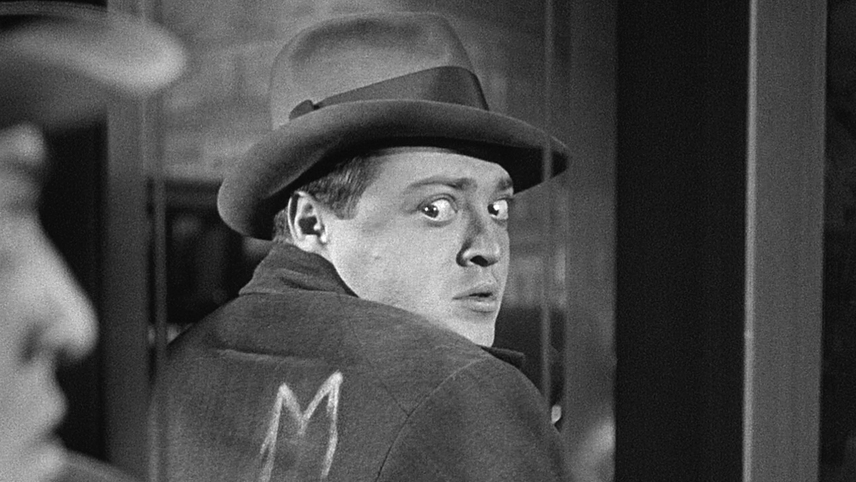
Director: Fritz Lang · Cinematographer: Fritz Arno Wagner · Screenplay: Fritz Lang, Thea von Harbou · Sound: Adolf Jansen · Editor: Paul Falkenberg · Production Design: Emil Hasler, Karl Vollbrecht · Key Cast: Peter Lorre (Hans Beckert), Otto Wernicke (Inspector Karl Lohmann), Gustaf Gründgens (Schränker), Ellen Widmann (Frau Beckmann), Inge Landgut (Elsie Beckmann) · Runtime: 117 minutes (original); 109 minutes (Criterion restoration) · Studio: Nero-Film AG · Producer: Seymour Nebenzal
1. A Tune Whistled Over a City’s Grave
Children sing in a circle. The rhyme is about a man in black who will come and chop them up. A mother leans out a window and tells them to stop. They don’t. They start again the moment she turns away, because children understand what adults refuse to admit: the monster is already here.
This is how M begins, and it is one of the most unsettling openings in the history of cinema. Not because anything violent happens. Because something ordinary happens. A little girl bounces a ball against a poster that asks: “Who is the murderer?” A shadow falls across her. A voice, offscreen, offers to buy her a balloon. And then a melody: Edvard Grieg’s “In the Hall of the Mountain King,” whistled in a thin, reedy tone that sounds less like music than like breathing. The ball rolls out from under a bush. The balloon drifts into power lines.
Elsie Beckmann is dead, and the film has not shown a single frame of violence.
This sequence alone would earn M its place in film history, but its real achievement is structural. Fritz Lang, making his first sound film in 1931, understood something that most of his contemporaries would not grasp for another decade: that sound is most powerful not when it replaces silence, but when it coexists with it. The whistling does not illustrate the scene. It is the scene. It carries the threat that the image refuses to depict. The absence of the crime onscreen forces the audience to construct the horror themselves, and that construction is worse than anything a camera could record.
The choice of Grieg was not accidental. “In the Hall of the Mountain King” is a piece most audiences already knew. It had associations with fairy tales, with childhood, with a kind of antic energy. Lang took those associations and poisoned them. By the third or fourth time the melody recurs, the audience flinches at the sound of a tune they might have once hummed to themselves. The leitmotif, borrowed from opera and transplanted into cinema for what many scholars consider the first time, becomes a weapon. It announces the killer’s presence before the camera finds him. It forces the viewer to listen the way a potential victim would listen: with dread dressed as recognition.
One more detail matters. Peter Lorre could not whistle. The sound you hear in the film is Fritz Lang himself, dubbing the melody in post-production. The director’s own breath becomes the killer’s signature. It is one of those facts that, once known, changes the texture of every scene in which the whistle appears.
2. Peter Lorre and the Invention of the Sympathetic Monster
Peter Lorre was twenty-six years old and had appeared in exactly two films before M. After it, he would spend the rest of his career trying to escape the shadow of Hans Beckert. He never fully succeeded, which tells you something about how total the performance is.
What Lorre does in M should not work. He plays a child murderer. The film does not soften this fact or explain it away. There is no tragic backstory, no abusive parent, no exculpating trauma. Beckert kills children because a compulsion inside him demands it, and the film allows him to say so, in a climactic monologue that remains one of the most electrifying scenes in all of cinema. “I can’t help myself,” he screams to the kangaroo court of criminals who have captured him. “I haven’t any control over this evil thing inside me.” His voice cracks. His eyes are enormous. Sweat glistens on his round face. For perhaps thirty seconds, you feel sorry for him. And then you remember what he does, and you feel ashamed that you felt sorry, and that shame is exactly where Lang wants you.
The performance operates on two planes simultaneously. In his early scenes, Lorre plays Beckert as a man trying to disappear into normalcy. He buys fruit. He reads the newspaper. He looks at his own reflection in a shop window with the blank curiosity of someone who does not recognize himself. These moments are quiet and naturalistic in a way that was almost unheard of in early sound cinema, where most actors still performed as though the balcony needed to hear them. Lorre whispers. He hesitates. He lets silences fill the frame. The restraint makes the explosion, when it comes, devastating.
That explosion is the trial scene. Cornered in an abandoned distillery by Berlin’s organized criminal underworld, Beckert is dragged before a jury of thieves, fences, and con artists who demand his execution. Lorre plays the terror as physical. His body contracts. He clutches at his coat. He sinks to his knees. And when he delivers the speech about the compulsion that drives him, Lorre makes a choice that separates genius from competence: he does not play for sympathy. He plays for truth. He lets the audience see a man describing his own condition with the horror of someone who understands exactly what he is and cannot stop being it. The sympathy arrives unbidden, which is why it disturbs.
Gustaf Gründgens deserves mention as Schränker, the leader of the criminal syndicate. He plays the role with an icy authority that makes the criminals’ outrage feel genuine. The moral inversion at the heart of the trial, where thieves and murderers sit in judgment of a murderer of a different kind, would collapse if the criminals felt like caricatures. Gründgens gives Schränker a bureaucratic seriousness that mirrors the police officials on the other side of the film’s parallel structure. Both groups are efficient. Both groups are self-interested. The difference between them, Lang suggests, is mostly a matter of paperwork.
3. Wagner’s Berlin: Shadow, Geometry, and the Architecture of Paranoia
Fritz Arno Wagner had already photographed Nosferatu for Murnau in 1922 and Spies for Lang in 1928. He was, along with Karl Freund, the defining cinematographer of German Expressionism. But what he does in M is not Expressionism in the classic sense. The distorted angles and painted shadows of The Cabinet of Dr. Caligari are gone. In their place is something harder to name: a realism that carries Expressionist DNA in its bones.
The Berlin of M is a city of surfaces. Walls, windows, doorways, tabletops, sidewalks. Wagner shoots them flat and hard, with a clarity that makes them feel oppressive rather than neutral. When the camera looks down a stairwell, the geometry is precise. When it frames a street, the composition is balanced. But the balance is wrong, somehow. It is the balance of a trap. The city is clean and orderly and absolutely suffocating.
Shadows in M do not behave the way they do in earlier Expressionist films. They are not stylized exaggerations of inner torment. They are functional. They hide things. When Beckert’s shadow falls across the poster in the opening scene, it is the shadow of an actual man standing in actual light. But the composition, the timing, the way the shadow swallows the words “Who is the murderer?” turns documentation into dread. Wagner achieves the emotional effect of Expressionism using the visual grammar of reportage.
The most celebrated visual device in the film is the empty frame. When Elsie Beckmann dies, Lang and Wagner show it through absence. The stairwell, empty. The table setting, one place unused. The ball, rolling to a stop. The balloon, tangled in wires. Each shot is held long enough for the audience to understand what is missing. This technique, now standard in horror and thriller filmmaking, was virtually unknown in 1931. The idea that what you do not show can be more terrifying than what you do show is an idea that M did not invent, exactly, but codified in a way that made it available to every filmmaker who came after.
4. Parallel Montage as Moral Equation
Halfway through the film, Lang makes a structural choice so bold that it essentially creates a new genre. He splits the narrative into two parallel investigations: the police hunting Beckert through bureaucratic procedure, and the criminal underworld hunting him through its own network of beggars and informants. Then he intercuts between them.
The cross-cutting is not just a narrative device. It is an argument. By placing the police conference and the criminal conference side by side, matching shot compositions and editing rhythms, Lang forces the viewer to notice the symmetry. The police chief leans forward and taps his desk. The crime boss leans forward and taps his desk. The police lay out maps. The criminals lay out maps. The police assign sectors. The criminals assign beggars. The two meetings become, visually, the same meeting. The parallel montage makes a claim that the dialogue never needs to state: that law and crime are parallel bureaucracies, separated by legitimacy but united by method.
This was not simply clever editing. It was a philosophical position embedded in the film’s structure. The Weimar Republic was a society where the boundary between legality and criminality had become so porous that the distinction felt performative. Lang, whose wife Thea von Harbou would later join the Nazi Party, understood that the machinery of order and the machinery of disorder run on the same fuel: the desire to control. The parallel montage does not merely compare the two groups. It implicates them both.
Editor Paul Falkenberg, who would later teach film editing in the United States, cut these sequences with a precision that serves the argument without flattening the drama. The transitions between the two meetings are timed to create a cumulative momentum. As both groups close in on Beckert, the cuts accelerate, and the viewer begins to feel the noose tightening from two directions. It is procedural filmmaking at its purest: the process is the suspense.
5. M: The Trial That Invented Modern Cinema
Here is what M is about, beneath the manhunt: the film asks whether a society that has lost its moral coherence can still administer justice.
The answer it gives is no. The police are competent but slow, hampered by procedure and jurisdiction. The criminals are efficient but self-interested, motivated less by outrage over dead children than by the inconvenience of increased police raids disrupting their business. And when the criminals finally catch Beckert and stage their mock trial in the basement of an abandoned distillery, the film arrives at its most devastating insight: that the mob’s desire for vengeance and the state’s obligation to due process are both, in their own way, inadequate responses to genuine evil.
This is a 10/10 film. It needs to be said plainly, because the temptation with a work this old and this canonical is to praise it with the detached respect one offers a museum piece. M is not a museum piece. It is a living, breathing, deeply uncomfortable film that still provokes the reactions Lang intended. The trial scene alone would justify the score. The way Lorre’s final monologue forces the audience to confront its own complicity, the way the criminals’ self-righteous fury mirrors every online mob that has ever formed around a target, the way the film ends not with catharsis but with a mother’s grief and a warning that no verdict can bring back what was lost: these are not historical achievements. They are current ones.
The film has weaknesses, but they are minor and period-specific. Some of the police procedural scenes in the middle act run long, not because the information is unimportant but because the pacing conventions of 1931 allowed for a deliberateness that modern audiences may find testing. A few of the supporting performances in the police headquarters scenes are broad in the way of early sound cinema, where actors had not yet learned to trust the microphone. These are the faintest of complaints against a work that remains, ninety-five years after its premiere, one of the most formally inventive and morally serious films ever made.
What elevates M beyond greatness into necessity is Lang’s refusal to provide an easy answer. The film does not side with the police, the criminals, or Beckert. It holds all three in a kind of moral suspension, asking the audience to do the work of judgment that the film’s own characters cannot perform honestly. This is not ambiguity for its own sake. It is ambiguity as a moral position: the acknowledgment that some problems cannot be solved by choosing a side, only by understanding why every side fails.
6. Weimar’s Last Mirror: A City That Could Not Save Itself
M premiered on May 11, 1931, at the Ufa-Palast am Zoo in Berlin. Within two years, Adolf Hitler would be Chancellor. Within four, the Nuremberg Laws would redefine who counted as human. Within eight, Europe would be at war. The film was not prophecy. It was diagnosis.
The Weimar Republic, in its final years, was a society consumed by exactly the kind of panic M depicts. Real serial killers had terrorized German cities throughout the 1920s: Fritz Haarmann in Hannover, Karl Grossmann in Berlin, Peter Kürten in Düsseldorf. The public appetite for lurid crime coverage, the scapegoating of outsiders, the erosion of trust in institutions, the willingness of ordinary citizens to embrace vigilante solutions because the system seemed incapable of protecting them: all of these phenomena were already present in the culture when Lang began writing the screenplay.
What makes M more than a snapshot of its moment is the precision of its political intelligence. The criminals in the film organize their manhunt by deploying beggars as surveillance agents, assigning them to sectors, demanding reports. The system they build is a miniature police state. The beggars, who are society’s most marginal members, become instruments of control. When they mark Beckert with the chalk letter “M” on his coat, they are branding him. Two years later, the Nazis would require Jews to wear yellow stars. Lang did not foresee this specific horror, but he understood the mechanism: the desire to make the dangerous visible, to mark the deviant body so that the community can identify and expel it.
Thea von Harbou, who co-wrote the screenplay, stayed in Germany after she and Lang divorced and became a member of the Nazi Party. Lang, who was half-Jewish by birth (though raised Catholic), fled to Paris and eventually to Hollywood. The film they made together sits at the exact fault line where their paths diverged. It is a collaboration between a woman who would accommodate fascism and a man who would flee it, and it carries the tension of that divergence in every frame.
7. From the Vampire of Düsseldorf to Hans Beckert
Lang always resisted the claim that M was based on Peter Kürten, the serial killer known as the Vampire of Düsseldorf, who murdered at least nine people between 1929 and 1930. In a 1963 interview, Lang insisted that multiple real cases informed the script, naming Haarmann, Grossmann, Kürten, and Denke as collective sources rather than models for a single character.
The distinction matters because it shapes how the film treats its killer. Beckert is not a fictionalized version of any real person. He is a composite, a distillation of what Lang and von Harbou found most frightening about the phenomenon of serial murder: not the violence itself, but the compulsion behind it. Kürten was, by many accounts, lucid and articulate about his crimes, capable of discussing them with a chilling detachment. Elements of this clarity appear in Beckert’s final monologue. But Beckert’s physical presence, the pudgy softness of Lorre’s body, the round face, the pop-eyed vulnerability, is the opposite of the predatory Kürten. Lang wanted the killer to look like a man you might pass on the street without noticing. The ordinariness is the horror.
Lang’s research was characteristically thorough. He spent eight days inside a German mental institution, interviewing patients and observing routines. Through contacts in Berlin’s homicide bureau, he met actual murderers. He studied the Ringvereine, the organized criminal societies that operated openly in Weimar Berlin, and depicted their hierarchies with an accuracy that lent the film’s underworld scenes their documentary texture. Twenty-five members of the cast were actual criminals, and several were arrested during the shoot.
This blending of research and fiction gives M a weight that purely invented crime stories rarely achieve. The film feels inhabited. Its Berlin is not a backlot abstraction but a city of specific streets, specific rooms, specific bureaucracies. The procedures the police follow are real procedures. The methods the criminals use are based on real methods. The only thing invented is Hans Beckert, the man at the center, and he is the one element that feels most inevitable.
8. Lang Before the Storm: An Auteur at the Edge of Exile
Fritz Lang was forty years old when he made M, and he had already directed some of the most ambitious films in the history of the medium. Metropolis, released in 1927, had nearly bankrupted UFA with its scale and vision. The spy thriller Spies, in 1928, had refined Lang’s talent for procedural suspense. The two-part epic Die Nibelungen had established him as a director capable of working on a canvas that rivaled opera.
M was, in many ways, a deliberate contraction. After the excess of Metropolis and the financial fallout that followed, Lang made a film with no special effects, no monumental sets, no crowd scenes. He shot it in six weeks at a rented Zeppelinhalle studio outside Berlin for the independent producer Seymour Nebenzal, who had offered Lang creative freedom in exchange for a modest budget. The constraints liberated him. Without spectacle to fall back on, Lang was forced to locate his drama in faces, in sounds, in the rhythm of editing. The result was the most intimate film of his career, and the one he would later call his favorite.
The intimacy did not mean simplicity. Lang’s control over every element of the production was absolute. He choreographed crowd movements like a military operation. He rehearsed dialogue scenes until the actors could deliver their lines with the naturalism he demanded. He personally dubbed the whistling that Lorre could not produce. And in the editing room, working with Paul Falkenberg, he shaped the parallel structure with a mathematical precision that turned the film’s two investigations into a single, interlocking argument.
After M, Lang made one more film in Germany: The Testament of Dr. Mabuse, which the Nazis banned. According to Lang’s own account, Joseph Goebbels then offered him the leadership of UFA, an offer Lang claimed to have declined before fleeing Germany that same evening. (Historians have questioned the details of this story, though the broad outlines are accepted.) He went to Paris, then to Hollywood, where he would spend two decades making noirs, westerns, and thrillers that carried the shadow of his German work in every composition. M was the last film he made as a free man in a free country. Everything that came after was exile.
9. The Film That Taught Cinema to Listen: Reception and Legacy
M was a critical success upon its release, though its commercial performance was modest. German censors initially approved it without cuts, a rarity for a film dealing with child murder, though it was later banned under the Nazi regime. An American release followed in 1933, first in the original German with subtitles, then in a re-dubbed English version that Lang did not supervise.
The film’s influence is so pervasive that cataloguing it risks sounding like a syllabus. The procedural thriller, the serial killer narrative, the sympathetic villain, the use of sound as a storytelling tool independent of dialogue: all of these now-standard elements of cinema can be traced, in part, to M. Alfred Hitchcock, who was developing his own theories about sound and suspense in the early 1930s, acknowledged Lang’s influence. The French New Wave directors, particularly Claude Chabrol, treated M as a foundational text. David Fincher’s Zodiac, with its dual investigation structure and its refusal to deliver catharsis, is a direct descendant.
But the deepest influence may be the one that is hardest to quantify: M taught filmmakers that what a film withholds can be more powerful than what it shows. The empty chair, the rolling ball, the balloon caught in the wires. These images carry their meaning through absence. Every horror film that has ever cut away from the violence at the crucial moment, every thriller that has trusted the audience to imagine what the camera will not depict, owes something to the choices Lang and Wagner made in 1931.
The Criterion Collection’s 2004 restoration, sourced from prints held by the Cinémathèque Suisse and the Netherlands Film Museum, runs 109 minutes and represents the most complete version of the film currently available. The original 117-minute cut shown at the Berlin premiere has never been fully reconstructed. A missing scene, whose script survives, depicts Beckert visiting a doctor. Its absence, like so many absences in this film, may be more eloquent than its presence would have been.
10. What Changes When You Already Know the Whistle
The first time you watch M, you listen for the whistle. The second time, you listen for what surrounds it.
Pay attention to the sounds that are not the whistle. The clatter of a knife on a plate. The thud of a ball against a poster. The scrape of a chair pushed back from a table. Lang fills his soundtrack with domestic noise, the ordinary sounds of a city going about its business, and uses that ordinariness as a baseline against which the whistle registers as an interruption. On a second viewing, the relationship between the two layers of sound becomes the film’s primary texture: the hum of normalcy, punctured.
Watch the hands. Lorre’s performance is often described in terms of his face, those extraordinary eyes, but his hands carry half the characterization. In the early scenes, Beckert’s hands are restless, fidgeting, peeling fruit, smoothing paper. In the trial scene, they become instruments of desperation: clutching, wringing, reaching out. Track the hands across the film and you will see a physical performance mapped onto the fingers.
Notice how few close-ups Lang uses compared to a modern thriller. Most of the film is shot in medium or wide compositions, placing characters within their environments rather than isolating them from those environments. The effect is claustrophobic rather than intimate. Beckert is always inside something: a crowd, a street, a building, a frame. He cannot escape, and the compositions will not let you forget it.
On your third viewing, if you get there, ignore Beckert entirely. Watch the mothers. Watch Frau Beckmann setting the table, calling down the stairwell, looking at the clock. Watch the women at the market, their suspicion hardening into paranoia. Watch the unnamed mother in the final shot, speaking directly to the audience. These women are the film’s conscience, and they are almost always at the edges of the frame, holding a grief that the plot’s machinery has no mechanism to address.
Film Trivia
The director’s own breath. Peter Lorre could not whistle, a significant problem for a character whose whistling serves as the film’s most iconic sound cue. Lang solved it by dubbing the whistle himself, recording his own rendition of Grieg’s “In the Hall of the Mountain King” in post-production. Every time you hear Beckert’s eerie melody in the film, you are listening to Fritz Lang.
A cast of actual criminals. Lang wanted the underworld scenes to feel authentic, so he recruited real members of Berlin’s criminal organizations to serve as extras. Twenty-five of them were arrested during the shoot for various outstanding warrants. Lang reportedly found the disruptions worth the verisimilitude they brought to the screen.
The title that kept changing. The film went through several working titles before Lang settled on the single letter. Early drafts were called Eine Stadt sucht einen Mörder (A City Searches for a Murderer), and promotional materials also used Dein Mörder sieht Dich an (Your Murderer Looks at You). Lang ultimately chose the stark, irreducible “M” because it mirrored the chalk mark the beggars use to brand Beckert, and because a single letter on a theater marquee was an act of marketing genius in itself.
Eight days among killers. While researching the script, Lang checked himself into a German mental institution for over a week, where he observed patients and interviewed convicted murderers. Through contacts in Berlin’s homicide bureau, he also met Peter Kürten, the Vampire of Düsseldorf, though Lang later downplayed the connection between Kürten and the fictional Hans Beckert, insisting the character was a composite drawn from multiple real cases.
Goebbels wanted him anyway. After M and its follow-up The Testament of Dr. Mabuse (which the Nazis promptly banned), propaganda minister Joseph Goebbels reportedly summoned Lang and offered him the leadership of Germany’s UFA studio, having been impressed by the filmmaker’s ability to command an audience. Lang, who was half-Jewish, claimed he fled Germany that very evening. The story may be embellished in its details, but the flight was real: Lang left for Paris and eventually Hollywood, never to make another German film until the late 1950s.


Leave a Reply