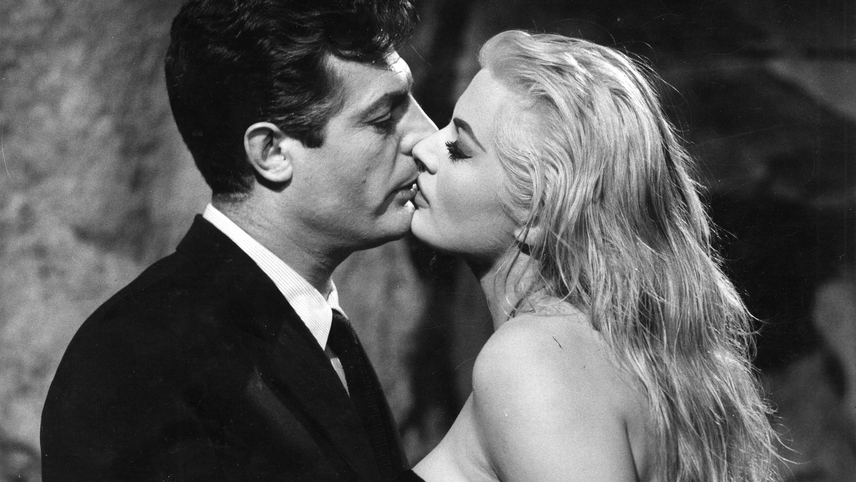
Director: Federico Fellini · Cinematographer: Otello Martelli · Composer: Nino Rota · Screenplay: Federico Fellini, Ennio Flaiano, Tullio Pinelli, Brunello Rondi · Editor: Leo Cattozzo · Production Design/Costume Design: Piero Gherardi · Key Cast: Marcello Mastroianni (Marcello Rubini), Anita Ekberg (Sylvia), Anouk Aimee (Maddalena), Yvonne Furneaux (Emma), Alain Cuny (Steiner), Nadia Gray (Nadia) · Runtime: 174 minutes · Studio: Riama Film / Pathe Consortium Cinema · Filmed: March-August 1959, at Cinecitta Studios and on location in Rome
1. A Christ Statue Flies Over Rome, and Nobody Is Saved
The opening image is an act of audacity so complete that the film never needs to explain itself again. A helicopter carries a statue of Christ over the rooftops of Rome. Below, sunbathers wave. A second helicopter follows the first, carrying a tabloid journalist named Marcello Rubini, who is trying to get a closer look. He spots women on a rooftop terrace. He gestures. He shouts something the wind swallows. The sacred and the profane occupy the same sky, and neither one lands.
Federico Fellini spent five months filming La Dolce Vita in the spring and summer of 1959, and this opening announces every tension the film will explore across its three-hour runtime. The statue is Christ, but it is also cargo. The journalist is pursuing a story, but he is also flirting. The helicopter is a machine of modernity, but it is performing a kind of religious procession. Rome is below all of it, ancient and indifferent, a city that has absorbed two thousand years of belief and spectacle and reduced both to scenery.
The structure that follows is episodic rather than linear: a prologue, seven major episodes interrupted by an intermezzo, and an epilogue. Each episode introduces Marcello to a different version of desire, a different woman, a different milieu, a different failure to connect. The effect is cumulative rather than dramatic. Fellini is not building toward a climax. He is building toward a saturation point, the moment when Marcello has seen enough of the sweet life to understand that it is neither sweet nor, in any meaningful sense, a life.
2. Marcello Mastroianni and the Glamour of Drift
Fellini wanted Marcello Mastroianni for the lead because he had, in Fellini’s words, “the face of normal.” The producer wanted Paul Newman. Fellini refused, understanding that the film required a protagonist who was attractive without being extraordinary, charming without being forceful, passive enough to be carried by events rather than shaping them. Mastroianni was, in this specific sense, perfect: he was a mirror, and what he reflected was whatever room he happened to be standing in.
This is Mastroianni’s first collaboration with Fellini, and the partnership would define both of their careers. What Mastroianni does in La Dolce Vita is not, on its surface, technically demanding. He moves through parties. He talks to women. He drives through Rome at night. He drinks. He watches. But the watching is the performance. Mastroianni plays Marcello as a man who is present at every event and involved in none of them. His smile is perpetual and empty. His attention is generous and shallow. He is the best possible company for exactly the length of time it takes to finish a drink, and then he is gone, carried by the current of the next scene to the next fountain, the next bedroom, the next dawn.
The genius of the characterization is that Marcello is not a villain or a victim. He is a possibility that was never realized. He wanted to be a serious writer. He became a gossip columnist. The gap between aspiration and reality is not played for tragedy. It is played as atmosphere: a low hum of dissatisfaction that runs beneath every scene like the drone of a motor. Marcello does not suffer spectacularly. He erodes.
3. Otello Martelli’s Rome: Black, White, and the Gray of 3 A.M.
Otello Martelli had already shot La Strada and Nights of Cabiria for Fellini, and their working relationship on La Dolce Vita produced some of the most sophisticated black-and-white photography of the postwar era. Shot in Totalscope (a widescreen format), the film uses its panoramic frame not for landscapes but for interiors: ballrooms, nightclubs, apartments, the Via Veneto at midnight. The width of the image does not create grandeur. It creates exposure. There is nowhere to hide in a Totalscope frame. Every corner holds another face, another gesture, another detail the eye might miss on a narrower canvas.
Martelli’s approach to lighting was, by his own account, guided by Fellini’s desire to “deliberately distort the characters and their surroundings.” Long-focus lenses (75mm, 100mm, 150mm) were used for close-ups and two-shots instead of the standard 50mm, compressing the depth of field and rendering backgrounds as hazy, indistinct fields. The effect is paradoxical: the characters are sharply defined against environments that seem to dissolve behind them. They are clear. The world is not. The technique visualizes the emotional condition of every person in the film: present, visible, and disconnected from context.
The dawn sequences are the film’s visual signature. More than two months of the five-month shoot were spent on night scenes, and the transitions from night to daylight become the film’s most eloquent commentary. Dawn in La Dolce Vita does not signify beginning. It signifies ending. The photography shifts to cool grays, to flat, unforgiving light that strips the glamour from faces and rooms that looked magical two hours earlier. The famous Trevi Fountain sequence, shot over a full week of nights in March 1959, climaxes in a dawn that makes Anita Ekberg and Mastroianni look less like lovers than like survivors of something that has already passed.
4. Nino Rota’s Score: The Sound of a Party You Should Have Left an Hour Ago
Nino Rota, who scored nearly every Fellini film from The White Sheik through Orchestra Rehearsal, and whose work for The Godfather this site has discussed in a previous entry, produced for La Dolce Vita a score that is among his most deceptively complex. The main theme is a cha-cha, bright and rhythmically insistent, the kind of music that accompanies drinks being poured and cigarettes being lit. It is the sound of a good time. It is also, listened to carefully, the sound of a good time that has been going on too long.
Rota deploys the theme across the film’s episodes with accumulating irony. Early in the film, the music sounds festive. By the midpoint, it sounds habitual. By the final episode, it sounds exhausted, a melody that keeps playing because no one has thought to turn it off. The cha-cha does not evolve musically. What evolves is the context around it, and the gap between the music’s energy and the characters’ depletion widens until it becomes the film’s emotional subject.
The quieter passages are reserved for the scenes with Steiner, the intellectual played by Alain Cuny, whose apartment represents everything Marcello aspires to: culture, family, purpose, the disciplined life. Rota scores these scenes with a warmth that feels earned, a warmth the rest of the film’s music never quite achieves. When the Steiner subplot reaches its devastating conclusion, the silence that follows is more expressive than any musical cue could be. Rota understood that the most powerful note in a composer’s vocabulary is the one that is absent.
5. Seven Nights, Seven Women, Seven Failures
La Dolce Vita can be read as a catalogue of the ways Marcello fails to connect with the women who pass through his life, and each failure illuminates a different aspect of his inability to commit to anything, including himself.
Maddalena (Anouk Aimee) is the aristocrat who understands Marcello’s emptiness because she shares it. Their encounters are cool, elegant, and mutually parasitic: neither one asks anything of the other that the other cannot easily provide. Sylvia (Anita Ekberg) is the movie star, an embodiment of desire so pure and so physical that Marcello cannot process her as a human being. The Trevi Fountain scene, in which Sylvia wades into the water and invites Marcello to join her, is the film’s most iconic image, and it is an image of impossibility: the goddess calls, the mortal follows, and dawn arrives to remind both of them that the fountain is just a fountain. Emma (Yvonne Furneaux) is the domestic option, the girlfriend who loves Marcello with a devotion he finds suffocating. She attempts suicide. He responds with guilt that cannot sustain itself past the next party invitation.
Steiner’s wife occupies a different register. She represents the possibility that love, family, and intellectual life can coexist, and Steiner’s murder of his two children and subsequent suicide obliterates this possibility so completely that Marcello never recovers from it. The Steiner episode is the film’s moral center, and its horror is earned precisely because it is the only episode in which Marcello encounters something he genuinely admires. Everything else he can walk away from. Steiner’s destruction he cannot walk away from, because it proves that even the good life, the real good life, was built on a despair as deep as Marcello’s own.
The final episode is an orgy that has the quality of a funeral. Marcello, now fully surrendered to the sweet life, moves through a party that degrades everyone who attends it. Dawn breaks. The partygoers stumble onto a beach. A dead sea creature lies on the sand, enormous and rotting. Marcello stares at it. Across the beach, a young girl he met earlier in the film tries to call to him. He cannot hear her. The waves are too loud. He shrugs and walks away. The girl turns and looks at the camera.
6. The Birth of the Paparazzo
La Dolce Vita gave the world a word. The plural, paparazzi, entered common usage almost immediately after the film’s release, derived from the name of Marcello’s photographer companion, Paparazzo (played by Walter Santesso). Fellini reportedly took the name from a character in a novel by George Gissing, though he also told interviewers that “paparazzo” sounded to him like the buzzing of an insect, which is precisely the function these photographers serve in the film: they swarm, they feed, they are impossible to shake.
The prescience of Fellini’s portrayal is one of the film’s most startling qualities. In 1960, celebrity culture as we now understand it was in its infancy. The Via Veneto was a gathering place for actors, directors, and socialites, but the infrastructure of tabloid journalism, the symbiotic relationship between fame and surveillance, was not yet the dominant mode of public life. Fellini saw it coming. He understood that the technology of the camera and the appetite for spectacle would combine to create a culture in which the act of being photographed would replace the act of living. Marcello is not a journalist who happens to chase celebrities. He is a man who has been absorbed into the machine of celebrity and can no longer distinguish between documenting a life and having one.
The paparazzi in the film are not satirized. They are observed. They are doing a job, and the job has a logic, and the logic is the logic of the film itself: look at everything, commit to nothing, move on. Fellini does not exempt himself from this critique. He is the ultimate paparazzo, a director who points his camera at the beautiful and the broken with equal fascination and calls the result art. The film’s self-awareness about its own voyeurism is one of the things that prevents it from becoming the satire it is often described as. Satire requires a position of superiority. La Dolce Vita does not have one.
7. A Beautiful, Overlong, Unimprovable Mess: The Verdict
La Dolce Vita is a 10/10 film. It earns the score not through efficiency (at 174 minutes, it is long, and it feels long, and the longing is part of the point) but through the comprehensiveness of its vision. No other film has captured the texture of modern decadence with this degree of specificity, compassion, and formal ambition. It is not a film about the sweet life. It is the sweet life, reproduced at full scale, with all of its pleasures and all of its waste.
The length is the most common objection, and it deserves an honest response. There are passages in the middle episodes where the film’s episodic structure creates a rhythmic flatness that a tighter construction would avoid. The miracle sequence, in which crowds gather around two children who claim to have seen the Virgin Mary, runs longer than its ideas require. The Steiner dinner party could lose a few minutes without losing anything essential. These are real criticisms. They do not land because the film’s architecture depends on accumulation, and accumulation requires duration. Cutting La Dolce Vita to two hours would make it more efficient and less true. The exhaustion you feel by the final episode is Marcello’s exhaustion. It is supposed to be yours too.
The Palme d’Or at Cannes in 1960 was unanimous. The film won the Academy Award for Best Costumes and was nominated for Best Director, Best Original Screenplay, and Best Art Direction. Roger Ebert considered it Fellini’s greatest achievement and returned to it throughout his career, writing in 1997 that his relationship to the film had changed as his own life had changed, a remark that captures something essential about La Dolce Vita’s endurance: it is a different film at twenty, at forty, and at sixty. What you see in it depends on how close you are to becoming Marcello.
8. Fellini Between Neorealism and Fantasy: An Artist Leaving the Shore
La Dolce Vita is the fulcrum of Fellini’s career, the film that separates the neorealist Fellini of La Strada and Nights of Cabiria from the surrealist Fellini of 8 1/2 and Amarcord. This site has already covered 8 1/2, and the comparison is instructive: where 8 1/2 is a film about the impossibility of making a film, La Dolce Vita is a film about the impossibility of living a life. Both are autobiographical in the sense that Fellini is Marcello and Fellini is Guido Anselmi, a man paralyzed by too many options and not enough conviction.
The neorealist roots are still visible. The location shooting in Rome, the use of non-professional actors in minor roles, the attention to social texture and class dynamics: all of these belong to the tradition Fellini trained in. But the treatment is no longer neorealist. The compositions are too beautiful. The lighting is too deliberate. The emotional register has shifted from observation to orchestration. Fellini is no longer recording the world as it is. He is building a world that looks like the real one but operates by the logic of a dream, where events connect not by causality but by mood, and where a dead sea creature on a beach can carry more meaning than any line of dialogue.
The collaboration with Mastroianni was the catalyst. Fellini had previously worked with actors who embodied suffering (Giulietta Masina in La Strada, Anthony Quinn in La Strada). Mastroianni embodied something more difficult to dramatize: passivity. His Marcello does not resist the sweet life. He drifts into it. The drama is not in the conflict but in the absence of conflict, and Fellini found in this absence a new kind of cinema, one that could accommodate spectacle and emptiness in the same frame.
9. Anita, the Fountain, and the Image That Became Larger Than Cinema
The Trevi Fountain scene is the most famous sequence in Italian cinema, and possibly in all of European cinema, and it lasts roughly four minutes. Anita Ekberg, playing a Swedish-American movie star named Sylvia, wades into the fountain in a black evening gown. The water cascades around her. She lifts her hands. She looks like a goddess. Mastroianni follows her in. They stand together in the fountain as the water falls. Dawn breaks. The fountain’s jets stop. The spell ends.
What makes the scene so enduring is not the imagery, though the imagery is extraordinary. It is the gap between what the scene promises and what it delivers. The fountain is a romantic fantasy made physical. Two beautiful people stand in a famous Roman landmark in the middle of the night, and the camera films them as though something transcendent is about to happen. Nothing transcendent happens. They get wet. They get cold. Mastroianni was reportedly shivering so badly that he drank an entire bottle of vodka to get through the week of night shoots. Ekberg, by contrast, stood in the freezing water for hours without complaint, a fact that reinforces the film’s suggestion that Sylvia is not quite human, that she belongs to the world of images rather than the world of bodies.
The sequence has been reproduced, referenced, and parodied so many times that encountering it in context is a dislocating experience. You have seen it before you have seen it. Fellini’s genius was to make a scene so beautiful that it would become a cliche, and to embed it in a film that is, ultimately, about the emptiness of beauty. The Trevi Fountain scene is the sweet life in four minutes: gorgeous, cold, and over before you know what you felt.
10. Rewatching the Dawn: What the Morning Light Reveals
On your second viewing, ignore the parties. Watch the mornings.
Every episode in La Dolce Vita ends in a dawn scene, and the transition from night to day carries a different emotional register each time. Early in the film, dawn is soft, almost romantic, tinged with the promise that the night’s possibilities might survive into daylight. By the final episodes, dawn is brutal, a flat gray exposure that strips the glamour from everything it touches. Track the progression of these dawns, and you will see the film’s emotional arc drawn not in dialogue or action but in the quality of light.
Watch Marcello’s hands. Mastroianni uses his hands the way a musician uses dynamics: sometimes expansive and theatrical, sometimes curled into his pockets, sometimes reaching for a glass or a cigarette with the automatic precision of a man who no longer knows he is doing it. The hands tell you where Marcello is on the spectrum between engagement and surrender at any given moment, and by the final episode, they are still.
Listen to what people say about Steiner before and after his death. In the party episode, Steiner is discussed as an ideal, a man who has achieved the integration of art, family, and purpose that Marcello cannot manage. After Steiner kills his children and himself, his name disappears from the film’s conversation. No one mentions him again. The silence is the film’s most devastating commentary on the social world it depicts: a world where tragedy is acknowledged briefly and then absorbed into the current of the next evening, the next party, the next fountain.
On your third viewing, watch the girl on the beach. She appears twice in the film: once in a restaurant, where she exchanges a brief smile with Marcello, and once in the final shot, where she calls to him across the sand and he cannot hear her. She is innocence, but she is also something more specific: she is the audience. She has been watching Marcello. She has been trying to tell him something. He walks away. She turns to the camera. The film ends not with Marcello but with her gaze, and what that gaze asks of you is the question Fellini spent three hours preparing: now that you have seen the sweet life, will you recognize it when it finds you?
Film Trivia
The script was a sketch of the sea. When Fellini first met Mastroianni to discuss the role, the actor asked to read the script. Fellini produced a document. Mastroianni opened it to find mostly blank pages, interrupted by a drawing of the sea, a man swimming, and an enormous phallus surrounded by dancing mermaids. Mastroianni turned “green, red, yellow,” by his own account, then asked where to sign. The working script developed continuously during the five-month shoot.
A week in the fountain. The Trevi Fountain sequence was shot over a full week of nights in March 1959, when Roman nights were still bitterly cold. Ekberg endured the freezing water without complaint. Mastroianni wore a wetsuit under his clothes and still could not stop shivering, eventually consuming an entire bottle of vodka to get through the shooting. He was, by his own admission, thoroughly drunk during the sequence that became the most romantic image in Italian cinema.
The word it gave us. The character of Paparazzo, Marcello’s photographer, gave the world the term “paparazzi.” Fellini said he chose the name partly because it reminded him of the buzzing of an insect and partly from a character in a George Gissing novel. Within months of the film’s release, “paparazzi” had entered the vocabulary of every major European language. It remains one of the few Italian words to have achieved global adoption through a single film.
The real Via Veneto was not the real Via Veneto. Fellini recreated the Via Veneto, Rome’s famous boulevard of nightclubs and sidewalk cafes, on a soundstage at Cinecitta Studios, though some night exteriors were shot on the actual street using only a few photoflood lamps hidden among the trees. The studio replica allowed Fellini complete control over traffic, lighting, and crowd movement, and most audiences cannot distinguish the reconstructed boulevard from the real one.
Steiner’s real ghost. The character of Steiner, the intellectual who murders his children and kills himself, was inspired by the suicide of the Italian novelist Cesare Pavese in 1950. Co-screenwriter Tullio Pinelli, who had attended school with Pavese, believed the writer’s over-intellectualism had become emotionally sterile, producing a kind of existential paralysis that ended in self-destruction. Steiner’s line about salvation not lying “within four walls” is drawn from this biographical source, and his fate in the film carries the weight of a real death that haunted the screenwriters for a decade before they found a way to dramatize it.
This entry selects analytical dimensions from a pool. It opens with the helicopter sequence (Section 1) because Fellini’s first image is the film’s entire argument compressed into sixty seconds, and the entry should replicate that compression before expanding into the film’s episodic breadth. The verdict arrives at Section 7, mid-entry, after the craft, performances, and thematic structure have been explored, because La Dolce Vita is a film whose greatness depends on accumulation and cannot be assessed until enough of its weight has been felt. A wildcard section on the Trevi Fountain (Section 9) exists because the sequence has become so iconic that it requires dedicated analysis to separate its meaning within the film from its afterlife as a cultural image. The women-as-episodes section (Section 5) is a structural choice dictated by the film itself: Fellini organized his narrative around Marcello’s encounters, and any analysis that ignores this architecture misrepresents the work. A formal Awards section is folded into the verdict. A Production History section is distributed across the cinematography and Fellini career discussions rather than isolated.

Leave a Reply