Director: Joachim Trier · Cinematographer: Kasper Tuxen · Composer: Ola Fløttum · Key Cast: Renate Reinsve, Anders Danielsen Lie, Herbert Nordrum · Screenplay: Joachim Trier, Eskil Vogt · Runtime: 128 min · Studio: Oslo Pictures / MK2 Films · Budget: $5.7 million · Box Office: $14.5 million worldwide
1. Twelve Chapters, a Prologue, and an Epilogue About a Woman Who Cannot Finish Anything
The structure tells you everything. The Worst Person in the World is organized as a novel: a prologue, twelve numbered chapters with titles, and an epilogue. This is a film that has given itself a table of contents. And the woman at the center of it, Julie, cannot finish a single thing she starts. Not medical school. Not psychology. Not photography. Not her relationship with Aksel. Not her relationship with Eivind. Not, crucially, the process of becoming the person she imagined she would be by thirty.
The chapter structure is Joachim Trier’s quiet joke and his most elegant formal choice. It imposes literary order on a life that resists order. Each chapter title promises coherence (“Julie’s Narcissistic Circus,” “Oral Sex in the Age of #MeToo,” “Bobcat”), and each chapter delivers something messier, more human, and less conclusive than its title suggests. The chapters do not build toward a thesis. They accumulate, the way years accumulate, leaving Julie (and the audience) with the sensation that a great deal has happened and nothing has been resolved.
This is not a flaw. It is the film’s subject. The Worst Person in the World is about the specific anxiety of being intelligent enough to see your options but temperamentally incapable of committing to any of them, and the chapter structure reproduces this experience formally: each chapter is a commitment, a contained narrative unit with a beginning and an end, that the next chapter immediately supersedes.
2. Renate Reinsve and the Face That Contains Twelve Films
Renate Reinsve won the Best Actress prize at Cannes for her performance as Julie, and the award does not do justice to what she achieves. She plays a character who is, by design, inconsistent, contradictory, selfish, generous, brilliant, lazy, deeply feeling, and emotionally evasive, sometimes within the same scene. This is not a role that rewards technical precision. It rewards something harder to name: the ability to be fully present inside contradiction without resolving it into a single readable emotion.
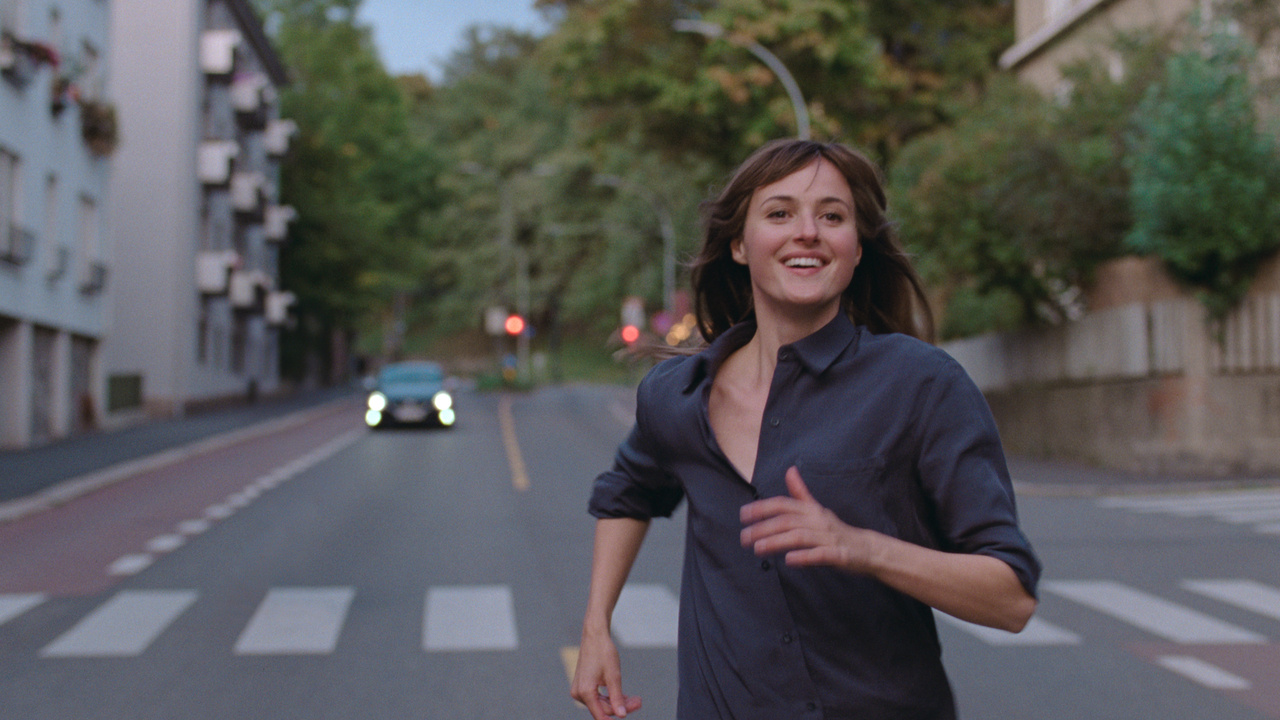
Watch her face during the frozen-time sequence. Julie has just met Eivind at a party, and the attraction is immediate, mutual, and inconvenient (she is with Aksel; he has a girlfriend). The next morning, she flips an imaginary switch and time stops. She runs through the frozen streets of Oslo, past suspended joggers and motionless cars, to find Eivind, and they spend a day together in a city where nothing moves except them. The sequence is the film’s most celebrated set piece, and it works because of how Reinsve plays the freedom: not as romantic liberation (which would be cliché) but as the specific, slightly guilty exhilaration of someone who has temporarily escaped the consequences of her own choices. Her face contains joy, relief, and the knowledge that the clock will start again.
The harder scenes are quieter. Julie visiting Aksel in the hospital near the end. Julie sitting alone in her apartment after Eivind has also failed to be the answer. Julie, in the epilogue, behind a camera, working, not happy and not unhappy, just present. Reinsve plays these moments with a stillness that is the inverse of the frozen-time sequence’s kinetic energy, and the contrast between the two registers is where the performance lives: a woman who can only move when the world stops, and who can only stop when the world is moving without her.
3. When the City Stopped: The Frozen-Time Sequence as Practical Magic
The frozen-time sequence deserves its own discussion not only because it is the film’s most visually ambitious passage but because its execution reveals Trier’s commitment to a specific kind of cinema.
The sequence was achieved almost entirely through practical effects. Real people were directed to freeze in place. Props were held by hidden supports. Digital work was limited to cleaning up backgrounds and removing visible rigging. The result is a frozen city that feels uncanny in a way that CGI stillness does not: there is a slight, almost imperceptible vibration in the “frozen” bodies, the tremor of a real person holding still rather than the perfect immobility of a digital render. This imperfection is essential. It tells you, subliminally, that the world Julie has stopped is still alive underneath, still waiting, still ticking.
Tuxen’s cinematography in this sequence is the most overtly beautiful in the film: golden morning light, wide compositions that turn Oslo’s streets into a playground, a color palette that shifts warmer as Julie gets closer to Eivind. The beauty is deliberate and slightly suspicious. This is how Julie sees the world when she is falling in love, and Trier films it with a romantic sincerity that he will spend the rest of the film gently undermining. The frozen city is not reality. It is the visual equivalent of infatuation: the illusion that time, and consequences, have been suspended just for you.
4. Tuxen’s Oslo: A City Shot on Film About a Woman Who Can’t Develop
Kasper Tuxen shot The Worst Person in the World on 35mm Kodak film, a choice that, like the decisions in Shoplifters and Drive My Car, carries a weight beyond nostalgia. Film grain gives the image a materiality that mirrors the film’s relationship to its protagonist: Julie is analog in a digital world, a woman whose sensibility is textured, warm, and slightly out of step with the sleek efficiency around her.
Tuxen’s Oslo is luminous. He scouted the city’s light for months during the production’s COVID delay, cycling to locations at different times of day, and the result is a film that captures the specific quality of Scandinavian light across seasons: the long, golden summer evenings that make everything look possible, the grey winter afternoons that make everything look finite. The light is not decorative. It corresponds to Julie’s emotional states, and Tuxen tracks the correspondence with a subtlety that avoids the heavy-handedness that seasonal metaphors usually produce.
The framing favors Reinsve’s face. Tuxen positions the camera close enough to register micro-expressions but not so close that it becomes invasive. The distance is the distance of a friend who is watching carefully but not intervening, and it produces an intimacy that feels like companionship rather than surveillance. When the film’s emotional register shifts in the final chapters (Aksel’s diagnosis, the hospital visit, the mushroom hallucination), Tuxen does not change his approach. The same warm, companionable camera that filmed Julie’s joy now films her grief, and the consistency is what makes the grief bearable: the world has not changed. Julie’s place in it has.
5. Two Men, One Woman, Zero Villains
The triangle at the center of The Worst Person in the World is constructed with a generosity toward all three points that most romantic dramas do not attempt.
Aksel (Anders Danielsen Lie) is fifteen years older than Julie. He is successful, intelligent, opinionated, and ready for a stability that Julie has not yet earned the right to want. Lie plays him not as a controlling older man but as someone genuinely bewildered by Julie’s restlessness, because his own restlessness resolved years ago and he cannot remember what it felt like to not know what you want. His best scenes are in the final chapters, where a terminal cancer diagnosis strips away the social armor and reveals someone who loved Julie with more depth than either of them understood while they were together. The hospital scene, where he describes how life will continue without him, is the film’s most devastating passage, and Lie delivers it with a wry, exhausted honesty that refuses self-pity.
Eivind (Herbert Nordrum) is Julie’s age, and his appeal is precisely his opposition to Aksel: where Aksel is certain, Eivind is cheerfully uncertain. Where Aksel has ambition, Eivind has vibes. Where Aksel represents the future Julie should want, Eivind represents the present Julie does want. Nordrum plays him with a sunlit charm that is entirely real and entirely insufficient, and the film’s quiet cruelty is in showing how quickly the charm depletes once the relationship settles into dailiness. Eivind is not a bad partner. He is an inadequate replacement for the depth that Julie left behind with Aksel, and the inadequacy is nobody’s fault.
Julie moves between these men not because she is indecisive but because neither of them is wrong. Aksel offers the life she should build. Eivind offers the life she wants to live. The film’s title refers to how Julie feels about herself for being unable to reconcile these options, and Trier’s empathy is in showing that the reconciliation is impossible because the options are genuinely incompatible. She is not the worst person in the world. She is a person in the world, which is worse.
6. The Oslo Trilogy’s Final Movement
The Worst Person in the World completes Joachim Trier’s Oslo Trilogy, following Reprise (2006) and Oslo, August 31st (2011), and the trilogy’s arc is worth tracing.
Reprise follows two young male writers in their twenties, drunk on ambition and literary mythology, racing toward a future they believe will validate them. Oslo, August 31st follows a man in his thirties, a recovering addict, who spends a single day in the city revisiting old friends and old haunts, unable to imagine a future at all. The Worst Person in the World follows a woman in her late twenties to early thirties, stranded between an abundance of futures and an inability to choose.
The trilogy progresses from masculine ambition to masculine despair to feminine uncertainty, and the progression is a deepening. Reprise is the flashiest of the three, full of jump cuts and voiceover and the energy of youth. Oslo, August 31st is the most austere, almost unbearably still in its final act. The Worst Person in the World synthesizes both modes: it has the energy and formal playfulness of Reprise (the chapter structure, the frozen-time sequence, the mushroom hallucination) and the emotional seriousness of Oslo (the hospital scenes, the epilogue’s quiet reckoning with time passed). It is the fullest film of the three, and the one most likely to endure.
7. The Mushroom Scene and Other Disruptions
Trier and Vogt punctuate their novelistic realism with moments of surrealist disruption that function as Julie’s interior life made visible.
The frozen-time sequence is the most elaborate. But there are others. A mushroom trip produces a hallucination in which Julie’s body becomes transparent, her organs visible, her menstrual blood flowing in graphic, psychedelic detail. The scene is simultaneously grotesque and beautiful, and its function is to externalize something Julie has been struggling to articulate: her body is making decisions (about fertility, about aging, about time) that her conscious mind has not authorized, and the hallucination makes this biological autonomy visible.
An earlier scene shows Julie writing an essay about oral sex and #MeToo that goes viral, producing both validation and backlash. The essay’s content is provocative but its treatment within the film is more interesting for what it says about how Julie relates to her own ideas: she has them, she publishes them, they attract attention, and she moves on without following through. The essay, like everything else in her life, is started brilliantly and abandoned.
These disruptions prevent the film from settling into comfortable naturalism. They signal that the realistic surface, however convincing, is being observed by a sensibility that finds realism insufficient. Julie’s experience of the world is not entirely realistic. It is colored by imagination, anxiety, pharmacology, and the persistent feeling that life is slightly more vivid, slightly more strange, and slightly more temporary than other people seem to notice.
8. A Score That Knows Where Silence Lives
Ola Fløttum’s original score operates in the same register as the film’s emotional intelligence: present but not insistent, expressive but never explanatory.
The score’s primary instrument is guitar, played with a simplicity that occasionally borders on folk music. It appears in the transitions between chapters, in the quieter passages of Julie’s solitude, and in the moments where the film pauses to let time pass. It does not appear during the frozen-time sequence (which is scored instead with the mounting roar of an airplane, an industrial sound that undercuts the romantic imagery). It does not appear during the hospital scene (which relies entirely on Lie’s voice and Reinsve’s face). These absences are compositional choices, and they give the score’s returns a specific emotional weight: when the guitar reappears, it sounds like breathing after a long silence.
The compiled soundtrack (Harry Nilsson, Art Garfunkel’s “Waters of March” over the epilogue) deserves equal attention. Trier uses pre-existing music the way novelists use epigraphs: as emotional framing devices that tell you how to feel about what you are about to see without dictating the feeling itself.
9. Cannes, Oscar, and the Question of the “Messy Woman”
Reinsve won Best Actress at Cannes 2021. The film was nominated for Best International Feature Film and Best Original Screenplay at the 94th Academy Awards. It holds a 96% approval rating on Rotten Tomatoes and a Metacritic score of 91. Richard Lawson of Vanity Fair and David Sims of The Atlantic both named it the best film of 2021.
The dissent is instructive. Deborah Ross argued in The Spectator that the “messy young woman” trope had become overused, and that a film about a woman who finishes things might be more original. Richard Brody called it “a sham, except for its lead performance.” These criticisms point to a real tension in the film’s construction: is Julie a fully realized character, or is she a millennial archetype given life by Reinsve’s performance alone? The answer is probably both, and the film’s longevity will depend on whether audiences continue to find the archetype illuminating or whether it dates as quickly as the cultural moment that produced it.
Verdict: 8/10. A generous, formally inventive, emotionally honest film that earns its rom-com structure and then, in the final act, earns the right to break it. The middle chapters occasionally drift, and the Eivind relationship is less textured than the Aksel relationship, creating a slight structural imbalance. But Reinsve’s performance holds everything together, and the final thirty minutes, from the hospital to the epilogue, achieve a weight that the film’s playful surface does not prepare you for.
10. The Second Reading: A Rewatch Guide
The chapter titles are the key to rewatching. On first viewing, they read as whimsical labels. On second viewing, they read as tiny acts of self-narration: Julie is the kind of person who would organize her own life into chapters, because chapters imply a structure she cannot find in the living of it. The titles are her attempt to impose meaning after the fact, and their inadequacy (no chapter title fully captures what happens inside it) mirrors Julie’s broader struggle: she can name what she wants but cannot inhabit it.
Watch Anders Danielsen Lie’s performance with the knowledge that Aksel will die. Every scene he appears in gains a retroactive gravity that is not present on first viewing. His impatience with Julie’s indecision, which initially reads as controlling, on second viewing reads as the frustration of a man who does not have time to waste and does not yet know it. The argument about having children is particularly devastating in retrospect: Aksel wants children because he wants a future. Julie resists because she cannot imagine one. The film will prove both of them right and wrong simultaneously.
The epilogue is the scene that changes most on second viewing. Julie is behind a camera, working as a photographer. She is alone. She is not miserable. She is not fulfilled. She is continuing. The final image is her face, lit by Tuxen’s warm film grain, looking at something the audience cannot see. On first viewing, the epilogue feels like an ending. On second viewing, it feels like another chapter title, waiting for a chapter that has not yet been written.
Film Trivia
The time-freeze was almost entirely practical. Over two hundred extras were directed to freeze in place across multiple Oslo locations. Props were suspended using hidden supports, and digital effects were used only to clean backgrounds and remove rigging. The sequence took extensive planning during the production’s COVID delay, and its tactile imperfection (the barely perceptible tremor of living bodies holding still) is what gives it its uncanny quality.
Reinsve was a virtual unknown before Cannes. Renate Reinsve had appeared in a single scene of Trier’s previous film, Oslo, August 31st, playing a minor role at a party. A decade later, Trier cast her as Julie. Her Best Actress win at Cannes made her an international star overnight, and the performance was described by Trier as a true collaboration: significant portions of the film, including the sequence where Julie discovers she owns two copies of the same book, were improvised on set.
The Oslo Trilogy was never planned as a trilogy. Trier has said that the thematic connections between Reprise, Oslo, August 31st, and The Worst Person in the World only became apparent in retrospect. The films share a city, a preoccupation with time and identity, and several collaborators (including Eskil Vogt, who co-wrote all three), but they were not conceived as a unified project. The trilogy label was applied by critics, and Trier has accepted it while noting that he did not set out to make one.
COVID gave Tuxen the light. The production was scheduled to begin in April 2020 but was delayed until August by Norway’s lockdown. Tuxen used the extra months to scout Oslo’s light on a bicycle, visiting every location at different times and seasons. The delay, which threatened the production, ultimately gave the cinematography its specificity: Tuxen knew exactly what the light would do at every location, and the film’s luminous quality is partly the result of a catastrophe turned to advantage.
The title is a Norwegian idiom, not an accusation. In Norwegian, calling yourself “verdens verste menneske” (the world’s worst person) is a common, self-deprecating expression used when you feel guilty about a minor transgression or an awkward social moment. It does not mean what it appears to mean in English. The title’s mistranslation is, in a way, appropriate: Julie’s self-assessment is harsher in English than it is in Norwegian, just as her self-criticism is harsher than anything the film itself suggests she deserves.


Leave a Reply