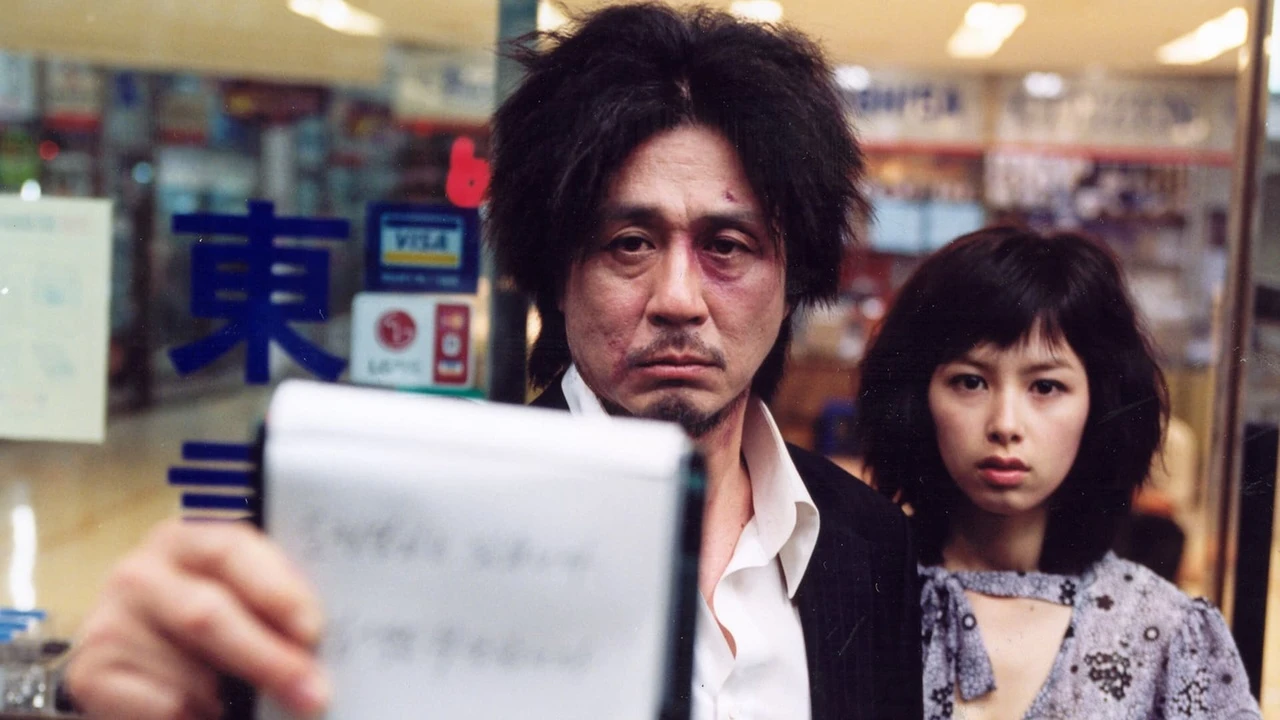
Director: Park Chan-wook · Cinematographer: Chung Chung-hoon · Composer: Cho Young-wuk · Screenplay: Park Chan-wook, Hwang Jo-yoon (based on the manga by Garon Tsuchiya and Nobuaki Minegishi) · Editor: Kim Sang-bum · Production Design: Ryu Seong-hie · Key Cast: Choi Min-sik (Oh Dae-su), Yoo Ji-tae (Lee Woo-jin), Kang Hye-jung (Mi-do), Oh Dal-su (Mr. Park), Yoon Jin-seo (Lee Soo-ah) · Runtime: 120 minutes · Studio: Show East / Egg Films · Budget: Approximately $3 million · Box Office: $17 million (worldwide)
1. Fifteen Years in a Room with Ugly Wallpaper
The room has a bed, a desk, a television. The wallpaper is hideous, a pattern so relentlessly cheerful it becomes a form of cruelty. Chinese dumplings arrive through a slot in the door. There is no window. There is no explanation.
Oh Dae-su spends fifteen years in this room. He does not know who put him there or why. He watches the news on television and learns he has been framed for his wife’s murder. He learns his daughter has been adopted by a new family. He watches years of programming, absorbing the world through a screen, growing older in a space that never changes. He shadowboxes. He punches the wall. He tries to kill himself. Someone revives him. He begins digging through the wall with a chopstick.
Park Chan-wook compresses these fifteen years into roughly twenty minutes of screen time, and the compression is the point. What prison does to a person is not dramatic. It is monotonous. It is the same meal, the same walls, the same flickering screen, day after day, until the days stop meaning anything. Park films the passage of time not as a montage of milestones but as a loop: eat, sleep, punch, dig, eat, sleep, punch, dig. The effect is suffocating. By the time Dae-su is released, the audience has spent just enough time in the room to understand, at a cellular level, the fury that drives everything that follows.
The room is also a thesis statement about the film’s philosophy. Dae-su’s imprisonment is Kafkaesque in the precise sense: the punishment precedes the crime, or rather, the punishment is disconnected from any logic the prisoner can access. He cannot confess because he does not know what he has done. He cannot atone because he does not know whom he has wronged. He can only endure, and endurance without purpose is the film’s definition of hell. Park has cited Kafka as a primary influence, and the debt is structural rather than stylistic. Oldboy borrows from The Trial the same dreadful proposition: that the system punishing you does not owe you an explanation, and that the absence of explanation is itself the punishment.
2. The Corridor: Three Minutes That Changed Action Cinema
The hallway fight scene in Oldboy has been analyzed, replicated, and homaged so many times that describing it risks redundancy. But the scene deserves a section not because it is a great action sequence, which it is, but because it is a great narrative sequence disguised as an action one.
Dae-su has found the private prison that held him for fifteen years. He has tortured the manager. He is trying to leave. Between him and the elevator is a narrow corridor filled with armed men. What follows is a single unbroken take, shot from the side in a lateral pan, lasting approximately three minutes. Dae-su fights his way through twenty-some opponents with a hammer and his fists. He is exhausted. He is clumsy. He gets stabbed in the back with a knife and keeps fighting. The men he defeats get back up, and he fights them again. When the elevator doors finally open at the far end, they reveal more guards. Cut to the next shot: the guards are on the floor, and Dae-su steps over them.
The scene took three days to film, required seventeen takes, and used almost no CGI (only the knife in Dae-su’s back was digital). But the technical achievement is secondary to the dramatic one. Park Chan-wook has described the corridor fight as a metaphor for the obstacles life places in your path. On a narrative level, it is a metaphor for Dae-su’s revenge: brutal, exhausting, ultimately futile, and won at a cost that makes victory indistinguishable from defeat.
What separates this scene from its many imitators is messiness. Dae-su does not fight like a martial arts hero. He fights like a man who taught himself to punch by hitting a wall for fifteen years. He stumbles. He wheezes. He swings the hammer with more desperation than skill. The choreography, designed by Kil-yong Yang, deliberately preserves the awkwardness of real combat, and this awkwardness is what gives the scene its emotional weight. You are not watching a display of competence. You are watching a man burn through whatever is left of himself to reach the other side of a hallway, and you understand, watching him, that reaching the other side will not save him.
3. Choi Min-sik: The Body as a Record of Damage
Choi Min-sik lost twenty pounds and trained for six weeks to prepare for the role of Oh Dae-su, and then he did something more extreme: he ate a live octopus on camera. Four takes. Four octopuses. The tentacles suctioned to his face as he chewed, and Park kept the most visceral take. Choi is a practicing Buddhist, and the scene reportedly caused him genuine anguish. He did it anyway, because the scene required it, because Dae-su’s first act after fifteen years of captivity is to consume something alive, and nothing short of the real thing would communicate the savagery of that hunger.
This commitment defines the entire performance. Choi plays Dae-su as a man whose body has been remade by confinement. His posture is coiled. His eyes are too wide, permanently alert in the way of animals that have lived too long in cages. When he smiles, it is the smile of someone who has forgotten when smiling is appropriate. The physical transformation is detailed enough to function as a character biography: you can read the fifteen years in the way he holds his shoulders, in the speed of his reflexes, in the controlled violence of his hands.
The performance peaks in the film’s climax, when the truth of Dae-su’s imprisonment is revealed and the revenge narrative collapses into something far more horrifying than violence. Choi’s work in this scene is extraordinary. His face passes through shock, denial, grief, and a species of recognition that is worse than any of them: the understanding that he has been manipulated not just into captivity but into love, and that the love is real even though its origins are monstrous. Words came out of his mouth that were not in the script, Choi later said in a television interview. His body took over. Cinematographer Chung Chung-hoon, filming from inches away, said he held his breath and could not help moaning behind the viewfinder.
4. Chung Chung-hoon’s Visual Architecture: Confinement, Release, and the Trap That Looks Like Freedom
Chung Chung-hoon met Park Chan-wook for the first time on the set of Oldboy, and the partnership would define both of their careers. Chung brought a background in expressive lighting and long, fluid takes; Park brought an obsession with compositional geometry and a conviction that the camera should function not as an observer but as “an expressive character of its own.”
The visual strategy of Oldboy follows Dae-su’s emotional trajectory in three distinct phases. During the imprisonment, the camera is locked, static, confined to the dimensions of the room. The compositions are flat and symmetrical, mirroring the monotony of captivity. The color palette is drained: institutional greens, muddy browns, the sickly glow of the television. These choices are claustrophobic by design. They make the audience feel the walls.
When Dae-su is released, the camera breaks free with him. The compositions become dynamic: handheld tracking shots, swooping crane movements, aggressive close-ups. The color palette explodes into the saturated neons and deep blacks of Seoul at night. The liberation is visual before it is narrative, and it generates a visceral relief that the story will spend the next hour systematically dismantling.
The third phase arrives with the revelation. As the truth closes in, the compositions begin to constrict again, subtly at first and then with oppressive force. The final scenes return to interiors, to enclosed spaces, to the geometry of rooms. The camera’s freedom was an illusion, just like Dae-su’s. The visual architecture of the entire film is a trap shaped like a corridor: you move forward, you fight, you reach the other side, and you discover that the other side was designed by the person who imprisoned you in the first place.
5. Cho Young-wuk’s Score and the Music of Irrecoverable Loss
Cho Young-wuk’s score for Oldboy operates on a principle of counterpoint that recalls the best work of Bernard Herrmann: the music does not simply accompany the action. It argues with it.
The main theme is a waltz. This is a deeply perverse choice for a film about kidnapping, torture, and revenge, and its perversity is its power. The waltz is elegant, melancholic, tinged with a classical formality that suggests a world of order and grace. It plays over scenes of extraordinary brutality, and the dissonance between what you hear and what you see creates a specific emotional effect: the sense that the violence is part of a design, that someone has choreographed the suffering, that the horror has been arranged for an audience. This is, of course, exactly what has happened within the plot. Woo-jin, the antagonist, has orchestrated Dae-su’s entire experience as a performance. The waltz is his theme, not Dae-su’s.
The score’s quieter passages, used during the scenes between Dae-su and Mi-do, are more conventionally romantic, and this conventionality becomes devastating in retrospect. The music tells you that their love is real. It is scored as genuine, as tender, as beautiful. Only the story will reveal that this beauty is part of the trap. The score never lies. It presents the emotions as they are experienced in the moment, even when the moment is built on a foundation the characters do not yet understand. Listening to the soundtrack after knowing the twist is one of the most disquieting experiences the film offers: every beautiful passage becomes evidence of manipulation.
6. From Manga to Greek Tragedy: The Adaptation That Devoured Its Source
Oldboy is loosely adapted from a Japanese manga by Garon Tsuchiya and Nobuaki Minegishi, serialized from 1996 to 1998. The adaptation is so radical that calling it “based on” the manga is generous. Park Chan-wook took the premise (a man imprisoned for years without explanation) and rebuilt everything else around it, replacing the manga’s detective-story structure with a mythological one.
The most significant departure is the twist. The manga’s revelation is relatively contained: the captor’s motivation is rooted in a schoolyard grudge. Park elevates this into something operatic. He makes the twist about incest, about the cyclical nature of sin, about the impossibility of escaping what your body has already done. The name “Oh Dae-su” is, by Park’s own admission, chosen to echo Oedipus, and the parallel is not merely nominal. Like Oedipus, Dae-su’s pursuit of truth is the mechanism of his destruction. Like Oedipus, the crime he discovers is one he committed in ignorance, and the knowledge of it transforms him from a man seeking justice into a man begging for the mercy of forgetting.
The Oedipal framework gives Oldboy a weight that the manga, for all its pleasures, does not possess. It transforms a revenge thriller into a tragedy in the classical sense: a story about a man undone by the consequences of his own nature. Dae-su did not choose to fall in love with Mi-do. He did not know. But the love happened inside his body, and his body does not care about innocence or manipulation or the intentions of the man who engineered the encounter. The horror of Oldboy’s ending is not that Dae-su has been tricked. It is that the trick worked because something in him was genuine.
7. The Vengeance Trilogy and the Futility of Getting Even
Oldboy is the second film in Park Chan-wook’s informal Vengeance Trilogy, following Sympathy for Mr. Vengeance (2002) and preceding Lady Vengeance (2005). The three films are unconnected by plot, character, or setting. They are connected by a single, relentless argument: that revenge destroys the avenger more completely than it destroys the target.
Sympathy for Mr. Vengeance is the coldest of the three, a chain of retaliations in which every act of violence generates a counter-act until everyone involved is dead. Lady Vengeance is the most baroque, a slow-burning fable about collective punishment that ends with an image of transcendence so ambiguous it may be either grace or delusion. Oldboy occupies the middle position, and it is the most emotionally devastating of the three because it is the most personal. Dae-su’s revenge is not abstract. He has a specific target, a specific grievance, a specific plan. He wants to find the man who imprisoned him and make him suffer. He achieves this goal. And the achievement reveals that the revenge was itself part of someone else’s plan, that Dae-su’s fury was a weapon his captor designed him to carry.
This is Park’s central insight, developed across all three films but stated most clearly in Oldboy: that the desire for revenge is not a response to injustice. It is a mechanism of control. The person who makes you want revenge has already won, because your anger belongs to them. Dae-su fights his way through a corridor of men to reach his captor, and his captor is waiting for him, smiling, because the corridor was built for Dae-su to fight through. The revenge was the prison.
8. A Film That Earns Its Brutality
Oldboy is a 9/10 film. The score reflects a judgment about proportion: the film’s emotional power is immense, its craft is extraordinary, and its final act is one of the most shattering sequences in 21st-century cinema. The deduction comes from a narrower concern. There are moments in the middle act where the plotting becomes overly elaborate, where the mechanics of the conspiracy require coincidences and timing that strain credibility, and where the film’s Kafka-meets-noir construction creaks slightly under the weight of its own ingenuity. These are minor fractures. They do not compromise the experience. But they prevent the film from achieving the seamless inevitability of a perfect 10.
What earns the 9 is the refusal to flinch. Oldboy depicts tooth extraction, live-animal consumption, self-mutilation, and incest, and not one of these elements feels gratuitous. Each act of violence serves the narrative’s argument about the cost of knowing the truth. Roger Ebert’s assessment remains the most precise: Oldboy is powerful not because of what it depicts but because of the depths of the human heart it strips bare. The violence is the surface. The subject is what lies beneath it: the question of whether you would choose ignorance over knowledge if knowledge meant discovering that your own body had betrayed you.
The film’s influence has been vast, particularly in the choreography of action cinema (the corridor fight spawned homages in Daredevil, The Raid, and dozens of others) and in the willingness of international audiences to engage with Korean cinema on its own terms. Oldboy won the Grand Prix at the 2004 Cannes Film Festival, where Quentin Tarantino, presiding over the jury, reportedly lobbied for it to receive the Palme d’Or. It has been ranked among the greatest films ever made by publications from Empire to The Guardian to The New York Times. An American remake, directed by Spike Lee in 2013, served primarily to demonstrate how unreplicable the original is.
9. Park Chan-wook and the Cinema of Moral Contamination
Park Chan-wook has described his filmmaking philosophy as the portrayal of something irrational: phenomena that cannot be explained logically. His characters are neither good nor evil. They are complex existences, to use his phrase, and the complexity is the point.
This positions Park within a tradition of Korean filmmaking that the cultural critic David Tizzard has identified as fundamentally different from Western narrative conventions. There is no moral protagonist for the audience to follow. Dae-su is sympathetic, but he is not innocent. Woo-jin is monstrous, but his grief is real. Mi-do is a victim, but her agency is never erased. The film does not distribute guilt according to a formula. It distributes it like weather: unevenly, unpredictably, and without respect for who deserves shelter.
Park shares this approach with his compatriot Bong Joon-ho, whose Parasite this site has covered and whose work similarly refuses to provide audiences with a character whose moral position they can occupy without discomfort. The Korean New Wave, if it can be called that, is partly defined by this refusal: a cinema that respects its audience enough to deny them the comfort of knowing who to root for. Oldboy is the sharpest expression of this principle because it goes further than refusing easy identification. It makes identification itself the trap. You root for Dae-su. You want him to succeed. You want the truth. And then the truth arrives, and you understand that wanting it was the worst thing you could have done.
10. What the Second Viewing Turns Inside Out
The first time you watch Oldboy, you watch it as a revenge thriller. The second time, you watch it as a love story. The third time, you watch it as a horror film. All three readings are correct.
On your second viewing, watch Woo-jin. Yoo Ji-tae plays the antagonist with a stillness that, on first viewing, reads as menacing composure. On second viewing, it reads as grief. Every scene Woo-jin occupies is saturated with a loss so total it has calcified into performance. He does not want revenge in the conventional sense. He wants someone else to understand what he has lost, and the only way to produce that understanding is to make Dae-su lose the same thing in the same way. Track Woo-jin’s face in the scenes where he watches Dae-su and Mi-do together. What you will see is not triumph. It is recognition.
Watch the television. During Dae-su’s imprisonment, the TV is his only connection to the outside world, and Park fills it with carefully chosen programming. On second viewing, the snippets of news and entertainment visible on the screen become a timeline, a history of the fifteen years Dae-su has lost. They also become, subtly, a map of the manipulation: the television is Woo-jin’s tool, the instrument through which he shapes Dae-su’s perception of reality. Notice what is shown and when. The information is not random.
Listen to the waltz differently. On first viewing, it sounds ironic, a civilized melody scoring uncivilized acts. On second viewing, it sounds sincere. It is Woo-jin’s music, and it expresses his understanding of his own plan as something beautiful: a work of art composed from human suffering. The waltz does not mock the violence. It aestheticizes it, and the aestheticization is the most disturbing thing in the film, because it asks whether the audience, by watching and admiring, is participating in the same act of aestheticization. Park has built a beautiful film about the weaponization of beauty, and he knows exactly what that makes you.
Film Trivia
Seventeen takes for the corridor. The hallway fight scene, filmed in a single continuous lateral take, required three full days of shooting and seventeen attempts before Park Chan-wook was satisfied. Almost no CGI was used; only the knife protruding from Dae-su’s back was digitally inserted. The messiness was choreographed, but the exhaustion on Choi Min-sik’s face was real.
Four octopuses and a Buddhist’s anguish. Choi Min-sik, a practicing Buddhist, ate a live octopus on camera for the sushi restaurant scene. Four takes were required, meaning four octopuses died for the sequence. Choi has spoken publicly about the distress the scene caused him, but he insisted on performing it himself because he believed the character’s hunger after fifteen years of captivity demanded nothing less than the genuine act.
Tarantino’s losing campaign. As president of the jury at the 2004 Cannes Film Festival, Quentin Tarantino reportedly lobbied hard for Oldboy to win the Palme d’Or. The top prize ultimately went to Michael Moore’s Fahrenheit 9/11, and Oldboy received the Grand Prix, the festival’s second-highest honor. Tarantino’s advocacy was instrumental in bringing the film to international attention and helped establish Park Chan-wook as a globally recognized auteur.
The Oedipus in the name. Park Chan-wook has acknowledged that he named his protagonist Oh Dae-su as a deliberate echo of Oedipus. The phonetic similarity is intentional, and the parallels are structural: both characters pursue truth that, once discovered, transforms them from seekers of justice into objects of tragedy. The name is a spoiler hiding in plain sight, visible only to those who already know the story’s shape.
Forty-eight hours without sleep. Production on Oldboy frequently stretched past twelve-hour days, with cast and crew occasionally working for forty-eight continuous hours. Park, characteristically democratic, would hold votes among the crew about whether to break or continue. They usually voted to push on. During the filming of the climactic revelation scene, Chung Chung-hoon noted that several crew members had fallen asleep on the floor from exhaustion, and the sound team had to be careful not to record their snoring.

Leave a Reply