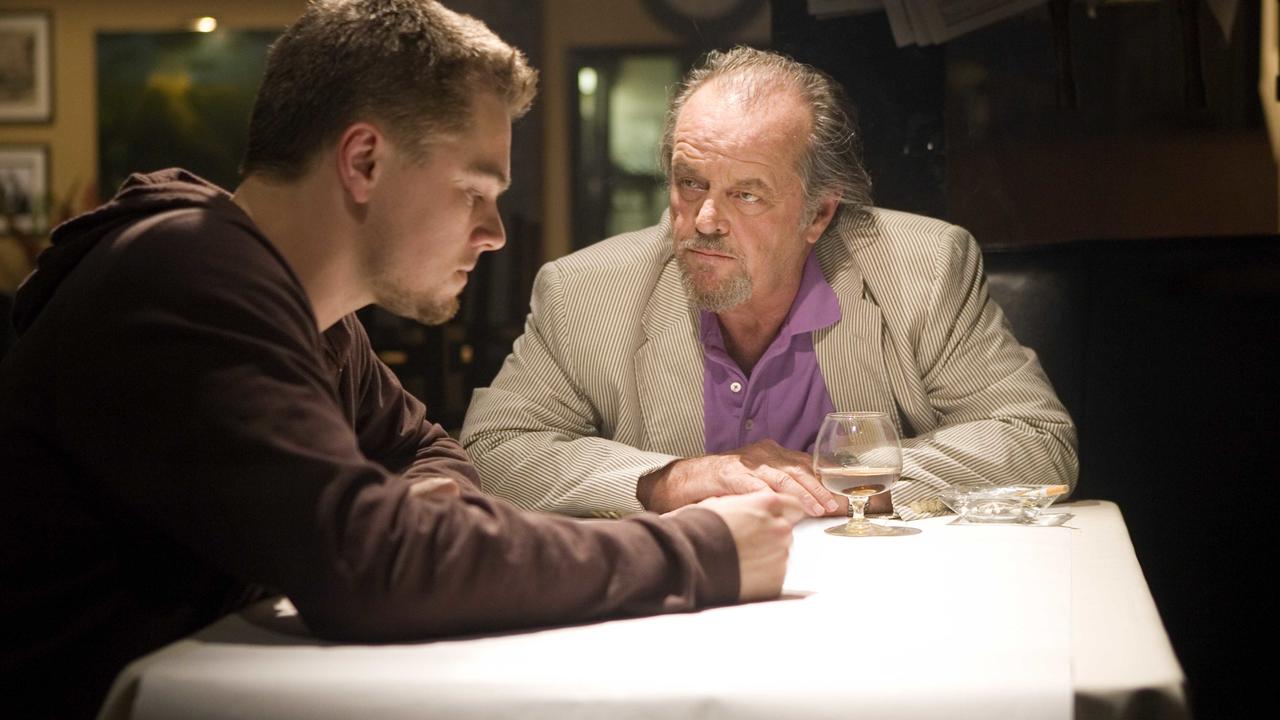
Director: Martin Scorsese · Cinematographer: Michael Ballhaus · Composer: Howard Shore · Screenplay: William Monahan (based on Infernal Affairs by Alan Mak and Felix Chong) · Editor: Thelma Schoonmaker · Production Design: Kristi Zea · Key Cast: Leonardo DiCaprio (Billy Costigan), Matt Damon (Colin Sullivan), Jack Nicholson (Frank Costello), Mark Wahlberg (Staff Sergeant Dignam), Martin Sheen (Captain Queenan), Vera Farmiga (Madolyn), Ray Winstone (Mr. French), Alec Baldwin (Ellerby) · Runtime: 151 minutes · Studio: Warner Bros. / Plan B Entertainment · Budget: $90 million · Box Office: $291 million (worldwide)
1. Two Rats in a Maze Built by the Same City
South Boston produces two young men. One becomes a cop who works for the mob. The other becomes a mobster who works for the cops. Neither one chose his role freely. Both were shaped by the neighborhood, by circumstance, by the gravitational pull of a crime boss named Frank Costello who saw in them something useful and put them on their respective paths before either was old enough to understand the transaction.
This mirror structure, inherited from Andrew Lau and Alan Mak’s 2002 Hong Kong thriller Infernal Affairs, is The Departed’s skeleton. But where the original was sleek and philosophical, guided by Buddhist notions of karmic suffering, Scorsese’s version is bruising, profane, and soaked in the specific class fury of Irish-American Boston. The transposition changes everything. Infernal Affairs asks whether a person can escape the consequences of betrayal. The Departed asks whether a person raised in a city that runs on betrayal ever had a self to betray in the first place.
Colin Sullivan (Matt Damon) and Billy Costigan (Leonardo DiCaprio) occupy opposite sides of a wall that is thinner than either of them realizes. Sullivan has the apartment, the badge, the girlfriend, the career trajectory. Costigan has the criminal record, the anxiety attacks, the therapist-mandated medication, and a handler who tells him his sacrifice will be rewarded while offering no evidence that any institution in Massachusetts has ever rewarded anything except compliance. The film’s central tension is not which mole will be exposed first. It is which one will collapse under the weight of pretending to be someone he is not, and the answer, delivered across two and a half hours of escalating paranoia, is: both of them.
2. Michael Ballhaus’s Last Scorsese: The Camera That Will Not Sit Still
The Departed was the eighth and final collaboration between Scorsese and cinematographer Michael Ballhaus, who had previously shot Goodfellas, The Age of Innocence, and Gangs of New York for the director. Their working relationship, refined across two decades, had evolved into what Ballhaus described as near-telepathic communication: they could block a scene together with minimal discussion, each anticipating the other’s instincts.
Ballhaus shoots The Departed with a restlessness that mirrors the characters’ psychological condition. The camera tracks, pans, dollies, and circles almost continuously. Static compositions are rare and, when they occur, feel like held breath. The movement is not decorative. It is diagnostic: it captures the physical experience of being a person who can never stop looking over his shoulder. Costigan cannot sit still because stillness means death. Sullivan cannot sit still because stillness means exposure. The camera adopts their condition as its own.
The most technically demanding sequences are the surveillance and counter-surveillance scenes, where Scorsese and Ballhaus must convey two parallel operations happening in the same city simultaneously. The cross-cutting between Sullivan feeding information to Costello and Costigan feeding information to Queenan generates a rhythm that accelerates throughout the film, tightening the cuts until the parallel lines converge in the rooftop sequence where Queenan is killed. Ballhaus frames this convergence with a compositional shift: the earlier sequences are shot in the cluttered, compressed interiors of Boston bars and offices, but the rooftop scenes open into vertical space, exposing the characters to the sky and to each other. The visual relief is also, of course, a trap.
3. DiCaprio, Damon, and the Two Faces of a Broken Mirror
Leonardo DiCaprio and Matt Damon occupy the film as complementary performances that are designed to be compared, and the comparison reveals something about each actor’s relationship to vulnerability.
DiCaprio plays Costigan as a man being eaten alive by his own performance. The undercover role requires him to become a criminal, and the becoming is not costume. It is corrosion. DiCaprio’s body language deteriorates across the film: his posture tightens, his jaw clenches, his eyes develop the darting quality of an animal in a cage. The anxiety attacks are not episodes. They are the baseline. The moments of calm are the episodes, brief respites that the film withdraws as soon as they arrive. DiCaprio’s achievement is to make the audience feel the physical cost of deception: the headaches, the insomnia, the constant low-grade terror of being discovered. By the film’s final act, Costigan looks ten years older than when the film began.
Damon plays Sullivan with the opposite strategy: smoothness as concealment. Sullivan is the mole who has mastered his cover so completely that the cover has become his identity. He is charming, efficient, and totally hollow. Damon plays the hollowness with a precision that can be mistaken for flatness; what he is doing is showing a man who has no interior life because the interior was emptied to make room for the performance. Sullivan does not struggle with his deception the way Costigan does. He has incorporated it. The only moments where the mask slips are sexual: his impotence with Madolyn, his overcompensation in public, the way his body stiffens when he feels control slipping. Damon understood that Sullivan’s weakness is not guilt. It is the terror that someone will notice there is nothing behind the competence.
Mark Wahlberg, as Staff Sergeant Dignam, delivers the film’s most volatile performance in what is essentially a supporting role. Every line Dignam speaks is an attack, and Wahlberg plays the aggression as a form of honesty: Dignam is the only character in the film who says exactly what he thinks, and what he thinks is that everyone around him is corrupt, incompetent, or both. The Oscar nomination was deserved. The performance is a sustained act of controlled fury that provides the film its moral compass, however abrasive.
4. Nicholson’s Costello: The Devil Who Improvised His Own Lines
Jack Nicholson reportedly told Scorsese before shooting began that the film needed “something a little more” than a standard gangster role. What he meant was that he intended to play Costello as a figure operating slightly outside the film’s realistic register, a character who is partly a South Boston crime boss and partly a manifestation of something older and more elemental: temptation, corruption, the system itself.
The performance divides critics and audiences. Some find it excessive, a collection of Nicholson mannerisms untethered from the discipline of the screenplay. Others find it essential, the wild center that gives the film’s otherwise precise machinery its anarchic energy. The honest assessment is that both readings are partly correct. Nicholson’s Costello is occasionally too big for the frame, particularly in the dinner scenes where his improvisations (many of his lines were developed on set) push the film toward a theatricality that sits uneasily alongside DiCaprio’s naturalism. But the excess is not accidental. Costello is based in part on Whitey Bulger, the real Boston crime boss who operated as an FBI informant for decades while running one of the most brutal criminal organizations in American history. The real Bulger was, by most accounts, exactly this kind of outsized personality: a man who performed his own mythology so convincingly that law enforcement could not decide whether to arrest him or applaud.
The character’s function in the film is structural rather than psychological. Costello is the force that sets both moles in motion. He recruited Sullivan as a child. He operates in the same ecosystem that produced Costigan’s family. He is not a villain in the conventional sense because the film does not allow for conventional villainy. He is the environment, the weather, the thing that was here before the characters arrived and will remain after they are gone.
5. From Hong Kong to Southie: What the Remake Gained and Lost
Warner Bros. purchased the remake rights to Infernal Affairs for $1.75 million in 2003. William Monahan wrote the adaptation, relocating the story from Hong Kong to South Boston and replacing the Buddhist moral framework with an Irish-Catholic one. Scorsese deliberately avoided watching Infernal Affairs until after completing his own film, a decision that freed the adaptation from fidelity and allowed it to develop its own moral logic.
What the remake gains is texture. Infernal Affairs is a tight, elegant, 101-minute thriller that trusts its structure to carry the emotional weight. The Departed is fifty minutes longer and uses that time to build a social world: Costello’s monologue about the Irish and Italian division of Boston, the class dynamics of the Massachusetts State Police, the institutional corruption of the FBI (which protected Bulger for decades in exchange for information), the specific geography of a city where the distance between the projects and the precinct is measured in blocks, not miles. Scorsese fills the film with the density of lived experience, and the density makes the betrayals feel rooted in something larger than plot.
What the remake loses is restraint. Infernal Affairs ends with a devastating moral irony: the surviving mole faces his reflection and understands that he will spend the rest of his life imprisoned by his own survival. The Departed ends with an elevator, a bullet, another bullet, another bullet, and a rat on a balcony railing. The violence of the ending has been defended as Scorsese’s naturalistic alternative to the original’s philosophical resolution: in Boston, the argument goes, there is no karmic reckoning, only gunfire. The defense is valid. But the blunt efficiency of the final sequence sacrifices something the original achieved, a lingering moral discomfort that follows you out of the theater and does not resolve. The Departed kills its problems. Infernal Affairs lets them live.
6. Thelma Schoonmaker and the Art of the Controlled Avalanche
Thelma Schoonmaker has edited every Scorsese film since Raging Bull, and her work on The Departed won the Academy Award for Best Film Editing. The award is justified by a film whose 151-minute runtime contains enough narrative for a miniseries yet never feels bloated, and whose pace accelerates so smoothly that the audience does not notice the gear shifts until the final act arrives with the velocity of something falling from a great height.
Schoonmaker’s most impressive achievement is the management of the film’s parallel timelines. For the first hour, Costigan’s infiltration of Costello’s crew and Sullivan’s rise within the police department are intercut with a rhythmic alternation that trains the audience to expect the cuts. Once the two mole hunts begin, Schoonmaker shortens the intervals, creating a mounting urgency that transforms the cross-cutting from a structural device into a dramatic one. The sequences where both moles are simultaneously trying to identify each other while their respective handlers close in from opposite directions are edited with a complexity that would be chaotic in less experienced hands. Schoonmaker keeps every thread visible, every beat legible, and every cut purposeful.
The use of popular music as an editing tool deserves attention. Scorsese has always been a master of the needle-drop, and The Departed deploys the Rolling Stones, the Dropkick Murphys, and Van Morrison with the precision of a DJ who understands that a song’s relationship to a scene is not accompaniment but argument. The Stones’ “Gimme Shelter” appears twice, a Scorsese signature, and each deployment changes the song’s meaning. Howard Shore’s original score operates in the spaces between the needle-drops, providing a connective tissue of guitar-based cues that are more textural than melodic, filling the silences that the songs leave behind.
7. Scorsese’s Consolation Prize and the Oscar That Arrived Late
The Departed won four Academy Awards: Best Picture, Best Director, Best Adapted Screenplay, and Best Film Editing. For Scorsese, it was his first Oscar after five previous nominations for directing, and the consensus among critics, journalists, and colleagues was blunt: the award was a correction, a recognition that the Academy had failed to honor Taxi Driver, Raging Bull, Goodfellas, and The Age of Innocence, and was making up for the omission with a film that, while excellent, was not his best work.
Scorsese himself acknowledged the dynamic with humor: “I won because this is the first movie I’ve done with a plot.” The self-deprecation contains a real observation. The Departed is, structurally, more conventional than most of Scorsese’s major work. It has a clear protagonist, a clear antagonist, a rising action, a climax, and a resolution. The formal adventurousness of Goodfellas (which this site has covered) or the psychological excavation of Taxi Driver is not present here. What is present is mastery: the total command of pace, performance, and visual storytelling that a director achieves after forty years of practice.
This is an 8/10 film. The score reflects a judgment about the gap between mastery and revelation. The Departed is superbly crafted, compulsively watchable, and populated by performances that range from excellent (DiCaprio, Wahlberg) to extraordinary (Damon’s quietly terrifying vacancy). It is also, for Scorsese, a film that does not take risks commensurate with his talent. The source material provides the architecture. The performances provide the emotion. The direction provides the energy. But the synthesis, while thrilling, does not produce the sense of discovery that marks Scorsese’s greatest work. You leave The Departed entertained, impressed, and satisfied. You leave Goodfellas changed.
8. Whitey Bulger’s Shadow: The Real Departed
Frank Costello is based, loosely but recognizably, on James “Whitey” Bulger, the leader of the Winter Hill Gang who operated as an FBI informant for over fifteen years while running a criminal empire responsible for at least eleven murders. Bulger’s story is one of the most extraordinary examples of institutional corruption in American law enforcement history: the FBI protected him from prosecution, tipped him off about investigations, and allowed him to operate with effective impunity in exchange for information about the Italian Mafia, which the Bureau considered a higher priority.
Scorsese and Monahan incorporated this history into the film’s subplot about Costello’s FBI connection, a detail that has no equivalent in Infernal Affairs and that grounds the film’s cynicism in documented reality. The idea that the criminals and the law enforcement apparatus are not opponents but partners, that the system requires both sides to function, is not a metaphor in The Departed. It is a description of how things actually worked in Boston for decades.
Bulger himself was arrested in 2011, five years after the film’s release, after sixteen years on the FBI’s Most Wanted list. He was convicted of eleven murders and sentenced to two consecutive life terms. He was beaten to death in prison in 2018, reportedly by fellow inmates. The arc of his life, from protected informant to fugitive to murder victim, is grimmer than anything the film depicts, which is perhaps why Scorsese chose Nicholson for the role: only an actor capable of making evil entertaining could represent a man whose real crimes were too ugly for entertainment.
9. Boston as Character: The Architecture of Loyalty and Betrayal
The Departed is set in a Boston where geography is destiny. South Boston, Charlestown, Dorchester, the waterfront, the State House: each neighborhood carries a specific class weight, a specific relationship to power, and a specific code of loyalty that the film maps with the attention of a sociologist.
Costigan comes from a family with connections to both sides of the law, which makes him useful as an undercover agent and expendable as a human being. Sullivan comes from the projects, which means his ascent through the police ranks is both an achievement and a cover story. Costello’s territory is the intersection where money and violence meet, and his control of that intersection is what makes him indispensable to both the criminals and the FBI. The geography is not backdrop. It is the mechanism that produces the characters and the betrayals that define them.
Scorsese, who grew up in Little Italy in New York, brings to Boston the same ethnographic attention he brought to his own neighborhood in Mean Streets and Goodfellas. The bars, the diners, the waterfront projects, the State Police headquarters: these are spaces that determine what kind of conversations can happen within them, what kind of loyalty is expected, what kind of violence is tolerated. The film’s visual design, overseen by production designer Kristi Zea, distinguishes between these spaces with subtle shifts in color temperature and clutter. Sullivan’s apartment is clean, modern, and empty. Costello’s world is dense, dark, and lived-in. The contrast tells you everything about the difference between a man who inhabits his life and a man who is performing one.
10. Second Viewing, Second Rat: What the Mirror Shows
On your second viewing, watch Sullivan’s face when he is alone.
Damon performs a private Sullivan that is almost invisible on first viewing because the audience is tracking the plot rather than the performance. When Sullivan is with other people, he is controlled, charming, effective. When he is alone, the control does not relax. It intensifies. He checks his phone. He adjusts his posture. He looks at himself in mirrors with the scrutiny of someone inspecting a disguise. There is no moment in the entire film where Sullivan is not performing, and the absence of an offstage self is the performance’s most disturbing revelation. Sullivan is not hiding something. He is hiding nothing.
Track the phone calls. Both moles use phones to communicate with their handlers, and Schoonmaker cuts between the calls with increasing frequency as the net tightens. On second viewing, pay attention to the physical spaces where the calls happen: bathroom stalls, stairwells, parking garages, the margins of public spaces. Both men retreat to the same kinds of spaces to make their calls, and the visual rhyming reinforces the film’s mirror structure. They are the same person, split into two bodies, performing opposite roles in the same rigged game.
Watch Martin Sheen. Captain Queenan is the most underplayed role in the film, and Sheen gives it a warmth that functions as the film’s only reliable moral reference point. He is the one authority figure who treats Costigan as a person rather than an asset. His death on the rooftop is the moment the film loses its conscience, and everything that follows, the escalating violence, the cascade of betrayals, the final bloodbath in the elevator, is the consequence of that loss. Sheen plays Queenan so quietly that you do not realize how much the film depends on him until he is gone.
Film Trivia
Scorsese’s plot joke. When Scorsese won the Academy Award for Best Director for The Departed, ending decades of perceived snubs, he acknowledged the irony with characteristic dryness. “I won because this is the first movie I’ve done with a plot,” he told journalists backstage. The remark was both self-deprecating and precise: The Departed is, structurally, his most conventional narrative since Cape Fear, and the Academy rewarded the accessibility.
The director who looked away. Scorsese deliberately chose not to watch Infernal Affairs, the Hong Kong original, until after he had completed The Departed. He wanted his version to develop its own identity, free from the visual and tonal specifics of Andrew Lau and Alan Mak’s film. Andrew Lau, when asked about the remake, said he thought his own version was better, but called the Hollywood adaptation “pretty good too.”
Ballhaus’s farewell. The Departed was the eighth and final collaboration between Scorsese and cinematographer Michael Ballhaus, who retired from feature filmmaking shortly afterward. Their partnership, which began with After Hours in 1985 and included Goodfellas, The Age of Innocence, and Gangs of New York, represents one of the most sustained director-cinematographer relationships in American cinema. Ballhaus died in 2017 at the age of eighty-one.
The Bulger connection runs deep. Costello’s character is based partly on James “Whitey” Bulger, the real Boston crime boss who operated as an FBI informant for over fifteen years. Bulger was not apprehended until 2011, five years after the film’s release, having spent sixteen years as a fugitive. He was beaten to death in federal prison in 2018 at the age of eighty-nine, reportedly within twelve hours of his arrival at the facility.
Brad Pitt’s graceful exit. Brad Pitt was originally slated to play Colin Sullivan and served as a producer on the film. He eventually stepped aside from the acting role, telling Scorsese that a younger actor should play the part, and recommended the casting process that led to Matt Damon. Pitt’s production company, Plan B Entertainment, remained attached to the project, making him one of the rare figures in Hollywood to produce his own replacement.

Leave a Reply