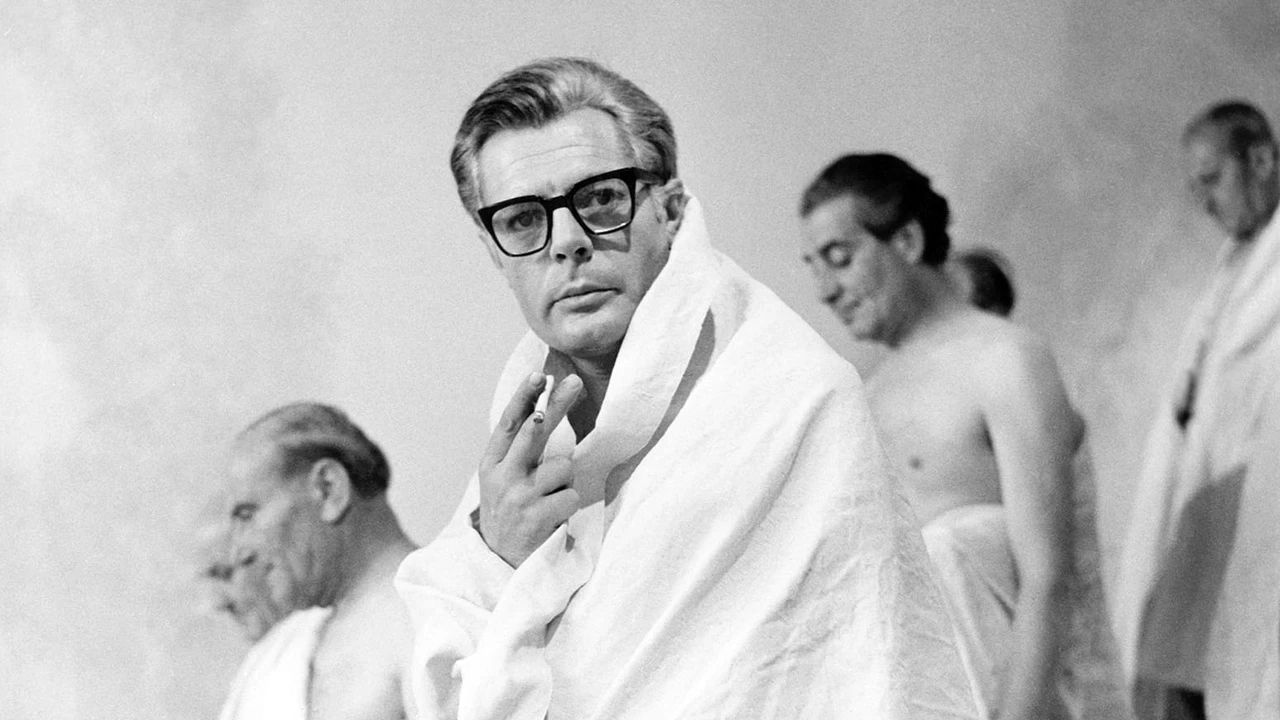
Director: Federico Fellini · Cinematographer: Gianni Di Venanzo · Composer: Nino Rota · Production Design/Costumes: Piero Gherardi · Key Cast: Marcello Mastroianni, Anouk Aimée, Claudia Cardinale, Sandra Milo, Rossella Falk, Barbara Steele, Eddra Gale · Runtime: 138 min · Studio: Cineriz / Francinex · Producer: Angelo Rizzoli
1. The Greatest Film About Not Being Able to Make a Film
Here is a movie about a director who cannot decide what his movie should be about. The director procrastinates, fantasizes, lies to his producer, sleeps with his mistress, avoids his wife, revisits his childhood, and, in the end, discovers that the chaos of not knowing is the film. This is also, essentially, the story of how 8½ itself was made. Fellini didn’t write a film about creative block. He had a creative block, and the resulting panic, improvisation, and exhilarating surrender to confusion produced one of the most important European films of the twentieth century.
The audacity is staggering even sixty years later. 8½ is a film that narrates its own impossibility. Its protagonist, Guido Anselmi (Marcello Mastroianni), is preparing a science fiction epic he no longer believes in. He retreats to a spa. He flirts. He lies. He daydreams. And as the film tracks his drift between reality, memory, and fantasy, it gradually dissolves the borders between these states until the audience can no longer tell, and no longer cares, which is which. The mess becomes the method. The confusion becomes beautiful.
It is not, however, flawless. The film’s treatment of its female characters, who exist almost entirely as projections of Guido’s desire, guilt, or nostalgia, is a legitimate problem that the film’s self-awareness only partially mitigates. Fellini knows Guido is a narcissist. He films the harem fantasy with a mixture of indulgence and irony. But irony is not the same thing as critique, and there are stretches where the film seems less interested in interrogating Guido’s relationship to women than in luxuriating in the spectacle of it. The question of whether the film transcends its protagonist’s limitations or merely aestheticizes them remains genuinely open.
What is not open is the question of craft. Every frame of this film is composed with an intelligence and an energy that remain startling. The transitions between temporal planes are so fluid that they redefine what cinema can do with subjectivity. And Nino Rota’s score, shifting between circus marches and melancholy strings, provides the emotional connective tissue that holds the whole gorgeous, unruly thing together.
Verdict: 10/10. A film that turned creative paralysis into the definitive statement on artistic process. Narcissistic, self-indulgent, and utterly essential.
2. Mastroianni as Fellini’s Beautiful, Empty Mirror
Marcello Mastroianni gives one of the most peculiar great performances in cinema history: he plays a man who is, in many ways, doing nothing. Guido Anselmi does not drive the plot. He does not make decisive choices. He does not transform. He drifts, he deflects, he charms, and he hides behind his sunglasses (literally: the dark glasses become a visual shorthand for emotional unavailability). The performance is built almost entirely on reaction rather than action, and its brilliance lies in how much Mastroianni communicates through stillness, evasion, and a particular quality of exhausted self-awareness.
Watch his body language in the scenes with Anouk Aimée’s Luisa. Mastroianni plays these moments with a specific register of guilt: not the dramatic guilt of a man caught in a lie, but the low-grade, chronic guilt of a man who knows he is disappointing someone and has made a permanent accommodation with that knowledge. He doesn’t flinch. He doesn’t apologize with conviction. He performs attentiveness while being fundamentally absent, and Aimée’s Luisa reads this performance with devastating accuracy. The marriage scenes are among the most painfully realistic depictions of emotional disconnection in 1960s cinema, and they work because both actors understand that the cruelty is not in what Guido says but in the gap between his words and his attention.
Aimée herself delivers a portrait of dignified frustration that cuts through the film’s surreal architecture with startling clarity. Every time the movie threatens to float away into Fellini’s dreamscapes, Aimée’s Luisa grounds it with a look that says: this man is real, this marriage is real, and the damage is real.
Sandra Milo, as Guido’s mistress Carla, plays the opposite register: warm, fleshy, uncomplicated, absurdly eager to please. It is a role that could easily become caricature, but Milo gives Carla a specific, touching practicality. She knows her position. She knows the rules. She performs cheerfulness as a survival strategy, and in the moments when the cheerfulness slips, the effect is unexpectedly moving.
Claudia Cardinale appears sparingly as Claudia, the idealized muse who represents everything Guido believes art should be: pure, uncomplicated, redemptive. She is given almost nothing to do except be beautiful, which is precisely the film’s point about how male artists use women as screens for their own fantasies. Cardinale plays this knowingly, and the brief scene where Claudia questions Guido’s conception of her is one of the film’s sharpest moments of self-critique.
3. Sets Made of Light: Di Venanzo’s Black-and-White Mastery
Gianni Di Venanzo was one of the great European cinematographers of the mid-century, and 8½ was his final collaboration with Fellini before his early death in 1966 at forty. He was aware that black-and-white photography was becoming a minority choice in Italian cinema, and he approached this film as if it might be his last chance to demonstrate what monochrome could do that color could not.
The answer, in Di Venanzo’s hands, is everything to do with the interplay between reality and imagination. Black and white eliminates the surface realism that color provides, and in doing so, it places reality and fantasy on the same visual plane. When Guido transitions from a conversation at the spa to a childhood memory of the beach, or from a press conference to the harem fantasy, the shifts feel seamless partly because the tonal palette is consistent. Color would have created a hierarchy: this scene looks real, this scene looks dreamy. Di Venanzo’s monochrome refuses that distinction.
He worked closely with production designer Piero Gherardi to design sets, in Di Venanzo’s phrase, “out of light” rather than through elaborate physical construction. This is visible throughout the film. The spa scenes are carved out of high-key illumination that makes the white walls, white robes, and white mineral baths feel both clinical and ethereal. The harem sequence uses warm, diffused light that softens every surface and every face, turning the fantasy into something physically inviting. The childhood sequences on the beach use hard, flat light that mimics the clarity of memory: everything is sharp, vivid, and slightly too bright, the way the past looks when you revisit it with longing rather than accuracy.
The camera movement deserves attention in its own right. Fellini and Di Venanzo favored long, unbroken tracking shots that follow characters through complex spaces, allowing the environment to reveal itself gradually rather than being established through cuts. The spa sequences are particularly effective in this regard: the camera glides through corridors and courtyards, picking up conversations, faces, and encounters in a flowing, almost musical rhythm that mirrors Guido’s distracted, scanning consciousness. You experience the spa the way Guido does: as a continuous field of stimuli, none of it quite landing, all of it registered.
4. Nino Rota and the Circus of the Soul
Nino Rota’s score for 8½ is, alongside his work on The Godfather, his most famous composition, and it achieves something that perhaps no other film score has: it makes creative despair sound like a carnival.
The signature motif is a circus march that recurs throughout the film in various orchestrations. It appears during the opening dream, returns during transitions between fantasy and reality, and culminates in the final sequence where all of the film’s characters join hands and dance in a circle around a circus ring. The march is jaunty, slightly absurd, and unmistakably melancholy underneath its brightness. It captures something essential about the film’s emotional register: the feeling that life is a ridiculous performance, and that acknowledging its ridiculousness is the closest thing to wisdom available.
But the score is not all circus music. Rota also provides moments of genuine romantic tenderness, particularly in the themes associated with Guido’s memories of his mother and his idealized vision of Claudia. These passages use strings and solo instruments in a way that is almost naively beautiful, as if the music belongs to a simpler, less ironic film. And that contrast is deliberate: when the tender themes give way to the circus march, or when they are interrupted by the atonal dissonance of Guido’s anxiety, the effect is of a man whose emotional life is constantly being invaded by his own self-consciousness. He cannot feel without immediately watching himself feel. Rota scores this condition with extraordinary precision.
The use of Wagner’s “Ride of the Valkyries” at the spa is one of the film’s great comic touches. The piece is absurdly grandiose for the setting, and Fellini uses it as a signal that even the most mundane environment is, in Guido’s imagination, inflated to operatic proportions. The gap between what the audience sees (elderly people taking mineral baths) and what the music implies (something heroic and vast) is the film’s comedy in miniature.
5. A Film That Made Itself: The Production as Parable
The production history of 8½ is not merely interesting. It is the film’s subject matter. The two are inseparable, and knowing how the film came into being deepens every scene.
After La Dolce Vita won the Palme d’Or in 1960, Fellini was at the peak of his international reputation and completely unable to decide what to do next. By autumn 1960, he had begun describing a film about “a man suffering from a creative block” in letters to collaborators, but the project refused to cohere. He could not decide whether his protagonist should be a writer, a theatrical producer, or something else entirely. He scouted locations across Italy, hoping the physical world would show him his film. It did not.
Under pressure from his producer Angelo Rizzoli, Fellini signed contracts, set dates, hired Mastroianni, Aimée, and Milo, booked Cinecittà, and brought on Di Venanzo and Gherardi. He still did not know what the film was about. In April 1962, sitting in his office, he began drafting a letter to Rizzoli confessing that he had “lost his film” and needed to abandon the project. He was interrupted by the chief machinist, who asked him to come toast the crew for the production’s official launch. Fellini put down the letter, went to the set, raised a glass, and in that moment of shame and obligation, the film revealed itself. He would make a movie about a director who cannot make his movie. The crisis was the story.
Shooting began on May 9, 1962 and proceeded for five months in conditions of extraordinary improvisation. Fellini taped a small note beneath the camera’s viewfinder: “Ricordati che è un film comico” (“Remember that this is a comic film”). Actors received their lines each morning, never the full script. Dialogue was rewritten during post-production dubbing, following the standard Italian practice of the era, which Fellini pushed further than anyone: he would shout instructions to his actors during filming, knowing the sound would be replaced later, and then rewrite their words entirely in the dubbing studio.
6. The Beautiful Confusion: Structure as Dream Logic
8½ has no conventional plot. It has, instead, a consciousness. The film follows Guido Anselmi’s mind as it moves between present, past, and fantasy, and the transitions between these modes are the film’s most radical formal achievement.
Fellini refuses to signal these transitions with the standard cinematic cues (dissolves, color shifts, voiceover annotations). A conversation in the present simply becomes a memory. A memory becomes a fantasy. A fantasy returns to the present, except the present has absorbed something from the fantasy. The audience is left to navigate these shifts without a map, and the experience is initially disorienting and eventually liberating: you stop trying to track “what is really happening” and begin to experience the film the way Guido experiences his own life, as a continuous stream in which all times and all selves coexist.
The opening dream sequence is the film’s structural thesis. Guido is trapped in a car during a traffic jam. Exhaust fills the vehicle. He escapes through the window, floating above the cars and ascending into the sky. A rope around his ankle pulls him back to earth. He wakes. The sequence lasts only a few minutes, but it contains the film’s entire argument: the artist’s desire for transcendence, the mundane forces that prevent it, and the cyclical return to reality that is both defeat and material.
The harem sequence, where Guido imagines all the women in his life gathered in a single farmhouse under his benevolent command, is the film’s longest sustained fantasy and its most controversial. Women are bathed, pampered, and attend to Guido’s every need; when they pass the age of thirty, they are sent upstairs. It is simultaneously a satire of male fantasy, an honest depiction of how one particular male mind works, and, depending on the viewer’s tolerance, either a brave act of self-exposure or a self-indulgent replay of precisely the attitudes it claims to critique. Fellini walks this line with visible pleasure, which is both the sequence’s strength and its problem.
The film’s structural innovation influenced an entire generation. Woody Allen’s Stardust Memories, Bob Fosse’s All That Jazz, and Charlie Kaufman’s Adaptation all owe direct debts to 8½’s method of using creative paralysis as narrative engine. None of them surpass it.
7. Fellini’s Journey: From Neorealism to Pure Cinema
8½ marks the decisive pivot in Fellini’s career, the point where the former neorealist screenwriter completed his transformation into something entirely different: a director of interior spectacle.
Fellini began as a collaborator of Roberto Rossellini, writing scripts for Rome, Open City and Paisà, films defined by their commitment to documenting external, social reality. His early directorial work (I Vitelloni, La Strada, Nights of Cabiria) maintained a connection to that tradition, even as it introduced a more personal, emotionally extravagant sensibility. La Dolce Vita, in 1960, was the hinge: still grounded in a recognizable Rome, still concerned with social portraiture, but increasingly drawn to spectacle, fantasy, and the filmmaker’s own psyche as subject matter.
8½ completed the break. Here, external reality becomes subordinate to the director’s interior world. Rome, the spa, the beach, the Cinecittà sets: these places exist in the film only as reflections of Guido’s (and Fellini’s) consciousness. The shift was decisive and permanent. Everything Fellini made afterward (Juliet of the Spirits, Fellini Satyricon, Amarcord, City of Women) would occupy this territory of subjective, hallucinatory cinema. For better and worse, 8½ is the film that gave Fellini permission to make cinema entirely on his own terms. The masterpieces that followed (Amarcord, especially) and the lesser works (City of Women, which indulges the narcissism without the counterbalancing self-critique) all descend from this moment.
The title itself is a self-referential gesture that announces the film’s methodology. 8½ refers to the number of films Fellini had directed up to that point: six features, two short segments in anthology films, and one co-directed feature, which he counted as half. The title says: this is not a story. This is a position in a body of work. The film is about itself, about its maker, and about the conditions under which it was made. That such radical self-reference could produce something universal rather than merely solipsistic is the film’s miracle.
8. The Saraghina Sequence and the Archaeology of Desire
No discussion of 8½ is complete without attention to the Saraghina sequence, which is not only the film’s most famous set piece but also its emotional key.
In a childhood flashback, young Guido and his schoolmates sneak away from their Catholic boarding school to the beach, where they pay a large, wild-haired woman named Saraghina (Eddra Gale) to dance for them. Saraghina performs a rumba in the sand, her body enormous and magnetic, her movements joyful and unselfconscious. The boys watch in a state of terrified, ecstatic fascination. The priests catch them, drag young Guido back to school, and subject him to punishment and confession. The sequence ends with Guido, having been told that Saraghina is the devil, returning to the beach alone. She is still there, still dancing. He watches from a distance, no longer joining in but unable to look away.
It is, in concentrated form, Fellini’s entire philosophy. Desire is original. Guilt is imposed. The body is beautiful and frightening. The church condemns what it cannot control. And the artist is the child who keeps returning to the beach, unable to participate and unable to stop watching.
Eddra Gale’s performance is extraordinary in its physicality. She is not conventionally attractive by any standard the film’s 1963 audience would have recognized, and that is essential: Saraghina is not an object of polished desire. She is an experience, a force, a presence that short-circuits the categories of beautiful and ugly altogether. Fellini shoots her from below, against the sky, in compositions that make her look monumental, mythic. She is the only figure in the film who exists entirely outside the machinery of Guido’s adult self-consciousness. She is not idealized, like Claudia. She is not managed, like Carla. She is not suffered through, like Luisa. She simply is, and the film’s emotional ache comes from Guido’s recognition that he has spent his entire adult life trying to recapture a directness of experience that ended the moment the priests dragged him off the beach.
9. The Spaceship and the Unmaking: How 8½ Ends
The ending of 8½ is one of the most debated finales in cinema, and its meaning depends entirely on what you believe the film is saying about the relationship between art and failure.
Guido’s science fiction epic has been in crisis throughout the film. An enormous spaceship launching pad has been constructed on a beach at massive expense. The producer is impatient. The cast is confused. The intellectual critic Daumier (Jean Rougeul) has been telling Guido, in increasingly acid terms, that the project has nothing to say. In the film’s climactic sequence, Guido faces a press conference at the launch pad, surrounded by journalists, actors, and crew, all demanding answers he does not have. He crawls under a table. He imagines shooting himself.
And then: the turn. Guido emerges from his despair and begins directing. Not the science fiction film, but this film, the one we have been watching. He calls all the characters from his life (his wife, his mistress, his parents, the priests, Saraghina, the circus performers) into a ring, and they join hands and dance. The circus march plays. Guido, now a child in a white outfit, leads the procession. The spotlight narrows. The film ends.
It is a resolution that resolves nothing in the conventional sense. The science fiction film is abandoned. The marriage is not repaired. The creative block is not overcome by finding the “right idea.” Instead, Guido accepts that his life, in all its confusion, contradiction, and failure, is his material. The parade of characters is not a triumph. It is a surrender. And it is, simultaneously, the most joyful moment in the film.
Fellini originally shot a different ending set on a train, with implications of suicide. He abandoned it on the advice of co-writer Tullio Pinelli and instead created the circus finale. The decision transformed the film from tragedy into something harder to categorize: not comedy, not tragedy, but a kind of ecstatic resignation. The acknowledgment that the mess is the art.
10. The Longest Shadow: Why Every Film About Filmmaking Owes 8½
The reception of 8½ was overwhelmingly positive, and its influence has been so pervasive that it now functions less as a film and more as a genre.
Upon release in February 1963, Italian critics recognized something unprecedented. The film won the Grand Prize at the Moscow International Film Festival in July, where the audience response reportedly alarmed Soviet authorities. It won the Academy Award for Best Foreign Language Film and Best Costume Design. François Truffaut called it “complete, simple, beautiful, honest.” The Cahiers du cinéma critics compared its importance to Citizen Kane.
Dissenting voices existed and deserve acknowledgment. Some critics found the self-referentiality hermetic, the treatment of women retrograde, and the narrative structure willfully obscure. These criticisms have not gone away. They have, if anything, intensified as critical frameworks for analyzing gender in cinema have become more sophisticated. 8½ remains a film that a viewer can simultaneously recognize as a masterpiece and find deeply uncomfortable in its sexual politics. Both responses are legitimate, and the film is strong enough to survive the tension between them.
The influence is measurable in specific films: Fosse’s All That Jazz (1979) transplants the structure into the world of Broadway choreography. Allen’s Stardust Memories (1980) recreates the adoring-and-hostile public, the creative crisis, and the spa setting so precisely that it borders on remake. Kaufman’s Adaptation (2002) updates the self-referential method for the age of meta-screenwriting. But the influence extends further than homages. 8½ effectively invented the film about filmmaking as a serious artistic mode. Before it, films about directors were backstage comedies or industry satires. After it, they could be philosophical inquiries into consciousness, creativity, and the nature of representation itself.
11. Where the Dream Starts and Stops: A Rewatch Guide
8½ rewards second viewing not through hidden details but through structural awareness. Once you know the film’s architecture, the experience transforms from confusion into recognition.
Track the transitions. On first viewing, the shifts between present, memory, and fantasy are disorienting. On second viewing, map them deliberately. Note the precise frames where reality gives way: a glance, a musical cue, a camera movement that carries Guido from one temporal plane to another. What seemed random reveals itself as a grammar, consistent and purposeful. Fellini almost never uses dissolves or conventional transition markers. The cuts are direct. The shift is in the content, not the editing.
Watch Mastroianni’s hands. His performance is built on small physical gestures that register differently when you know the character’s arc. The sunglasses going on and off. The way he touches his face when lying. The moments where his hands reach toward someone and then withdraw. These details are invisible on first viewing because the visual spectacle overwhelms them. On second viewing, they become the film’s most intimate layer.
Listen for Rota’s cues. The score functions as an emotional map. Each recurring theme is keyed to a specific mode of consciousness: the circus march for performance and self-awareness, the romantic strings for memory and longing, the dissonant passages for anxiety and creative paralysis. Once you hear the pattern, the music tells you where Guido’s mind is before the image does.
The harem sequence, with distance. This sequence reads very differently once you have reached the ending. The fantasy of total control over every woman in his life is precisely what Guido must surrender in order to make his film. The parade at the end is the harem sequence inverted: instead of women serving Guido, everyone (men, women, children, priests, performers) dances together as equals. The finale answers the fantasy, and the answer is generosity.
Claudia’s question. Near the end, Claudia asks Guido a question about his film’s protagonist: “He meets a girl that can give him a new life and he pushes her away?” Guido answers: “Because he no longer believes in it.” On second viewing, this exchange reads as Fellini’s most honest self-assessment: the muse figure cannot save the artist. Only the acceptance of confusion can.
Film Trivia
The letter that was never sent. In April 1962, Fellini sat in his Cinecittà office writing a letter to producer Angelo Rizzoli, confessing he had “lost his film” and needed to cancel the production. The chief machinist interrupted, asking him to come celebrate the official launch. Fellini put down the letter, went to the set, and in that moment of panic, realized the film would be about a director who cannot make his film. The confession letter was never finished.
A note taped to the camera. When shooting began on May 9, 1962, Fellini attached a small strip of brown paper tape below the camera’s viewfinder. Written on it were the words “Ricordati che è un film comico”: Remember that this is a comic film. It remained there throughout the five-month shoot, a reminder to himself that no matter how deep the existential crisis ran, the tone should stay buoyant.
Nobody saw the full script. Fellini never distributed a complete screenplay to his cast. Actors received their lines for the day’s shoot each morning, often on a single sheet of paper. Because Italian films of this era were shot without live sound recording, Fellini would shout instructions during takes, knowing the audio would be replaced in post-production. He then rewrote much of the dialogue during the dubbing sessions, sometimes altering meanings entirely.
The title is a ledger entry. “8½” refers to Fellini’s count of his directorial output: six solo features, two short segments in anthology films (contributing half a film each to the total), and one co-directed feature with Alberto Lattuada (counted as half). The working title had been “La bella confusione” (“The Beautiful Confusion”), proposed by co-writer Ennio Flaiano, but Fellini replaced it with the numerical title as a final act of self-reference.
Claudia Cardinale’s voice, for once, was her own. Due to her Tunisian accent and husky vocal quality, Cardinale’s dialogue in Italian films was routinely dubbed by other actresses. 8½ marked the first time she was permitted to dub her own voice in post-production. The decision suited the character: Claudia is meant to represent an idealized purity, and giving her Cardinale’s actual voice, however unconventional, added an authenticity that a polished dub would have undercut.
This entry selects analytical dimensions from a pool. All five anchors are present: critical verdict, performances, visual craft, reception and legacy, and the rewatchability guide. Earned sections cover the score, the director’s body of work, the production history that is inseparable from the film’s subject matter, the film’s structural innovation, and the ending’s significance. Two wildcard sections isolate dimensions unique to this film: “The Saraghina Sequence and the Archaeology of Desire” examines the childhood memory that encodes Fellini’s entire understanding of art, guilt, and the body, while “The Beautiful Confusion” treats the film’s dream-logic structure as a formal invention that redefined cinematic subjectivity. Awards history is addressed within the reception section rather than given its own.

Leave a Reply