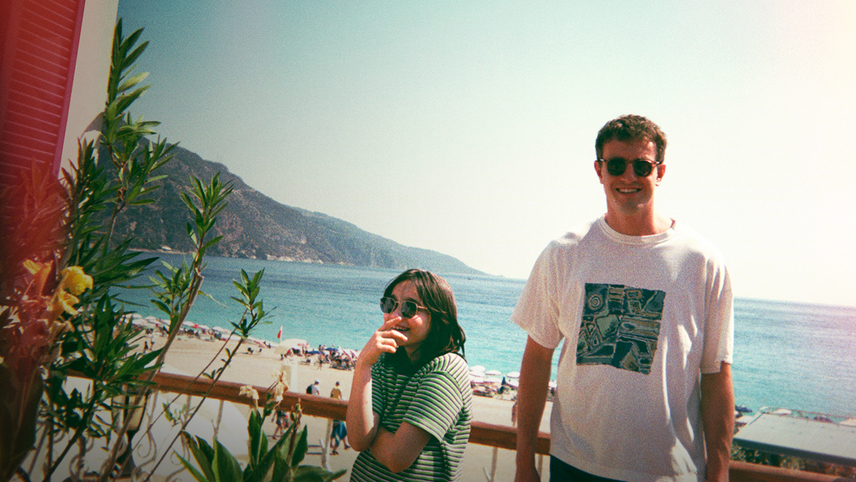
Director: Charlotte Wells · Cinematographer: Gregory Oke · Composer: Oliver Coates · Screenplay: Charlotte Wells · Editor: Blair McClendon · Production Design: Billur Turan · Key Cast: Paul Mescal (Calum), Frankie Corio (Sophie), Celia Rowlson-Hall (Adult Sophie) · Runtime: 102 minutes · Studio: A24 / BBC Film / BFI · Producers: Adele Romanski, Amy Jackson, Barry Jenkins, Mark Ceryak · Shot on: 35mm (ARRICAM LT, Cooke S4 lenses)
1. The Camcorder Knows Something You Don’t
A MiniDV camcorder records a man and a girl in a hotel room. The image is lo-fi, fuzzy, timestamped. The girl is eleven. The man is her father. They are on holiday in Turkey. She points the camera at him. He ducks away, smiling. She persists. He relents. The footage is banal in the way that all home video is banal: nothing happens, and everything is happening.
Twenty years later, a woman watches this footage in the dark. She is Sophie, the girl, now in her early thirties. The camera pans between the MiniDV playback on a television screen and the reflection of adult Sophie watching it, her face ghosting over her father’s image in the glass. Two timescales occupy the same frame. The person remembering and the person being remembered are superimposed, and neither one is fully visible.
This is how Aftersun announces what it is: not a story about a holiday, but a story about a woman trying to reconstruct her father from the evidence he left behind. The evidence is incomplete. The camcorder captured surfaces. The film will spend ninety minutes searching for what the surfaces concealed.
2. What Charlotte Wells Built from What She Lost
Charlotte Wells has described Aftersun as loosely based on her own life, though she has been careful to distinguish between autobiography and the thing autobiography becomes when you shape it into art. The film is dedicated to her father. The nature of that dedication, the specific weight it carries, becomes clear only in the final minutes, though the clues are present from the opening frame for anyone watching closely enough.
Wells was a first-time feature director, thirty-five years old, working with a budget modest enough that every creative choice had financial implications. She and cinematographer Gregory Oke were classmates at NYU’s Tisch School of the Arts. Editor Blair McClendon was another Tisch contemporary. The production team was a cohort, people who had been making films together since student projects, and the intimacy of those relationships is legible in the finished work. Aftersun does not feel like a first film in the sense of tentativeness. It feels like a first film in the sense of urgency: the work of someone who has been carrying this material for years and has finally found the form to hold it.
Barry Jenkins, the director of Moonlight, served as a producer, and his influence is felt not in any specific stylistic choice but in the permission his involvement signals: permission to be elliptical, to trust the audience with gaps, to build a film around what is not said rather than what is. Wells has spoken of Jenkins’s encouragement during development, and the alignment between Moonlight’s fragmented, time-shifting structure and Aftersun’s own approach to memory is not coincidental. Both films understand that the past does not arrive in chronological order. It arrives in fragments, triggered by a song or a gesture or the quality of light on water, and the film’s job is to honor the disorder rather than correct it.
3. Gregory Oke’s 35mm Memory: Why the Film Had to Be Analog
The decision to shoot on 35mm film was, by Oke’s account, non-negotiable. A film about memory had to be captured on a medium that behaves like memory: warm, grainy, slightly imprecise, beautiful in its imperfection. Digital would have been sharper, cleaner, cheaper. It would also have been wrong. The slight softness of celluloid, the way it renders skin tones and ambient light, gives Aftersun the quality of something recalled rather than recorded.
Oke framed the film at 1.85:1, a ratio intimate enough to hold two people in close conversation without the widescreen emptiness that a broader frame would create. The camera strategy follows a rule so precise it functions as a grammar: when we see Sophie, we occupy her perspective, grounded in close-ups and mid-shots that place the audience inside her experience. When we see Calum, we observe him from a greater distance, from behind, in reflections, at disjointed angles. The distinction is subtle on first viewing and devastating on second: we see Sophie clearly because she is the one remembering. We see Calum obscurely because he is the one being remembered, and memory, however loving, is always partial.
The MiniDV camcorder footage, shot on actual standard-definition video, provides the film’s textural counterpoint. The contrast between the lush 35mm and the degraded video is the contrast between how memory feels (golden, saturated, impossibly vivid) and what memory actually contains (pixelated, incomplete, unable to hold focus on the thing that matters most). Wells and Oke intercut between the two formats with a fluidity that makes the transitions feel less like editorial choices and more like the involuntary shifts of a mind moving between levels of recall.
4. Paul Mescal’s Calum: The Performance That Hides in the Margins
Paul Mescal received an Academy Award nomination for Best Actor for this role, which is remarkable given how little the film tells us about Calum directly. He is thirty-one years old. He is Sophie’s father but does not live with her mother. He has a broken arm in a cast. He practices tai chi in the hotel room. He reads a self-help book alongside a volume by the Scottish filmmaker and poet Margaret Tait. He is kind, attentive, playful, and present with his daughter in every scene they share. He is also, in ways the film refuses to make explicit until its final minutes, drowning.
Mescal’s achievement is to play both realities simultaneously without letting either one dominate. The Calum that Sophie sees is warm, silly, devoted. The Calum that the camera catches in unguarded moments, when Sophie is not looking, is something else: a man sitting on a balcony at night staring at nothing, a man crying silently on the edge of a bed, a man standing at the railing of a hotel overlooking the sea with a stillness that could be contemplation or could be something darker. Mescal does not play these moments as revelations. He plays them as leakage, the private self seeping through the cracks of the public performance of fatherhood.
The restraint is the performance. A more conventional approach would have given Calum a scene of confession, a monologue, a breakdown that makes the subtext text. Wells gives him nothing of the kind. The closest we get is a conversation in which Calum tells Sophie, with a casualness that does not quite disguise its desperation, that she should live wherever she wants and be whoever she wants. The line sounds like encouragement. It sounds, on second viewing, like a farewell.
5. Frankie Corio and the Miracle of a Child Who Does Not Perform Childhood
Frankie Corio was eleven years old and had no professional acting experience when Wells cast her as the young Sophie. The performance is one of the most naturalistic child performances in recent cinema, and the word “naturalistic” does not do it justice. Corio does not act natural. She is natural. The difference is the difference between imitation and the thing itself.
Sophie is at the edge of adolescence, and Corio plays this liminality with an unconscious precision that no direction could produce. She is a child who still wants to play games with her father and a young person who is beginning to notice the world of teenagers around the resort: the older kids, the flirtations, the awareness of her own body. She moves between these registers without signaling the transition, the way actual eleven-year-olds do, shifting from gleeful to sulky to curious to bored within the span of a single poolside afternoon.
The chemistry between Corio and Mescal is the film’s foundation. If the audience does not believe that these two people love each other, nothing else in the film works. Wells built the relationship through improvisation and extended rehearsal, allowing Corio and Mescal to develop a rapport that reads as history rather than performance. The small gestures, the way Sophie drapes herself over Calum’s back, the way Calum pretends to be annoyed when she films him, the way they share a silence that is comfortable rather than empty, carry the emotional weight that the script deliberately withholds from dialogue.
6. Oliver Coates and the Sound of a Memory Trying to Surface
Oliver Coates’s score for Aftersun is built from cello, electronics, and a pervasive sense of something just out of reach. The compositions do not accompany the image in any conventional sense. They exist alongside it, occupying the same temporal space but operating at a different emotional frequency, the way a feeling can coexist with a memory of a different feeling without either one canceling the other.
The score’s most powerful interventions come during the strobe-lit sequences, brief, abstract eruptions in which adult Sophie appears in a dark space, illuminated by pulsing light, reaching toward or away from a figure who may be Calum. These sequences have no narrative content. They are emotional events: the visceral experience of a memory that the mind cannot fully access, a feeling that arrives without its context, urgent and undirected. Coates’s music in these passages is dense, layered, almost physical, and it transforms the film from a naturalistic character study into something closer to an act of psychic excavation.
The use of popular music is equally deliberate. The film’s deployment of “Under Pressure” in its climactic sequence has been widely praised as one of the best music cues of 2022, and its power derives from context rather than selection. The song plays in a karaoke bar where Calum and Sophie are spending their last evening together. The camera cuts between Calum singing, Sophie watching, and the strobe-lit abstract space where adult Sophie reaches for her father across a darkness that swallows him. The song’s lyrics, about pressure and love and the terror of being unable to reach someone, become not a commentary on the scene but the scene itself: the present and the past and the imagined all compressed into a single, unbearable musical moment.
7. The Strobe and the Void: Aftersun’s Structural Wildcard
The strobe-lit sequences are the film’s most formally daring element, and they exist outside the film’s otherwise naturalistic register. They show adult Sophie (played by dancer and filmmaker Celia Rowlson-Hall) in a dark, undefined space, lit by intermittent flashes that make the image stutter and pulse. Sometimes she dances. Sometimes she reaches toward a figure in the darkness. Sometimes the figure reaches back.
These sequences are not flashbacks or flash-forwards. They are not dreams. They are the film’s representation of the space between memory and understanding: the place where adult Sophie goes when she tries to feel her way back to her father and cannot reach him. The strobe effect fragments the image the way trauma fragments recall, producing impressions rather than narratives, sensations rather than events. Wells has not explained these sequences in interviews, and the refusal to explain is part of their power. They are the film’s unconscious, the material that cannot be organized into story, only felt.
The formal risk is considerable. In a film otherwise committed to the textures of realistic observation, these abstract interruptions could feel like intrusions from a different movie. They do not, because Wells places them at moments when the naturalistic surface has reached the limit of what it can express. The holiday footage can show us Calum’s smile. The strobe sequences show us what that smile costs Sophie to remember.
8. A Quiet Devastation: The Verdict
Aftersun is an 8/10 film. The score reflects a judgment that is partly about ambition and partly about reach. What Wells achieves here, in her first feature, with a cast of unknowns and a budget that barely covered the cost of 35mm stock, is extraordinary: a film about grief that never mentions grief, a film about loss that never confirms what was lost, a film about a father that is ultimately about the daughter who survived him.
The 8 rather than 9 reflects two honest observations. First, the film’s middle act, while never less than beautiful, occasionally drifts into a rhythm of resort-holiday observation that trusts its own atmosphere more than its audience’s patience. Individual scenes of Sophie and Calum at the pool, at dinner, on a boat are lovely in isolation but produce, in sequence, a flatness that the film’s emotional architecture needs more variation to support. Second, the strobe sequences, while formally thrilling, are deployed often enough that they begin to lose their disruptive power by the final act, when they should be at their most potent.
What earns the 8 and makes Aftersun essential viewing despite these reservations is the final ten minutes, which accomplish something so structurally ambitious that the comparison to Moonlight is not flattery but description. The film’s entire emotional argument, held in suspension for ninety minutes, detonates in a sequence that fuses the camcorder footage, the 35mm memory, the strobe void, and the “Under Pressure” performance into a single sustained passage of cinema that is, without exaggeration, one of the most emotionally devastating things produced in the 2020s. Sight and Sound ranked Aftersun as the best film of 2022. Mescal’s Oscar nomination followed. Wells won the BAFTA for Outstanding Debut. None of these honors is excessive.
9. The Daughter’s Cinema: Charlotte Wells and the New Language of Retrospective Grief
Aftersun belongs to an emerging tradition in 21st-century filmmaking that might be called the cinema of retrospective grief: films in which adult children return, through memory or investigation, to parents they lost before they could understand them. Joanna Hogg’s The Souvenir films occupy adjacent territory. So does Celine Sciamma’s Petite Maman. So, in a different register, does Kogonada’s After Yang.
What distinguishes Wells’s contribution is the specificity of her formal approach. She does not reconstruct the past. She reconstructs the act of reconstruction. The film is not about what happened on the holiday. It is about what happens when you try to remember what happened on the holiday and discover that the camcorder captured everything except the thing you needed to see. The MiniDV footage is evidence, but it is evidence of surfaces: smiles, waves, sunburn. The 35mm footage is memory, which is warmer and more vivid than evidence but equally unreliable. The strobe sequences are the feeling that remains when both evidence and memory have been exhausted: the raw, unprocessed grief of knowing that your father was in pain and you were too young to see it.
A.O. Scott, writing in The New York Times, described Wells as “very nearly reinventing the language of film.” The claim is extravagant but not unfounded. What Aftersun does with the interplay between video formats, between temporal planes, between what a child sees and what an adult understands, is genuinely new. Not unprecedented, exactly; the influences are visible (Claire Denis, Hou Hsiao-hsien, the Scottish filmmaker Margaret Tait, whose book appears on Calum’s nightstand). But the synthesis is Wells’s own, and it produces an emotional effect that no other film in recent memory has achieved: the sensation of watching someone you love disappear in the act of being remembered.
10. What the Camcorder Missed: A Rewatch in Three Layers
On your second viewing, watch what Calum does when Sophie is not looking.
The film is structured around Sophie’s perspective, which means the camera follows her attention. When Sophie is engaged with her father, we see Calum through her eyes: present, playful, warm. When Sophie’s attention wanders, to the teenagers at the pool, to a game of foosball, to her own reflection, the camera drifts with her, and Calum falls to the edge of the frame or out of it entirely. In those margins, Mescal is doing his most important work. A hand gripping a railing. A face turned toward the sea. A posture that has collapsed the moment his daughter looked away. These moments last two or three seconds each. They are the film’s hidden text, and they are visible only when you know to look for them.
Watch the mud bath scene. Calum and Sophie cover themselves in therapeutic mud at an outdoor spa, and the sequence is played for warmth and humor: father and daughter being silly together, caked in gray. But the mud covers Calum’s body completely, erasing his features, turning him into an anonymous figure. It is the film’s most literal image of a person disappearing, and it is presented as a game. On second viewing, the game is unbearable.
Listen to what Sophie says about the sky. She tells Calum that sometimes at school she looks up at the sun and thinks about the fact that they can both see it, even though they are not together. “I think it’s nice that we share the same sky,” she says. On first viewing, the line is sweet. On second viewing, it is the thesis of the entire film: the belief that distance is survivable because the connection persists, because you are both underneath the same sky. The film’s final passage asks whether this belief survives the discovery that the other person is gone. Sophie shares the sky with no one now. The sun is still there. The sharing is not.
Film Trivia
Shot on 35mm by insistence. Wells and Oke agreed from the earliest stages of development that Aftersun had to be captured on celluloid. The warmth and grain of 35mm, they felt, replicated the texture of memory in a way that digital could not. The production used an ARRICAM LT with Cooke S4 lenses, processing the film at a lab in Istanbul, where the shoot took place. The choice was expensive for a debut feature, but Wells considered it essential to the film’s emotional identity.
The NYU cohort. Wells, Oke, and editor Blair McClendon were all contemporaries at NYU’s Tisch School of the Arts, where they collaborated on student films and shorts before graduating. Their working relationship predates Aftersun by nearly a decade, and the shorthand they developed over years of collaboration is visible in the film’s seamless integration of cinematography and editing. The trust between director, cinematographer, and editor is the invisible architecture of the film’s emotional precision.
Barry Jenkins as guardian angel. The director of Moonlight and If Beale Street Could Talk served as a producer on Aftersun, and his involvement helped secure financing and distribution through A24. Jenkins has spoken publicly about his admiration for Wells’s vision, and the structural DNA of Moonlight, which also uses fractured timelines and withheld information to build toward devastating emotional revelations, is visible in Aftersun’s approach. Wells has described their creative relationship as formative.
The Margaret Tait clue. Among the books on Calum’s nightstand in the hotel room, visible for only a few seconds, is a volume of writings by Margaret Tait, the Scottish filmmaker and poet whose 1992 film Blue Black Permanent deals with a daughter’s attempt to understand her mother’s death by drowning. Wells has acknowledged Tait as a key influence, and the book’s placement in the frame is a quiet signal to attentive viewers about the film’s deeper subject. It sits between a tai chi manual and a self-help book, two other artifacts of a man trying to hold himself together.
The “Under Pressure” gamble. The climactic sequence, in which Calum sings the Bowie and Queen song at a karaoke bar while the film cross-cuts between timelines, was the sequence Wells built the entire film around. She has described it as the emotional destination she was navigating toward from the first frame. The song’s title and subject matter, about the pressure of living and the difficulty of loving, transforms from background music into the film’s confession: the thing Calum could not say to his daughter, articulated through someone else’s words, in a room full of strangers, on the last night of a holiday from which he may never have returned.

Leave a Reply