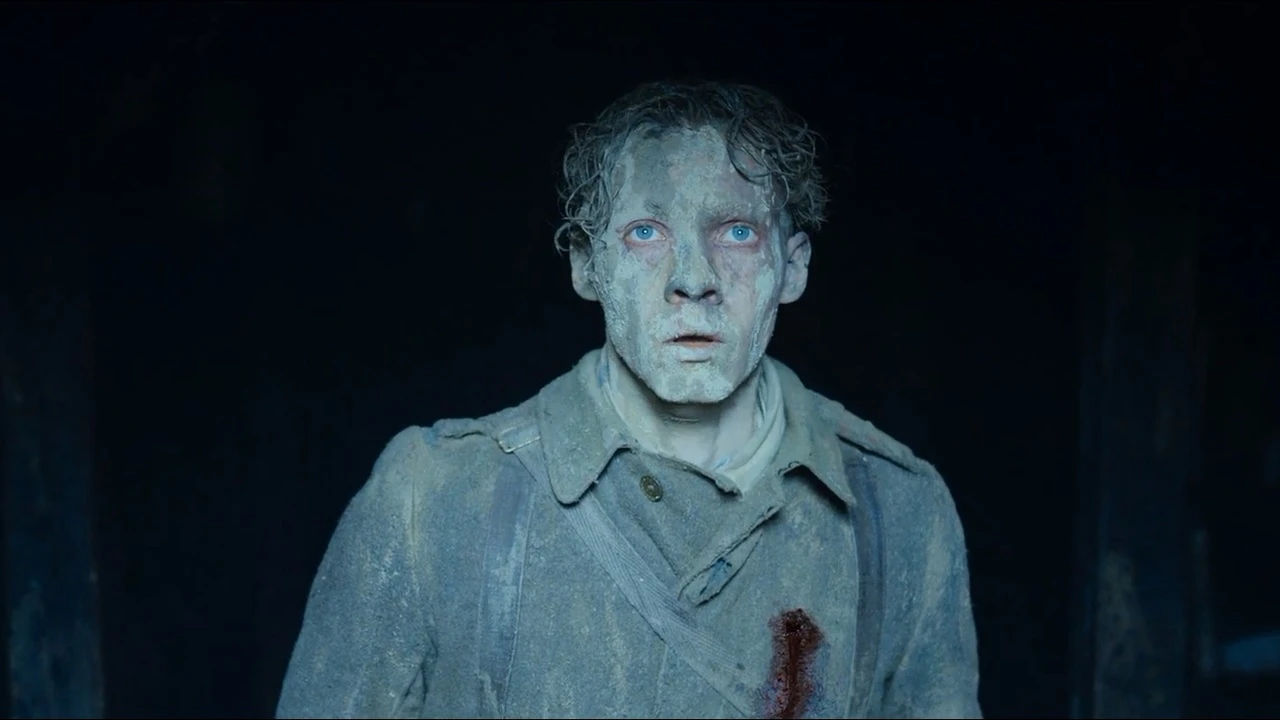
Director: Edward Berger · Cinematographer: James Friend · Composer: Volker Bertelmann (Hauschka) · Editor: Sven Budelmann · Production Design: Christian M. Goldbeck · Screenplay: Edward Berger, Lesley Paterson, Ian Stokell · Based on: the novel by Erich Maria Remarque (1929) · Key Cast: Felix Kammerer (Paul Baumer), Albrecht Schuch (Kat), Daniel Bruhl (Matthias Erzberger), Aaron Hilmer (Albert), Moritz Klaus (Franz Muller) · Runtime: 148 minutes · Producer: Malte Grunert · Studio: Amusement Park Film / Netflix · Country: Germany/UK · Language: German, French
The Machine Eats Its Young
The film opens with a fox. A vixen nurses her cubs in a den dug beneath the Western Front. The camera watches them with the patient intimacy of a nature documentary. Then the ground shakes. Explosions. The cubs scatter. The burrow fills with dirt. The camera cuts to a boy in a trench. This is the logic of Edward Berger’s All Quiet on the Western Front: nature exists in the margins of annihilation, and the war does not care about either.
Before the first battle, Berger shows us something that Remarque’s novel described but that no previous adaptation has visualized with such stomach-turning clarity. A dead soldier is stripped of his uniform. The uniform is collected, washed, mended, and reissued to a new recruit. Paul Baumer receives his uniform with someone else’s name still stitched into the collar. He is told it must have been a mislabel. It was not. The coat belonged to a dead man, and the army has recycled it because the machine requires fresh bodies and has more bodies than coats. This opening sequence, scored to Volker Bertelmann’s three-note harmonium motif, establishes the film’s thesis before a word of dialogue is spoken: war is an industrial process, and soldiers are its raw material.
Berger’s adaptation is the third feature film based on Remarque’s 1929 novel, after Lewis Milestone’s 1930 version (which won the Academy Award for Best Picture) and Delbert Mann’s 1979 television film. The 2022 version departs from the novel in significant ways. It adds a parallel storyline following the armistice negotiations, led by the German politician Matthias Erzberger (Daniel Bruhl). It compresses the novel’s episodic structure into a tighter temporal frame. It excises Paul’s leave from the front, a section that some critics consider the book’s emotional core. These changes generated substantial debate, particularly among German and Anglophone critics who disagreed about whether the adaptation honored or betrayed Remarque’s intent.
The debate is legitimate. Remarque’s novel is about alienation: the slow, invisible destruction of a young man’s capacity to feel, to connect, to return to civilian life. The 2022 film is about something narrower and more visceral: the physical horror of mechanized warfare and the absurdity of dying for a cause that has already been abandoned. Berger’s Paul does not go home on leave. He does not sit in his childhood room and realize he can no longer fit inside his former self. What he does is survive one battle, then another, then another, until the armistice is signed and his commanding officer sends him into one final, pointless assault. The film trades the novel’s interiority for sensory assault, and the trade is costly. What it loses in psychological depth, it gains in visceral impact.
This is a powerful, flawed, and necessary film. It is not the definitive adaptation of Remarque’s novel. It is, however, a devastating piece of anti-war cinema that accomplishes something the 1930 version, for all its pioneering importance, could not: it makes trench warfare feel like what it was. Not heroic. Not even tragic, in the classical sense. Just industrial. A process. A machine that runs until someone turns it off, and then starts again.
Verdict: 8/10
Kammerer’s Face and the Erosion of a Boy
Felix Kammerer, in his feature film debut, carries the entire weight of All Quiet on the Western Front on a face that changes so gradually that the transformation is visible only in retrospect. In the opening scenes, Paul Baumer is smooth-skinned, bright-eyed, vibrating with the patriotic enthusiasm that his teachers have drilled into him. By the final act, his face is a landscape of mud, blood, and exhaustion. The change is not performed through dramatic set pieces. It accumulates, frame by frame, like a time-lapse of decay.
Kammerer’s achievement is in what he does not do. He does not give Paul a defining emotional moment, a single scene where the character’s innocence breaks. Instead, the innocence drains away continuously, like heat from a body exposed to cold. His eyes, which are alert and curious in the first act, become progressively flatter. His movements, initially energetic, slow into the mechanical repetitions of someone conserving energy for survival. By the film’s final battle, Paul fights with the blank efficiency of a machine component, killing because that is what the machine requires, not because he believes in anything.
Albrecht Schuch, as the older soldier Stanislaus Katczinsky, provides the film’s warmth. Kat is resourceful, cynical, and protective, and Schuch plays him with a gruffness that barely conceals the tenderness beneath. The relationship between Paul and Kat is the film’s emotional spine, and its destruction is the film’s cruelest stroke. Kat’s death, changed from the novel (where he is killed by a stray shell fragment), occurs through a petty, senseless act of violence that reinforces the film’s argument: in this war, there is no meaningful death, only death.
Daniel Bruhl, as the diplomat Erzberger, operates in a different register entirely. His scenes, set in railway carriages and elegant rooms far from the front, are filmed with a coolness that contrasts sharply with the mud and fire of Paul’s world. Bruhl plays Erzberger as a man navigating political machinery with the same helplessness that Paul navigates military machinery. Both men are trapped inside systems that will crush them whether they comply or resist. The historical Erzberger was assassinated in 1921 by right-wing nationalists who blamed him for signing the armistice. The film does not show this, but it does not need to. The diplomat’s fate is implied by the contempt his own generals direct at him.
Friend’s Camera and the Mud That Swallows Everything
James Friend’s cinematography won the Academy Award, and the award was earned in the trenches. Literally. Friend shot the battle sequences at a level of physical immersion that places the camera inside the experience of combat rather than above or beside it. The lens is low, at the eye level of a man crawling through mud. The frame is often partially obscured by earth, water, smoke, or debris. The viewer does not watch the battle. The viewer is in the battle, coated in the same filth, flinching at the same explosions.
The color palette is aggressively drained. The trenches and no man’s land are rendered in tones of grey, brown, and the sickly yellow of gas clouds. The sky, when visible, is white and featureless, offering no orientation and no beauty. The only color that registers with any force is the red of blood and fire, which appears sporadically against the monochrome landscape like a wound on dead skin. This desaturation is not a stylistic affectation. It is a representation of what prolonged combat does to perception: the world narrows, color retreats, and the visual field contracts to the immediate space between you and the thing that is trying to kill you.
Friend’s most accomplished sequence is the first major battle, a long-take assault across no man’s land that tracks Paul and his unit from the trench, over the top, across the cratered landscape, and into the French lines. The take is not unbroken (invisible edits are stitched throughout), but the effect is continuous: the camera never retreats, never cuts to a wide establishing shot, never allows the viewer the comfort of distance. The sequence is exhausting, which is the point.
The armistice scenes, by contrast, are filmed with classical restraint. Bruhl’s railway carriages are well-lit, well-composed, and stable. The camera does not shake. The frame is not obscured. The visual grammar of these scenes communicates a simple irony: the people who decide when wars end live in a different visual universe than the people who fight them.
Three Notes on a Great-Grandmother’s Harmonium
Volker Bertelmann’s score begins with three notes. They are played on a harmonium built in the nineteenth century, an instrument that belonged to Bertelmann’s great-grandmother. He refurbished it, placed microphones inside and underneath it, ran the output through a stack of distorted Marshall amplifiers, and boosted the bass until the sound resembled a modular synthesizer more than a parlor organ. The resulting three-note motif sounds like industrial machinery. Like a siren. Like something enormous and mechanical grinding to life.
Director Edward Berger heard the first ninety seconds and said it sounded like Led Zeppelin. Bertelmann took this as confirmation that he was on the right path.
The three-note motif is the most divisive element of All Quiet on the Western Front. Some critics and audiences found it electrifying: a sonic representation of war as industrial process, a musical embodiment of the machine that chews up human bodies and spits out recycled uniforms. Others found it intrusive, a blunt instrument hammering the viewer into submission rather than inviting engagement. Jonathan Broxton of Movie Music UK called the score terrible and accused it of nearly ruining the film. The Academy gave it the Oscar for Best Original Score.
Both responses have merit, and the score’s polarizing reception is itself revealing. Bertelmann deliberately avoided the conventions of war film scoring. There are no brass fanfares, no martial drums, no orchestral crescendos that might accidentally ennoble the violence. The score refuses to make combat exciting. It makes combat mechanical. The three-note motif returns at moments of systemic cruelty (the uniform sequence, the troop deployments, the final assault) and is absent from moments of human connection (Paul and Kat sharing stolen food, Paul lying beside the French soldier he has killed). The score does not accompany the film. It argues with it, insisting that the human moments are temporary and the machine is permanent.
The most sophisticated use of the motif comes in a cue called “Scarf,” where Bertelmann reworks the three brutal notes into a fragile, almost Bachian string passage. The transformation is startling: the same intervals that signify destruction in the opening sequence become, in this variation, a lament for lost humanity. Bertelmann described this version as “the religious theme,” an attempt to capture the spiritual dimension of what the soldiers have lost. It is the score’s most beautiful moment, and it works precisely because the listener has spent two hours associating those notes with horror. The beauty is earned by the brutality that preceded it.
The Sound of a World That Has Forgotten Silence
Frank Kruse’s sound design for All Quiet on the Western Front operates on a principle that most war films ignore: the ear adapts. In the early battle sequences, every explosion is distinct, every gunshot sharp, every scream legible. As the film progresses, the soundscape compresses. Explosions begin to blur into one another. Individual voices disappear into a collective roar. The acoustic world narrows, mimicking the perceptual narrowing that combat induces in those who endure it.
Bertelmann and Kruse worked together to create a seamless boundary between score and sound design, and the boundary is often invisible. The snare drum patterns that appear intermittently throughout the film occupy an ambiguous space: they are too rhythmic to be gunfire, too irregular to be music. They function as a sonic bridge between Bertelmann’s score and the ambient violence of the front, blurring the line between what the film is telling you and what the war is doing to you. The intermittent snare attacks are designed, in Bertelmann’s words, to “attack the viewer,” to replicate the randomness of incoming fire that keeps soldiers in a permanent state of alertness.
The quieter passages are equally considered. When Paul and Kat share stolen food behind the lines, the distant rumble of artillery never fully disappears. It sits at the bottom of the mix, a low-frequency presence that the characters no longer notice but the audience cannot ignore. This persistent bass is the film’s sonic thesis: on the Western Front, silence does not exist. The war is always there, even when it is not actively killing.
The most effective use of sound comes during Paul’s encounter with the French soldier he stabs in a shell crater. The dying man’s breathing fills the frame. It is wet, labored, and long. Berger holds the scene for minutes while Paul listens to the life he has taken leaving the body beside him. No music. No explosions. Just breath, growing weaker, and the sound of mud shifting beneath two bodies. It is the film’s most intimate moment, and its intimacy is entirely acoustic.
What Remarque Wrote and What Berger Chose to Film
Erich Maria Remarque’s All Quiet on the Western Front, published in 1929, is narrated in the first person by Paul Baumer, a young German soldier on the Western Front during World War I. The novel’s power lies in its interiority: Paul’s thoughts, his gradual emotional numbing, his inability to reconnect with civilian life during leave, and his awareness that the war has destroyed something inside him that cannot be rebuilt. The book is not primarily about combat. It is about what combat does to the mind that survives it.
Berger’s adaptation makes a conscious choice to externalize what the novel keeps internal. Where Remarque gives us Paul’s thoughts, Berger gives us Paul’s body: running, crawling, bleeding, killing, eating, sleeping in mud. The film’s Paul rarely speaks about his inner life. We infer it from Kammerer’s face, from his posture, from the diminishing vitality of his movements. This is a legitimate cinematic translation, but it changes the meaning. Remarque’s Paul is a thinker who fights. Berger’s Paul is a body that endures.
The most significant addition to the source material is the Erzberger subplot. Remarque’s novel contains no political figures and no depiction of the armistice negotiations. The 1930 film follows suit, ending with Paul’s death on a day when the military report reads “All quiet on the Western Front.” Berger’s film intercuts Paul’s story with Erzberger’s, creating a structural tension between the men who negotiate the end of the war and the men who are still dying in its final hours. This addition sharpens the film’s political argument (the generals who oppose the armistice are willing to sacrifice soldiers for pride) but dilutes its emotional focus. Every minute spent with Bruhl in a railway carriage is a minute not spent with Kammerer in a trench, and the film’s power is overwhelmingly in the trenches.
The most significant omission is Paul’s leave. In the novel, Paul returns home and discovers that he no longer belongs there. His father’s friends ask him about the war with boorish enthusiasm. His former teacher still preaches patriotic duty. Paul sits in his childhood bedroom and realizes that the boy who lived here is dead. This section, which the 1930 film renders powerfully, is absent from Berger’s version. Its absence makes the 2022 film more relentless but less complete. Without the leave, Paul has no civilian self against which to measure his destruction. The contrast between the front and home, which is the engine of Remarque’s tragedy, is simply missing.
A German Film About German Soldiers: The Weight of the Perspective
All Quiet on the Western Front is the first major German-language adaptation of Remarque’s novel since the book’s publication. This fact is more remarkable than it appears. The novel was written in German, by a German veteran, about German soldiers, and it has been adapted twice before as English-language productions by American and British filmmakers. The story of German suffering in World War I has, until now, been told primarily in English.
Berger’s decision to make the film in German, with German actors, on European locations, restores something that the English-language versions inevitably lost: the specificity of the German experience. Paul and his friends speak their own language. They sing their own songs. They argue with their own military hierarchy. The French are the enemy, and they are filmed as the enemy, which is disorienting for an English-speaking audience accustomed to seeing World War I from the Allied perspective. The film does not ask the viewer to take sides. It asks the viewer to acknowledge that the boys in the other trench were also boys, and that the machine ate them too.
This perspective carries a particular weight in the context of German cinema’s relationship with its own military history. The legacy of two World Wars, the Holocaust, and the ideological catastrophe of National Socialism has made German filmmakers cautious about depicting German soldiers sympathetically. Berger navigates this terrain by making his film emphatically anti-war rather than pro-soldier. Paul is not heroic. He is a victim of a system that used his patriotism as fuel and discarded him when the fuel ran out. The film’s sympathy is for the human being, not the uniform.
The armistice subplot reinforces this framework. General Friedrichs, who opposes the ceasefire and orders the final attack, is not a villain in the melodramatic sense. He is a man who believes that honor requires one more push, one more sacrifice, one more morning of killing before the clock runs out. His belief costs dozens of lives. Berger films the final battle with a cold fury that does not distinguish between the soldiers and the general who sent them. The machine includes everyone.
From Toronto to Four Oscars: The Awards Season That Almost Did Not Happen
The path to All Quiet on the Western Front’s Oscar success began with a sixteen-year struggle to secure the film rights to Remarque’s novel. Writers Lesley Paterson and Ian Stokell first obtained an option in 2006 and spent the next decade and a half renewing it annually at a cost of $10,000 to $15,000 per year. Paterson financed the renewals in part by competing in XTERRA triathlons, winning five world championships and using the prize money to keep the option alive. The total expenditure on rights alone approached $200,000.
The film premiered at the Toronto International Film Festival in September 2022 and was released on Netflix the following month after a limited theatrical run. It received 14 BAFTA nominations and won seven, including Best Film. At the 95th Academy Awards, it received nine nominations, including Best Picture, and won four: Best International Feature Film, Best Cinematography, Best Original Score, and Best Production Design. It did not win Best Picture, which went to Everything Everywhere All at Once.
The critical reception was strong but not unanimous. Rotten Tomatoes records a 90% approval rating. German critics were generally more reserviced than Anglophone ones, with some arguing that the film’s relentless visceral intensity betrayed the novel’s more contemplative approach. The New York Times praised the armistice subplot while noting that the film lacked the 1930 version’s emotional depth. The film’s champions emphasized its formal achievements (the cinematography, the score, the production design) and its relevance as an anti-war statement in an era of renewed European conflict.
On Netflix, the film reached audiences that a subtitled German-language war film would never have found in theatrical distribution alone. This accessibility is part of its legacy: it brought Remarque’s story to millions of viewers who had never read the novel and never seen the 1930 film, and it did so in the language Remarque wrote in.
What Survives the Second Assault
All Quiet on the Western Front is a film whose impact on first viewing is almost entirely sensory. The battles overwhelm. The score attacks. The mud, the blood, the noise: they fill the frame and leave little room for reflection. On a second viewing, the sensory assault is familiar, and the film’s structure becomes legible.
Watch the uniform sequence at the opening with attention to every step in the process. The body is collected. The coat is removed. It is bundled, transported, washed, dried, inspected, repaired, folded, and distributed. Each step is filmed with the precision of an instructional video. The sequence is a thesis on dehumanization, and its power depends on duration. The longer it runs, the more clearly the audience understands that the army sees soldiers as interchangeable components.
Track the fox. The vixen and her cubs appear at the beginning and near the end. Their presence is not symbolic in the literary sense. It is ecological. The foxes live in the same landscape as the soldiers, and the film grants them the same visual attention. On a second viewing, the fox becomes a reminder that the land will outlast the war, and that the machinery of human destruction is a temporary imposition on a landscape that does not care about nations or treaties.
Pay attention to Paul’s hands. In the early scenes, they hold books, wave to friends, button a clean uniform. As the film progresses, they grip rifles, claw through mud, press into wounds. By the final act, they are instruments of mechanical violence, operating independently of the face above them. Kammerer’s hands tell the story of the film’s thesis: the machine does not destroy you all at once. It absorbs you, piece by piece, until the human being is gone and only the component remains.
Film Trivia
A triathlete saved the film. Writer Lesley Paterson spent sixteen years maintaining the option on Remarque’s novel, paying annual renewal fees that totalled approximately $200,000. To finance the renewals, she competed in XTERRA triathlons, winning five world championships and using the prize money to keep the project alive.
The fox was real. The opening fox sequence required a collaboration between cinematographer James Friend and wildlife cameraman Rob Hollingworth. A pregnant fox was placed in a purpose-built den designed for camera traps. She gave birth on camera. The cubs were raised in the filming environment so they would be comfortable with the equipment. The sequence was shot to look like a David Attenborough nature documentary rather than a feature film.
A great-grandmother’s harmonium became Led Zeppelin. Volker Bertelmann created the score’s signature three-note motif using a harmonium that had belonged to his great-grandmother. He placed microphones inside the instrument and ran the sound through distorted Marshall amplifiers. When he sent ninety seconds to director Edward Berger, the director called back and said it sounded like Led Zeppelin. Bertelmann took it as a compliment.
The name in the collar. The opening sequence, in which Paul receives a recycled uniform with a dead soldier’s name stitched inside, is not from Remarque’s novel. It was invented by Berger for the film. The detail efficiently communicates what the novel takes chapters to establish: the army does not see soldiers as individuals. It sees them as material.
This entry selects 10 analytical dimensions from a pool. The five anchors are present: critical verdict, performances, visual craft, reception and legacy, and rewatchability guide. Earned sections cover Bertelmann’s score, sound design (treated as a separate dimension because its integration with the score is one of the film’s defining formal achievements), the adaptation’s relationship to Remarque’s source material, and the cultural significance of the German-language perspective. A wildcard examination of the uniform-recycling motif as the film’s thesis on industrialized warfare is threaded through the verdict and rewatchability sections. An awards section is absorbed into the reception discussion. A director’s body of work section is omitted because Berger’s prior filmography, while competent, does not generate sufficient standalone analytical substance.


Leave a Reply