Director: Justine Triet · Cinematographer: Simon Beaufils · Composer: No original score (featured music includes 50 Cent’s “P.I.M.P.” and Chopin) · Key Cast: Sandra Hüller, Swann Arlaud, Milo Machado-Graner, Antoine Reinartz, Samuel Theis · Runtime: 151 minutes · Studio: Les Films Pelléas / Les Films de Pierre / France 2 Cinéma · Budget: €6.2 million · Box Office: $36 million worldwide
1. Anatomy of a Fall: The Trial You Cannot Judge
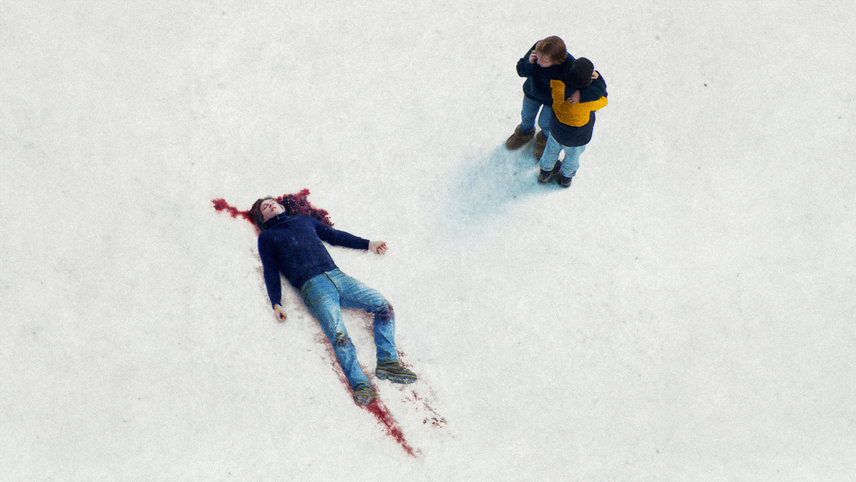
Justine Triet’s Palme d’Or winner is the most intellectually honest courtroom drama in recent memory, and its honesty is precisely what makes it so uncomfortable. Most trial films are designed so that the audience knows more than the jury. They provide privileged access: a flashback, a confession, a detail the prosecution misses. Anatomy of a Fall refuses this access entirely. The audience knows exactly what the jury knows, which is not enough. Sandra Voyter’s husband is dead. He fell from the third floor of their Alpine chalet. It might have been suicide. It might have been murder. The film provides evidence for both readings and declines to endorse either.
Sandra Hüller plays Sandra Voyter, a German-born writer living in France with her French husband Samuel and their visually impaired son Daniel. The marriage is troubled. Samuel is depressed, creatively blocked, resentful of his wife’s literary success. Sandra is ambitious, direct, impatient with Samuel’s self-pity. These facts are established through trial testimony, through a secretly recorded argument of devastating intimacy, and through the quiet observations of eleven-year-old Daniel, who cannot see clearly but who hears everything.
The film’s structure is a slow, meticulous accumulation of detail. The first act establishes the death and its immediate aftermath. The second act, which occupies the majority of the runtime, moves through the trial with a specificity that borders on procedural obsession. Witnesses testify. Experts analyze blood spatter. Audio recordings are played. Arguments are made and rebutted. The pacing is deliberate, and some viewers will find the courtroom sequences repetitive. They are not wrong. The repetition is part of the method. Trials are repetitive. Justice is repetitive. The same facts, rearranged, examined from a different angle, producing a different story each time.
The third act brings Daniel to the witness stand, and the film, which has been operating as an intellectual exercise in ambiguity, suddenly acquires an emotional gravity that changes everything. The boy must decide what he believes about his parents’ marriage, and his decision will determine whether his mother goes to prison. Milo Machado-Graner’s performance in these scenes is among the most remarkable by a child actor in recent European cinema, not because of its technical sophistication but because of its raw, unguarded honesty.
The film is long. At 151 minutes, it tests patience. Certain courtroom exchanges could have been trimmed without losing analytical depth. The absence of a traditional score sometimes leaves scenes without the rhythmic propulsion they need. These are genuine flaws in a film whose ambitions are otherwise fully realized.
Verdict: 9/10. A film that respects the audience enough to deny them certainty. Anatomy of a Fall does not tell you what happened. It shows you how truth is constructed, contested, and ultimately decided by people who were not in the room. It is one of the finest courtroom films ever made, and it leaves you arguing with yourself for days.
2. Hüller, the Boy, and the Art of Being Watched
Sandra Hüller’s 2023 was extraordinary. She delivered two of the year’s most acclaimed performances, in this film and in The Zone of Interest, and the two roles could not be more different. In Glazer’s film, she is a monster of domesticity. In Triet’s, she is a woman whose domesticity is being weaponized against her.
Sandra Voyter is not a sympathetic character in the conventional sense. She is blunt, sometimes cruel, frequently impatient. She does not perform grief the way the court expects. She does not cry on cue. She does not modulate her intelligence to make herself more palatable. Hüller plays these qualities not as character flaws but as character traits, and the distinction is crucial. The prosecution’s case depends on reading Sandra’s temperament as evidence of guilt. The film’s brilliance is that it invites the audience to do the same thing and then makes them aware of what they are doing. You are judging a woman for being difficult. Is that the same as judging her for murder?
The multilingual dimension of Hüller’s performance is itself a structural element. Sandra speaks German natively, communicates with her husband in English (the language in which they raised Daniel as a compromise), and must defend herself in a French court where her imperfect French puts her at a perpetual disadvantage. The language shifts are not ornamental. They are the film’s central metaphor: the impossibility of perfect translation between what happened and what can be said about what happened. Sandra cannot fully express herself in the language of her own trial, and this inadequacy becomes, in the prosecution’s hands, evidence of evasiveness.
Machado-Graner’s Daniel is the film’s moral compass, which is a terrible burden for an eleven-year-old to carry. The performance operates in a register of careful observation: Daniel listens. He processes. He forms conclusions that he does not share until forced. His visual impairment is not a gimmick. It is a narrative condition. He experiences his parents’ marriage primarily through sound, and the film’s use of audio, particularly the recorded argument, mirrors his perceptual world. When Daniel finally takes the stand, the courtroom falls silent, and the silence is the most dramatic moment in the film. His testimony is not about facts. It is about belief, about who he chooses to be loyal to, and his choice is both heartbreaking and pragmatic in equal measure.
Swann Arlaud as Sandra’s defense attorney Vincent provides the film’s warmest presence. His relationship with Sandra is professional but tinged with an old affection that the film wisely never explains fully. Arlaud plays Vincent as a man who believes in his client, and his belief is not sentimental. It is strategic, committed, and occasionally fierce. He is the only person in the film who seems to understand that Sandra’s personality is not relevant to the question of whether she committed murder.
3. Snow, Altitude, and the Camera That Chooses No Side
Simon Beaufils’s cinematography serves the film’s epistemological argument: the camera does not know what happened, and it will not pretend to know. The visual style is observational, almost documentary in its restraint. Handheld shots dominate. The framing is loose, often slightly off-center, as though the camera arrived a moment too late or positioned itself a few degrees from the optimal angle. This imprecision is deliberate. A more polished, more controlled visual style would have imposed a certainty that the narrative refuses.
The Alpine setting provides the film’s visual signature: snow, grey sky, the cold geometry of the mountain chalet. The exteriors are shot in natural light with no augmentation, and the overcast conditions produce an image that is tonally flat, drained of warmth, aesthetically neutral. The landscape does not comment. It does not dramatize. It simply exists as the environment in which a death occurred, and its neutrality mirrors the film’s refusal to guide interpretation.
The courtroom sequences are lit by the fluorescent fixtures of the actual location, and the resulting light is institutional, unforgiving, designed for function rather than atmosphere. Hüller’s face under fluorescent light looks different from her face in the Alpine daylight: harder, more angular, the shadows falling in places that emphasize rather than soften. Whether this makes her look more guilty or more truthful depends entirely on the viewer, which is the point. The cinematography does not adjudicate. It presents.
The most visually significant sequence is not a grand composition but a small, almost throwaway shot: Daniel sitting on the floor with the family dog, Snoop, stroking the animal while listening to his parents’ recorded argument playing on the courtroom speakers. The camera holds on Daniel for what feels like minutes. His face processes the argument in real time. He hears things he was not supposed to hear. The shot is static, the framing simple, and the effect is devastating because the camera has finally found something it is willing to commit to: not a position on guilt or innocence, but a child being damaged by the mechanisms of adult justice.
4. “P.I.M.P.” and Chopin: The Soundtrack of a Collapsing Marriage
Anatomy of a Fall has no original score. The film’s sound world is built from ambient noise, courtroom acoustics, and two pieces of pre-existing music that serve as structural markers for the disintegration of the Voyter marriage.
The first is 50 Cent’s “P.I.M.P.,” which plays during the film’s opening sequence. Sandra is conducting an interview in the chalet when Samuel, upstairs, begins playing the song at punishing volume. The music is aggressive, sexually confrontational, and completely incongruous with the Alpine setting. Sandra’s interview is ruined. The song is Samuel’s weapon: he uses it to intrude upon his wife’s professional life, to assert his presence in a space where she is trying to work. The choice of “P.I.M.P.” is not random. It is a song about control, about ownership, and its presence in the marriage’s domestic architecture turns it into a commentary on the power dynamics that the trial will later dissect.
The second piece is a Chopin piano work that Samuel has been practicing obsessively in the weeks before his death. Daniel plays a simplified version on the piano after his father dies, and the music becomes a thread connecting the boy to his dead father through the only language they shared without complication. The Chopin is tender, technically modest, emotionally direct. It is everything that “P.I.M.P.” is not, and the contrast between the two pieces encodes the film’s portrait of Samuel: a man torn between aggression and vulnerability, between the desire to hurt his wife and the desire to be seen as an artist.
The absence of a conventional score is the film’s most important sonic decision. Courtroom dramas typically use music to cue the audience’s emotional responses: tension during cross-examination, warmth during sympathetic testimony, dread during revelations. Triet strips all of this away. The courtroom sounds like a courtroom: shuffling papers, clearing throats, the acoustics of a large room with hard surfaces. Emotion, when it arrives, comes from the dialogue and the performances, not from a composed soundtrack telling you how to feel. The result is a film that treats its audience as jurors, providing evidence without editorial comment.
5. The Recorded Argument: Marriage as Crime Scene
The wildcard this film demands. At the center of the trial is an audio recording that Sandra’s husband made, without her knowledge, of one of their arguments. The recording is played in court. It lasts several minutes. It is one of the most excruciating sequences in recent cinema, not because of violence but because of intimacy. Two people who once loved each other are shredding each other’s self-worth with the precision of surgeons.
The argument covers everything: professional jealousy, domestic labor, the accident that caused Daniel’s blindness (Samuel was supposed to be watching him), sexual frustration, creative failure, the slow accumulation of resentment that turns a partnership into a siege. Sandra is sharp, articulate, cutting. Samuel is wounded, self-pitying, accusatory. Neither emerges well. Both have legitimate grievances. The argument does not have a winner because arguments between spouses almost never do. It has only damage.
What makes the scene radical is its relationship to the trial. The prosecution presents the recording as evidence of Sandra’s capacity for violence. The defense presents it as evidence of Samuel’s instability. The judge and jury hear the same audio and must decide which reading is correct. The audience, hearing the same audio, must do the same. And the terrible truth is that both readings are supported by the evidence. The argument reveals a woman who is capable of cruelty and a man who is capable of self-destruction, and the question of which capability led to his death is not answered by the recording. It is only complicated.
Triet and Harari wrote the argument as an extended improvisation-feeling scene, and Hüller and Theis perform it with a rawness that makes the fictional frame disappear. You forget you are watching actors. You forget this is a courtroom. You are listening to a marriage in its final, unsalvageable stage, and the experience is so visceral that you want to look away. The courtroom audience in the film has the same reaction: discomfort, voyeurism, the guilt of listening to something that was never meant to be heard.
This sequence is the film’s thesis in miniature. Every marriage contains material that, taken out of context and played before strangers, would sound incriminating. The legal system requires that private life be made public, and the process of making it public distorts it. The recording is true. It is also, inevitably, a distortion. It captures one argument on one day between two people who also loved each other, and it presents that argument as representative. Whether it is representative is the question the trial, and the film, cannot answer.
6. Triet, Harari, and the Amanda Knox Obsession
Justine Triet has spoken openly about the genesis of Anatomy of a Fall. She wanted to make another trial film after her 2016 In Bed with Victoria, and she became fascinated by the Amanda Knox case, in which a young American woman was tried for murder in an Italian court. The Knox case provided the template: a foreign woman tried in a language not her own, judged not merely on evidence but on her demeanor, her personality, her failure to grieve in the culturally expected manner.
Triet and her partner Arthur Harari (they are a couple as well as collaborators) co-wrote the screenplay over an extended period. The writing process was unusual: certain scenes were tightly scripted while others, particularly the marital argument, were given space for the actors to improvise within a structured framework. The combination of precision and freedom gives the film its distinctive texture, in which forensic detail coexists with emotional chaos.
The decision to make Sandra German and the trial French was structural, not cosmetic. The language barrier literalizes the film’s central concern: the gap between experience and expression, between what happened and what can be communicated about what happened. Sandra asks to testify in English because her French is imperfect, and this request becomes a point of contention. The prosecution implies that her preference for English is evasive. The defense argues that it is practical. The audience watches a woman being disadvantaged by the mechanics of communication, and the film asks whether justice is possible when the accused cannot fully speak.
This is Triet’s fourth feature and by far her most ambitious. Her earlier films, Solferino, In Bed with Victoria, and Sibyl, were well-received but operated on a smaller scale. Anatomy of a Fall represents a leap in scope, confidence, and formal ambition that announced Triet as a major voice in European cinema. The Cannes jury, presided over by Ruben Östlund, awarded the Palme d’Or unanimously, which is rare for a prize that typically reflects compromise.
7. Palme d’Or, Oscar, and the Macron Controversy
The film’s awards trajectory was spectacular and politically charged. The Palme d’Or at the 76th Cannes was followed by six César Awards, including Best Film, and five Academy Award nominations, including Best Picture, Best Director, Best Actress, and Best Original Screenplay. The screenplay won the Oscar, giving Triet and Harari the most prestigious English-language award for a script written primarily in French.
The political dimension is impossible to ignore. During her Cannes acceptance speech, Triet criticized French President Emmanuel Macron’s handling of the pension reform protests, a statement that generated controversy and, according to French industry insiders, contributed to France’s Oscar committee choosing to submit The Taste of Things rather than Anatomy of a Fall as the country’s entry for Best International Feature Film. The decision was widely perceived as punitive. The Taste of Things did not receive a nomination. Anatomy of a Fall received five nominations in major categories, making the committee’s choice look both petty and strategically foolish.
The film grossed $36 million worldwide on a budget of €6.2 million, making it one of the most commercially successful foreign-language films of the post-pandemic era. In France, it sold 1.9 million admissions. In the United States, Neon’s release earned $5.1 million, the highest-grossing specialized foreign-language release since the pandemic. The commercial performance confirmed what the awards had suggested: the audience for ambitious, morally complex European cinema is larger than the industry typically assumes.
The critical consensus was near-universal. The film holds a 96% approval rating on Rotten Tomatoes. Anthony Lane, writing in The New Yorker, called it a magnificently slippery thriller. Cahiers du Cinéma ranked it third on its 2023 list. The recurring praise focused on Hüller’s performance, Triet and Harari’s screenplay, and the film’s structural refusal to resolve its central ambiguity. The rare criticisms addressed pacing in the courtroom sequences and an occasional flatness in the visual presentation, both of which are fair observations about a film whose power is more literary than cinematic.
8. French Justice, Foreign Eyes: The Courtroom as Translation Problem
The French legal system operates differently from the Anglo-American model, and Anatomy of a Fall takes pains to show these differences without explaining them didactically. There is no jury sequestration. The judges participate actively in questioning. Expert witnesses are court-appointed rather than hired by the parties. The tone is less adversarial and more inquisitorial, and Triet films the proceedings with the specificity of someone who researched the system thoroughly and trusts the audience to absorb its mechanics through observation.
The most significant procedural difference is the role of the presiding judge, who functions not as a neutral referee but as an active investigator. The judge asks questions. The judge redirects testimony. The judge maintains a level of control over the narrative that would be unusual in an American courtroom. Anne Rotger plays the judge with a severity and precision that anchors the courtroom sequences, and her occasional interventions serve as reminders that the trial is not a contest between two lawyers. It is a state investigation into a death.
Sandra’s foreignness within this system is the film’s quiet engine. She is German, living in France, married to a Frenchman, raising a French child, working in English. She belongs fully to no linguistic community. Her intelligence, which in her own language would be an asset, becomes a liability in French because it reads as coldness, as calculation, as the wrong kind of competence. The prosecution does not say “she is guilty because she is foreign.” It does not need to. The foreignness operates beneath the surface of every exchange, shaping perceptions that no one acknowledges and everyone acts upon.
Triet draws on the Knox case explicitly here. Knox was convicted in Italy partly because her behavior after her roommate’s murder did not conform to Italian expectations of grief. She did yoga. She kissed her boyfriend. She seemed insufficiently devastated. Anatomy of a Fall poses the same question: what happens when the accused grieves in the wrong cultural register? Sandra does not weep. She does not collapse. She maintains composure. And the courtroom reads this composure as evidence, not of innocence, but of capacity.
9. The Dog, the Child, and What Cinema Owes to Snoop
The Palm Dog Award, given annually at Cannes for the best canine performance, went to Messi, the border collie who plays Snoop in Anatomy of a Fall. The award is lighthearted. The performance is not.
Snoop is Daniel’s guide through a world he cannot fully see, and the dog’s presence in nearly every scene involving the boy creates a visual language of dependency and trust. When Daniel tests whether Snoop would react to his father’s death by feeding the dog aspirin to simulate unconsciousness, the scene is the film’s most morally complex moment from a child’s perspective. Daniel is not being cruel. He is conducting an experiment, trying to determine whether his mother is telling the truth, and the experiment requires him to risk the life of the being he trusts most.
The dog functions as the film’s only truly innocent character. Snoop did not kill anyone. Snoop did not lie. Snoop was present at the death and cannot testify. In a film about the inadequacy of language to capture truth, the mute witness is the one who knows the most and can say the least. Triet frames Snoop repeatedly in compositions that place the dog at the center of the family triangle, and Messi’s performance (trained rather than directed, but responsive and present in every scene) gives the film an emotional anchor that the human characters, with their ambiguities and defensive postures, cannot provide.
10. What You Decide on Second Viewing
Anatomy of a Fall changes on rewatch because you change. The question the first time is what happened. The question the second time is why you believe what you believe.
Watch Sandra’s face during the recorded argument. In the courtroom, when the audio plays, the camera stays on Hüller. Her expression is not defensive. It is not guilty. It is the face of a woman hearing her worst moments replayed for strangers, and the emotion is shame, not fear. On second viewing, this distinction reshapes the scene entirely.
Track the prosecution’s rhetorical strategy. Antoine Reinartz’s prosecutor builds his case not on physical evidence, which is ambiguous, but on character assassination. He presents Sandra as ambitious, sexually liberated, and insufficiently deferential to her husband. On first viewing, these feel like relevant facts. On second viewing, they feel like misogyny disguised as procedure.
Listen to what Daniel does not say. His testimony is composed of careful selections. He tells the court what he believes, not what he knows, and the gap between belief and knowledge is where the film lives. On rewatch, trace the moments where Daniel could have said more and chose not to, and ask yourself what his silence is protecting.
Notice the geography of the chalet. The third-floor balcony, the angle of the fall, the blood spatter on the shed: these physical details are presented and analyzed but never resolved into a single coherent narrative. On second viewing, try to reconstruct the fall yourself. You will find, as the investigators did, that the evidence supports multiple scenarios, and no amount of looking will make one scenario more true than another.
Revisit the final scene. Sandra lies on the bed with Snoop. The trial is over. She is acquitted. The camera holds. Is she relieved? Is she grieving? Is she guilty? The film will not tell you. It trusts you to sit with not knowing, which is the hardest thing any film can ask of its audience.
Film Trivia
Triet was inspired by Amanda Knox. In interviews, Triet cited the Knox case as a formative influence: a foreign woman tried in a country not her own, judged on her personality as much as on evidence. The parallel informed every dimension of the screenplay, from Sandra’s nationality to the language dynamics of the trial.
France’s Oscar committee snubbed the film politically. After Triet criticized President Macron during her Cannes acceptance speech, France’s Oscar committee chose The Taste of Things over Anatomy of a Fall as its Best International Feature Film submission. Insiders described the decision as punitive. The Taste of Things was not nominated. Anatomy of a Fall received five nominations and won Best Original Screenplay.
The dog won its own Cannes prize. Messi the border collie received the Palm Dog Award at Cannes, a semi-official prize given annually for the best canine performance. The award is humorous in conception, but Messi’s work in the film is substantial: the dog appears in dozens of scenes and provides the film’s emotional baseline.
The argument was partly improvised. Triet gave Hüller and Samuel Theis a structured framework for the recorded argument scene but allowed significant room for improvisation within it. The rawness of the exchange, which many viewers describe as almost unwatchable in its intimacy, comes from the actors’ willingness to inhabit the conflict without the safety net of a fully scripted scene.
Hüller released two career-defining performances in one year. Sandra Hüller appeared in both Anatomy of a Fall and The Zone of Interest in 2023, delivering radically different performances in each. She has stated that filming the two roles in close succession was exhausting but that the contrast between them, one a woman under unjust scrutiny, the other a woman avoiding all scrutiny, clarified something for her about what acting can explore.
This entry selects analytical dimensions from a pool. The five anchors are present: critical verdict, performances, visual craft, reception and legacy, and rewatchability guide. Earned sections cover the compiled soundtrack, the director’s body of work, and the French legal system as a narrative device. One wildcard section, “The Recorded Argument: Marriage as Crime Scene,” examines the film’s most devastating sequence as a thesis about the distortion inherent in making private life public. A second earned section addresses Snoop the dog as a structural and emotional element. Sections on production history and cultural context beyond the courtroom are omitted: the production was straightforward, and the film’s cultural argument is fully contained within its legal framework.


Leave a Reply