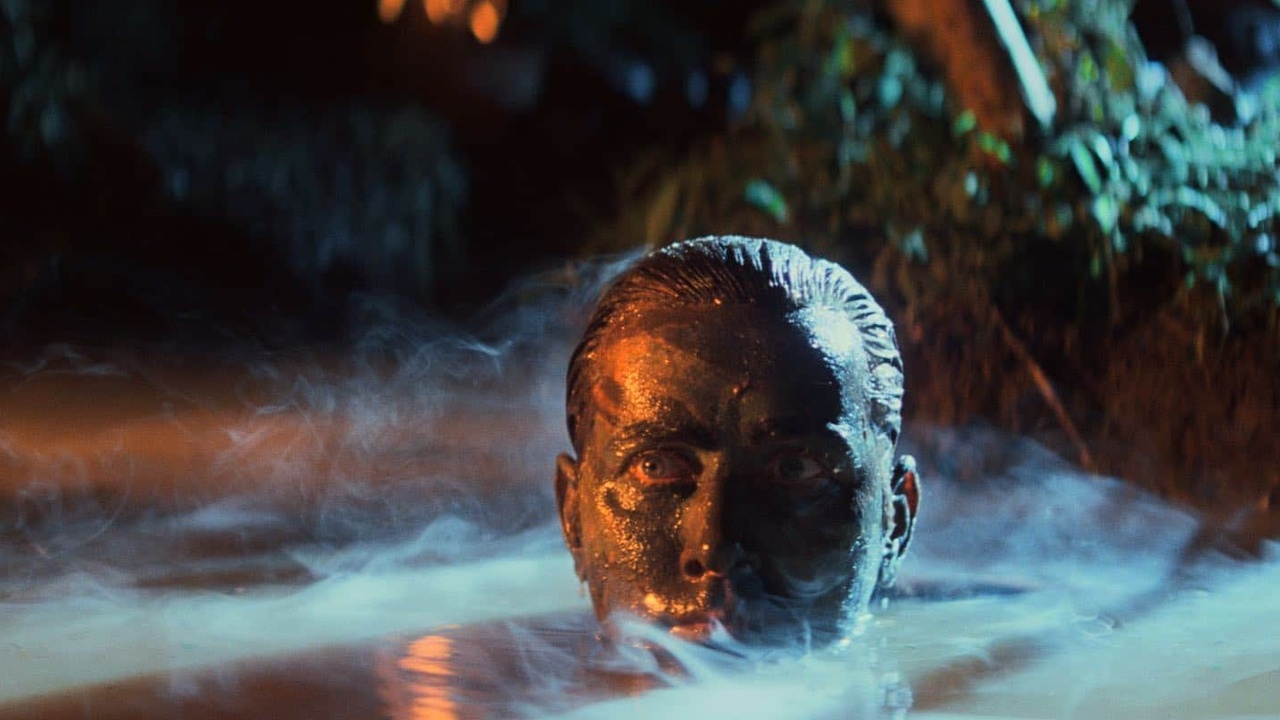
Director: Francis Ford Coppola · Cinematographer: Vittorio Storaro · Composer: Carmine Coppola, Francis Ford Coppola · Production Design: Dean Tavoularis · Key Cast: Martin Sheen, Marlon Brando, Robert Duvall, Frederic Forrest, Albert Hall, Sam Bottoms, Laurence Fishburne, Dennis Hopper · Runtime: 147 min (Theatrical) / 202 min (Redux) / 182 min (Final Cut) · Studio: Zoetrope Studios / United Artists · Budget: $31.5 million · Box Office: $150 million worldwide
1. A War Film That Became Its Own War
Apocalypse Now is not a film about the Vietnam War. It is a film about what happens to the human mind when civilization’s rules are stripped away and nothing remains but instinct, violence, and the terrifying freedom of moral emptiness. The Vietnam setting provides the geography. The war provides the pretext. But what Coppola actually made is closer to a fever dream than a combat film: a river journey into the darkest recesses of American mythology, where the line between savior and savage dissolves in the jungle heat.
The ambition is staggering. Starting from John Milius’s screenplay, loosely adapted from Joseph Conrad’s Heart of Darkness, Coppola built something that refuses the conventions of every genre it inhabits. It is not a war film in the way that Platoon or Full Metal Jacket are war films: there is no platoon to care about, no basic training arc, no clear moral framework. It is not a literary adaptation in any faithful sense: Conrad’s nineteenth-century Congo becomes Vietnam-era Cambodia, and the ivory trader becomes a rogue Special Forces colonel. It is not a psychological thriller, though it contains one of cinema’s most unnerving descents into madness. It is, instead, all of these things and none of them, a film that creates its own category and lives there alone.
The weaknesses are real. The Kurtz compound sequence, which should be the film’s culmination, is its least controlled passage. Brando’s improvisations, filmed in shadow to disguise his physical condition, oscillate between genuinely unsettling and frustratingly opaque. The philosophical monologues sometimes reach for profundity and grasp only abstraction. And the film’s treatment of Vietnamese and Cambodian people as backdrop, landscape, or spectacle is a problem that the decades have not softened.
But the greatness overwhelms the criticisms. Vittorio Storaro’s cinematography is among the finest ever committed to celluloid. Walter Murch’s sound design redefined what cinema could do with audio. The river journey, as a structural and emotional device, produces an accumulating dread that no conventional narrative could match. And the production itself, a 238-day ordeal of typhoons, heart attacks, and financial ruin, became the film’s dark twin: Coppola went up his own river, and what he brought back changed cinema.
Verdict: 10/10. An imperfect masterpiece, which is the only kind of masterpiece that a film this ambitious could be.
2. The River as Spine: A Structure Built on Current
The genius of Apocalypse Now’s structure is its simplicity. Captain Willard (Martin Sheen) travels up a river on a patrol boat. He has a mission: find and kill Colonel Kurtz. Everything that happens between Saigon and Kurtz’s compound is an episode, a station of the cross, and the episodes grow progressively stranger, more violent, and more disconnected from anything recognizable as military order.
This structure, borrowed from Conrad but transformed by Milius and Coppola, does something that no conventional three-act screenplay could. It eliminates the need for plot. There are no reversals, no subplots, no love interest, no ticking clock in the traditional sense. There is only the river, and the river only flows one direction. Each stop along the journey (Kilgore’s beach assault, the USO show, the Do Lung Bridge, the Montagnard outpost) is self-contained but also cumulative: each episode peels away another layer of institutional sanity, so that by the time Willard reaches Kurtz, both he and the audience have been so thoroughly disoriented that Kurtz’s madness begins to feel less like insanity and more like an honest response to an insane situation.
The river also provides the film’s visual logic. Storaro and Coppola use the journey upstream as a journey into darkness, both literal and figurative. The early sequences are brightly lit, almost garish in their Technicolor excess (the helicopter attack, the beach party). The middle sequences dim into twilight, fog, and smoke. The Kurtz compound is almost entirely in shadow. This chromatic arc, from light to dark, is the film’s visual argument made manifest: the further you travel from civilization, the less you can see, and the less there is to see that you would want to.
3. Storaro’s Inferno: Painting War with Light and Shadow
Vittorio Storaro’s cinematography on Apocalypse Now won the Academy Award, and it deserved more than that. It is, alongside his work on The Conformist, the most fully realized expression of his philosophy that cinematography is “writing with light,” and the film’s visual language is so complete that you could watch it without sound and still understand its argument.
Storaro’s approach was governed by a theory he has discussed extensively: the conflict between natural and artificial light as a metaphor for the conflict between nature and civilization. In the early sequences, the lighting is harsh, artificial, military. Fluorescent tubes in the briefing room. Spotlights on the helicopter assault. Stage lights at the USO show. This is the light of American technological supremacy, the light that illuminates and controls. As the patrol boat moves deeper into the jungle, the artificial light sources disappear and are replaced by firelight, moonlight, and the green-filtered glow of vegetation. By the time Willard reaches Kurtz, the only light sources are candles and the ambient glow of the jungle itself. The technology has been stripped away. What remains is primal.
The helicopter assault sequence is the film’s most visually spectacular set piece, and Storaro shot it with a combination of technical precision and controlled recklessness that reflects the scene’s content. Real napalm was detonated, producing heat that the crew could feel from hundreds of meters away. The helicopters were flown by Filipino military pilots who were simultaneously on call for actual combat operations against insurgents. Storaro placed himself in danger repeatedly to capture compositions that treat warfare as simultaneously horrifying and beautiful, and that tension, the aesthetic seductiveness of destruction, is one of the film’s central and most uncomfortable themes.
The Kurtz compound is Storaro’s masterwork within the masterwork. Brando was filmed almost entirely in fragmented light: half his face illuminated, the other half lost in darkness. This was partly a practical solution (Brando had arrived significantly overweight, and Coppola needed to minimize full-body shots), but Storaro transformed the limitation into a visual thesis. Kurtz is a man split between two worlds. He is half-visible. Half-knowable. The lighting tells you this before Brando speaks a single word.
4. Sheen, Duvall, Brando: Three Performances, Three Americas
The performances in Apocalypse Now exist on different registers that correspond to different phases of the American experience in Vietnam: the institutional, the operational, and the post-rational.
Martin Sheen’s Willard is the institutional man, the soldier who functions within the system even as he recognizes its absurdity. Sheen plays him as someone who has been hollowed out by prior tours of duty. The narration (written by Michael Herr, whose book Dispatches is the definitive literary account of the war) gives Willard a wry, dissociated intelligence, but Sheen’s physical performance tells a different story: this is a man operating on depleted reserves, going through the motions of military competence while something inside has already broken. The hotel room scene that opens the film, in which Willard, drunk and despairing, punches a mirror and bleeds across the frame, was partially unscripted. Sheen was genuinely intoxicated, and the blood was real. The scene stayed in the film because it captured something that performance alone could not: the authentic texture of a man coming apart.
Robert Duvall’s Lieutenant Colonel Kilgore is the film’s most famous supporting performance, and his brief screen time (roughly fifteen minutes) has produced some of cinema’s most quoted dialogue. Duvall plays Kilgore not as a villain but as a true believer: a man for whom war is not a moral problem but a lifestyle, an aesthetic experience. He surfs during combat. He plays Wagner from helicopter speakers. He speaks of napalm with sensory nostalgia. Duvall’s genius is in making Kilgore likeable. The character is insane by any reasonable standard, but Duvall’s charisma, his physical ease, his evident joy in the role, make the audience complicit in his worldview for the duration of his scenes. When you laugh at Kilgore, you are laughing with the war machine. That is the point.
Marlon Brando’s Kurtz is the most debated element of the film, and the debate is warranted. Brando arrived in the Philippines unprepared, overweight, and uninterested in Coppola’s conception of the character. Production shut down for a week while director and star negotiated what the role would be. What emerged is a performance delivered almost entirely in close-up, in shadow, in fragments. Brando mumbles, whispers, free-associates. He recites T.S. Eliot. He tells a story about a snail crawling along the edge of a razor. Some of this is genuinely chilling. Some of it is self-indulgent. All of it is impossible to ignore. Whether Brando’s Kurtz is a great performance or a great accident is a question the film leaves deliberately unanswered, because the ambiguity serves Kurtz’s function in the narrative: he is meant to be unknowable.
5. Walter Murch and the Sound of Madness
The sound design of Apocalypse Now, supervised by Walter Murch, is as revolutionary as its cinematography, and in some ways more influential. Murch essentially invented modern sound design with this film, and his techniques have been replicated in virtually every major production since.
The opening sequence is the definitive example. Jim Morrison’s voice singing “The End” is layered over the sound of helicopter rotors, which blend into the whir of a ceiling fan in Willard’s hotel room. The rotors never fully disappear. They pulse beneath the music, beneath the dialogue, beneath the ambient sound of Saigon, creating a persistent aural drone that functions as Willard’s psychological state made audible. He is always at war. Even in his hotel room, the war is inside him, and the sound tells you this through a technique that no prior film had attempted with such sophistication.
Murch developed the concept of “worldizing,” in which pre-recorded sound is played through speakers in real environments and re-recorded, capturing the acoustic properties of the space. This gives the film’s sound a textural realism that purely studio-mixed audio cannot achieve. The jungle sounds are not generic tropical ambience. They are layered, specific, three-dimensional: insects at different distances, water against different surfaces, vegetation rustling at different heights. The cumulative effect is immersive in a way that approaches physical discomfort. The jungle does not recede into background. It presses in.
The helicopter attack sequence uses Murch’s directional mixing to place the audience inside the assault. Wagner’s “Ride of the Valkyries” does not simply play over the action. It emanates from the helicopters’ speakers, which means its volume and spatial position shift as the helicopters move through the frame. The Vietnamese villagers hear it approaching before they see the machines. The music is a weapon. Murch’s mix makes the audience experience it as such.
6. Conrad’s Ghost: Heart of Darkness as Structural Skeleton
Apocalypse Now is not a faithful adaptation of Heart of Darkness. It is something more interesting: a recontextualization that uses Conrad’s structure while replacing his politics with an entirely different set of anxieties.
Conrad’s 1899 novella concerns a steamboat captain named Marlow who travels up the Congo River to retrieve a Belgian ivory trader named Kurtz who has “gone native.” The novella is, depending on who reads it, either a critique of European colonialism or a deeply racist text that reduces Africa to a metaphor for European psychological darkness. Both readings have merit, and the tension between them has fueled decades of critical argument, most famously in Chinua Achebe’s 1977 essay accusing Conrad of dehumanizing Africa.
Coppola and Milius kept Conrad’s structure (the river journey, the escalating encounters, the final confrontation with a man who has crossed the line) but replaced the colonial context with America’s Vietnam-era crisis of self-image. Kurtz is no longer a trader. He is a soldier, the best and brightest of the American military, who has followed the logic of the war to its conclusion and discovered that the conclusion is barbarism. His “method” (his willingness to commit atrocities without moral hesitation) is presented not as madness but as a more honest version of what the entire American military is already doing with greater hypocrisy and less efficiency. The horror, the horror is not Kurtz’s discovery of savagery in the other. It is his discovery of savagery in himself, and in the civilization that produced him.
This reframing is the film’s most daring intellectual move, and it explains why the U.S. military refused to cooperate with the production. Apocalypse Now does not argue that war is hell. It argues that the American way of war is a form of organized insanity, and that the most sane response to organized insanity might be to go insane on your own terms. That is Kurtz’s position. The film does not endorse it, but it refuses to dismiss it.
7. 238 Days in the Jungle: The Production That Mirrored Its Subject
The production of Apocalypse Now is the most notorious in cinema history, and it deserves its own section not as gossip but because the making of the film is inseparable from its meaning. Coppola went into the Philippine jungle to make a movie about a man who goes into the jungle and loses his mind. Coppola went into the Philippine jungle and lost his mind. The parallel is not incidental. It is the film’s deepest layer.
The shoot was planned for five months. It lasted 238 days. The budget ballooned from $12 million to over $31 million, most of it Coppola’s own money. He mortgaged his house, his vineyards, and his future earnings. If the film failed, he would be financially destroyed.
The disasters accumulated with an almost literary symmetry. Harvey Keitel was fired after two weeks and replaced by Sheen. Typhoon Olga destroyed the sets two months into filming, shutting down production for three months. Military helicopters loaned by President Ferdinand Marcos were periodically recalled to fight actual communist insurgents, leaving Coppola stranded mid-scene. Sheen, thirty-six years old and drinking heavily, suffered a near-fatal heart attack and had to crawl a quarter of a mile to find help. He claimed it was heat stroke to avoid shutting down the production. His brother Joe Estevez doubled for him in rear-angle shots for six weeks. Dennis Hopper was reportedly under the influence throughout his time on set. And Brando arrived overweight, unprepared, and unwilling to follow the script, forcing Coppola to shut down production for a week to reconceive the entire final act.
Coppola himself was not exempt. He suffered an epileptic seizure on set. He threatened suicide multiple times, according to his wife Eleanor, who was filming the documentary Hearts of Darkness: A Filmmaker’s Apocalypse throughout the production. He could not view his footage on location because there were no processing facilities in the Philippines; he was shooting the entire film blind.
The result was over a million feet of exposed film, roughly ninety times what a finished two-hour movie requires. Post-production took three years. The film premiered, unfinished, at Cannes in May 1979, where Coppola told the press: “We were in the jungle, there were too many of us, we had access to too much money, too much equipment, and little by little we went insane.”
8. Three Films, One River: Theatrical, Redux, and Final Cut
Apocalypse Now exists in three official versions, and the choice between them is not trivial. Each produces a meaningfully different experience.
The 1979 theatrical cut (147 minutes) is the tightest and most propulsive. It moves with the relentless forward momentum of the river itself, and its compression serves the film’s hallucinatory quality: events arrive and disappear before you can fully process them, which mirrors Willard’s drugged, dissociated consciousness. The theatrical cut is the version that won the Palme d’Or and the version that established the film’s reputation. For most viewers, it is the best starting point.
Apocalypse Now Redux (2001) restores 49 minutes of footage, including the extended French plantation sequence, additional scenes at the Playboy Bunny stop, and various expansions of existing scenes. The French plantation is the most significant addition: a long, wine-soaked dinner scene in which a French colonial family, still living in Vietnam decades after Dien Bien Phu, debates the war’s meaning with Willard. It is well-acted and historically interesting, but it arrests the film’s forward momentum at precisely the point where the audience needs the journey to accelerate. Redux is best understood as a scholarly companion: valuable for understanding Coppola’s complete vision, but dramatically inferior to the theatrical cut.
The Final Cut (2019), at 182 minutes, represents Coppola’s definitive version. It retains the French plantation scene but trims it, restores some Redux material and cuts other additions, and benefits from a full 4K restoration with Dolby Atmos sound. It is the most balanced version: more expansive than the theatrical cut without Redux’s self-indulgence. If you can only watch one version, the Final Cut is the recommendation.
9. Napalm, Wagner, and the Aesthetics of Annihilation
There is a question at the center of Apocalypse Now that the film poses but deliberately refuses to answer: is it possible to make an anti-war film that is also, at the level of spectacle, thrilling?
The helicopter assault sequence is the crux of this problem. It is one of the most exciting action sequences ever filmed. The Valkyries blare. The helicopters descend in formation. The napalm erupts in orange-black mushroom clouds. The camera swoops and glides with a balletic grace that makes destruction look choreographed, purposeful, beautiful. And Kilgore, who orchestrates the attack as though it were a surfing expedition interrupted by minor inconveniences (enemy fire, civilian casualties), is irresistible company. The audience does not want to leave him. The audience, for the duration of this sequence, wants to be on his helicopter, feeling the wind, hearing the music, watching the world burn.
This is the sequence that François Truffaut might have had in mind when he famously suggested that every film about war ends up being pro-war, because cinema cannot help but make violence exciting. Coppola is acutely aware of this paradox, and his solution is not to make the violence less exciting but to make the audience’s excitement the subject. The helicopter sequence seduces you. The rest of the film punishes you for having been seduced. Each subsequent episode is grimmer, stranger, more morally dislocating, and part of what creates that escalating discomfort is the memory of how good the violence felt during the Kilgore scene. You carry your own complicity downstream.
Storaro’s cinematography is central to this strategy. He photographs the napalm strikes with the same compositional care that a landscape painter would bring to a sunset. The explosions are framed to maximize their aesthetic impact. The result is images of extraordinary beauty that depict extraordinary destruction, and the gap between the beauty and the destruction is the film’s moral chasm.
10. The Darkness We Brought With Us: Reception and Legacy
Apocalypse Now premiered at Cannes in May 1979 in an unfinished state and shared the Palme d’Or with The Tin Drum. Initial critical response was divided in a way that now seems almost quaint: reviewers who praised the film’s visual and auditory achievement often questioned whether Coppola had found an adequate intellectual framework for his spectacle. The Kurtz sequences, in particular, were seen as a letdown after the river journey’s accumulating power.
Time has been generous to the film, and the initial criticisms have largely been absorbed into the film’s mythology rather than sustained as active objections. Apocalypse Now is now routinely cited among the greatest films ever made, and its influence extends far beyond the war genre. The visual grammar of the helicopter assault has been replicated in countless action films. Murch’s sound design became the template for immersive cinema audio. Storaro’s use of light and darkness as moral vocabulary has influenced cinematographers across every genre. Even the production’s notoriety has become a kind of secondary text: Hearts of Darkness may be the greatest making-of documentary ever produced, and its footage has permanently altered how audiences understand the relationship between artistic ambition and personal destruction.
The film was nominated for eight Academy Awards and won two: Best Cinematography (Storaro) and Best Sound (Murch and his team). The failure to win Best Picture (it lost to Kramer vs. Kramer) is now considered one of the Academy’s most conspicuous misjudgments. The film was selected for preservation in the National Film Registry in 2000.
11. Up the River Again: A Rewatch Guide
Apocalypse Now is one of those rare films that changes fundamentally on second viewing, not because you notice hidden details but because you arrive at it differently. The first viewing is an assault. The second is an education.
Watch Willard’s face during the Kilgore sequence. On first viewing, Duvall’s performance dominates every scene he appears in. On second viewing, track Sheen instead. Willard watches Kilgore with a mixture of fascination and contempt that prefigures his response to Kurtz. The film is telling you that Kilgore and Kurtz are two versions of the same phenomenon. Willard sees this before the audience does.
Listen to what the river sounds like. Murch’s sound design evolves as the boat moves upstream. The early sequences have the ambient noise of a functioning military infrastructure: radio chatter, engines, distant artillery. By the time the boat reaches the Do Lung Bridge, the ambient sound is dominated by insects, water, and human screaming. At Kurtz’s compound, even the insects have quieted. Track this progression consciously, and the film’s aural architecture becomes visible.
The Do Lung Bridge as turning point. This brief, hallucinatory sequence (soldiers fighting without officers, no one knowing who is in command, a man firing a grenade launcher into the darkness) is the film’s structural hinge. Everything before it is recognizable as war. Everything after it is something else. On second viewing, notice how the visual and auditory textures shift permanently after this scene.
Kurtz’s monologues as echoes. Brando’s fragmented speeches are easy to dismiss as rambling on first viewing. On second, listen for the specific references: T.S. Eliot’s “The Hollow Men,” the story about the inoculated children whose arms were hacked off by the Viet Cong, the razor and the snail. Each monologue is addressing a specific philosophical problem about the relationship between morality and effectiveness. Whether Brando solves these problems is debatable. That he identifies them precisely is not.
The ending, all three times. Watch the theatrical cut’s ending first (Willard kills Kurtz, takes the boat downstream). Then watch Redux’s ending (originally, the end credits played over footage of the compound being bombed). Then the Final Cut. Each ending produces a different moral conclusion, and the differences reveal how uncertain Coppola remained about what his own film meant.
Film Trivia
The opening scene was real chaos. Martin Sheen was genuinely intoxicated during the filming of Willard’s hotel room breakdown, shot on his thirty-sixth birthday. The blood from the mirror was real. Sheen later said he needed to “exorcize” something personal through the scene. Coppola kept the cameras rolling, and the footage became one of the most visceral openings in cinema history.
A fourteen-year-old lied his way into the jungle. Laurence Fishburne was only fourteen when he was cast as the seventeen-year-old crew member “Clean,” having lied about his age to secure the role. The production lasted so long that Fishburne was eighteen by the time the film was released. He essentially grew up on the set of one of the most chaotic productions in Hollywood history.
Real cadavers on set. During filming at Kurtz’s compound, rumors circulated that some of the “prop” corpses were real human remains. Producer Gray Frederickson investigated and discovered that a local prop supplier had been sourcing actual cadavers, reportedly from a grave robber rather than a medical facility. The discovery triggered a police investigation, and crew passports were temporarily confiscated.
Brando’s shadow was born from necessity. Colonel Kurtz was written as a lean Special Forces warrior. Brando arrived in the Philippines significantly overweight and having neither read the script nor Conrad’s novella. Coppola shut down production for a week to reconceive the character, and Storaro’s decision to film Brando almost entirely in shadow and fragmented close-ups transformed a logistical problem into one of cinema’s most iconic visual choices.
Coppola’s pasta, flown from Italy. While the production hemorrhaged money and the crew traveled to Manila to shower, Coppola coped with his mounting despair through culinary extravagance. He had pasta imported from Italy and, for his thirty-seventh birthday, arranged for an entire plane of hot dogs to be flown in from San Francisco. The disconnect between the director’s indulgences and the crew’s hardships mirrored, with uncomfortable precision, the film’s own critique of American excess abroad.
This entry selects analytical dimensions from a pool. All five anchors are present: critical verdict, performances, visual craft, reception and legacy, and the rewatchability guide. Earned sections cover the adaptation from Heart of Darkness, the production history (which is inseparable from the film’s meaning), the sound design (Walter Murch’s revolutionary contribution deserves its own section), and the three official versions of the film. Two wildcard sections address dimensions unique to Apocalypse Now: the river as structural principle, replacing conventional plot with geographic and psychological current, and the aesthetics of annihilation, examining the film’s deliberate use of visual beauty to implicate the audience in the seductiveness of violence.

Leave a Reply