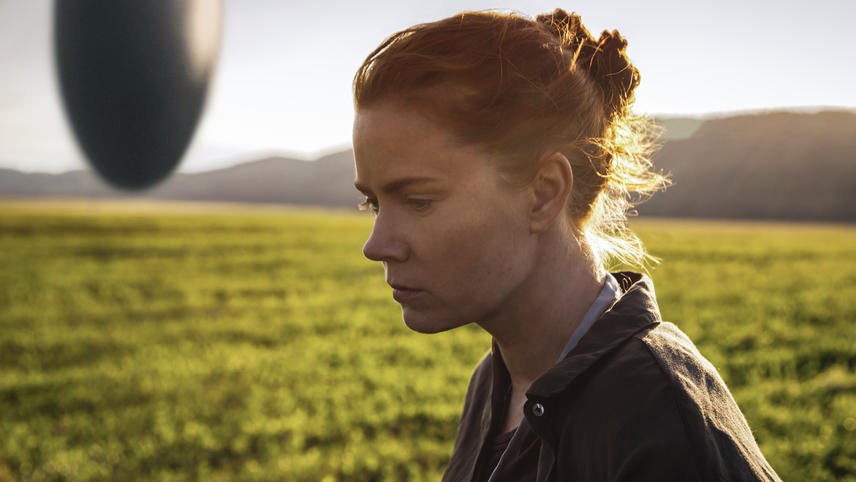
Director: Denis Villeneuve · Cinematographer: Bradford Young · Composer: Jóhann Jóhannsson · Production Design: Patrice Vermette · Key Cast: Amy Adams, Jeremy Renner, Forest Whitaker, Michael Stuhlbarg · Runtime: 116 minutes · Studio/Distributor: 21 Laps Entertainment / FilmNation Entertainment (Paramount Pictures) · Budget: $47 million · Box Office: $203 million worldwide
Arrival: The Science Fiction Film Where the Weapon Is a Word
Most science fiction films about alien contact are really about explosions. The aliens arrive. Humanity responds with fear and firepower. The resolution involves either defeating the invaders or learning that they come in peace, but the learning happens through spectacle rather than dialogue. Arrival does something genuinely radical. It takes the act of communication itself and makes it the entire drama. The aliens are here. They are trying to tell us something. The question is not whether we can fight them but whether we can understand them, and whether understanding them will change us in ways we cannot undo.
Louise Banks is a linguistics professor recruited by the military to decode the language of twelve extraterrestrial ships that have appeared at seemingly random locations around the world. She enters one of the ships, encounters two heptapod aliens, and begins the painstaking work of building a shared vocabulary from nothing. Meanwhile, the world’s governments are losing patience. China and Russia prepare military responses. The clock is running out on diplomacy. The film’s tension does not come from alien aggression. It comes from human impatience, from the inability of nations to coordinate, from the fragility of cooperation under pressure.
Running beneath this geopolitical thriller is a story about a mother and her daughter. The film opens with what appears to be a montage of Louise’s memories: her daughter’s birth, childhood, illness, and death. The montage is tender and devastating, and it frames everything that follows as the experience of a woman carrying grief. The film allows you to believe this reading for nearly its entire runtime. Then, in its final act, it reveals that these are not memories. They are visions. Louise’s encounter with the alien language is rewiring her perception of time. She is not remembering her daughter. She is seeing her daughter’s future, a future that has not happened yet, a future she will choose to live despite knowing how it ends.
The structural elegance is breathtaking. The film’s central formal trick is also its central philosophical argument: if you could see your entire life at once, would you still choose to live it? Louise’s answer is yes. She chooses the daughter she will lose. She chooses the love that will dissolve. She chooses grief as the price of joy, and she pays it in advance.
Verdict: 9/10. Arrival is one of the most intellectually ambitious and emotionally devastating science fiction films ever made. Its central conceit is executed with an elegance that rewards both first-time viewers and repeat visitors. The military subplot occasionally lapses into generic thriller mechanics, and Jeremy Renner’s Ian is somewhat underwritten. But Amy Adams delivers a performance that deserved the Academy Award it was inexplicably denied, and the film’s final revelation transforms everything that preceded it into something richer and sadder and more beautiful.
The Memory That Isn’t a Memory: How Arrival Hides Its Meaning in Plain Sight
The film’s greatest achievement is structural, and it depends on exploiting the audience’s deepest assumption about how stories work.
When we see images of a woman with her daughter, we assume we are watching the past. Every narrative convention supports this reading. Opening montages establish backstory. A mother’s grief motivates her present actions. The daughter’s death explains Louise’s isolation, her melancholy, her willingness to take a dangerous assignment. The audience files the montage under “sad backstory” and moves on.
This is the trap. The opening images are not memories. They are flash-forwards. Louise is not a woman haunted by the daughter she lost. She is a woman being shown the daughter she has not yet had, the daughter she will have with Ian, the daughter who will die of a rare disease in her twenties. The alien language does not merely communicate information. It restructures the consciousness of anyone who learns it. Louise is not receiving messages from the heptapods. She is learning to perceive time the way they do: all at once, past and future equally present, equally real.
The reveal reframes every scene. Louise’s apparent grief at the beginning becomes anticipatory grief, the sorrow of someone who has already seen the loss that awaits her. Her growing urgency in the translation sessions is not merely professional diligence; it is the response of someone whose consciousness is fracturing under the weight of seeing two timelines simultaneously. The moments with her daughter that felt like wistful recollection become acts of preemptive love, each one chosen with full knowledge that they will end.
Eric Heisserer’s screenplay accomplishes this without a single line of deceptive narration. Nothing Louise says or does is false. The film simply withholds context and lets the audience’s narrative conditioning do the rest. When the truth arrives, you realize you were never lied to. You were just reading the images in the only order your mind knew how to arrange them. The film’s formal structure is its argument: humans perceive time as linear, and this limitation shapes everything we understand about cause, effect, and choice.
Bradford Young’s Muted Light: Science Fiction Through a Dirty Lens
Denis Villeneuve wanted Arrival to look, in his words, “slightly boring.” He wanted a dirty science fiction film, one rooted in the overcast skies and institutional fluorescence of the real world rather than the sleek visual grammar of Hollywood futurism. He found his collaborator in Bradford Young, a cinematographer known for his work on naturalistic dramas like Selma and A Most Violent Year.
Young’s palette for Arrival is dominated by grays, blues, and muted greens. The Montana landscape where Louise’s ship has landed is cloudy and damp. The military encampment is a collection of identical tents under harsh temporary lighting. The interior of the alien vessel is a dark corridor leading to a wall of fog. There is no visual comfort anywhere in the film. Even the scenes with Louise’s daughter, which might conventionally be bathed in warm, golden light, are shot with a coolness that refuses to sentimentalize them.
The color timing shifts to track Louise’s psychological state. Young deliberately allowed Adams’s skin to look pale and washed out during the sequences of greatest emotional strain. Villeneuve told him not to worry about conventional beauty standards for skin tone, to let Louise exist in a visual space of exhaustion and melancholy. The result is a protagonist who looks like someone who has not slept in days, which she has not.
The approach to the alien ship is the film’s visual masterpiece. Young shoots the approach from below, the ship’s massive dark surface hanging in the fog like a stone ceiling, and the figures walking toward it are tiny, dwarfed, insignificant. The image communicates everything the screenplay needs about the power differential between humanity and whatever is inside. When Louise enters the ship and gravity shifts, Young keeps the camera close to her body, and the disorientation is physical. You feel the ground change under you. The camera does not show you the aliens immediately. It shows you the fog, the glass, the shapes moving behind it. The withholding is more effective than any reveal could be.
Amy Adams and the Face of Someone Learning to See Time Differently
Amy Adams carries Arrival almost entirely through her face. The role does not require physical action, dramatic confrontation, or extended monologue. It requires an actress who can communicate the experience of a mind being quietly, irreversibly altered by an encounter with something beyond human understanding. Adams does this with such subtlety that many viewers do not realize, until the reveal, that they have been watching the performance in the wrong order.
In the early scenes, Adams plays Louise as guarded, professional, and slightly sad. The sadness reads as backstory: she has lost her daughter, and the grief is a low hum beneath her competence. This is the reading the audience is meant to make, and Adams supports it without overplaying. There is no dramatic indication that Louise is experiencing something more complex than grief. She simply moves through her work with the careful attention of someone who has learned to manage pain by staying busy.
As the translation sessions progress and Louise’s exposure to the heptapod language deepens, Adams introduces almost imperceptible shifts. Her gaze lengthens. Her pauses before speaking become fractionally longer, as though she is consulting a second timeline before responding to the first. Her face, in certain moments, registers an emotion that is not quite grief and not quite recognition: it is closer to someone hearing a phrase in a language they did not know they understood.
The final act requires Adams to play a woman who has just learned that the daughter she will have will die, that her marriage will fail, and that she will choose all of it anyway. The choice is made in a series of looks rather than words. Adams does not cry. She does not collapse. She simply decides, and the decision registers as a stillness so complete it feels like the temperature in the room has dropped. That the Academy did not nominate her for Best Actress remains one of the most glaring oversights of the decade.
Jóhannsson’s Last Great Collaboration: Sound as Something Arriving
Jóhann Jóhannsson’s score for Arrival is the last great work of a collaboration that produced three of the finest film scores of the 2010s. His scores for Villeneuve’s Prisoners and Sicario had already demonstrated his ability to create sonic landscapes that function below the threshold of conscious musical recognition. For Arrival, he went further. The score does not sound like music. It sounds like a signal.
The main theme is built on choral textures that Jóhannsson processed and manipulated until the human voices became alien. You can hear that voices are singing. You cannot identify the language or the melody. The effect sits in an uncanny space between the familiar and the incomprehensible, which is precisely the space the film inhabits. The music is the experience of encountering meaning that you cannot yet decode.
Jóhannsson supplements his original compositions with a piece by Max Richter (“On the Nature of Daylight”) that bookends the film. The Richter piece, with its slow, aching string melody, was not part of Jóhannsson’s score; Villeneuve had been using it as temp music and ultimately decided it was irreplaceable. The decision was controversial. Jóhannsson’s own score was ruled ineligible for the Academy Award for Best Original Score partly because of the inclusion of pre-existing music. The loss of an Oscar nomination for one of the year’s finest scores is a small injustice that the film’s reputation has long since outgrown.
The sound design, which won the Oscar for Best Sound Editing, works in concert with the score to blur the line between music and environmental noise. The deep, resonant vibration of the heptapod ship functions simultaneously as a sound effect and a bass tone that anchors Jóhannsson’s choral textures. The heptapods’ vocalizations, which sound like whale song processed through stone, create a sonic environment in which language, music, and ambient sound become indistinguishable. You are hearing communication. Whether it is the aliens speaking, the score scoring, or the sound design designing is a question the film deliberately refuses to answer.
Ted Chiang’s Novella and the Gift of Knowing What You’ll Lose
Ted Chiang’s “Story of Your Life” (1998) is one of the most celebrated works in contemporary science fiction. It is also, by any screenwriting standard, unfilmable. The novella is structured as a second-person address from a mother to her unborn daughter, interleaving the story of first contact with the story of the daughter’s life and death. There is no villain, no military subplot, and no geopolitical tension. The novella is a philosophical meditation on free will, linguistic relativity, and the nature of time, and it unfolds with the quiet rigor of a mathematical proof.
Eric Heisserer’s adaptation had to solve three problems. First, the novella’s second-person narration does not translate to cinema. Second, the absence of external conflict makes for a dramatically inert film. Third, the central conceit, that learning the alien language grants the ability to perceive the future, requires the audience to understand a linguistic theory (the Sapir-Whorf hypothesis) that most viewers have never encountered.
Heisserer’s solutions were shrewd. He replaced the second-person address with the film’s structural misdirection, showing the daughter’s life as apparent memories rather than future visions. He added the military subplot and the geopolitical countdown to provide conventional dramatic momentum. And he dramatized the Sapir-Whorf hypothesis through Louise’s experience rather than her explanation: you watch her consciousness change, and the theory becomes unnecessary to articulate because you have seen it in action.
The adaptation’s boldest choice was to make the gift of the alien language a choice rather than a consequence. In Chiang’s novella, Louise’s foreknowledge is presented as an inevitable result of learning Heptapod B: once you see time non-linearly, you cannot unsee it. The film adds a layer of agency. Louise chooses to have her daughter despite knowing the outcome. The novella asks: what would it mean to know the future? The film asks: would you choose a love you know will end in grief? The second question is more cinematic, more emotional, and more universally devastating.
Language Reshapes Reality: The Film That Took a Linguistic Theory Literally
The Sapir-Whorf hypothesis, in its strong form, proposes that the language you speak determines how you perceive reality. A language with no future tense, for instance, might produce speakers who experience time differently than English speakers do. The hypothesis is controversial among linguists. Most accept a weak version (language influences thought) while rejecting the strong version (language determines thought).
Arrival takes the strong version and makes it literal. The heptapods’ written language, Heptapod B, is non-linear. Their logograms do not progress from beginning to end. Each one is a complete thought, a circle of meaning that contains its entire content simultaneously. Learning to write in Heptapod B requires learning to think in Heptapod B, and thinking in Heptapod B means perceiving time as the heptapods do: all at once, without sequence, without causality as humans understand it.
The film makes this concept accessible by showing rather than explaining. We watch Louise learning to read the logograms. We watch her consciousness shift. We watch the flash-forwards increase in frequency and specificity as her fluency grows. The Sapir-Whorf hypothesis is never named on screen. It does not need to be. The film dramatizes it so effectively that the theoretical framework becomes unnecessary.
What makes this more than a clever premise is its emotional application. The alien language is not a superpower. It is a burden. Seeing the future means seeing everything: the joy and the loss, the love and its dissolution, the daughter and her death. Louise does not gain knowledge. She gains grief, freely chosen and fully anticipated. The linguistic theory becomes the vehicle for the film’s moral argument: that to live fully requires accepting loss as part of the structure of existence, not as an interruption of it.
Close Encounters, Contact, and the Sci-Fi Film That Chooses Conversation Over Combat
Arrival belongs to a small and distinguished tradition of science fiction films that take first contact seriously as a problem of communication rather than a pretext for warfare. Spielberg’s Close Encounters of the Third Kind (1977) showed humanity reaching across the gulf of species through music. Zemeckis’s Contact (1997) followed a scientist who listened for signals and was ridiculed for her patience. Kubrick’s 2001: A Space Odyssey (1968) presented an alien intelligence so vast that communication was impossible, and the encounter could only be experienced, not understood.
Arrival extends this lineage by making the linguist, not the soldier or the scientist, the protagonist. Louise’s expertise is not in physics or weapons systems. It is in the mechanics of meaning: how sounds become words, how words become sentences, how sentences become understanding. The film argues that the most important skill humanity possesses in the face of the unknown is not technological but linguistic. The ability to build a shared vocabulary from nothing is the foundational act of civilization, and it is the act Arrival dramatizes with more care and specificity than any previous science fiction film.
The contrast with the military response is deliberate and pointed. Every time the film cuts from Louise’s patient, incremental translation work to the generals demanding immediate results, the gap between the two approaches becomes more painful. The military wants answers. Louise is building the capacity to ask the right questions. The film’s sympathies are clear, but it does not caricature the military perspective. Forest Whitaker’s Colonel Weber is not a warmonger. He is a responsible officer under enormous pressure, and his impatience is rational given the stakes. The conflict is structural, not personal: the timescale of genuine understanding is incompatible with the timescale of geopolitical crisis.
Villeneuve and Science Fiction: The Director Who Found His Language
Denis Villeneuve has said he was born in science fiction. Raised in rural Quebec, surrounded by snow and emptiness, he spent his childhood reading graphic novels and watching science fiction films. When he became a filmmaker, he channeled that sensibility into thrillers and dramas that operated with a science fiction director’s attention to world-building and atmosphere. Prisoners feels like a dystopian film set in the present. Sicario feels like a war film set in a world whose rules have been subtly altered. The genre was always there, waiting beneath the surface.
Arrival was the first time Villeneuve worked in science fiction directly, and the fit was immediate. His methodical pacing, his attention to environmental detail, his willingness to let scenes breathe without musical or editorial acceleration: all of these tendencies, which sometimes tested audiences in his thriller work, became virtues in a genre that rewards patience and immersion. The slow approach to the alien ship, the long translation sessions, the incremental accumulation of understanding: these are scenes that a faster director would compress and that Villeneuve gives their full duration.
The film launched a sequence of three science fiction projects that redefined Villeneuve’s career: Arrival, Blade Runner 2049, and Dune. Each is larger in scale than the last. Each is more visually ambitious. But Arrival remains the most emotionally concentrated, the one in which the science fiction premise is most intimately connected to a human emotional truth. Blade Runner 2049 asks philosophical questions about consciousness. Dune asks political questions about power and ecology. Arrival asks a personal question about love and loss, and it asks it with a directness that the larger films, for all their grandeur, cannot match.
Eight Oscar Nominations, One Glaring Snub, and a Genre’s Validation
Arrival received eight nominations at the 89th Academy Awards, including Best Picture, Best Director, Best Adapted Screenplay, Best Cinematography, and Best Film Editing. It won one: Best Sound Editing. The recognition was significant. Science fiction films are rarely nominated for Best Picture, and the nomination signaled that the Academy was willing to treat cerebral genre filmmaking with the same seriousness it traditionally reserves for period dramas and prestige biopics.
The notable absence was Amy Adams. Despite nominations from the Golden Globes, BAFTA, SAG, and the Critics’ Choice Awards, Adams was not nominated for the Academy Award for Best Actress. The omission was widely regarded as a mistake, and it remains one of the most discussed snubs of recent Oscar history. Adams’s performance is the film’s emotional anchor, and the absence of recognition from the institution that otherwise nominated the film in seven categories suggests a persistent bias against genre performances that are quiet rather than showy.
Jóhannsson’s score was declared ineligible for the Best Original Score category because of the inclusion of Max Richter’s pre-existing “On the Nature of Daylight.” The ruling was technically correct and aesthetically absurd: Jóhannsson’s original compositions are among the most innovative film music of the decade, and their ineligibility because another piece of music was used in the same film penalized the composer for a decision made in the edit.
The film’s commercial performance was a rare bright spot for adult-oriented science fiction. On a budget of $47 million, Arrival grossed over $203 million worldwide, demonstrating that an audience exists for films that treat their viewers as intelligent. The success gave Villeneuve the credibility and industry trust to take on Blade Runner 2049, which was already in pre-production when Arrival opened. Whether the industry learned the right lesson from Arrival’s success is debatable. What is not debatable is the film’s status as one of the defining science fiction works of the decade.
What the Film Becomes When You Already Know What the Visions Are
Arrival is one of the rare films that is better on second viewing than on first. The first time is a thriller with a twist. The second time is an elegy that happens to contain a thriller.
On your rewatch, watch the opening montage not as memory but as prophecy. Every image of Louise’s daughter is a future she has not yet chosen. The grief on Adams’s face in these scenes is not retrospective. It is the grief of someone seeing what is coming and preparing herself to accept it. The montage, which felt like backstory on first viewing, becomes the film’s thesis: this is what she will lose, and she will choose it anyway.
Track the logograms. The circular, self-contained nature of Heptapod B’s written language mirrors the film’s own structure. The story begins where it ends. The opening and closing images are variations of the same shot. The film is itself a logogram: a complete meaning expressed in a form that does not distinguish between beginning and ending.
Listen to Jóhannsson’s score with attention to how it enters and exits scenes. The choral textures do not arrive at dramatic moments. They arrive at moments of understanding, when Louise’s perception shifts and the alien becomes slightly less alien. The score is not telling you what to feel. It is telling you what Louise is beginning to perceive.
Pay attention to Ian. On a first viewing, Jeremy Renner’s character is underwritten, a supporting figure who provides scientific context and occasional warmth. On a second viewing, knowing that Ian is the father of Louise’s daughter, every interaction between them takes on a different weight. His small kindnesses, his admiration for her work, his gentle humor: these are the seeds of the love that will produce the daughter and eventually dissolve under the pressure of what Louise knows and Ian cannot.
Watch Louise’s face in the final phone call to the Chinese general. She has just experienced a vision of a future conversation in which he tells her his private phone number and the dying words of his wife. She uses this information, which she has not yet received, to prevent a war. The paradox is the film’s most explicit demonstration of non-linear time, and Adams plays it as a woman who is simultaneously terrified and certain, acting on knowledge she cannot explain and should not possess.
Film Trivia
One name on three pieces of paper. When the producers and Villeneuve sat down to discuss casting, each person wrote their top choice for Louise on a separate piece of paper. All three opened their papers simultaneously. All three had written Amy Adams.
The linguist who prepared a linguist. Adams consulted with McGill University linguist Jessica Coon to prepare for the role. Coon advised on how a real linguist would approach the problem of decoding an entirely unknown language, and her input informed the specificity of Louise’s methodology in the translation sequences. Coon has said that Arrival is the most accurate depiction of linguistic fieldwork she has seen in cinema.
The score that disqualified itself. Jóhannsson’s original score was ruled ineligible for the Academy Award for Best Original Score because the film also includes Max Richter’s “On the Nature of Daylight,” a pre-existing composition that Villeneuve had been using as temp music and ultimately could not replace. Jóhannsson was reportedly disappointed but accepting. He died in February 2018, at the age of forty-eight, before completing his work on what would have been another collaboration with Villeneuve.
The ending that Interstellar killed. In earlier drafts of the screenplay, the heptapods’ gift was to be blueprints for an interstellar ark that would enable humanity to help them three thousand years in the future. After Christopher Nolan’s Interstellar was released in 2014 with its own space-travel-as-salvation climax, Heisserer and Villeneuve agreed their ending would feel derivative. They replaced the ark with the gift of the language itself, a change that Heisserer has called the best decision he made during the adaptation process.
This entry selects analytical dimensions from a pool. All five anchors are present: the critical verdict, Amy Adams’s performance, Bradford Young’s cinematography, reception and legacy, and the rewatchability guide. Earned sections cover Jóhannsson’s score, the adaptation from Ted Chiang’s novella, genre lineage within the first-contact tradition, and Villeneuve’s career trajectory. Two wildcard sections address what makes Arrival unique: the structural misdirection that disguises flash-forwards as memories, and the Sapir-Whorf hypothesis taken to its literal, devastating extreme. Production design is omitted because the film’s visual world, while effective, is deliberately utilitarian and better addressed within the cinematography section. Cultural context is omitted because the film’s concerns are philosophical and personal rather than sociopolitical.


Leave a Reply