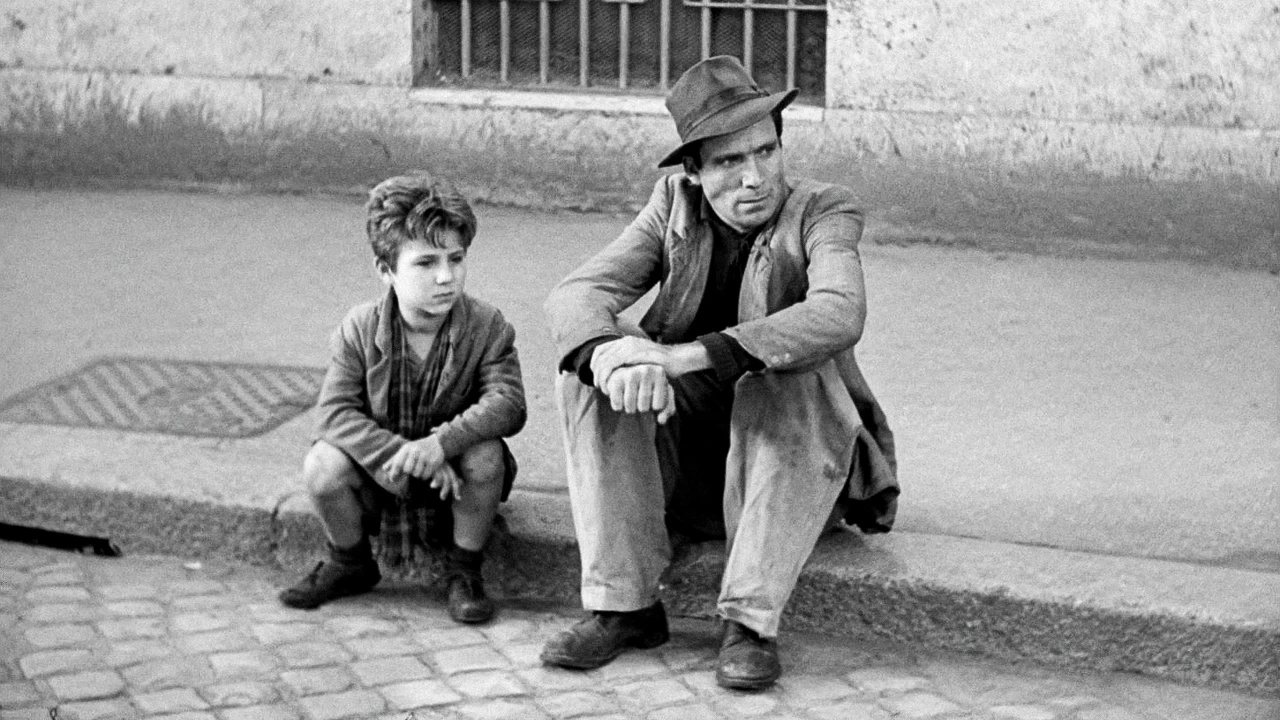
Director: Vittorio De Sica · Cinematographer: Carlo Montuori · Composer: Alessandro Cicognini · Editor: Eraldo Da Roma · Screenplay: Cesare Zavattini, Vittorio De Sica, Suso Cecchi d’Amico, Oreste Biancoli, Adolfo Franci, Gherardo Gherardi, Gerardo Guerrieri · Based on: the novel by Luigi Bartolini (1946) · Key Cast: Lamberto Maggiorani, Enzo Staiola, Lianella Carell · Runtime: 89 minutes · Studio: Produzioni De Sica · Budget: ~$133,000 (estimated) · Box Office: ~$459,000 worldwide (primarily from re-releases)
Eighty-Nine Minutes That Rebuilt Cinema from the Rubble
There is a moment near the end of Bicycle Thieves when Antonio Ricci stands on a Roman sidewalk, sweating, humiliated, surrounded by strangers who have just caught him trying to steal a bicycle. His son Bruno watches from a few meters away. The crowd threatens Antonio. A man slaps him. And Bruno, eight years old, begins to cry. Not for himself. For what he has just seen his father become.
That single scene contains the entire film. Poverty does not kill Antonio. It does something worse. It makes him into the thing he has spent the whole day hunting. The Italian title is plural for a reason: Ladri di biciclette. Thieves, not thief. The man who searches for a thief becomes one himself, and his son is there to see it happen.
Vittorio De Sica’s 1948 film is, on its surface, about a man looking for a stolen bicycle in post-war Rome. Beneath that surface, it is about the systematic destruction of dignity by economic desperation. It is about fatherhood under pressure that no father should have to bear. It is about a city so large and so indifferent that one man’s crisis registers as nothing at all.
What distinguishes Bicycle Thieves from the hundreds of social realist films it inspired is its refusal to sentimentalize or to politicize beyond what the story earns. There are no speeches. There is no villain. The thief is as poor as Antonio. The police are not cruel, merely useless. The church offers shelter but no salvation. Every institution Antonio encounters operates with a kind of procedural blankness that is far more devastating than malice. The system is not broken. It is simply not designed for people like him.
The film is 89 minutes long. It contains no wasted scene, no decorative subplot, no moment that exists for any purpose other than advancing Antonio’s search and deepening our understanding of what that search costs him. This economy is not minimalism for its own sake. It is a moral position. De Sica strips away everything that might distract from the human being at the center.
Some films earn their reputation through ambition, through scale, through the sheer audacity of what they attempt. Bicycle Thieves earns its reputation through precision. Every frame serves. Every silence means something. Nearly eight decades after its release, no film has told a simpler story with greater devastating effect.
Verdict: 10/10
Maggiorani’s Shoulders and Staiola’s Eyes
Neither Lamberto Maggiorani nor Enzo Staiola had ever acted before Bicycle Thieves. Maggiorani was a steel factory worker from Rome. Staiola was an eight-year-old boy spotted on the street during production. Their lack of training is not a limitation the film overcomes. It is the foundation on which the film stands.
Maggiorani carries the entire film in his body. Watch his posture in the opening scenes, when Antonio has just secured the poster-hanging job: his spine is straight, his stride purposeful, his face bright with the specific relief of a man who can finally provide for his family. Now watch his posture in the final act. His shoulders have collapsed inward. His walk has become a shuffle. He touches his face constantly, as though checking whether he is still himself. This physical deterioration is not the work of an actor making choices. It is the work of a man inhabiting a situation so completely that his body responds before his mind does.
The performance has an accidental genius that no professional training could replicate. Maggiorani does not act desperation. He is desperate, because De Sica placed him inside the emotional architecture of desperation and asked him to simply exist there. The scene in the restaurant, where Antonio watches a wealthy family eating while Bruno looks on, works because Maggiorani’s discomfort is not performed. He is visibly uncertain about being on camera, about being in this situation, and that uncertainty reads as the exact social anxiety the scene requires.
Staiola, meanwhile, gives one of the great child performances in cinema without appearing to perform at all. Bruno is not a cute movie kid. He is a working child. He wakes before dawn. He polishes the bicycle. He carries his father’s supplies. He is serious, competent, and deeply attentive to the adults around him. His eyes are enormous, and De Sica understood that those eyes were the film’s secret weapon. Bruno sees everything. He sees his father’s pride. He sees it crumble. He sees the slap, the humiliation, the attempted theft. And in the final shot, when he reaches up and takes his father’s hand, those eyes hold something that no adult actor could manufacture: a grief that does not yet understand itself.
Staiola went on to become a mathematics teacher. He appeared in a handful of other films, but none matched Bicycle Thieves, and he never pursued acting as a career. He died in Rome on June 4, 2025, at the age of 85. The boy with the expressive eyes lived a quiet life. The performance did not.
Rome Without Postcards: Montuori and the Unbeautiful City
Carlo Montuori’s cinematography in Bicycle Thieves performs an act of refusal. This is Rome, one of the most photographed cities on earth, and Montuori declines to photograph any of it beautifully. There is no Colosseum. No fountain. No piazza bathed in golden light. The Rome of this film is a labyrinth of grey streets, crowded markets, rain-slicked pavement, and apartment blocks whose walls are streaked with the residue of war.
Every shot was made on location. No sets were built. No studio lighting was used. Montuori worked with natural light and the overcast skies of a Roman winter, and the resulting images have a documentary texture that makes the fiction feel like reportage. The black-and-white palette is not high-contrast or expressionist. It lives in the middle greys, in a tonal range that mirrors the moral ambiguity of the story. Nothing is pure black. Nothing is pure white. Everything exists in the uncertain space between.
Pay attention to how Montuori frames Antonio within the city. He is consistently dwarfed. In the unemployment office, he is one body among hundreds, the camera pulling back to reveal the sheer scale of joblessness. In the market at Porta Portese, he is swallowed by the crowd. At the football stadium near the end, where rows of bicycles line the streets, the camera shows us dozens of identical machines, and Antonio’s stolen Fides becomes a needle in an infinite haystack. The visual argument is architectural: this city is too large, too dense, too indifferent to notice one man’s catastrophe.
There is one moment of visual tenderness. When Antonio and Bruno eat together at the restaurant, Montuori moves the camera closer than anywhere else in the film. The tight framing creates a brief pocket of intimacy, a father and son sharing a meal, and for a few minutes the enormous city recedes. Then they leave the restaurant and the city swallows them again.
The 1.37:1 aspect ratio, standard for the era, works in the film’s favor. The nearly square frame cannot contain wide vistas or panoramic grandeur. It forces closeness. It keeps returning to faces, to hands, to the narrow streets where Antonio’s search unfolds. Montuori did not have the budget for elaborate camera movements, but the constraints produced a visual discipline that more expensive films rarely achieve.
An Object Becomes a Life: The Bicycle as Economic Destiny
The bicycle in Bicycle Thieves is not a metaphor. It is an economic fact. Without the bicycle, Antonio cannot take the poster-hanging job. Without the job, he cannot support his family. Without his family’s survival, he has no identity, no function, no place in the social order. The bicycle is the hinge on which an entire life pivots.
This literalness is the film’s greatest strength and the quality most often misunderstood by critics who want to read the bicycle as a symbol of something grander. It does not represent hope. It does not represent modernity. It does not represent the fragility of post-war recovery, though it participates in all of these themes incidentally. The bicycle is a Fides brand bicycle required for a specific job obtained through a specific government employment office, and its theft creates a specific, concrete, solvable problem that the entire apparatus of Roman civic life proves incapable of solving.
The genius of Zavattini and De Sica’s screenplay is that they understood how devastating specificity can be. A film about poverty in the abstract would invite sympathy. A film about one man who needs one bicycle to do one job invites identification. We do not feel sorry for Antonio as a representative of the Italian working class. We feel the weight of his particular Tuesday, his particular humiliation, his particular failure to recover a particular object.
Consider the pawnshop scene early in the film. Maria, Antonio’s wife, strips the bed of her dowry linens to redeem the bicycle from the pawn broker. The camera watches the clerk carry the bundled sheets up a towering wall of shelves, each shelf packed with identical bundles from other families who have made the same trade. That single image communicates more about systemic poverty than any speech could. Every bundle is a family’s bet. Every bundle is someone else’s bicycle.
And then, when the bicycle is stolen, the entire bet collapses. Not because of malice or injustice in any dramatic sense, but because of probability. In a city full of desperate people, theft is not an aberration. It is arithmetic.
1948: Rebuilding with Bare Hands and Losing with Broken Laws
Italy in 1948 was a country caught between the memory of fascism and the promise of reconstruction. The war had ended three years earlier. Mussolini was dead. The monarchy had been abolished by referendum in 1946. A new republic was struggling to establish itself, and the Marshall Plan was pouring American money into Western Europe. But the money moved slowly, and it moved unevenly. For the working poor in Rome, the grand political transformations of the era were abstractions. What mattered was work, food, and rent.
Unemployment in post-war Rome was staggering. Entire neighborhoods operated on informal economies, black markets, and the thin hope of government job placements. The employment office scene in Bicycle Thieves is not exaggerated. Lines of hundreds of men waiting for a handful of positions was a daily reality. The system of prioritized job listings that Antonio navigates was a real bureaucratic structure, and its inadequacy was widely understood.
De Sica and Zavattini were not making a political film in the partisan sense. They were not arguing for communism or against capitalism or advocating for any specific policy. They were doing something more subversive: showing what life looks like for a person the system does not see. Antonio is not oppressed by a tyrant. He is simply invisible to institutions that function perfectly well for people with more resources.
The Catholic Church appears in the film as one of several institutions that fail Antonio. The charity mission offers hot soup in exchange for attending a service. The fortune teller offers comfort in exchange for money. The police take a report and do nothing. Each encounter follows the same pattern: an institution acknowledges Antonio’s existence, extracts something from him (time, money, attention, dignity), and sends him away without solving his problem. De Sica is not anticlerical or anti-state. He is something more difficult to argue with. He is precise.
The Boy Who Watches Everything: Bruno as Cinema’s Silent Jury
The emotional devastation of Bicycle Thieves does not come from Antonio. It comes from Bruno.
Remove Bruno from the film and you have a competent social drama about a man searching for a stolen bicycle. A sympathetic story, a pointed political document, a well-constructed narrative. But you lose the element that turns competence into genius: the presence of a witness. Bruno does not drive the plot. He does not solve the problem or complicate it. He watches. And because he watches, we are forced to watch differently.
Children in film are often used as emotional shortcuts. They cry, they suffer, they look up at adults with trembling lips, and the audience responds with a reflexive protectiveness that the film hasn’t necessarily earned. De Sica does not use Staiola this way. Bruno is not pathetic. He is capable. He works alongside his father with the focused competence of a child who has never known leisure. When he is frightened or hurt, his responses are clipped and practical. He does not cry for the camera. He cries at the end because something inside him has broken, and by that point, we have spent ninety minutes watching him hold himself together with such discipline that his collapse feels seismic.
The film’s moral architecture depends entirely on Bruno’s gaze. When Antonio visits the fortune teller, Bruno waits outside, observing the transaction with quiet skepticism. When Antonio chases the old man through the church, Bruno follows, confused but loyal. When Antonio slaps Bruno in frustration, the camera stays on the boy’s face as he processes the blow, not with the melodramatic shock of a movie child but with the stunned recalibration of a real one.
And then the final sequence. Antonio, desperate, attempts to steal a bicycle himself. He is caught. The crowd turns on him. Bruno watches from across the street. The boy’s face holds an expression that is impossible to name precisely, because it contains too many emotions at once: fear, shame, love, disillusionment, and a fierce protectiveness that has nowhere to go. When the bicycle’s owner decides not to press charges, and Antonio stumbles away in tears, Bruno walks up and takes his father’s hand.
That gesture is the last image in the film, and it is the most complex moral statement in neorealist cinema. Bruno has seen his father become a thief. He reaches for his hand anyway. Is it forgiveness? Is it loyalty? Is it a child’s instinct to hold on to the only safety he knows, even when that safety has just been exposed as fragile? The film refuses to answer, and the refusal is the answer. Love persists even after the thing you loved has been diminished. That is either consolation or tragedy. Probably both.
Cicognini’s Restraint and the Sound of a City Ignoring You
Alessandro Cicognini’s score for Bicycle Thieves does what the best film scores do and what the worst film scores refuse to do: it knows when to be absent.
The most emotionally shattering moments in the film play without music. Antonio’s attempted theft. Bruno’s final tears. The slap. The confrontation with the young thief in the tenement. Cicognini and De Sica understood that silence, in the context of a film that has been scoring its gentler moments, creates a withdrawal effect. When the music disappears, the audience feels its absence as a kind of abandonment. The film stops holding your hand at exactly the moment when the events on screen become unbearable.
Where the score does appear, it favors a warm, almost nostalgic Italian romanticism that works as counterpoint rather than reinforcement. The theme that accompanies Antonio and Bruno’s walk through the city has the lilt of an accordion on a Sunday afternoon. It sounds like the Rome that tourists imagine, the Rome of cafés and strolls and small pleasures. Against the images of grey streets and desperate searching, this warmth becomes ironic without being sarcastic. The music remembers a city that the characters cannot access.
The film’s sound design, constrained by 1948 mono recording technology, is necessarily simple. But the ambient noise of Rome functions as a kind of sonic texture that the score cannot provide. Market vendors shouting. Traffic. Church bells. The constant low hum of a city going about its business. These sounds establish what the cinematography confirms: the world is indifferent. Antonio’s crisis generates no special acoustics. The city does not quiet down for his suffering. It keeps going, and he is one voice among millions.
Neorealism Was Not a Style. It Was a Refusal.
Italian neorealism is often taught as an aesthetic: real locations, non-professional actors, natural lighting, working-class subjects, minimal plot. These are accurate descriptors, but they mistake the symptoms for the disease. Neorealism was not a checklist. It was an argument. The argument went like this: the cinema we have been making is a lie, and we will stop lying now.
The lie was the cinema of the Fascist era, the so-called “white telephone” films of the 1930s and early 1940s. These were glossy studio productions featuring wealthy characters, polished sets, and stories that had nothing to do with the reality of Italian life. Mussolini’s regime supported this cinema because it served as an anesthetic. If Italians could watch beautiful people living beautiful lives in beautiful apartments, perhaps they would not notice what was happening outside the theater.
When the regime collapsed and the war ended, a generation of filmmakers looked at the rubble of their country and decided that the camera had to look at it too. Roberto Rossellini’s Rome, Open City (1945) is generally identified as the first neorealist film, shot on the streets of recently liberated Rome with scraps of film stock and a cast that mixed professionals with amateurs. De Sica’s Shoeshine (1946) followed, then Visconti’s La Terra Trema (1948), and then Bicycle Thieves.
What separates Bicycle Thieves from its neorealist peers is its discipline. Rossellini’s early films have a raw, improvisational energy that sacrifices coherence for immediacy. Visconti’s work is operatic, tending toward the monumental. De Sica found a middle path. Bicycle Thieves looks improvised, feels spontaneous, and is in fact one of the most carefully planned productions in Italian cinema. Seven screenwriters worked on the script. Multiple cameras were used to capture crowd scenes. Every location was scouted and selected for its specific visual and narrative function. The effortlessness is an illusion, and the illusion is the point.
The movement burned bright and brief. By the early 1950s, audiences had tired of poverty on screen, Italian censors had grown hostile, and the filmmakers themselves were evolving in different directions. De Sica would make Umberto D. in 1952, a film even bleaker than Bicycle Thieves, and it would be a commercial disaster. But the seed had been planted. Satyajit Ray watched Bicycle Thieves before making Pather Panchali. The French New Wave directors studied it. Ken Loach built an entire career on its principles. The refusal echoed for decades.
De Sica’s Radical Compassion
Vittorio De Sica’s career traces one of the strangest arcs in cinema. He began as a matinee idol in the 1930s, a handsome leading man in the kind of lightweight romantic comedies that neorealism would later repudiate. He transitioned to directing during the war, and between 1946 and 1952, he produced four films that constitute the highest sustained achievement in Italian cinema: Shoeshine, Bicycle Thieves, Miracle in Milan, and Umberto D.
Then he went back to making lightweight comedies and melodramas. The rest of his career, with a few exceptions, is a slow retreat from the heights he reached in those six years. He won two more Academy Awards (for Yesterday, Today and Tomorrow in 1964 and The Garden of the Finzi-Continis in 1970), but these later films, however accomplished, operate at a lower altitude.
What made De Sica extraordinary during his neorealist period was not technique or vision in the abstract but a specific quality of attention. He watched people. He watched how factory workers sat down, how children walked, how the poor carried their bodies in spaces designed for the middle class. And then he transferred that attention to the screen with a fidelity that no other director of the period matched.
De Sica was himself an actor, and this shaped his directorial method in a crucial way. He did not give his non-professional performers motivation or backstory or emotional direction in the way that a Method-trained director might. He acted out each scene himself, gesture by gesture, expression by expression, and asked his cast to reproduce what he showed them. The performances in Bicycle Thieves are, in a real sense, De Sica’s own performance distributed across the bodies of people who had never stood in front of a camera. This is why the film feels both naturalistic and precisely controlled. It is both things at once, because De Sica was both things at once: an instinctive observer of human behavior and a meticulous craftsman of screen performance.
His partnership with screenwriter Cesare Zavattini was essential. Zavattini provided the ideological framework: cinema must show life as it is, not as we wish it were. De Sica provided the warmth. Where Zavattini tended toward the programmatic, De Sica tended toward the compassionate. Bicycle Thieves is the perfect synthesis. It has Zavattini’s rigorous focus on economic reality and De Sica’s bottomless sympathy for the people trapped inside it.
Casting from the Street: The Production That Practiced What It Preached
The making of Bicycle Thieves is itself a story about the collision between art and economics. De Sica could not secure financing from any major Italian studio. The film’s subject matter was considered uncommercial, its insistence on non-professional actors a risk, and its politics (to the extent that depicting poverty is a political act) uncomfortable for an Italian film industry eager to project a more optimistic image.
The most famous offer came from David O. Selznick, the Hollywood producer behind Gone with the Wind. Selznick expressed interest in financing the film on one condition: Cary Grant would play Antonio Ricci. De Sica declined. He reportedly considered requesting Henry Fonda as a counter before abandoning the Hollywood route entirely. He raised the money from private Italian sources and maintained full creative control.
The casting process embodied the neorealist philosophy. De Sica found Lamberto Maggiorani when the factory worker brought his own son to audition for the role of Bruno. De Sica ignored the child and hired the father. He chose Maggiorani because of the way he moved, the way he sat down, the way his work-hardened hands gestured when he spoke. Lianella Carell, who plays Maria, was a journalist who had approached De Sica for an interview and was cast on the spot.
Enzo Staiola’s discovery came later, after filming had already begun. De Sica was shooting a scene in a Roman street when a crowd gathered to watch. Among the onlookers was a boy with a round face and large, watchful eyes. De Sica saw him and felt, as he later put it, that Saint Gennaro had sent the boy to him. Staiola had no acting experience. He was eight years old and had been walking home from school.
The production shot entirely on Roman streets, which presented logistical challenges that the finished film disguises completely. Crowd scenes required careful choreography across multiple cameras. The rain in several key sequences was manufactured. The documentary appearance of the film is, paradoxically, the product of intense planning. Seven screenwriters shaped a script that was adapted very loosely from Luigi Bartolini’s 1946 novel, a satirical work about an artist (not a worker) who owns a second bicycle (not his only one) and holds reactionary views about the poor. Almost nothing survived from the source material except the premise of a stolen bicycle. Zavattini and De Sica transformed a cynical comedy into a humanist tragedy.
From the Streets of Rome to the Conscience of World Cinema
Bicycle Thieves was not well received in Italy upon its release. Italian audiences, weary of poverty both on and off screen, resented a cinema that insisted on showing them what they already knew. The film was also attacked by some on the political right for portraying Italy in a negative light, and by some on the left (including Luchino Visconti) for what they considered its sentimentality.
Abroad, the response was different. The film won an Honorary Academy Award in 1950 (the Best Foreign Language Film category did not yet formally exist). It won the BAFTA for Best Film and the Golden Globe for Best Foreign Language Film. In 1952, the inaugural Sight & Sound poll of critics and directors named it the greatest film ever made, ahead of Chaplin’s City Lights and The Gold Rush. (Citizen Kane, now a perennial fixture on such lists, was not included.)
The Sight & Sound ranking held for a decade before Bicycle Thieves slipped in subsequent polls. By 2012, it had settled at 33rd. This trajectory tells a story of its own. The film’s reputation has not declined so much as diffused. Its innovations were so thoroughly absorbed by the cinemas it influenced that what once seemed radical now seems natural. We take it for granted that films can be shot on real streets with untrained actors because Bicycle Thieves (and its neorealist contemporaries) proved it could be done.
The film’s influence is vast and specific. Satyajit Ray has cited it as the catalyst for Pather Panchali. The French New Wave directors studied its location work and its rejection of studio conventions. Ken Loach’s entire filmography operates within the tradition Bicycle Thieves established. Abbas Kiarostami, the great Iranian director, shares De Sica’s commitment to non-professional performers and stories drawn from ordinary life. Even American independent cinema of the 1990s and 2000s carries traces of the neorealist grammar that Bicycle Thieves codified.
André Bazin, the French critic whose writings became the theoretical foundation of modern film criticism, devoted some of his most important essays to this film. He argued that Bicycle Thieves represented the pinnacle of a cinema that trusted reality over artifice, observation over manipulation, and the viewer’s intelligence over the filmmaker’s need to explain. Whether one agrees with Bazin or not, the fact that the film could generate criticism of that caliber speaks to its richness.
Roger Ebert, revisiting the film in 1999, observed that it remained alive and fresh despite its status as an official masterpiece. Masterpieces often calcify. They become things you study rather than watch. Bicycle Thieves, perhaps because of its brevity and simplicity, has resisted this fate. It still works. It still hurts.
What to Watch For When You Already Know the Ending
Bicycle Thieves changes on second viewing. The suspense of the search dissolves, and in its place, something more intricate appears: the architecture of inevitability.
Track Bruno’s face throughout the film, not Antonio’s. On a first viewing, the eye follows the father because the plot belongs to him. On a rewatch, shift your attention entirely to the son. Watch how Staiola’s expression calibrates itself to each new situation. There is a moment outside the fortune teller’s door where Bruno folds his arms and shifts his weight with the patience of someone who has waited outside many doors. That gesture is not directed. It is lived.
Count the institutions Antonio approaches and note the pattern. The employment office. The police station. The church. The fortune teller. The union hall. Each encounter follows a nearly identical rhythm: hope, procedure, refusal, departure. Once you see the pattern, the film’s structure reveals itself as a series of closed doors, each one more tightly shut than the last.
Watch the backgrounds. De Sica fills his frames with extras who are not acting. They are living their lives, and their indifference is part of the film’s argument. In the market scene at Porta Portese, notice the volume of secondhand goods being sold. Beds, coats, linens, tools. Every item represents another family’s sacrifice. The visual environment tells a story of collective dispossession that the narrative only addresses through Antonio’s individual case.
Pay attention to the rain. It appears at moments of intensified desperation and disappears when the film offers brief reprieves. The rain in the scene where Antonio first discovers the theft is manufactured, but it reads as fate.
Finally, watch the last sixty seconds with full awareness of the plural title. Ladri di biciclette. Thieves of bicycles. There are two thieves in this film. One at the beginning. One at the end. The entire moral journey is contained in the distance between them.
Film Trivia
Hollywood’s most absurd casting proposal. David O. Selznick offered to finance the entire production if De Sica would cast Cary Grant as Antonio Ricci. De Sica turned him down, explaining that Grant was too bourgeois, too gentlemanly, and that his hands had no blisters on them. He briefly considered requesting Henry Fonda as a counter-offer before abandoning Hollywood money altogether and raising the budget from Italian investors. The decision preserved the film. It is nearly impossible to imagine Cary Grant pawning bed linens.
The factory worker who became a star and then became poor. Lamberto Maggiorani was fired from his factory job shortly after the film’s release. His employers assumed that a movie star would no longer need a factory salary. In reality, Maggiorani earned very little from the film. He spent the rest of his life working as a bricklayer, attempting without success to land more acting roles. De Sica never cast him again. Maggiorani died in Rome in 1983 at the age of 73, a fate more quietly devastating than anything in the film that made him famous.
A future legend in the background. Among the non-professional extras in Bicycle Thieves is a sixteen-year-old boy playing one of the seminary students that Bruno sees walking together. His name was Sergio Leone. Two decades later, he would reinvent the Western genre with films like The Good, the Bad and the Ugly and Once Upon a Time in the West, becoming one of the most influential directors in cinema history.
The film that broke the Production Code. When Bicycle Thieves was submitted to the American Production Code Administration for approval, the censors demanded that two scenes be cut: a brief visit to a brothel and a moment where Bruno urinates against a wall. De Sica refused. American cinema chains released the film without the PCA seal, and audiences came anyway. The incident was one of several that weakened the Production Code’s authority throughout the 1950s, contributing to its eventual abolition.
The boy who became a math teacher. Enzo Staiola was eight years old when De Sica spotted him on a Roman street and cast him as Bruno. He appeared in a few more films during the early 1950s, including The Barefoot Contessa with Humphrey Bogart, but never pursued acting as a career. He became a mathematics teacher and later worked as a land registry clerk. Staiola died in Rome on June 4, 2025, at the age of 85, having lived a life as quiet and unassuming as his most famous performance was loud in its impact.
This entry selects analytical dimensions from a pool. The five anchors are present: critical verdict, performances, visual craft, reception and legacy, and rewatchability guide. Earned sections cover Cicognini’s score, neorealist genre lineage, De Sica’s body of work, the cultural context of post-war Italy, and the film’s production history (which absorbs the adaptation analysis, since almost nothing of Bartolini’s novel survived into the screenplay). Two wildcard sections address qualities unique to this film: the bicycle as literal economic object rather than metaphor, and Bruno’s function as the film’s silent moral witness. Sections on awards history and editing structure are omitted because the former is adequately covered within the reception section and the latter, while competent, does not generate enough distinctive analysis to justify a standalone treatment.

Leave a Reply