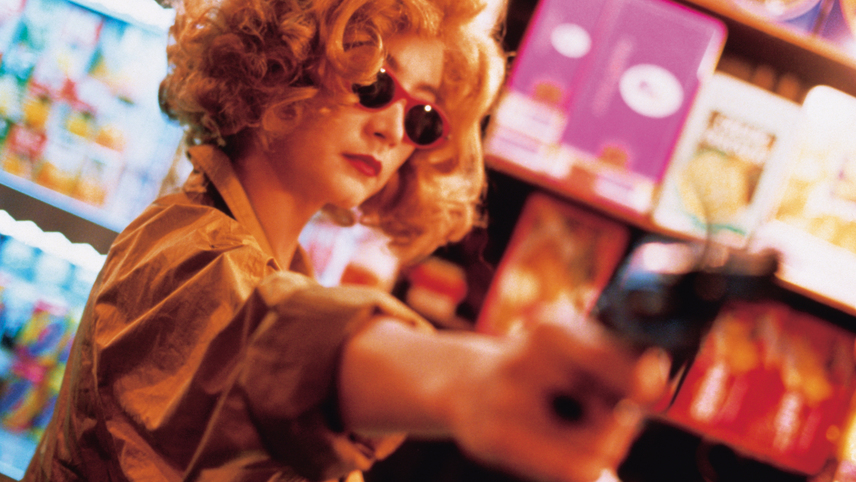
Director: Wong Kar-wai · Cinematographers: Christopher Doyle, Andrew Lau Wai-keung · Composer: Frankie Chan, Roel A. Garcia · Editor: William Chang, Hai Kit-wai, Kwong Chi-leung · Production Design/Costume Design: William Chang · Key Cast: Takeshi Kaneshiro (Cop 223), Brigitte Lin (Woman in Blonde Wig), Tony Leung Chiu-wai (Cop 663), Faye Wong (Faye), Valerie Chow (Flight Attendant) · Runtime: 102 minutes · Studio: Jet Tone Production · Budget: HK$15 million (approximately $2 million)
1. Expiration Dates: Why This Film Still Tastes Fresh
If memories could be canned, would they also have expiry dates? If so, I hope they last for centuries.
That voiceover, spoken by a heartbroken young cop buying cans of pineapple that expire on May 1, is the closest thing Chungking Express has to a thesis statement. The film is about expiration: of love, of habit, of a city. It is also, paradoxically, about the refusal to let things expire. Two policemen in Hong Kong lose their girlfriends. Two women enter their orbits. Nothing is resolved in the way a romantic comedy would resolve it. Everything is felt in the way only Wong Kar-wai’s films feel things: intensely, messily, with a camera that seems to be falling in love at the same speed as its characters.
This is a 9/10 film. It misses the top mark not because of any significant flaw but because its two halves are not equal. The first story, starring Takeshi Kaneshiro as Cop 223 and Brigitte Lin as a drug smuggler in a blonde wig, is sharp and poignant but runs at a lower emotional temperature than what follows. It is prologue dressed as a short film. The second story, starring Tony Leung Chiu-wai as Cop 663 and Faye Wong as the snack bar worker who secretly rearranges his apartment, is where the film finds its heart, its humor, and its heartbreak. The imbalance is deliberate. Wong structured the film as a diptych where the second panel outshines the first, so that the audience’s emotional investment deepens rather than plateaus. But the first half, for all its pleasures, occasionally feels like warmup.
What earns the 9 is everything else. The cinematography is among the most influential of the 1990s. The performances are pitch-perfect. The soundtrack has permanently altered the emotional associations of at least two pop songs. And the film’s central insight, that loneliness in a city of six million people is not the absence of contact but the wrong kind of contact, remains as true in 2026 as it was in 1994.
2. Two Cinematographers, Two Loneliness
The split in Chungking Express runs deeper than its two stories. It has two cinematographers, and their visual approaches are as different as the cops they photograph.
Andrew Lau Wai-keung shot the first segment. His camera moves through Chungking Mansions, the labyrinthine tenement building in Tsim Sha Tsui, with a frantic handheld energy that matches Cop 223’s extroverted desperation. The most distinctive technique here is the low frame rate. Lau shot key sequences at six frames per second, then used step printing to duplicate each frame four times, arriving at the standard twenty-four frames per second for playback. The result is a smeared, strobe-like motion blur that makes Hong Kong look like it is running past you at a speed your eyes cannot process. The city becomes a streak of neon and bodies. Only the characters in the foreground remain sharp, isolated by the technique into a pocket of stillness while everything around them races toward expiration.
Christopher Doyle took over for the second segment, and the visual register shifts immediately. Doyle’s camera is still handheld, still restless, but the quality of movement changes. Where Lau’s camera crashes through spaces, Doyle’s drifts through them. The neon palette softens. The step-printing effect recurs but is used more selectively, often in sequences where Faye and Cop 663 occupy the same frame but seem to exist in different temporal planes: she moves at normal speed, the crowd around her blurs, and he stands still, trapped in the routine of loss. The effect visualizes the film’s emotional argument with startling clarity. People in love exist at a different speed than the world around them.
Doyle later said of the shoot that it was “ad hoc and improvised in many situations,” that they were filming in the busiest part of Hong Kong without permits, that every day felt like planning a robbery. The guerrilla energy is visible in the footage: reflections in rain-wet streets, neon signs bleeding into lens flares, tight corridors where the camera has to flatten itself against a wall to let an actor pass. The imperfections are inseparable from the beauty. A more controlled shoot would have produced a more controlled film, and a more controlled film would have missed the point entirely.
3. Faye Wong and the Art of Breaking Into Someone’s Life
Faye Wong was not an actress when Wong Kar-wai cast her. She was one of the most famous pop singers in Asia, with virtually no screen experience. Doyle has recalled that she would finish a take and simply walk off set to her car, assuming her work was done, because she had no frame of reference for the iterative process of filmmaking. This naivety, if that is the right word, is embedded in the performance and is part of why it works.
Faye, the character, is one of the most original creations in 1990s cinema. She works at the Midnight Express snack counter. She plays “California Dreamin’” by the Mamas and the Papas at full volume, over and over, to the visible irritation of everyone around her. She develops a crush on Cop 663, a regular customer. When his ex-girlfriend drops off a spare set of his apartment keys at the counter, Faye starts letting herself in while he is at work and quietly transforming his living space: replacing his soap, swapping his canned fish for fresh, redecorating in increments so subtle he does not notice. She is, by any reasonable definition, committing a series of break-ins. She is also performing one of the most tender courtship rituals ever filmed.
The genius of Wong’s writing here is that he trusts the audience to hold both truths at once. Faye’s intrusions are invasions of privacy. They are also expressions of a care so specific and so attentive that they put the grand gestures of conventional romance to shame. She does not leave love letters. She changes his towels. She does not confess her feelings. She buys him new fish for his tank. The romantic vocabulary of the film is domestic, practical, rooted in objects rather than declarations. Wong understands that love, at its most honest, is not about what you say to someone. It is about whether you notice their soap is running out.
Faye Wong plays all of this with a lightness that conceals the difficulty of the performance. She dances while she works. She hums. She radiates a distracted happiness that is, upon closer inspection, a form of displacement: she channels everything she cannot say to Cop 663 into physical energy directed elsewhere. The performance is instinctive rather than calculated, which gives it a transparency that a more experienced actress might have obscured with technique. You believe Faye because Faye Wong, at that moment in her career, did not know how to pretend.
Tony Leung Chiu-wai, by contrast, is one of the most experienced and technically accomplished actors in Asian cinema, and his performance as Cop 663 is a masterclass in contained sadness. He talks to his soap. He tells his dishcloth it needs to stop crying. He addresses these objects with the seriousness of a man who has no one else to talk to, and the scenes are simultaneously comic and devastating. Leung’s gift is that he can play absurdity and grief in the same breath without either one cancelling the other.
4. “California Dreamin’” and the Soundtrack of Misplaced Longing
Wong Kar-wai does not use music as underscore. He uses it as architecture.
“California Dreamin’” plays so many times in Chungking Express that it stops being a song and becomes a spatial element, like the fluorescent lights or the steam from the noodle stand. It is Faye’s anthem, the song she blasts to drown out the world, and its lyrics, about cold days and grey skies and the desire to be somewhere else, map perfectly onto her situation: a woman in the most densely populated city on earth who dreams of escaping to a place she has probably never been.
The Cranberries’ “Dreams” serves a different function. Where “California Dreamin’” is externalised, played loud, shared with (or inflicted upon) everyone in earshot, “Dreams” is internalised. It plays during Faye’s private moments, her secret visits to Cop 663’s apartment, her quiet walks through corridors. The song’s lyrics are about the disorientation of new feeling, and Faye Wong recorded her own Cantonese-language cover of it for the film, a detail that blurs the boundary between the character and the performer in a way that is characteristic of Wong Kar-wai’s approach to casting: he does not simply hire actors. He harvests their real selves.
The soundtrack is widely credited with introducing dream pop to Hong Kong audiences. The Cranberries and Cocteau Twins both saw significant commercial success in the region after the film’s release, and Hong Kong pop music shifted audibly in its wake. This cultural impact was not engineered. It was a side effect of Wong’s instinct for matching emotional texture to sonic texture. He heard something in “California Dreamin’” that most listeners had stopped hearing decades ago: the ache underneath the melody, the way the song sounds like summer but feels like loss.
Dinah Washington’s “What a Difference a Day Makes” appears briefly but crucially, underscoring the film’s preoccupation with how quickly emotional landscapes can shift. One day you are talking to your dishcloth. The next day someone has replaced your towels and you haven’t noticed. The next day you notice. The film’s relationship with time, with expiration, with the speed at which feelings arrive and depart, is inseparable from its musical choices. Every song in Chungking Express is about the gap between where you are and where you want to be.
5. Wong Kar-wai Between Epics: The Accidental Masterpiece
The production story of Chungking Express is inseparable from the production story of Ashes of Time, the martial arts epic that Wong Kar-wai had been editing for two years and was nowhere near finishing. Exhausted by the scale and ambition of that project, Wong took what he described as a break: two months, a small budget, no permits, no finished script, and a crew that nicknamed themselves “CNN” because they were shooting like a news team, grabbing footage wherever and whenever they could.
Wong wrote each day’s scenes the night before or the morning of shooting. The second story was written in a single day. A third story, developed during production, eventually became the basis for Fallen Angels, released the following year. The film was shot in sequence, which is extremely unusual for narrative filmmaking and lent the production a road-movie quality even though it never leaves Hong Kong. William Chang and Wong Kar-wai edited the two halves simultaneously, each taking one storyline, which accounts for the slightly different rhythmic textures of the two segments.
The improvisation was not chaos. It was a method. Wong Kar-wai’s signature approach to filmmaking has always involved writing around his actors rather than asking them to inhabit pre-existing characters. He creates situations and lets the performers fill them with behavior. Doyle described the process as changing “a situation rather than a performance”: if a scene was not working, the solution was never to ask the actor to try something different. It was to move the furniture, change the angle, reverse the blocking, and see what emerged. The result is a film that feels discovered rather than constructed, as though the camera happened to be in the right place at the right time and caught something that was already happening.
This method, born from necessity on Chungking Express, would become Wong’s defining approach for the rest of his career. In the Mood for Love, which this site has already covered, was made with vastly more resources but the same fundamental philosophy: trust the actors, trust the moment, trust that the camera will find the story if you give it enough room to look.
6. 0.01 Centimeters: Proximity, Anonymity, and the Loneliness of Crowds
Cop 223’s voiceover in the opening minutes contains the film’s most frequently quoted observation: that every day we brush past so many other people, and that at the moment of closest proximity, we are 0.01 centimeters apart, but six hours later, the distance between us has grown to 2,800 miles.
The line is sentimental, and Wong Kar-wai does not care. Sentimentality, in his cinema, is not a weakness. It is the natural language of people who feel things more intensely than their circumstances allow them to express. Hong Kong in 1994 was a city of proximity and anonymity, six million people crammed onto a peninsula and its surrounding islands, sharing elevators and escalators and noodle bars, touching without connecting. The impending 1997 handover to China gave this condition an additional dimension of anxiety: the city itself was approaching an expiration date, a political transfer that would change its identity in ways no one could fully predict.
Wong never references the handover directly. He does not need to. The film’s obsession with expiration dates, with the urgency of connection, with the fear that the things you love will be different by the time you return to them, is the handover translated into the language of romantic comedy. Cop 223 buys pineapple cans that expire on May 1, the day he has decided his heartbreak will end. Cop 663 discovers that his apartment has been slowly changed by someone he did not invite. In both cases, the anxiety is the same: the world is changing around you, and you are the last to know.
Chungking Mansions, where the first story unfolds, is the perfect physical metaphor. A seventeen-story residential and commercial building in the middle of Tsim Sha Tsui, it houses guest houses, restaurants, shops, currency exchanges, and populations from across South Asia, Africa, and the Middle East. It is a microcosm of global displacement compressed into a single address. Wong shoots it as a vertical city within a city: corridors stacked on corridors, faces passing faces, a density so extreme that solitude feels like an achievement.
7. The Tarantino Connection and the Western Discovery of Wong Kar-wai
Chungking Express reached American audiences through one of the stranger distribution pipelines in 1990s cinema. Quentin Tarantino, already the most visible champion of Hong Kong cinema in Hollywood, saw the film and declared it one of his favorites. He arranged for its North American release in March 1996 through Rolling Thunder, a distribution label he had created under Miramax specifically to bring overlooked genre and arthouse films to American screens.
The Tarantino endorsement was a double-edged introduction. On one hand, it guaranteed attention from audiences who might never have encountered a Wong Kar-wai film otherwise. On the other, it positioned Chungking Express within Tarantino’s personal canon, a context that emphasized its cool-factor and pop-culture literacy while underplaying its emotional depth. American critics responded accordingly: some reviewed the film as though it were an exercise in style, a mood board rather than a story. Roger Ebert gave it three out of four stars and described it as a film for people who love cinema itself rather than its “surface aspects such as story and stars,” which is a fair description delivered in a tone that slightly undersells what the film achieves.
The deeper legacy of Chungking Express in Western cinema runs through a different channel. Barry Jenkins, the director of Moonlight and If Beale Street Could Talk, has cited it as a foundational influence, and the connection is visible in Jenkins’s use of saturated color, intimate handheld camerawork, and soundtracks that function as emotional counterpoint rather than accompaniment. Sofia Coppola’s Lost in Translation, with its jet-lagged strangers connecting briefly in a foreign city, owes a clear debt. The film’s influence on the “vibes cinema” of the 2010s and 2020s, films that prioritize atmosphere and emotional texture over narrative architecture, is pervasive enough to be invisible: the aesthetic it pioneered has been so thoroughly absorbed that its origins are easy to forget.
8. William Chang and the World Inside Four Walls
William Chang Suk-ping is one of the most important and least discussed collaborators in Wong Kar-wai’s filmography. He served as editor, production designer, and costume designer on Chungking Express, an unusual combination of roles that gave him control over both the visual environment the actors inhabited and the rhythm at which the audience experienced it.
Cop 663’s apartment is Chang’s signature achievement in this film. It is a small, cluttered space that becomes the theater for Faye’s secret renovations, and every object in it is both a prop and a character. The stuffed animal on the bed. The row of canned goods in the kitchen. The dish towel that Cop 663 addresses with genuine concern. Chang selected and arranged these objects so that they could be gradually replaced by Faye without the change registering consciously on first viewing. The apartment is a puzzle box designed to be solved on rewatch: each visit reveals another substitution, another quiet alteration, another sign that someone has been here.
The costumes serve a parallel function. Brigitte Lin’s blonde wig and dark raincoat in the first story are a costume within a costume: the drug smuggler is disguised, performing a role, and her clothes announce the performance. Faye’s wardrobe is the opposite: loose, casual, slightly too big, as though she dressed in a hurry or grabbed whatever was closest. The contrast communicates something about the two women’s relationships to identity that the script never states. The smuggler is someone pretending to be someone else. Faye is someone who has not yet decided who she is.
9. Hong Kong at 0.01 Centimeters: The City as Emotional Landscape
Every Wong Kar-wai film is a love letter to Hong Kong, but Chungking Express is the most direct. The city is not a backdrop. It is a character, a co-narrator, a system of corridors and escalators and fluorescent-lit counters that shape the emotional possibilities available to the people who move through them.
The Midnight Express snack counter, where Faye works and Cop 663 orders his coffee, is the spatial center of the second story. It is a liminal space, neither private nor public, a place where transactions occur that are superficially commercial but actually emotional. Faye serves Cop 663 his food. He pays. They exchange a few words. The counter between them is narrow enough that their hands could touch, and they never do. Wong shoots this space with a specificity that elevates it from a set to a world: the steam, the clutter, the other customers who occupy the margins of the frame, the way the fluorescent light flattens everything into a democracy of visibility where no one looks more important than anyone else.
The escalators in the Mid-Levels neighborhood, which would become even more iconic in Wong’s later films, appear here as a visual metaphor for the film’s central preoccupation: movement that feels like progress but returns you to where you started. People ride up. People ride down. The city circulates. Nobody arrives.
10. Rewatch as Renovation: What Faye Changed While You Weren’t Looking
On your second viewing, watch the apartment.
Track every object in Cop 663’s flat from its first appearance to its last. The goldfish. The canned goods. The towels. The soap. Chang and Wong have embedded a silent narrative in the set dressing: each time Faye visits, something changes, and the changes are so minor that they function as a test of the viewer’s attention. If you catch them, you feel the intimacy of Faye’s project. If you miss them, you experience the film the way Cop 663 does: oblivious to the care being lavished on you, noticing only that things feel vaguely different without understanding why.
Listen to “California Dreamin’” differently. On first viewing, it is Faye’s theme song, a marker of her personality. On second viewing, listen to the lyrics as a commentary on the film’s geography. Hong Kong is cold and grey and dense in the film’s visual palette, and California is an abstraction, a warmth that exists only as desire. Faye’s obsession with the song is not just a character quirk. It is a map of her inner life: she wants to be somewhere she is not, with someone she cannot reach, in a version of herself she has not yet become.
Watch the moment where Cop 223 and Cop 663 pass each other in the Midnight Express. It lasts about two seconds. Their shoulders nearly touch. Neither one looks at the other. This is the film’s structural hinge, the point where one story ends and another begins, and it happens at 0.01 centimeters. The two stories are not connected by plot. They are connected by proximity: two men occupying the same physical space, unaware of each other, each absorbed in his own version of the same loneliness. If you blink, you miss it. If you catch it, the entire architecture of the film clicks into place.
Film Trivia
The break between epics. Chungking Express was made during a two-month pause in the post-production of Ashes of Time, Wong Kar-wai’s martial arts epic that had been in production for over two years. Wong has described the film as therapy: a fast, cheap project made to remind himself why he enjoyed directing. The “break film” became more famous than the epic it interrupted.
CNN on the streets. The crew operated without filming permits in some of Hong Kong’s busiest locations. Wong Kar-wai said they called themselves “CNN” because they shot like a news team: bring the camera, get the footage, leave before anyone asks questions. The guerrilla approach lent the film an energy that a more controlled production could not have replicated.
Faye Wong’s exit strategy. Faye Wong, one of Asia’s biggest pop stars, had almost no acting experience before the film. Christopher Doyle recalled that after each take, she would simply walk off set and get into her car, assuming her work was done. Wong Kar-wai eventually learned to work around this habit, building a shooting rhythm that accommodated an actress who treated filmmaking the way she treated a recording session: deliver the performance, then leave.
A third story became a second film. During production, Wong Kar-wai developed a third storyline that would have brought the runtime to nearly three hours. He removed it and expanded it into Fallen Angels (1995), which functions as a darker, more nocturnal companion piece to Chungking Express. The two films share a visual vocabulary but opposite emotional temperatures: Chungking Express is warm and restless, Fallen Angels is cold and hypnotic.
Tarantino’s personal import. Quentin Tarantino was so taken with Chungking Express that he created a distribution label, Rolling Thunder Pictures, partly to bring it to American audiences. The North American release in March 1996 introduced Wong Kar-wai to the Western mainstream and helped establish the international market for Hong Kong arthouse cinema that would later benefit films like In the Mood for Love and Happy Together.

Leave a Reply