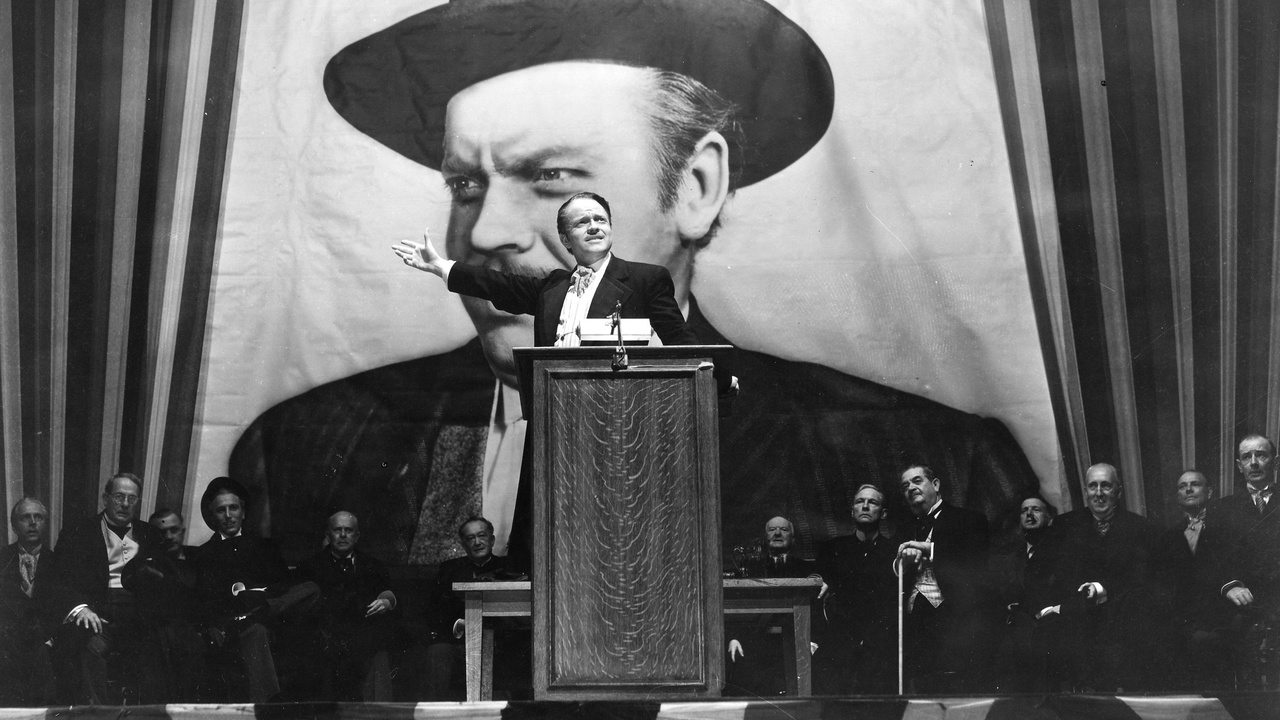
Director: Orson Welles · Cinematographer: Gregg Toland · Composer: Bernard Herrmann · Key Cast: Orson Welles, Joseph Cotten, Dorothy Comingore, Agnes Moorehead, Everett Sloane, Ruth Warrick, Ray Collins, George Coulouris · Runtime: 119 minutes · Studio: RKO Radio Pictures / Mercury Productions · Budget: $839,000 · Box Office: Lost approximately $150,000 in initial release
1. The Film That Taught Cinema How to Remember
Every discussion of Citizen Kane begins with the same problem: how do you say something new about the film that has been called the greatest ever made for the better part of a century? The answer is that you probably cannot, and the honest thing to do is to acknowledge that up front and then try anyway.
Here is what Citizen Kane is actually about, beneath the biographical framework and the mystery of Rosebud: it is about the impossibility of knowing another person. Charles Foster Kane is interviewed, eulogized, investigated, and reconstructed by five different narrators across multiple decades, and at the end of all that testimony, the reporter gives up. The audience learns what Rosebud means. The characters do not. And even the audience’s knowledge is incomplete, because a sled explains a childhood. It does not explain a life.
Welles was twenty-five years old when he made this film. That fact is so frequently cited that it has lost its capacity to shock, but it should not have. Twenty-five is an age at which most directors are assisting someone else. Welles, at twenty-five, produced the most formally innovative American film of its era and gave a lead performance that required him to age from a young idealist to a ruined old man across a single production. The audacity is not the youth. The audacity is the competence.
The film’s innovations have been exhaustively catalogued. Deep focus cinematography. Low-angle shots that showed ceilings. Non-linear narrative structure. Overlapping dialogue. Composite optical effects of unprecedented sophistication. None of these techniques were invented by Welles or Toland. All of them had precedents in German Expressionism, in French cinema, in earlier Hollywood productions. What Citizen Kane did was synthesize them into a unified visual and narrative language so coherent that it felt new. The individual ingredients were borrowed. The recipe was original.
The film is not without weaknesses, though admitting this feels almost transgressive given its canonical status. Dorothy Comingore’s Susan Alexander is written as a figure of pathos but played with a stridency that occasionally tips into caricature, particularly in the opera sequences. The Rosebud revelation, despite its emotional resonance, invites a reductive reading of Kane’s psychology that the rest of the film is sophisticated enough to resist. And the mystery structure, with Thompson moving from witness to witness, produces some pacing inconsistencies in the middle third.
But these are the flaws of a masterpiece, not the flaws of a lesser film. They exist within a work that redefined what cinema could do structurally, visually, and narratively, and they are dwarfed by the ambition and execution of everything around them.
Verdict: 10/10. The reputation is earned. Citizen Kane is not the greatest film ever made because a poll says so. It is the greatest film ever made because eighty-five years later, filmmakers are still learning from it, and the lessons have not been exhausted.
2. Welles at Twenty-Five: Playing God, Playing Old, Playing Himself
The performance is inseparable from the production. Welles did not simply act in Citizen Kane. He directed it, produced it, co-wrote it, and supervised every element of its visual design. The result is a performance shaped by total authorial control, which gives it a coherence that conventionally directed performances rarely achieve. Every angle from which Welles is photographed, every shadow that falls across his face, every edit that determines how long we look at him was decided by the man being looked at.
Kane as a young newspaper editor is Welles at his most naturally charismatic: fast-talking, physically loose, energetic to the point of recklessness. There is genuine joy in these scenes, a sense of a man drunk on his own talent and convinced that talent is the same thing as virtue. Welles plays youth not as innocence but as appetite, and the distinction is important. Kane is never naive. He is hungry, and the hunger is for everything: newspapers, political power, love, attention, art, real estate, the world itself.
The aging process is remarkable for 1941. Maurice Seiderman’s makeup took hours to apply and transformed Welles from a vital young man into a stooped, jowled figure moving through the caverns of Xanadu with the slow deliberation of someone for whom every step has become an effort. But the makeup is only half the performance. Welles changes his voice, his posture, his rhythm. Old Kane speaks in shorter sentences. He pauses before words. His body occupies space differently, taking up more room while seeming to contain less energy. The transformation is not just cosmetic. It is behavioral, and it is sustained across dozens of scenes without a single moment of inconsistency.
Joseph Cotten’s Jedediah Leland provides the film’s moral center, which is a thankless job in a story about a man who consumes everything around him. Cotten plays Leland with a wry sadness that deepens across the film. His drunk scene, in which Leland falls asleep at his typewriter while writing a negative review of Susan Alexander’s opera debut, is one of the great pieces of physical acting in American cinema: a man who has reached the end of his loyalty and can no longer stay awake for the pretense.
Agnes Moorehead, in her film debut as Kane’s mother, appears in only one significant scene and creates a character so complete that her absence from the rest of the film becomes a structural element. The boarding house scene, in which she signs away her son to the banker Thatcher, is played with a stillness that communicates everything the dialogue leaves unsaid. Her face as young Charles plays in the snow outside the window is the emotional foundation on which the entire film rests.
3. Toland’s Revolution: Deep Focus and the Democracy of the Frame
Gregg Toland asked to work on the film. He approached Welles, not the other way around. Toland was already the most celebrated cinematographer in Hollywood, having won the Academy Award for Wuthering Heights in 1939, and he saw in Welles’s inexperience an opportunity to experiment without the interference of a director who already knew the rules. Welles did not know the rules. Toland could therefore rewrite them.
The deep focus technique, in which both foreground and background remain in sharp focus simultaneously, was not new. What was new was its deployment as a narrative strategy rather than a visual effect. In the boarding house scene, three planes of action exist within a single composition: young Charles playing in the snow through the window (background), his mother and Thatcher negotiating his future at the table (midground), and his father protesting in the foreground. The audience’s eye is free to move between all three planes, to watch any of the three stories happening simultaneously. The technique democratizes the frame. It trusts the viewer to look where they choose, rather than directing attention through editing.
Toland achieved the deep focus through a combination of methods: faster film stock, smaller apertures, high-intensity arc lighting, and wide-angle lenses. The technical demands were extreme. The lighting required to maintain sharp focus across the full depth of the frame was so intense that the sets were uncomfortably hot. The smaller apertures reduced the amount of light reaching the film, requiring exposures so long that camera movement became nearly impossible. The visual beauty of the result conceals the physical difficulty of producing it.
The low-angle shots, which showed ceilings in an era when studio sets simply did not have them, required building complete rooms with fabric ceilings that could conceal microphones. The angles themselves serve a narrative function: Kane is shot from below when he is powerful, making him loom over the audience. As his power declines, the angles level, and by the time he is destroying Susan’s room at Xanadu, the camera is at his height or above. The visual grammar maps directly onto the arc of the character.
Welles shared the final screen credit with Toland, a gesture almost unheard of in 1941. The cinematographer’s name appears on the same title card as the director’s. It was Welles’s acknowledgment that the film’s visual identity was a genuine collaboration, not a hired service. The two men spent weeks before production with art director Perry Ferguson, planning every shot in miniature, rehearsing camera positions with a periscope on architectural models. The visual design of Citizen Kane was not discovered on set. It was engineered in advance, with the precision of an architectural project.
4. Bernard Herrmann and the Sound of American Ambition
Herrmann’s score for Citizen Kane was his first feature film composition, arriving before Psycho, before Vertigo, before Taxi Driver would be written by anyone. Like Welles, Herrmann was in his twenties and operating at a level that defied his experience. The score does not accompany the film. It argues with it.
The most audacious musical decision is the opera. Herrmann composed an original aria, “Salammbo,” for Susan Alexander’s disastrous debut. The piece is deliberately mediocre. It sits in a register that exposes the singer’s limitations, placing demands on the voice that a trained professional could meet but that Susan, with her modest talent, cannot. The music is designed to fail, and its failure is the point. Herrmann constructed a piece that sounds plausibly operatic to a general audience but that anyone with musical training can identify as cruel. It is a composition about the gap between ambition and ability, which is also what the film is about.
The score’s broader strategy is motivic. Herrmann builds short musical phrases and recombines them rather than developing extended melodies. This technique mirrors the film’s narrative structure, in which fragments of Kane’s life are assembled, rearranged, and recontextualized by different narrators. The music does what the screenplay does: it presents pieces rather than wholes, suggesting that the complete picture is always just out of reach.
The newsreel sequence uses pastiche brilliantly. Herrmann mimics the bombastic, patriotic scoring of actual newsreels so accurately that the parody disappears into the form. The transition from the newsreel’s false confidence to the quieter, more ambiguous music of the investigation scenes is itself a tonal argument. The public Kane has one soundtrack. The private Kane has another. Neither tells the whole truth.
The relationship between Herrmann and Welles would continue through The Magnificent Ambersons and several radio productions, but Citizen Kane remains the purest expression of their collaboration. Both men were maximalists working with the discipline of miniaturists, and the score reflects this: grand in its gestures, precise in its construction, never using a full orchestra where a smaller ensemble would cut deeper.
5. Rosebud and the Lie of Explanation
The wildcard this film demands is a section about its most famous element, because Rosebud is simultaneously the most celebrated and most misunderstood device in American cinema.
The common reading is sentimental: Rosebud is the sled, the sled represents childhood innocence, and Kane spent his entire life trying to recover what was taken from him when his mother sent him away. This reading is not wrong. It is simply incomplete, and the film knows it. Thompson, the reporter, says as much: “I don’t think any word can explain a man’s life.” The film gives the audience the answer to the mystery and then, in the same breath, tells them the answer does not matter.
What Rosebud actually does is expose the inadequacy of biographical investigation as a method for understanding a human being. The entire structure of the film is an investigation. Five witnesses. Multiple decades. Hundreds of facts. And at the end of all of it, the investigator knows nothing that matters. The audience knows one thing more than the investigator, and that one thing, the sled, is a detail so reductive that it almost mocks the effort that preceded it. Here is the answer to your question. It explains nothing.
Welles himself was ambivalent about Rosebud. He called it “dollar-book Freud” and acknowledged that it was the most criticized element of the film. But the criticism misses the structural function. Rosebud is not the film’s meaning. It is the film’s demonstration that meaning, in the biographical sense, is always reductive. You can burn a man’s possessions and find a clue. You can name the clue. You can identify the moment of origin. And you will still not know who he was.
The burning of the sled in the furnace is the film’s final image (before the “No Trespassing” sign returns to close the frame). Fire consumes the only piece of evidence that might have unlocked Kane’s interior life, and no one notices. The workers tossing objects into the furnace do not know what they are burning. The smoke rises from the chimney of Xanadu, and the camera pulls back, and the fence reappears, and the story ends where it began: on the outside, looking in, unable to enter.
This is not sentimentality. It is epistemology. The film is asking whether any person can ever be fully known, and its answer is no. The sled is not the point. The impossibility is the point.
6. Mankiewicz, Welles, and the Longest Credit Dispute in Hollywood
The authorship of the Citizen Kane screenplay is the most debated credit question in film history, and it has never been fully resolved. Herman J. Mankiewicz wrote the first drafts at a ranch in Victorville, California, recovering from an automobile accident and supervised (some would say monitored) by John Houseman. Welles revised extensively. How much of the finished screenplay belongs to each man depends on whom you ask and when you ask them.
Pauline Kael’s 1971 essay “Raising Kane,” published in The New Yorker and later as the introduction to The Citizen Kane Book, argued that Mankiewicz was the primary author and that Welles’s contribution was largely directorial rather than literary. The essay was influential, controversial, and, according to subsequent scholarship, substantially overstated. Peter Bogdanovich, Robert Carringer, and others demonstrated through analysis of drafts and production records that Welles made significant structural and dialogue revisions, particularly in the second half of the screenplay.
The credit reads “Screenplay by Herman J. Mankiewicz and Orson Welles.” Welles’s assistant Richard Wilson later recounted that the guild credit form originally listed Welles first, and that it was Welles himself who circled Mankiewicz’s name and drew an arrow placing it in the primary position. Whether this gesture reflects generosity, guilt, or political calculation is one of the smaller mysteries within the larger mystery of the film’s creation.
What the dispute obscures is that the screenplay, regardless of who wrote which line, is one of the most structurally innovative in American cinema. The non-linear narrative, organized around multiple narrators whose accounts contradict and complement each other, was unprecedented in mainstream filmmaking. The dialogue moves at the pace of real conversation, with overlaps and interruptions that would not become standard technique for another two decades. And the structure itself is an argument: that a life cannot be told in chronological order because a life is not experienced in chronological order. Memory edits. Memory reorganizes. Memory lies. The screenplay performs this truth rather than describing it.
7. Hearst, the Boycott, and the Film That Nearly Disappeared
William Randolph Hearst did not see Citizen Kane before he decided to destroy it. He did not need to. His gossip columnist, Louella Parsons, attended a preview screening and reported back. Hedda Hopper, Parsons’s rival, attended uninvited and wrote negatively about the film. The Hearst newspaper chain banned any mention of Citizen Kane, any advertising for it, and, according to some accounts, any mention of RKO’s other films as well. The campaign was effective. Theaters that depended on Hearst newspaper advertising declined to book the film. The planned premiere at Radio City Music Hall was cancelled.
The film opened on May 1, 1941, not at a prestigious Hollywood venue but at a former vaudeville hall on Broadway. Reviews were overwhelmingly positive. The New York Times praised it. John O’Hara, writing in Newsweek, called it the best picture he had ever seen and declared Welles the best actor in the history of acting. The enthusiasm of the critics could not overcome the practical reality that a significant percentage of American theaters would not show the film. It closed its initial run with a loss of approximately $150,000.
Hearst reportedly offered to purchase the negative for more than it had cost to produce, with the intention of destroying every print. RKO declined. The film survived, but it vanished from public consciousness for more than a decade. Its resurrection began in France, where André Bazin and the critics of Cahiers du Cinéma recognized it as a watershed in film language. A 1956 American reissue brought it back to domestic audiences. By the time the British Film Institute’s Sight & Sound poll first placed it at number one in 1962, the film had completed one of the most remarkable journeys in cinema history: from commercial failure to consensus masterpiece within twenty years.
The Hearst episode is not merely colorful backstory. It is the proof of the film’s central argument. Kane/Hearst tried to control his own narrative. Welles created an alternative narrative. Hearst tried to suppress it. Time overruled him. The man who believed he could shape reality through his newspapers was ultimately powerless against a single film. The irony would not have been lost on Welles.
8. Nine Nominations, One Win, and the Oscars as a Political Document
Citizen Kane received nine Academy Award nominations at the 14th ceremony in February 1942: Best Picture, Best Director, Best Actor, Best Original Screenplay, Best Cinematography, Best Art Direction, Best Sound, Best Score, and Best Film Editing. It won only for Best Original Screenplay.
The loss of Best Picture to How Green Was My Valley is routinely cited as the greatest Oscar mistake in history, and the narrative has hardened into received wisdom: the industry punished Welles for his arrogance and sided with the establishment. The reality is more complicated. How Green Was My Valley is a fine film directed by John Ford, who was already the most respected filmmaker in Hollywood. The Academy’s membership in 1942 was conservative, and Welles, a twenty-five-year-old outsider who had arrived from theater and radio with an unprecedented contract, was not popular with the establishment.
Reports from the ceremony suggest that Citizen Kane was booed whenever it was announced as a nominee. Whether this hostility reflected genuine aesthetic disagreement, loyalty to Hearst, resentment of Welles’s contract, or some combination of all three is impossible to determine at this distance. What is clear is that the single win, for screenplay, was a compromise. The Academy could not ignore the film entirely. It also could not crown it.
The long-term consequence of the Oscar snub was paradoxically beneficial. Had Citizen Kane won Best Picture in 1942, it would have been absorbed into the industry’s self-congratulatory narrative: Hollywood recognizes greatness. Instead, the loss became part of the film’s mythology: greatness rejected by its own industry, validated only by time. The narrative of the misunderstood masterpiece is more compelling than the narrative of the awarded one, and it gave Citizen Kane a counter-cultural cachet that a shelf of golden statues could never have provided.
9. Eighty-Five Years of Influence, and Counting
Citizen Kane topped the Sight & Sound poll for five consecutive decades, from 1962 through 2002. It was displaced by Vertigo in 2012 and fell further in the 2022 poll, where generational turnover and a broader, more globally diverse voter base reshaped the canon. The decline in polling position does not represent a decline in influence. It represents a maturation of the conversation. The question is no longer whether Citizen Kane is the greatest film ever made. The question is whether the concept of “the greatest film ever made” is itself useful.
The film’s technical innovations have been so thoroughly absorbed into the language of cinema that they have become invisible. Deep focus is standard. Non-linear narrative is a screenwriting convention. Low-angle compositions are in every director’s toolkit. Overlapping dialogue is naturalism. The visual grammar that Welles and Toland invented has become the grammar itself, which means that modern audiences watching Citizen Kane for the first time often wonder what the fuss is about. Everything in the film looks familiar. It looks familiar because everything that came after it learned from it.
The influence extends beyond technique. Citizen Kane demonstrated that a commercial American film could operate as a work of intellectual ambition without sacrificing entertainment value. It proved that narrative fragmentation could be more compelling than chronological storytelling. It established the director as the primary creative force in filmmaking, a concept that French critics would formalize as the auteur theory two decades later. It showed that a debut filmmaker, given sufficient freedom, could produce a masterwork.
The film’s influence on specific directors is well documented. Scorsese’s biographical epics owe their structural DNA to Kane. Fincher’s approach to institutional power draws from the same well. Nolan’s non-linear narratives follow paths that Welles cleared. The Coen Brothers’ visual compositions frequently echo Toland’s deep focus. The list is long enough to become meaningless. At a certain point, influence becomes atmosphere. Citizen Kane is not a film that influenced other films. It is the air that other films breathe.
10. What Changes When You Know What Rosebud Means
Citizen Kane is one of the rare films that improves with every viewing because the mystery, once solved, reveals itself as the least interesting element. Freed from the question of what Rosebud means, you can attend to how the film thinks.
Watch the transitions between narrators. Each narrator’s account begins from a specific emotional position. Bernstein remembers Kane with loyalty and warmth. Leland remembers him with disillusioned affection. Susan remembers him with exhaustion and resentment. The same events, refracted through different relationships, produce different films. On rewatch, track how the visual style shifts subtly to match each narrator’s emotional register. Bernstein’s sections are warmer. Susan’s are harsher. The cinematography adjusts to the storyteller.
Count the mirrors and reflections. Kane is frequently seen reflected in glass, in mirrors, in polished surfaces. The reflections multiply as his power grows and his relationships decay. By the time he walks through the hall of mirrors at Xanadu, the multiplied images are not a stylistic flourish. They are a portrait of a man who has become nothing but surface, endlessly reproduced and endlessly empty.
Listen to the sound design in the Xanadu sequences. Every voice echoes. Every footstep reverberates. The mansion is acoustically designed to make human presence feel small. The sound team created this effect by recording dialogue in actual cavernous spaces rather than in the studio, and the resulting hollowness makes Xanadu feel not like a home but like a monument to loneliness. A mausoleum for the living.
Track the breakfast table montage. Kane and his first wife, Emily, are shown at breakfast over a span of years, their conversation shrinking from affectionate banter to hostile silence. The sequence lasts less than three minutes and compresses an entire marriage. On rewatch, notice that the table grows physically longer in each successive shot. The distance between them is literal. The production design is doing the work of dialogue.
Revisit the snow globe. It appears in the first scene and the last. On first viewing, it is a symbol. On second viewing, notice how the glass catches light differently each time it is shown. The reflections inside the globe change depending on where Kane is when he holds it. The snow globe is not a static object. It is a lens, and what it shows depends on the angle of the viewer. Which is, of course, the film’s entire argument.
Film Trivia
Welles called the studio “the greatest railroad train a boy ever had.” When RKO executives visited the set unannounced, Welles instructed his crew to start a baseball game and walked off. The contract that gave him final cut privilege was unprecedented for a first-time director and has never been replicated on such terms for a debut filmmaker since.
The pterodactyls stayed. During the picnic sequence, back-projection footage was borrowed from King Kong (1933). On closer inspection, the birds flying past in the background are visibly pterodactyls from the earlier film. RKO told Welles to remove them. He liked them and kept them in the final cut.
Toland volunteered. The most celebrated cinematographer in Hollywood approached Welles, not the other way around. Toland saw an inexperienced director as an opportunity to experiment without resistance, and the gamble produced the most influential cinematography in American film history. Welles repaid the faith by placing Toland’s credit on the same title card as his own directing credit, a gesture without precedent in the studio system.
The film was almost purchased and burned. William Randolph Hearst reportedly offered more than the production budget to buy the negative and destroy all prints. RKO refused, but Hearst’s newspaper boycott was effective enough to make the film a commercial failure. The most celebrated American film of the twentieth century lost money on its initial release.
Most of the principal actors were new to motion pictures. The end credits include an unusual statement noting that most of the cast were film newcomers, drawn from Welles’s Mercury Theatre company. Agnes Moorehead, Joseph Cotten, and Everett Sloane all made their feature film debuts or near-debuts in the production. Welles populated his first film with people who had no Hollywood habits to unlearn.
This entry selects analytical dimensions from a pool. The five anchors are present: critical verdict, performances, visual craft, reception and legacy, and rewatchability guide. Earned sections cover the score, the screenplay’s contested authorship, the Hearst controversy, and awards history. One wildcard section, “Rosebud and the Lie of Explanation,” examines the film’s most famous device as an argument about the limits of biographical knowledge rather than a sentimental symbol. A section on production history is folded into the cinematography and authorship discussions rather than standing alone, to avoid redundancy.

Leave a Reply