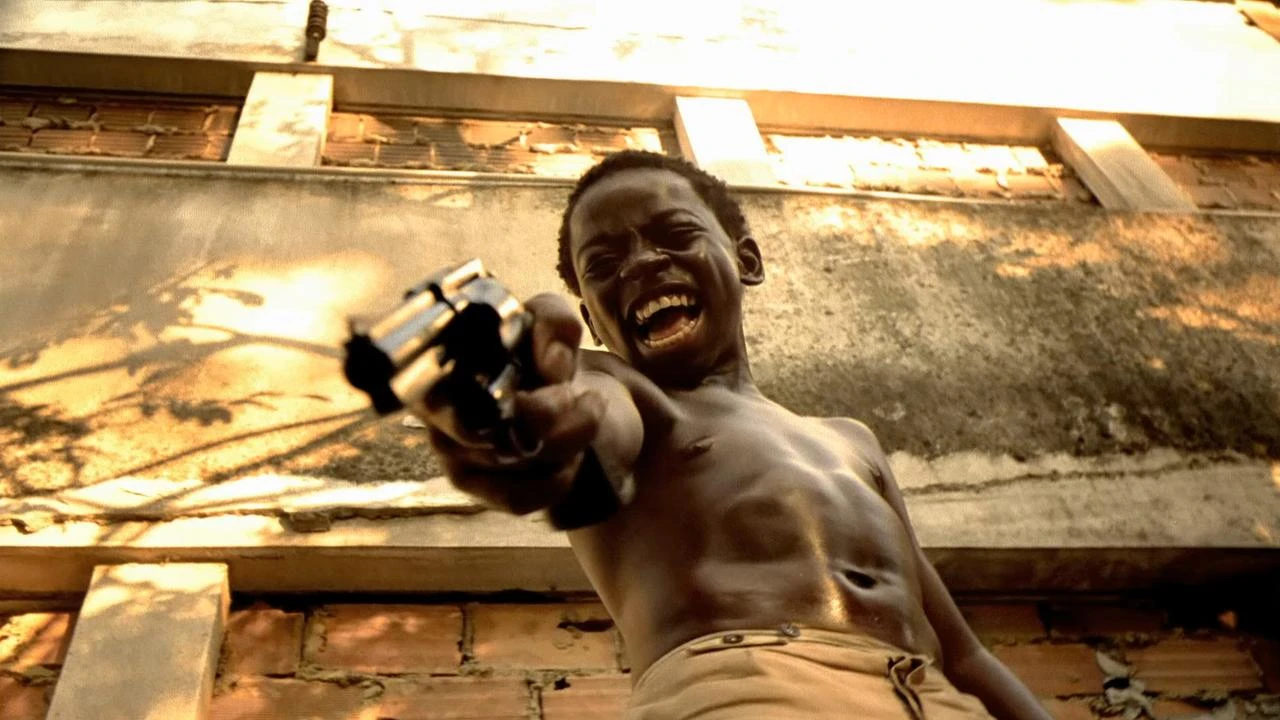
Director: Fernando Meirelles & Kátia Lund · Cinematographer: César Charlone · Composer: Antonio Pinto & Ed Córtes · Key Cast: Alexandre Rodrigues, Leandro Firmino, Douglas Silva, Phellipe Haagensen, Seu Jorge, Alice Braga · Runtime: 130 minutes · Studio/Distributor: O2 Filmes / VideoFilmes / Globo Filmes (Miramax, US) · Budget: $3.3 million · Box Office: $30.7 million worldwide
City of God: A Masterpiece Built on Ground Nobody Wanted to Look At
There is a housing project on the outskirts of Rio de Janeiro called Cidade de Deus. It was built in the 1960s to relocate flood victims and the urban poor to a place far enough from the city center that their existence could be conveniently forgotten. Over the next two decades, the project became one of the most violent places on Earth. Children ran drug operations. Teenagers settled territorial disputes with automatic weapons. The police arrived, collected bribes, and left. God’s city had no god in it.
Fernando Meirelles and Kátia Lund’s film does not observe this world from a safe distance. It throws you into the middle of a chicken chase on a sun-drenched street, surrounds you with armed teenagers, and begins running. The camera runs because the characters run. The editing cuts because bullets cut. The narration, provided by the young photographer Rocket, unfolds with the breathless authority of someone telling you a story they barely survived. You are not watching poverty. You are inside it, moving at its speed, breathing its air.
City of God spans three decades of life in the favela, from the small-time holdups of the 1960s Tender Trio through the psychopathic empire-building of Li’l Zé in the late 1970s to the gang war that engulfs the neighborhood in the early 1980s. The structure is novelistic: dozens of characters enter and exit, their stories overlapping and colliding like molecules in a heating solution. Each story is distinct, but the pattern is always the same. Someone acquires a gun. Someone builds a territory. Someone dies. Someone younger takes over. The cycle is the subject.
The film has been criticized for aestheticizing violence, for making a spectacle of suffering, for exporting Brazilian poverty as entertainment. These are serious charges, and they deserve serious engagement. But City of God does not glamorize the world it depicts. It does something more complicated and more honest: it makes that world vivid enough to be felt. The glamor, where it exists, belongs to Li’l Zé and Benny and the other drug lords who build their power on charisma and fear. It is their glamor, not the film’s. Meirelles photographs their swagger because swagger is how they survive. The camera does not endorse it. It records it.
Verdict: 10/10. City of God is one of the great crime epics, a film that belongs in the same conversation as Goodfellas and The Godfather while owing its power to a tradition entirely its own. Its energy is ferocious, its scope enormous, and its humanity persistent even in its most violent sequences. It does not sentimentalize poverty. It does not look away from brutality. It looks directly at both and finds, in the space between them, a boy with a camera trying to see clearly.
César Charlone’s Camera: Handheld, Sun-Bleached, and Running for Its Life
The visual strategy of City of God is built on a deliberate tension between rawness and precision. Cinematographer César Charlone, a Uruguayan with a background in documentary work, shot the film using a combination of 35mm for wide shots and landscapes and 16mm for close-ups, dialogue scenes, and the interiors of the favela. The 16mm stock adds a graininess that the film exploits rather than conceals. The texture looks like heat. It looks like dust. It looks like a photograph taken in harsh light with imperfect equipment, which is exactly what Rocket, the narrator, would produce.
Charlone’s framing shifts registers to match the film’s three-decade timeline. The 1960s sequences are photographed with more stability and wider compositions, reflecting a period when the favela was merely poor rather than lethal. As the story moves into the 1970s and 1980s, the camera grows tighter, more agitated, more handheld. The visual grammar mirrors the escalation of violence. By the final gang war, the camera is practically sprinting alongside the characters, dodging around corners, whipping to follow gunfire.
The color palette is equally considered. Charlone bathes the favela in hot, desaturated tones that make the sunlight look oppressive rather than warm. The sky is white. The walls are bleached. The rare moments of color saturation, such as Benny’s farewell party, feel almost surreal against the prevailing palette, and their vividness makes the return to harshness even more punishing.
The chicken chase that opens the film is a miniature masterclass. The chicken was not scripted to bolt; it escaped during filming, and Charlone followed it with the camera, producing a sequence of chaotic, breathless handheld footage that Meirelles recognized as the perfect opening. The chase establishes the film’s visual contract immediately: this camera will follow whatever is moving, wherever it goes, however dangerous the territory. It will not wait for you to catch up.
Non-Actors, Real Favelas, and the Children Who Play Killers
Almost the entire cast of City of God was drawn from the communities the film depicts. Alexandre Rodrigues, who plays Rocket, was a resident of Vidigal. Leandro Firmino, who plays Li’l Zé, came from the favelas. Most of the young actors had no prior experience. They were recruited through a months-long process organized by the production team and acting coach Fátima Toledo, who ran workshops that trained roughly a hundred young people in improvisational technique before casting began.
Toledo’s method was immersive and occasionally aggressive. To generate authentic hostility between the characters Dadinho (Li’l Dice) and Marreco, she instructed actor Renato de Souza to bully Douglas Silva, who was playing the young Dadinho, for two weeks. The slap that Marreco delivers on screen, and Silva’s furious, tearful reaction, were entirely real. In another scene, young actor Felipe Paulino was guided to imagine an intense physical pain traveling through his body to produce the terror visible in his face as Li’l Zé forces him to choose between being shot in the hand or the foot.
The ethics of these methods are worth scrutinizing. Toledo’s coaching produced performances of astonishing authenticity, but it did so by inducing genuine distress in children. The line between directing a performance and causing harm is not always clear, and City of God’s most disturbing scenes sit directly on that line. The film’s power owes much to the fact that the fear you see on screen was real fear, which is both an artistic triumph and an ethical complication.
After filming, the production team established Nós do Cinema (“We From the Cinema”), an assistance program designed to help cast members transition into professional careers. The results were mixed. Some, like Alice Braga, built successful international careers. Others returned to the favelas and proved difficult for documentarians to locate a decade later. The film changed Brazilian cinema, expanding the country’s acting community and accelerating production. Whether it changed the lives of the people who made it is a more complicated question.
Daniel Rezende’s Cuts: When Time Becomes a Weapon
The editing of City of God is not a technical element in service of the story. It is the story. Daniel Rezende, who received an Oscar nomination and won the BAFTA for his work, constructs the film as a series of narrative accelerations and temporal loops that make time itself feel predatory.
The film’s structure borrows from Pulp Fiction’s playbook of non-linear narration, but the purpose is different. Tarantino rearranges time for ironic effect. Meirelles and Rezende rearrange time to demonstrate how violence reproduces itself across generations. The film begins at the end, loops back to the beginning, tells three decades of history in overlapping chapters, and returns to the opening scene with the audience now understanding every figure in the frame. The circularity is not a narrative trick. It is the thesis. The cycle repeats. The names change. The guns stay.
Within individual sequences, Rezende’s cutting rhythm is extraordinarily fluid. He can sustain a scene for minutes when the drama requires patience, as in the extended sequence of Benny’s farewell party, where the editing relaxes into the music and allows the viewer to feel the brief, fragile happiness of a community enjoying itself. Then he can cut a scene down to fractions of seconds, layering freeze frames, split screens, on-screen text, and rapid montage to compress years of gang warfare into minutes of screen time.
The freeze frames deserve special attention. Rezende uses them not as stylistic flourishes but as moments of narrative identification. When Rocket introduces a new character, the frame freezes and a title appears. The device is borrowed from documentary technique, and it serves a dual function: it tells you the character’s name, and it tells you that this character matters enough to be named. In a film where dozens of young men die anonymously, the act of naming them is itself a statement.
Antonio Pinto’s Score and the Pulse of a Neighbourhood
Antonio Pinto’s original score does not sit on top of City of God. It burrows into the film’s rhythmic DNA and becomes indistinguishable from the ambient noise of the favela. Percussion dominates. The beats are influenced by Brazilian funk, samba, and Afro-Brazilian drumming traditions, and they accelerate and decelerate in sync with the film’s editing rhythm. When the violence intensifies, the drums intensify. When the film pauses for breath, the score drops to a murmur.
The licensed music is equally important. The soundtrack spans three decades of Brazilian and American popular music, from samba to James Brown to Raul Seixas, and the selections mark the passage of time as precisely as the production design does. The 1960s sequences are accompanied by traditional Brazilian sounds. By the time the 1970s arrive, American funk and soul have penetrated the favela, carried by the same globalized drug economy that is transforming the neighborhood. The music does not merely date the scenes. It tracks the cultural forces that are reshaping the community from the outside.
The opening chicken chase is scored with a percussive frenzy that sounds like the inside of a panic attack. The farewell party, the film’s single scene of unguarded happiness, is set to music that makes you want to dance and simultaneously fills you with dread, because by this point in the film you know that any moment of joy in the Cidade de Deus is a countdown to something terrible.
Paulo Lins’s Novel and the Distance Between Page and Screen
City of God is adapted from Paulo Lins’s 1997 novel of the same name, a sprawling, 600-page chronicle based on over a decade of sociological research Lins conducted in the real Cidade de Deus. Lins grew up in the favela. He studied anthropology and worked as a research assistant before transforming his fieldwork into fiction. The novel is dense, populated by hundreds of characters, and written in a style that blends literary prose with the street slang of Rio’s poorest neighborhoods.
Bráulio Mantovani’s screenplay performs an act of radical compression. The novel’s vast character network is condensed into a handful of central figures. Rocket and Li’l Zé, who occupy less prominent positions in the novel, become the film’s twin protagonists. Entire subplots are excised. The novel’s more explicit engagement with the economics of drug trafficking and the complicity of state institutions is streamlined into a visual narrative that communicates these structures through atmosphere rather than exposition.
The adaptation’s most significant choice is the point of view. Lins’s novel is omniscient, moving between perspectives with the freedom of a sociological study. The film gives everything to Rocket. His narration, his perspective, his camera. This decision sacrifices some of the novel’s analytical breadth in exchange for emotional coherence. You experience the favela through the eyes of someone who lives there but stands slightly apart from its violence, and that partial distance is what makes the film bearable. Without Rocket, City of God would be an assault. With him, it is a story about surviving an assault.
Meirelles, Lund, and the Question of Who Tells This Story
Fernando Meirelles is a white, middle-class filmmaker from São Paulo. He had visited a favela once or twice before being introduced to Paulo Lins. He had no lived experience of the world the film depicts. He knew this was a problem, and he addressed it by inviting Kátia Lund as co-director.
Lund had directed News from a Personal War, a documentary about favela life, and she had relationships within the communities that Meirelles needed to access. Her role was primarily with the cast: recruiting young people from the favelas, running the months-long acting workshops, and working on set to draw authentic performances from non-professionals. She did not choose the crew, and she did not determine the visual style. But without her, the cast would not have existed, and without the cast, the film would not be what it is.
The Academy did not nominate Lund for Best Director alongside Meirelles, a decision that reflected both the institution’s historical discomfort with co-directors and a more specific failure to recognize the collaborative nature of the film’s achievement. Meirelles has been careful to credit Lund publicly, but the imbalance in recognition persists.
The question of who has the right to tell stories about communities they did not grow up in does not have a simple answer. What can be said is that Meirelles’s approach was deliberate. He embedded himself in the community, hired from it, trained within it, and tried to make a film that would feel authentic to the people it depicted while reaching an audience far beyond them. The tension between outsider perspective and insider experience is built into the film’s DNA, and it is a productive tension rather than a resolved one.
Favelas, Housing Projects, and Brazil’s Invisible Cities
Cidade de Deus was not born from neglect. It was built by the state. In the 1960s, the Brazilian government constructed the housing project to relocate thousands of people displaced by floods and urban clearance projects. The residents were moved to the outskirts of Rio de Janeiro, far from employment, infrastructure, and public services, and then largely abandoned. What followed was not a failure of planning. It was the entirely predictable consequence of concentrating poverty, removing economic opportunity, and withdrawing institutional support.
The film does not explain this history in a lecture. It shows it. The opening 1960s sequences depict a community that is poor but functional. Children play. Families gather. The Tender Trio commits small holdups with a spirit closer to mischief than malice. Then the drug economy arrives, and with it comes weaponry that transforms interpersonal disputes into warfare. The escalation across the film’s three decades is not a story about bad people in a bad place. It is a story about what happens when a society builds a container, fills it with people it does not want, and removes every exit except the ones that involve a gun.
Meirelles could not film in the actual Cidade de Deus because the real favela was too dangerous during production. Most of the film was shot in Cidade Alta, a different favela, with local security guards hired by the community’s unofficial authorities. The production existed inside the same structures of informal power that the film depicts, which is either ironic or instructive depending on how you read it.
Goodfellas in the Tropics? Why the Comparison Flatters and Misleads
The Goodfellas comparison is inevitable and understandable. Both films use first-person narration by a character adjacent to violence. Both employ freeze frames, non-linear structure, and needle-drop soundtracks to compress decades of criminal enterprise into two hours of kinetic cinema. Both treat the rise and fall of gang hierarchies as a subject worthy of novelistic scope.
But the comparison obscures more than it reveals. Goodfellas is about men who choose crime because it offers a better life than the legal alternatives available to them. Henry Hill could have been a working-class New Yorker. He chose not to be. City of God is about children who enter the drug trade because no other economy exists in their neighborhood. Li’l Dice does not choose crime over a legitimate career. There is no legitimate career. The question of moral agency that animates Goodfellas is largely absent from City of God, replaced by a more structural argument about what happens when an entire community is denied access to legal economic life.
Scorsese’s camera loves its gangsters. It admires their suits, their meals, their entrances. Meirelles’s camera loves its favela, not its gangsters. The distinction is crucial. City of God’s most visually exuberant sequences are about the community: the football games, the dance scenes, the washing lines and crowded streets. The violence, when it comes, is photographed with urgency rather than relish. The camera does not linger on wounds the way Scorsese lingers on the aftermath of a beating. It moves through violence the way the characters do: quickly, because staying still will kill you.
The more useful comparison might be to the work of the Brazilian Cinema Novo movement of the 1960s, particularly Glauber Rocha’s Black God, White Devil, which explored poverty and violence in the Brazilian Northeast with a political intensity that City of God inherits and transforms. Where Cinema Novo used stylistic austerity as a political statement, City of God uses stylistic excess to the same end. The energy of the filmmaking mirrors the energy of the community. Both are relentless, resourceful, and unwilling to wait for permission.
Hand or Foot: When Children Become the Horror
There is a scene in City of God that separates it from every other crime film ever made. Li’l Zé has cornered two boys, neither older than eight or nine, who belong to a rival gang of children called the Runts. He forces them to choose: shot in the hand or the foot. Then he shoots one of them.
The scene is not staged for shock. It is staged for recognition. This is what happens here. This is what happens when children are given guns and told that territory is everything. The boy’s scream is the sound of a childhood ending, not metaphorically but literally, in a concrete act of violence committed by a teenager against a child in broad daylight while other teenagers watch.
What makes the scene so devastating is the acting. Douglas Silva, who plays the young Li’l Dice (Li’l Zé’s childhood incarnation), was a child himself during filming. He delivers a performance of casual cruelty that is more frightening than any adult villain in the film because it communicates the total normalization of violence. Li’l Dice does not struggle with what he does. He enjoys it. He has been shaped by a world in which power is the only currency, and he is learning to spend it.
The scene also functions as the film’s moral thesis. Crime films typically protect children. The children in The Godfather play innocently while adults negotiate power. In City of God, the children are the negotiation. They are the soldiers, the dealers, the casualties. The film’s most radical argument is not that poverty produces violence. It is that poverty produces a world in which childhood itself becomes a casualty, where the distinction between child and combatant dissolves, and where the moral categories adults rely on to organize their understanding of the world no longer apply.
Four Oscar Nods, Zero Foreign Language Recognition, and a Country Transformed
City of God premiered out of competition at the 2002 Cannes Film Festival and opened in Brazil later that year. When Miramax acquired the US distribution rights, the film crossed over to international audiences with an impact that few non-English-language films have matched. On a budget of $3.3 million, it grossed over $30 million worldwide.
The Academy Award nominations arrived as a paradox. The film received four nods: Best Director, Best Adapted Screenplay, Best Cinematography, and Best Film Editing. It won none of them. More bewilderingly, it was not nominated for Best Foreign Language Film. It had been Brazil’s official submission the previous year and had failed to make the shortlist. By the time the wider nominations came through, the eligibility window for the foreign language category had closed. The result was a film recognized as among the best-directed, best-shot, best-written, and best-edited of the year, but not acknowledged as the best film in a language other than English. The absurdity speaks for itself.
The film’s impact on Brazilian cinema was immediate and lasting. Before City of God, there were almost no professional Black actors in Brazil’s film industry. The success of the film and the training programs associated with it expanded the industry’s talent pool and its sense of what stories could be told. Meirelles has stated that the film influenced public policy as well, with former President Lula crediting it with shaping discussions about security and inequality. In June 2025, The New York Times ranked it fifteenth on its list of the best films of the twenty-first century.
The legacy extends beyond rankings. City of God demonstrated that a film made with non-professionals, in a language spoken outside Hollywood, about a community most audiences had never considered, could compete at the highest level of world cinema. It did not ask for permission. It did not wait for an invitation. It arrived fully formed, and the world adjusted.
What the Editing Teaches You on the Second Pass
City of God is one of those films that moves so fast on first viewing that you absorb it as sensation rather than structure. The second viewing is where the architecture reveals itself.
Track the visual motifs that connect the three decades. Chickens appear in each era. Guns appear in each era, but they change: handguns in the 1960s, revolvers in the 1970s, automatic weapons in the 1980s. The progression is never commented on. It is simply present, and it tells you everything about the escalation the film is tracking.
Watch Rocket’s position in the frame. In the early sections, he is peripheral, glimpsed at the edges of scenes that belong to other characters. As the film progresses and his narration gains confidence, he moves toward the center. By the final act, when he begins photographing the gang war, he is the camera. The frame becomes his point of view. The film’s visual language and the character’s professional ambition converge.
Pay attention to the chapter titles and how they subdivide the narrative. Each named section focuses on a different character or group, and the film tells you the story of each one from beginning to end before looping back to the main timeline. This creates a mosaic effect that mimics the experience of knowing a community: you learn people’s stories piecemeal, from different angles, with gaps and overlaps. On a rewatch, you can track how the chapters interlock and how minor figures in one chapter become central figures in the next.
Listen for the moments of silence. In a film this loud and kinetic, they are rare and deliberate. The silence after the Runts shooting. The silence when Rocket holds his camera and understands that his photographs will be published. These pauses are the film’s equivalent of holding its breath, and they carry more emotional weight than any of the gunfire.
Film Trivia
The chicken that wrote the opening. The famous chicken chase was not in the original script as filmed. During shooting, the chicken escaped and Charlone instinctively chased it with his camera. The resulting footage was so dynamic and chaotic that Meirelles restructured the film’s opening around it. Charlone later credited God with being more creative than the filmmakers.
Real bullying for a real reaction. Acting coach Fátima Toledo instructed actor Renato de Souza to physically bully young Douglas Silva for over two weeks before filming their confrontation scene. Silva’s tears and anger were genuine. Toledo’s immersive coaching methods were controversial but produced performances from non-professionals that no conventional technique could replicate.
The Oscar snub that makes no sense. City of God was Brazil’s official submission for Best Foreign Language Film at the 75th Academy Awards, but failed to make the shortlist. A year later, its wider US release earned it four other Oscar nominations. The film was apparently good enough for Best Director and Best Cinematography, but not for the one category specifically designed to recognize it. Kátia Lund’s name was also excluded from the Best Director nomination, a decision attributed to the Academy’s then-restrictive policy on co-directors.
The photographer shoots his own scene. Cinematographer César Charlone insisted that Alexandre Rodrigues, who plays the photographer Rocket, actually operate the camera himself for the film’s climactic photographs. Charlone taught Rodrigues how to handle the equipment, believing that the physical act of operating a camera would produce an authenticity no acting technique could match.
This entry selects analytical dimensions from a pool. All five anchors are present: the critical verdict, performances, visual craft, reception and legacy, and the rewatchability guide. Earned sections cover the editing (which functions as a co-author of the narrative), the score, the source material adaptation, the directors’ collaborative approach, cultural and historical context, and genre lineage. One wildcard section addresses the element that distinguishes this film from every other crime epic: the use of children as both perpetrators and victims of violence, collapsed into a single unbearable scene. Awards and production history are folded into the reception section. A second wildcard was considered for the chicken chase but is integrated into the cinematography section instead, where it belongs.

Leave a Reply