Director/Writer/Editor: Abbas Kiarostami · Cinematographer: Ali Reza Zarrindast · Music: Kambiz Roushanavan · Key Cast: Hossain Sabzian, Mohsen Makhmalbaf, Abolfazl Ahankhah, Mehrdad Ahankhah, Mahrokh Ahankhah, Hossain Farazmand (all playing themselves) · Runtime: 98 minutes · Studio: Kanoon · Country: Iran · Language: Persian
The Most Honest Film Ever Made About Lying
Here is the premise. A poor, unemployed cinephile named Hossain Sabzian impersonates the famous Iranian director Mohsen Makhmalbaf. He convinces a middle-class Tehran family, the Ahankhahs, that he is preparing a new film and wants to cast them in it. He visits their home repeatedly over two weeks. He borrows a small amount of money. He is exposed, arrested, and brought to trial. That is the crime.
Here is what makes it a masterpiece. Abbas Kiarostami heard about the case, abandoned the film he was about to shoot, persuaded the judge to let him film the trial, then convinced every person involved to reenact the events of the story for his camera. The accuser, the accused, the journalist who broke the story, the family who pressed charges, the director who was impersonated, and the filmmaker making the film about all of it: every person on screen is playing themselves. The boundary between what is documented and what is staged does not blur. It evaporates.
Close-Up is not a documentary. It is not fiction. It is not a courtroom drama or a character study or a meditation on cinema, though it functions as all of these. What it is, most precisely, is a film about the gap between who you are and who you believe you deserve to be, made by a director who understood that the only honest way to explore that gap was to refuse the safety of a fixed form.
Sabzian’s crime is small. He borrowed 1,900 tomans for a taxi. He told lies. He performed a role. But the film treats his crime as though it were philosophically enormous, because it is. What Sabzian did was not fraud in any meaningful financial sense. It was something more unsettling: he proved that identity is a performance, that social respect flows to names rather than to people, and that a poor man reading a book on a bus can become someone else simply by saying so. The Ahankhah family was not robbed of money. They were robbed of certainty. They could no longer trust that people are who they claim to be. For a society built on hierarchies of class and reputation, that is a more dangerous theft than any sum of cash.
Kiarostami does not judge Sabzian. He does not excuse him either. He does something rarer and more difficult: he takes Sabzian’s suffering seriously without dismissing the suffering he caused. The courtroom scenes, filmed as they actually happened, give Sabzian space to explain himself, and his explanations are heartbreaking, self-serving, contradictory, and sincere. He loved Makhmalbaf’s films. He wanted to make art. He wanted to be treated with dignity. He wanted, for a few weeks, to be someone whose words mattered. Every one of these desires is human. Every one of them was fulfilled through deception. The film holds both facts at once and does not flinch.
This is cinema at its most radical: not because of what it shows, but because of what it refuses to resolve. Close-Up asks whether a man who lied about being an artist was, in the act of lying, doing something artistic. It does not answer. That refusal is the answer.
Verdict: 10/10
Everyone Plays Themselves, and That Is the Problem
The opening credits of Close-Up list every cast member as playing “himself” or “herself.” This is technically accurate and philosophically explosive. If Sabzian is playing himself, is he acting or testifying? If the Ahankhahs are reenacting their own deception, are they performing or remembering? If Makhmalbaf shows up as Makhmalbaf, is his presence documentary or cameo?
The film’s entire structure depends on this ambiguity, and every person on screen navigates it differently.
Sabzian is the center. He is not a trained actor, and yet what he does on screen is unmistakably a performance. In the courtroom, his testimony oscillates between raw confession and practiced rhetoric. He knows the camera is watching. He knows this is his chance to explain himself to an audience larger than any courtroom could hold. His sentences have a rhythmic quality, a rising emotional cadence that suggests he has rehearsed these feelings, if not these exact words. When he says that cinema is his only escape from the suffering of poverty, the statement is both genuine and strategic. It is both true and a performance of truth. Kiarostami’s genius is to let us see both layers without forcing us to choose one.
The Ahankhahs are compelling for the opposite reason. Where Sabzian performs sincerity, the family performs restraint. Mr. Ahankhah, the father, is visibly uncomfortable on camera, and his discomfort reads as credibility. He does not dramatize his grievance. He states it plainly: this man came into our home, ate our food, told us lies, and took our money. The modesty of the complaint makes it more powerful than any dramatic speech could. Mrs. Ahankhah, by contrast, reveals flashes of genuine hurt during the reenacted bus scene, a reminder that the deception began with a conversation she thought was friendly.
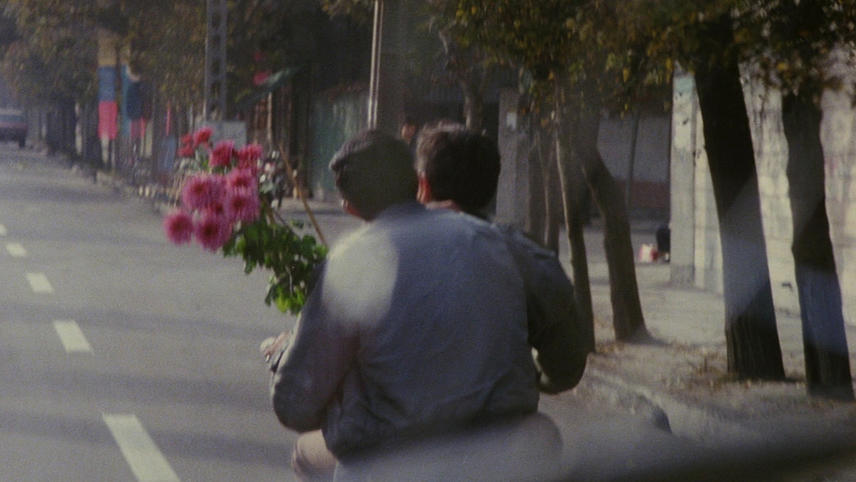
And then there is Makhmalbaf. The real Makhmalbaf appears in the final sequence, meeting Sabzian for the first time outside the prison. His presence creates a vertiginous loop: the man who was impersonated now stands beside the man who impersonated him, and both of them are being filmed by a third man who is making a movie about the impersonation. Makhmalbaf is gracious, buying Sabzian flowers, riding a motorcycle through Tehran. His generosity is touching and also, inevitably, a performance of generosity, because the camera is there, because it is always there.
Close-Up makes one thing clear: there is no way to play yourself on camera without performing. The act of being filmed transforms presence into performance. Kiarostami understood this before anyone else did, and he built an entire film on the understanding.
Two Gauges of Film, Two Registers of Truth
Ali Reza Zarrindast’s cinematography in Close-Up operates on a formal split that most viewers feel before they consciously identify it. The reenacted scenes, depicting events before the trial, were shot on 35mm film. The courtroom footage was shot on 16mm. The difference is visible in texture, grain, and light. The 35mm scenes are smoother, more composed, more recognizably “cinematic.” The 16mm courtroom footage is grainier, rougher, with the visual quality of news reportage or surveillance tape.
This is not a practical compromise. It is a philosophical statement.
By using 35mm for the reconstructions and 16mm for the trial, Kiarostami assigns a higher production value to the scenes that are staged and a lower one to the scenes that are real. The fictions look polished. The truth looks raw. For any other filmmaker, this might be an accident or a budget constraint. For Kiarostami, it is the argument. Cinema beautifies. Reality is messy. When Sabzian impersonated a director, he was reaching for the polished version of life that cinema promises. When he sits in the courtroom explaining why, the image quality reminds us that this is not cinema’s version of truth. It is the version that does not flatter.
The camera work in the courtroom is particularly notable. It is restless in a way that the rest of the film is not, zooming in and out on Sabzian’s face as he speaks, sometimes settling on a close-up of his eyes and sometimes pulling back to reveal the full social architecture of the room: the judge at his desk, the complainants on one side, the accused on the other, Kiarostami’s crew visible at the margins. These zooms are not decorative. They represent a camera trying to get closer to something it cannot fully reach. Sabzian is explaining himself, and the camera keeps pressing in, as though the truth might be located at a specific focal distance.
Outside the courtroom, the film favors static compositions and patient observation. The famous opening sequence, in which the journalist and the soldiers ride a taxi to the arrest, is filmed through the windshield with the fixed attention of someone watching a situation develop. The car rolls down tree-lined streets. The passengers chat. When they arrive, the camera stays with the taxi driver. We miss the arrest entirely. We watch a man kick an aerosol can down a slope. This is Kiarostami in miniature: the important thing is happening somewhere else, and what we see instead tells us more.
The Microphone That Breaks at Exactly the Right Moment
The final sequence of Close-Up is one of the most debated passages in world cinema, and the debate hinges on a piece of equipment that appears to malfunction.
After his trial, Sabzian is released. The real Mohsen Makhmalbaf arrives on a motorcycle to meet him. Kiarostami’s crew follows them from a van, filming with a long lens. Makhmalbaf buys Sabzian a bouquet of flowers. They ride together through Tehran toward the Ahankhah house. And then the audio cuts out.
The sound becomes intermittent, breaking up into fragments. We hear snatches of conversation, then static, then silence, then more fragments. Makhmalbaf and Sabzian are talking, but we cannot hear most of what they say. When they arrive at the Ahankhahs’ home, the sound partially returns, and we hear Sabzian’s tearful voice. Then the film ends.
Kiarostami presented this as a technical accident: the wireless microphone had a loose connection and the sound dropped repeatedly during filming. Some critics accept this explanation. Others do not. And a few, most notably Godfrey Cheshire, have established that at least some of the audio disruption was created in post-production. The “accident” was, to some degree, designed.
Whether authentic or staged, the broken microphone is the film’s final and most elegant argument about the limits of cinema. For 90 minutes, Kiarostami has been closing in on Sabzian, zooming toward him, giving him space to explain, pressing the camera into his face. Now, at the moment of reunion and reconciliation, the technology fails. The film cannot deliver the emotional climax it has been building toward. The moment when Sabzian finally meets the man he impersonated, the moment when the fictional version of Makhmalbaf and the real one converge, is exactly the moment when cinema admits it cannot capture what is happening.
This is not a flaw. It is a thesis. The film has been asking all along whether the camera can access truth. The broken microphone answers: not entirely. Not completely. Something always escapes. The gap between what we see and what we understand is the space where real life lives, and cinema, for all its power, cannot close that gap. It can only point toward it and fall silent.
Neither Documentary Nor Fiction: The Category That Does Not Exist
Close-Up is frequently described as a “docufiction” or a “documentary-fiction hybrid.” These terms are accurate and inadequate. They describe the film’s ingredients without capturing its flavor. What Kiarostami made is not a mixture of two existing forms. It is a new form that has no real precedent and very few successors.
The problem with calling it a documentary is that large portions of the film are staged. The reenactments of Sabzian’s meetings with the Ahankhahs, his bus encounter with Mrs. Ahankhah, his arrest: these events happened, but the versions we see are reconstructions performed after the fact by the real participants. They are, by any definition, fiction. They are scripted, lit, framed, and directed.
The problem with calling it fiction is that the trial footage is real. The courtroom scenes were filmed as they happened, in real time, with no script. Sabzian’s testimony is his actual testimony. The judge is the actual judge. The proceedings are genuine legal proceedings with genuine consequences.
Most hybrid films resolve this tension by establishing clear markers. They tell you when you are watching documentary footage and when you are watching dramatization. Close-Up does not. It cuts between registers without signal or announcement. A reenacted scene leads directly into a courtroom scene, and the transition is seamless because the same people appear in both. The viewer is left to determine, on a scene-by-scene basis, what is “real.” And as the film progresses, the question becomes less interesting than the realization that it does not matter. Whether Sabzian is testifying in a real courtroom or reenacting a conversation in a living room, he is doing the same thing: performing himself for a camera. The ontological distinction between documentary and fiction collapses because, in front of a lens, there is no ontological distinction.
Orson Welles’s F for Fake (1973) is the closest cinematic ancestor. Both films interrogate the nature of deception and the unreliability of cinema as a truth-telling medium. But Welles is playful, almost gleeful, in his trickery. Kiarostami is tender. He does not delight in the collapse of categories. He simply observes that the categories were never as stable as we assumed.
Kiarostami Among the Living
Abbas Kiarostami spent most of his career filming ordinary Iranians doing ordinary things, and finding in their ordinariness something close to revelation. He made films about a boy trying to return a friend’s notebook (Where Is the Friend’s Home?, 1987), about a man driving through earthquake-devastated villages (And Life Goes On, 1992), about a couple arguing on a hillside while olive trees sway in the background (Through the Olive Trees, 1994). His camera was patient, his compositions precise, and his sympathy for his subjects absolute.
Close-Up sits at the center of this body of work and also slightly outside it. It is more formally radical than anything Kiarostami had made before, and its self-reflexive structure anticipates the films that would follow. The Koker trilogy (Where Is the Friend’s Home?, And Life Goes On, Through the Olive Trees) revisits the same locations and overlapping characters, each film commenting on the one before it. Close-Up takes that strategy to its extreme: it is a film that comments on its own existence while that existence is still being constructed.
Kiarostami was, in the language of film theory, a meta-cinematic filmmaker. But the term makes him sound colder and more academic than he was. His interest in the relationship between cinema and reality was not intellectual. It was humane. He wanted to know whether the camera could see people as they are, not as they perform. He suspected the answer was no. He kept trying anyway.
His later work carried these questions further. Taste of Cherry (1997), which won the Palme d’Or at Cannes, ends with a behind-the-scenes sequence that shatters the fiction the viewer has been immersed in. Certified Copy (2010) builds its entire narrative on the impossibility of distinguishing originals from imitations. But Close-Up remains the purest expression of the problem. It is the film where Kiarostami discovered that the most interesting thing cinema can do is confess its own limitations.
Kiarostami died on July 4, 2016, at the age of 76. He left behind a body of work that changed what cinema could be and a reputation that grew continuously from the early 1990s until his death. Close-Up was the film that made that reputation possible.
Cinema After the Revolution: Art Under Conditions of Invisible Constraint
Close-Up was released in 1990, one year after the death of Ayatollah Ruhollah Khomeini, the leader of the 1979 Islamic Revolution. Iran’s post-revolutionary cinema operated within a framework of censorship that was at once strict and strangely productive. Certain subjects were forbidden: direct criticism of the regime, explicit sexuality, unambiguous depictions of alcohol consumption, physical contact between unrelated men and women. Within those boundaries, however, Iranian filmmakers developed a cinema of extraordinary subtlety, finding ways to say what could not be said directly by saying something adjacent to it.
Kiarostami was not a political filmmaker in the obvious sense. He did not make protest films or smuggle dissident messages into his stories. But Close-Up is quietly political in ways that transcend its surface narrative. The film shows a functioning Iranian courtroom with a mullah-judge who listens, considers evidence, and renders a lenient verdict. It shows a poor man speaking in his own defense and being heard. It shows class dynamics operating without violence: the Ahankhahs are not cruel to Sabzian, and their decision to pardon him is genuine. These are images of a society that is more complicated, more humane, and more functional than Western audiences were accustomed to seeing.
At the same time, the film’s central tension is inseparable from the specific conditions of post-revolutionary Iran. Sabzian’s love of cinema is not incidental. It is his only access to a world that his economic circumstances have shut him out of. Iranian cinema in the late 1980s was producing internationally acclaimed work (Makhmalbaf’s The Cyclist, Kiarostami’s own Where Is the Friend’s Home?), but the filmmakers who made this work belonged to a cultural elite that Sabzian could admire but never join. His impersonation is, at root, an act of class aspiration: he wanted to be treated the way directors are treated, with respect, attention, and the assumption that his words carried weight. When the family discovered his lie, what collapsed was not just a con but a brief experiment in social mobility.
The film was poorly received in Iran upon release, partly because Iranian audiences did not yet see their own cinema as worthy of self-reflection. The audience abroad was different. European and American critics recognized Close-Up as something new, and it became one of the key films through which Iranian cinema entered the global conversation.
How a Magazine Article Became a Masterpiece
In 1989, Kiarostami was in pre-production on a film called Pocket Money when he read an article by journalist Hassan Farazmand in the Iranian magazine Sorush. The article described the arrest of a man who had been impersonating Mohsen Makhmalbaf. Kiarostami immediately stopped work on Pocket Money. He went to the prison, met Sabzian, and asked him a question. Sabzian’s response: “You could make a film about my suffering.”
The production that followed operated with a speed and improvisation that would be impossible in most film industries. Kiarostami persuaded the judge to allow cameras in the courtroom and to advance the trial date to fit the production schedule. He secured the participation of the Ahankhahs, who agreed to reenact their own deception. He reached Makhmalbaf and arranged for him to meet Sabzian after the verdict. He also, less visibly, worked with Sabzian on his courtroom testimony, helping to shape the arguments that Sabzian would present in his own defense.
This last point raises the question that haunts the film: how much of what we see is Kiarostami’s construction? He did not simply observe events. He accelerated the trial. He coached the defendant. He arranged the reunion that would become the climax. He persuaded the family to pardon Sabzian, a decision that may or may not have occurred without his intervention. Kiarostami is not merely the director of Close-Up. He is a character in the story, a participant whose presence altered the outcome. The filmmaker who set out to document a deception ended up perpetrating one of his own: a film that looks like found truth but is, in significant part, shaped truth.
Kiarostami never denied this. He claimed credit for the screenplay. He listed himself as editor. He understood that the line between documenting reality and constructing it is not just thin but possibly imaginary. Close-Up is a film about a man who pretended to be a filmmaker, made by a filmmaker who pretended to be a documentarian. The symmetry is too perfect to be accidental.
The film was shot in approximately 40 days. The courtroom scenes came first, filmed as the trial proceeded. The reenactments were shot afterward, with each participant revisiting the locations where the events had originally taken place. The final motorcycle sequence was filmed last. The total budget was minimal, even by Iranian standards. The result was a film that Werner Herzog called the greatest documentary about filmmaking he had ever seen. Herzog was not wrong, except that it is not a documentary.
The Ethics of Asking a Man to Relive His Humiliation
There is a question that Close-Up raises and never addresses, a question that sits beneath the film’s surface like a fault line: Is it ethical to ask Sabzian to do this?
Sabzian was arrested, humiliated, tried, and imprisoned for impersonating a famous man. The experience, by his own testimony, was devastating. His marriage had already collapsed. His finances were ruined. His standing in his community was destroyed. And then Kiarostami arrived and asked him to do it all again, on camera, for an audience.
The request is not cruel in any obvious sense. Kiarostami treats Sabzian with evident sympathy. The film gives him more screen time and more dignity than any other participant. It takes his love of cinema seriously. It allows him to articulate his motives with eloquence that the original arrest report did not capture. In many ways, Close-Up is the most compassionate thing that ever happened to Sabzian. It turned his humiliation into art and his obscurity into a kind of legacy.
But compassion and exploitation are not always distinguishable, and the film is honest enough to leave that tension visible. When Sabzian reenacts his initial meeting with Mrs. Ahankhah on the bus, he is performing the origin of his own downfall. When the Ahankhahs reenact their growing suspicion, they are reliving the experience of being deceived. These reenactments serve Kiarostami’s film. They create the narrative structure that transforms a minor crime story into a philosophical inquiry. Whether they serve the participants is a harder question.
Sabzian’s life after Close-Up suggests that the film did not save him. He fell into a deep depression. He felt alienated in public, recognized by strangers as the man who had pretended to be someone else. He spent his final years selling pirated DVDs at a bus terminal in south Tehran. He wrote screenplays that no one produced. In 2006, on his way to meet Kiarostami for another film project, he suffered respiratory failure on the Tehran metro, lapsed into a coma, and died at the age of 52.
The film that made Sabzian famous did not make him happy. It did not lift him out of poverty. It gave him a moment of visibility and then returned him to the invisibility that had driven him to impersonate Makhmalbaf in the first place. This is not Kiarostami’s fault. A film cannot fix a life. But it forces a reckoning with the limits of what art can do for the people it depicts. Close-Up found beauty in Sabzian’s suffering. Whether Sabzian found beauty in Close-Up is a question the film, characteristically, leaves open.
The Film the World Discovered Before Iran Did
Close-Up was released in Iran to almost uniformly negative reviews. Iranian critics and audiences saw it as trivial, a minor-key curiosity about an unimportant case involving unimportant people. The country’s cinema culture at the time was not accustomed to the level of self-reflection that Kiarostami was proposing. A film about a man who impersonated a filmmaker, made by a filmmaker who was commenting on filmmaking, struck many as navel-gazing.
Abroad, the reception was the opposite. European festival programmers and critics recognized something unprecedented. The film screened at the Montreal International Festival of New Cinema, where it won the Quebec Film Critics Award, and at Istanbul, where it took the FIPRESCI Prize. These were modest laurels, but they launched a reputational trajectory that would accelerate over the following decades.
By the time the 2012 Sight & Sound poll was conducted, Close-Up had entered the top 50 greatest films of all time. In the 2022 edition, it climbed to 17th. This is an extraordinary ascent for a low-budget Iranian film with no stars, no genre classification, and no conventional narrative structure. It suggests that Close-Up is the rare film whose importance increases with time rather than diminishing. As cinema has become more self-aware, more interested in the boundary between reality and performance, Close-Up has come to look less like an outlier and more like a prophecy.
The film’s influence is wide but often invisible. It appears on the personal top-ten lists of filmmakers as varied as Martin Scorsese, Quentin Tarantino, and the Safdie brothers. Nanni Moretti made a short film about a theater owner preparing to screen it. A Belgian film journal, Sabzian, took its name from the central figure. The follow-up documentary Close-Up Long Shot (1996) by Moslem Mansouri and Mahmoud Chokrollahi revisited Sabzian five years later, extending the recursive loop that Kiarostami had initiated.
What Close-Up demonstrated, and what the world took decades to fully absorb, is that the most powerful cinema is the cinema that admits it is cinema. Not through Brechtian alienation or postmodern irony, but through the simple, devastating acknowledgment that the camera changes everything it touches, that every person filmed becomes, to some degree, a fiction, and that the truth is always somewhere just outside the frame.
What Changes When You Already Know Everyone Is Real
Close-Up is a different film the second time. On a first viewing, the narrative exerts a pull: you want to know what happened, what the verdict was, whether Sabzian was sincere or manipulative. On a second viewing, those questions are settled, and what emerges is the architecture.
Watch the opening taxi sequence again with attention to what Kiarostami chooses to show and what he withholds. The arrest happens off screen. We stay with the driver. He picks flowers from a trash heap. He kicks a can. These are the moments Kiarostami considers more important than the dramatic climax of an arrest, and on a second viewing, you begin to understand why: the film is not interested in drama. It is interested in the space around drama, the margins where life continues unaffected.
During the courtroom scenes, shift your attention from Sabzian to the judge. The judge is a mullah who agreed, unusually, to allow cameras in his courtroom. Watch how he manages the proceedings, how he balances Kiarostami’s cinematic needs against legal protocol, how he occasionally addresses the camera directly. He is simultaneously conducting a trial and participating in a film, and his navigations between these two roles are quietly fascinating.
Track the bouquets of flowers. One appears in the opening sequence, pulled from the garbage by the taxi driver. Another appears in the final sequence, purchased by Makhmalbaf for Sabzian. The visual rhyme connects the film’s beginning and end and suggests that beauty in Close-Up is always recovered from unlikely places: trash heaps, bus encounters, small crimes, broken microphones.
Listen for the moments when Sabzian’s rhetoric shifts register. In some passages, he speaks with a plainness that feels unrehearsed. In others, his language becomes more elevated, more poetic, more deliberately shaped. These shifts mark the boundary between the man and the performance of the man, and on a second viewing, they are legible in ways they were not the first time.
Finally, pay attention to Kiarostami himself. He appears on screen only briefly, in the prison visit and in the judge’s chambers, but his presence saturates the film. Every framing choice, every cut, every decision about what to include and what to omit is an act of authorship as deliberate as anything Sabzian did when he pretended to be Makhmalbaf. On a second viewing, Close-Up becomes a film about two imposters: one who wanted to be a director, and one who was a director and used his authority to reshape reality. The difference between them is a matter of degree, not of kind.
Film Trivia
The abandoned film. When Kiarostami read the Sorush magazine article about Sabzian’s arrest in 1989, he was deep in pre-production on a film called Pocket Money. He shut the project down the same day. Pocket Money was never made. No other details about its intended story have been widely published, making it one of the great what-ifs of Iranian cinema.
A projectionist’s mistake that improved the film. Kiarostami’s original edit of Close-Up followed chronological order. When the film screened at a festival in Munich, the projectionist loaded the reels in the wrong sequence. Kiarostami watched the scrambled version and realized it worked better than his own arrangement. He re-edited the film to reflect the accidental order, and the non-chronological structure of the final version is, in part, the product of someone else’s error.
The journal that bears his name. In Belgium, a film journal called Sabzian was founded in tribute to the film’s central figure. It publishes criticism and essays about cinema in Dutch and English. The name is both a homage and an irony: the man who could never become a filmmaker became the namesake of a publication dedicated to film culture.
A fatal journey to see Kiarostami. In August 2006, Sabzian was on his way to meet Kiarostami for preliminary discussions about a new film when he suffered respiratory failure on the Tehran metro. He lapsed into a coma and died on September 29, 2006, at the age of 52. He had spent his final years selling pirated DVDs at a bus terminal. An international film journal carries his name. He never made a film of his own.
This entry selects analytical dimensions from a pool. The five anchors are present: critical verdict, performances, visual craft, reception and legacy, and rewatchability guide. Earned sections cover Kiarostami’s body of work, the cultural context of post-revolutionary Iranian cinema, the film’s production history, and genre lineage (here framed as genre dissolution, since Close-Up resists classification). Two wildcard sections address qualities specific to this film: the broken microphone in the final sequence as both technical failure and philosophical thesis, and the ethical questions surrounding Kiarostami’s request that Sabzian reenact his own humiliation. A standalone score/sound section is omitted because the film’s most significant use of sound is covered within the microphone wildcard, and Kambiz Roushanavan’s theme from The Traveler, while beautiful, appears too briefly to sustain independent analysis.

Leave a Reply