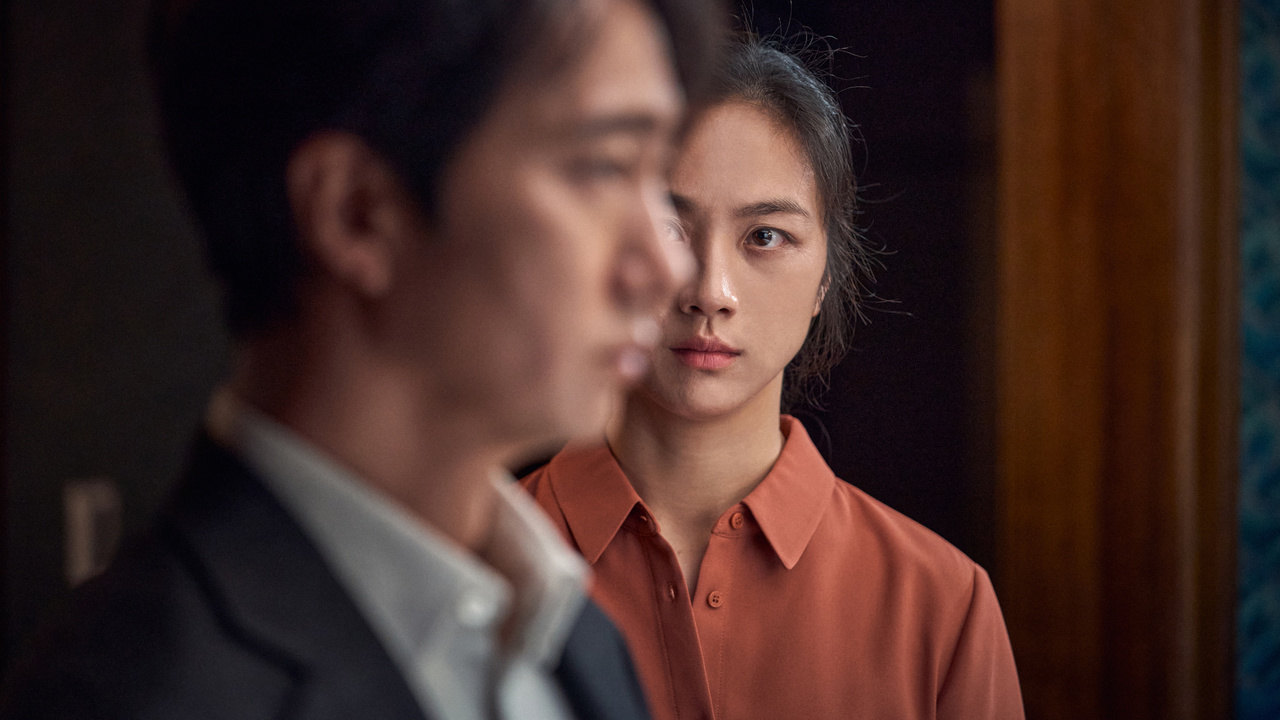
Director: Park Chan-wook · Cinematographer: Kim Ji-yong · Composer: Jo Yeong-wuk · Key Cast: Tang Wei, Park Hae-il, Lee Jung-hyun, Go Kyung-pyo · Runtime: 138 minutes · Studio: CJ ENM / Moho Film · Budget: $10 million · Box Office: $21.7 million worldwide
1. Decision to Leave: A Love Story Disguised as a Murder and a Murder Disguised as a Love Story
Park Chan-wook’s most elegant film is also his most heartbreaking, and it achieves both qualities by refusing to separate them. Decision to Leave is a crime film in which the crime is almost incidental. It is a romance in which the romance is almost fatal. It is a mystery in which the greatest mystery is not who killed the victim but why the detective cannot stop wanting the woman who probably did.
Hae-jun (Park Hae-il) is a meticulous police detective in Busan who suffers from insomnia and comes alive only when there is a death to investigate. When a retired immigration official is found dead at the base of a mountain, Hae-jun begins investigating the man’s widow, Seo-rae (Tang Wei), a Chinese immigrant who speaks imperfect Korean, who cared for elderly patients with tender professionalism, and who does not seem sufficiently upset about her husband’s death. The investigation draws Hae-jun toward Seo-rae with a gravitational pull that the film treats as both an intellectual obsession and an erotic compulsion, though neither character acts on the eroticism in any conventional way. This is a love story in which nobody touches.
Park Chan-wook, known for the visceral extremity of Oldboy and the baroque sensuality of The Handmaiden, operates here at a lower temperature than in any of his previous work. Decision to Leave is restrained where his earlier films were excessive, quiet where they were loud, achingly tender where they were savage. The violence exists (people die, investigations proceed, consequences accumulate), but it is never the point. The point is the space between two people who cannot be together, who know they cannot be together, and who arrange their entire lives around the impossibility of what they feel.
The film’s structure mirrors its emotional logic: it doubles. The first half investigates one death. The second half investigates another. The two halves rhyme, echo, and complicate each other, and what seemed resolved at the midpoint reopens in the second half with devastating implications. This doubling is the film’s most ambitious structural choice, and it is also its most divisive. Some viewers find the second half redundant. Others find it essential. I find it essential. The first half is a story about desire. The second half is a story about what desire costs, and you cannot tell the second story without the first.
The film is not perfect. The plot mechanics in the second half require concentrations of coincidence that strain credulity, and the investigation subplot involving Seo-rae’s second husband is less compelling than the original mountain-death mystery. The runtime, at 138 minutes, could have been trimmed in the middle section without losing emotional weight.
Verdict: 9/10. The most romantic film Park Chan-wook has ever made, and one of the most visually inventive love stories of the decade. Decision to Leave is a film about the impossibility of being with someone and the impossibility of not being with them, and it ends with an image so beautiful and so devastating that it redefines everything that came before.
2. Tang Wei’s Stillness, Park Hae-il’s Sleeplessness
Tang Wei, the Chinese actress best known for Ang Lee’s Lust, Caution, gives a performance of such calculated opacity that the audience spends the entire film trying to read her, and never fully succeeds. Seo-rae is a woman who may be a murderer, who may be a victim, who is certainly lonely, and who uses her loneliness as a tool with a precision that makes it impossible to determine where the strategy ends and the sincerity begins.
The performance operates in the gap between languages. Seo-rae speaks Korean imperfectly, using a translation app on her phone, sometimes switching to Mandarin, sometimes constructing sentences with a formality that native speakers would never use. Tang Wei, who actually learned Korean for the role, plays the language barrier not as a limitation but as a characterization. Seo-rae’s slightly stilted Korean becomes part of her allure: she says things in ways that a Korean speaker would not, and the unfamiliarity makes ordinary statements sound poetic. When she tells Hae-jun that she finds mountains boring because they just sit there, while the sea is always moving, the observation is banal in content and electrifying in delivery. Her Korean turns simplicity into strangeness.
Park Hae-il’s Hae-jun is the quieter performance, the one the film needs as its foundation while Tang Wei provides the destabilizing force above it. Hae-jun is competent, principled, slightly dull in his domestic life, and entirely alive only when pursuing a case. Park plays the insomnia as a physical state, not a dramatic device: the redness around the eyes, the slight delay in reactions, the way Hae-jun’s body relaxes when he is surveilling Seo-rae at night, as though watching her is the only thing that gives him rest. The irony is structural. The detective cannot sleep because his mind will not stop working. When he watches Seo-rae, his mind stops working and starts feeling, and the relief is visible in his posture.
The chemistry between the leads is built on absence rather than consummation. They do not kiss until a moment so charged that the restraint of the preceding two hours makes the contact feel seismic. Park Chan-wook understands that desire is more powerful when it is withheld than when it is satisfied, and he withholds it with the discipline of a filmmaker who has spent his career studying the mechanics of obsession.
3. Mountains, Oceans, and Kim Ji-yong’s Vertigo of Longing
Kim Ji-yong’s cinematography is the most technically ambitious element of a film that is technically ambitious in every dimension. The camera in Decision to Leave does things that cameras in Korean cinema have rarely done: it floats, it penetrates, it occupies impossible positions, it moves through walls and windows and screens of phones, treating the physical world as permeable and the psychological world as the only architecture that matters.
The most distinctive visual strategy is the subjective insert. When Hae-jun imagines what Seo-rae might have done on the night of the murder, the film does not cut to a flashback. Instead, Hae-jun appears within the reconstructed scene, watching Seo-rae move through the events he is imagining. He is simultaneously detective and audience, observer and voyeur. The technique dissolves the boundary between investigation and fantasy, between professional curiosity and romantic obsession. When Hae-jun watches Seo-rae in his mind, he is also watching the version of her he wants to see, and the film never confirms whether his version is the true one.
The mountain and sea imagery is not decorative. It is the film’s symbolic spine. Park Chan-wook has cited Confucius: “The wise man admires water, the kind man admires mountains.” Hae-jun is the mountain: stable, upright, rooted. Seo-rae is the sea: changeable, deep, capable of eroding anything given enough time. The first death occurs on a mountain. The final scene occurs at the sea. The movement from mountain to ocean is the movement from Hae-jun’s world to Seo-rae’s, and the film’s visual palette shifts accordingly. The mountain sequences are green, vertical, solid. The ocean sequences are blue-grey, horizontal, dissolving.
Kim Ji-yong shoots the surveillance sequences with a voyeuristic intimacy that makes the audience complicit. When Hae-jun watches Seo-rae through binoculars, the camera adopts his point of view: the circular vignetting of the lens, the slight shake of handheld observation, the flattened depth of a telephoto perspective. The audience is not watching Hae-jun watch Seo-rae. The audience is watching Seo-rae through Hae-jun’s eyes, and the identification is total. We are the detective. We are falling in love. We cannot stop looking.
4. Jo Yeong-wuk and the Melody That Cannot Resolve
Jo Yeong-wuk, Park Chan-wook’s longtime composer, delivers a score that operates on the principle of emotional suspension. The main theme is a melody that approaches resolution and then turns away from it, circling back to its opening phrase without ever arriving at the tonic. This harmonic strategy mirrors the film’s central relationship: two people who approach each other, almost connect, and then withdraw into their separate orbits.
The instrumentation is deliberately restrained. Strings and piano dominate, with occasional woodwind textures that evoke something between classical romanticism and Korean traditional music without committing fully to either. The restraint is essential. Park Chan-wook’s earlier films were scored with operatic intensity. Decision to Leave requires something more fragile, more uncertain, more willing to leave space for silence. Jo’s score occupies that space with a delicacy that never tips into sentimentality.
The film’s most aurally complex sequences are not the scored moments but the surveillance scenes, where sound design and music blend until they become indistinguishable. The ambient sounds of Seo-rae’s apartment, heard through Hae-jun’s monitoring equipment, mix with the score’s string textures to create a sonic environment that is simultaneously domestic and menacing. The sound of Seo-rae cooking, washing dishes, moving through rooms becomes, through Hae-jun’s obsessive listening, a kind of music. The score acknowledges this by adopting the rhythms of her daily routine, turning mundane sounds into melodic fragments.
The film’s final sequence, set on a beach at twilight, uses the score’s unresolved theme at its most exposed and its most devastating. The melody plays as Seo-rae walks toward the sea, and the harmonic suspension that has defined the entire score suddenly becomes not a compositional technique but an emotional state. The music cannot resolve because the relationship cannot resolve. The melody will never arrive home because there is no home for these two people to share. The lack of resolution is the resolution.
5. Kim Sang-beom’s Invisible Architecture: Editing as Consciousness
The editing of Decision to Leave is the element most frequently cited by critics and filmmakers as the film’s technical breakthrough, and editor Kim Sang-beom, who has cut nearly every Park Chan-wook film since Joint Security Area, deserves co-authorship credit for what the film achieves.
The cuts in Decision to Leave do not follow conventional continuity logic. They follow emotional logic. When Hae-jun thinks of Seo-rae, the film cuts to Seo-rae, not in flashback but in a present tense that exists only in his mind. When Seo-rae explains what happened on the mountain, the film places Hae-jun inside her explanation, walking through the reconstructed crime scene as though he were there. Time collapses. Space becomes subjective. The editing creates a consciousness that belongs to neither character individually but to the space between them, the shared mental territory where detective and suspect, lover and beloved, overlap.
Kim won the José Salcedo Award for Best Editing at the Valladolid International Film Festival, and the award recognized the precision of a technique that appears effortless but is, in fact, extraordinarily complex. Every subjective insert must be timed to the emotional rhythm of the scene it interrupts. Too long and the insert becomes a digression. Too short and it reads as a glitch. Kim finds the exact duration for each, and the result is a film that flows between objective and subjective reality with the seamlessness of a mind moving between perception and imagination.
The doubling structure of the two halves creates its own editorial challenge. The second investigation must rhyme with the first without repeating it. Kim achieves this through rhythmic variation: the second half cuts faster, compresses time more aggressively, allows less space between revelations. The acceleration mirrors Hae-jun’s increasing desperation and Seo-rae’s increasing determination. The editing becomes a clock, and the clock is running out.
6. The Phone as Love Letter: Technology and Intimacy in Park Chan-wook
This is the wildcard the film demands. Decision to Leave is, among many other things, the most sophisticated film ever made about how smartphones mediate romantic connection.
Seo-rae’s translation app is the film’s central metaphor. She speaks Mandarin into her phone. The phone produces Korean. Hae-jun reads the Korean. At every stage, meaning is filtered, delayed, and potentially distorted. The translation is imperfect. Idioms do not survive. Tone is lost. The app gives Seo-rae access to Korean while simultaneously marking her as foreign, as someone who needs a machine to be understood. The phone is simultaneously a bridge and a wall, and the film exploits this duality in every scene where it appears.
Park Chan-wook has discussed his initial reluctance to include extensive smartphone use in the film. He considered setting the story in an earlier period so that the characters could exchange handwritten letters. The decision to keep the contemporary setting transforms the phones from necessary props into narrative instruments. Text messages appear on screen as graphic elements, floating in the frame near the characters’ faces. Voice messages play over images of the person receiving them. The phone becomes a third character in the relationship, the intermediary through which desire is expressed, misunderstood, and occasionally betrayed.
The surveillance technology extends the phone’s function. Hae-jun watches Seo-rae through cameras, tracks her location through GPS, listens to her through monitoring devices. These are professional tools, legally justified by the investigation. They are also the instruments of romantic obsession, and the film refuses to distinguish between the two uses. When Hae-jun watches Seo-rae eat dinner alone in her apartment, the surveillance footage looks identical to a love scene shot from a respectful distance. The technology that is supposed to reveal the truth about a potential murderer instead reveals the truth about the detective: he is in love, and his investigation is the only language in which he can express it.
The final act subverts the phone’s function entirely. The device that connected Hae-jun and Seo-rae becomes the device that preserves the evidence of their connection and, ultimately, the instrument through which Seo-rae communicates her last decision. The phone, which began as a translation tool, ends as a confessional. Technology does not mediate the romance. Technology is the romance, or at least the only form in which these two people can safely hold it.
7. From Vengeance to Vertigo: Park Chan-wook’s Evolution
Decision to Leave arrives after a career trajectory that few directors have navigated with such deliberation. The Vengeance Trilogy (Sympathy for Mr. Vengeance, Oldboy, Lady Vengeance) established Park as a filmmaker of operatic violence and moral complexity. Thirst (2009) applied the same intensity to a vampire romance. The Handmaiden (2016) was a lavish period piece about desire, deception, and liberation, and it remains his most commercially successful international release.
Decision to Leave represents a stripping-away. The violence is minimal. The sexuality is almost entirely sublimated. The visual palette, while still precise, is cooler and more naturalistic than the saturated worlds of his earlier films. Park has described wanting to make “a Korean movie,” meaning a film rooted in Korean landscape, Korean emotional registers, and Korean social textures rather than the genre-blending maximalism that defined his international reputation.
The Hitchcock comparisons are inevitable and welcomed by the director. Decision to Leave is structured as a Vertigo riff: a detective falls in love with a woman he is investigating, and the investigation becomes indistinguishable from the obsession. But where Hitchcock’s Scottie is destroyed by his inability to separate the real woman from his projection, Park’s Hae-jun is destroyed by something more complex. He knows Seo-rae is real. He knows she may be a killer. He loves her anyway, and the “anyway” is the film’s moral territory. Vertigo is about illusion. Decision to Leave is about choosing reality and finding that reality is unbearable.
The collaboration with co-writer Jeong Seo-kyeong, who also co-wrote The Handmaiden and Thirst, gives the screenplay its structural sophistication. The doubling of the two halves, the rhyming deaths, the way the second investigation mirrors and inverts the first: these are literary constructions that operate at the level of architecture rather than dialogue. Jeong and Park build their screenplays the way composers build symphonic movements, with themes introduced, developed, and recapitulated across a structure that rewards both first-time viewing and extended analysis.
8. Mountains and Water: The Confucian Architecture of Desire
The film’s symbolic system is drawn from East Asian philosophy and deployed with a specificity that Western audiences may miss on first viewing. Seo-rae quotes Confucius to Hae-jun: “The wise man admires water, the kind man admires mountains.” The quotation is not ornamental. It is the film’s structural blueprint.
Hae-jun is the mountain. He is virtuous, stable, principled. He does his job. He stays married. He climbs mountains on weekends. His moral compass points north. Seo-rae is the water. She is fluid, adaptable, impossible to contain. She moves between countries, between languages, between identities. She flows around obstacles rather than confronting them. Water and mountains, in Confucian thought, complement each other. They also cannot merge. A mountain can stand beside an ocean. It cannot become the ocean. The ocean can erode the mountain. It cannot become solid.
The geography of the film enacts this opposition. The first death occurs on a mountaintop. The first half of the film is set in Busan, a coastal city but one where Hae-jun’s life is organized around vertical, mountainous space. The second half moves to Ipo, a smaller city by the sea, and the landscape flattens. The imagery shifts from cliffs and peaks to sand, fog, and water. The visual movement from mountain to ocean is the movement from Hae-jun’s moral world to Seo-rae’s emotional world, and the film’s final scene, set at the edge of the sea as the tide comes in, resolves the opposition in the only way it can be resolved: not by merging the two elements but by letting one consume the other.
The final image is among the most devastating endings in twenty-first century cinema. Seo-rae buries herself in the sand at low tide and waits for the sea to cover her. She becomes, literally, the place where mountain and ocean meet: earth buried by water. Hae-jun arrives too late. He digs in the sand. The tide erases everything. The image is simultaneously beautiful, horrifying, and logical within the film’s symbolic system. Water and mountain do not merge. Water covers the mountain. The mountain disappears.
9. Cannes Best Director, Oscar Snub, and the MUBI Effect
Decision to Leave premiered in competition at the 75th Cannes Film Festival in May 2022, where Park Chan-wook won Best Director. The award was his second major Cannes prize, following the Grand Prix for Oldboy in 2004. The Cannes reception established the film as one of the year’s most acclaimed works and launched a distribution campaign that would take it to 192 countries.
MUBI acquired North American, UK, Indian, and Turkish distribution rights, marking one of the streaming platform’s most significant theatrical releases. The film opened in the United States on October 14, 2022, and became MUBI’s most-streamed title, introducing the platform to audiences who had previously associated it with more obscure repertory programming. The MUBI association gave Decision to Leave a curatorial credibility that complemented its Cannes pedigree.
The film’s absence from the Academy Award nominations was the most discussed snub of the 2022-2023 awards cycle. South Korea submitted the film for Best International Feature Film, but it was not shortlisted. No nominations in any category followed. The omission was attributed to the film’s complexity, its subtlety, and the Academy’s historical inconsistency with East Asian cinema that does not fit neatly into genre categories. (Parasite’s sweep three years earlier had not, it turned out, permanently expanded the Academy’s appetite for Korean cinema.)
Critical response was overwhelmingly positive: 94% on Rotten Tomatoes from 239 reviews. Wendy Ide in The Observer gave it five stars and praised its dangerously handsome cinematography. David Rooney of The Hollywood Reporter described Park as a world-class artist at the top of his game. The recurring note in reviews was surprise at the film’s restraint, its tenderness, its willingness to prioritize emotional devastation over the visceral shock that Park’s earlier work had trained audiences to expect.
10. What the Second Viewing Reveals About the Tides
Decision to Leave is a film that requires two viewings because the second half recontextualizes the first, and the ending recontextualizes everything.
Watch Seo-rae’s face during the first interrogation. The scene plays as a cat-and-mouse exchange on first viewing. On second viewing, watch Tang Wei’s eyes. She is not evading. She is evaluating. She is deciding, in real time, whether this detective is someone she can use, trust, or love, and the answer, visible only in retrospect, is all three simultaneously.
Track the food. Seo-rae brings Hae-jun sushi. She prepares meals. She feeds him. In Korean and Chinese culture, feeding someone is an act of care that operates below language. On rewatch, the food scenes form their own narrative: the progression from formal offering to intimate provision charts the relationship’s development without a word of romantic dialogue.
Listen to the translation app’s errors. The app mistranslates at key moments, and the mistranslations are not random. They produce meanings that are truer than the intended message, or meanings that reveal what the speaker is actually feeling rather than what they are trying to say. The technology fails, and in failing, tells the truth.
Notice when Hae-jun can and cannot sleep. His insomnia correlates precisely with the state of his relationship to Seo-rae. When he is watching her, he sleeps. When he is separated from her, he cannot. The insomnia is not a character quirk. It is a diagnostic instrument, measuring the distance between them in hours of lost rest.
Revisit the burial. Seo-rae digs herself into the sand and waits. The composition is wide, showing the scale of the beach, the smallness of the human figure against the ocean. On second viewing, recognize that this is not a suicide in the conventional sense. It is a decision, carefully made, to become the element that defined her. She does not drown. She is reclaimed.
Film Trivia
Tang Wei learned Korean for the role. The Chinese actress devoted months to Korean language study before filming, and her imperfect fluency in the film is genuine rather than performed. Park Chan-wook wanted the language barrier to feel authentic, and Tang Wei’s actual relationship to Korean as a learned language gave Seo-rae’s speech patterns a naturalism that acting alone could not produce.
Park considered setting the film in the past. In interviews, Park Chan-wook admitted that he initially disliked the idea of smartphones dominating the visual field and considered making Decision to Leave a period piece in which the characters would exchange handwritten letters. The decision to keep the contemporary setting and embrace technology as a narrative instrument transformed the film’s central metaphor from correspondence to translation.
The film was sold to 192 countries before its premiere. CJ ENM completed international sales ahead of the Cannes screening, reflecting both Park’s global reputation and the Korean film industry’s commercial reach in the early 2020s. The breadth of distribution ensured that Decision to Leave reached audiences in territories where Korean cinema had previously struggled to find theatrical exhibition.
MUBI’s most-streamed film ever. Following its theatrical run, Decision to Leave became the most-watched title in MUBI’s history when it debuted on the platform in December 2022. The film’s success on MUBI expanded the platform’s subscriber base and demonstrated that art-house streaming services could compete for major titles with larger competitors.
The beach burial was Park’s ending from the beginning. Park Chan-wook has stated that the final image, Seo-rae burying herself in sand at the tide line, was the first element of the film he conceived. The entire screenplay was constructed backward from that image, building a narrative that would make the ending feel not just inevitable but earned. The two-year writing process with Jeong Seo-kyeong was organized around arriving at a single moment on a beach.
This entry selects analytical dimensions from a pool. The five anchors are present: critical verdict, performances, visual craft, reception and legacy, and rewatchability guide. Earned sections cover the score, editing as a narrative instrument, the director’s body of work, and the Confucian mountain-water symbolism. One wildcard section, “The Phone as Love Letter,” examines the film’s radical treatment of smartphone technology as the medium through which modern romance is conducted, mistranslated, and ultimately lost. Sections on production history and broader cultural context are folded into other sections rather than standing alone.

Leave a Reply