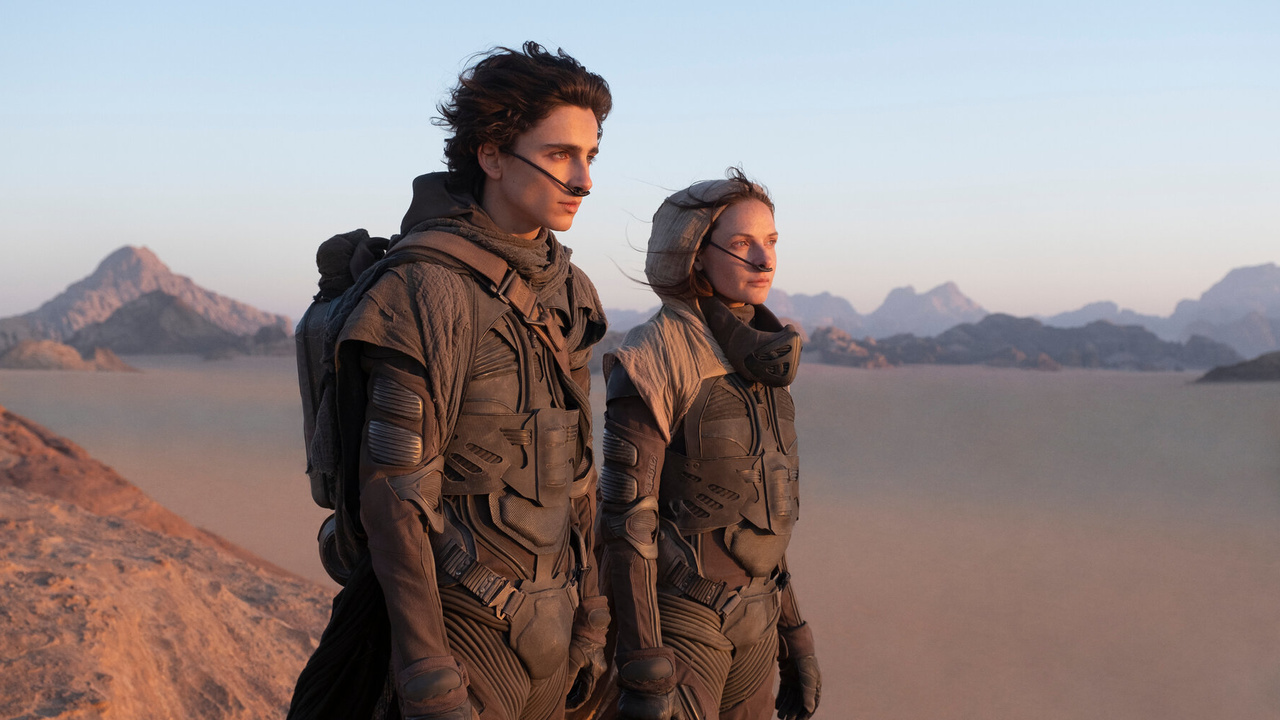
Director: Denis Villeneuve · Cinematographer: Greig Fraser · Composer: Hans Zimmer · Production Design: Patrice Vermette · Key Cast: Timothée Chalamet, Rebecca Ferguson, Oscar Isaac, Josh Brolin, Stellan Skarsgård, Jason Momoa, Zendaya, Javier Bardem, Charlotte Rampling · Runtime: 155 minutes · Studio/Distributor: Legendary Pictures / Warner Bros. · Budget: $165 million · Box Office: $411 million worldwide
Dune: Part One: Half a Masterpiece, Honest About the Math
Frank Herbert’s Dune has been called unfilmable for so long that the word has become part of its mythology. Jodorowsky tried and produced one of cinema’s great unfinished dreams. David Lynch tried and produced a film he has disowned. The novel is too dense, too political, too interior, too reliant on internal monologue and ecological exposition to survive the compression that film demands. Denis Villeneuve’s solution was to refuse the compression entirely. He split the novel in half, adapted only the first portion, and titled the result Part One with no guarantee that Part Two would ever be made.
The gamble was enormous. A $165 million film that ends mid-story, released simultaneously in theaters and on HBO Max during a pandemic, based on a sixty-year-old novel that most of its target audience has not read. The fact that it worked, both commercially and artistically, is a testament to Villeneuve’s stubbornness and to the quality of what he put on screen.
What Villeneuve put on screen is visually staggering. Greig Fraser’s cinematography makes Arrakis feel like a real place photographed by a real camera under a real sun that will kill you. Hans Zimmer’s score vibrates through your sternum. Patrice Vermette’s production design gives every surface the weight of stone and history. The world-building is so immersive that the film’s first hour, which is largely setup and exposition, never feels like homework. You are learning the rules of a world because the world is interesting enough to deserve them.
Where the film falters is precisely where its half-story structure demands it. The second hour loses momentum as Paul’s journey shifts from political intrigue to desert survival, and the narrative engine that powered the first half (the Atreides’ arrival on Arrakis and the looming Harkonnen betrayal) is replaced by a more episodic rhythm that builds toward a conclusion the film cannot provide. Paul’s arc is incomplete. His transformation from prince to prophet is barely begun. The story stops rather than ends. The closing title card feels less like a resolution than a promise, and promises are not dramatic structure.
Timothée Chalamet is a compelling screen presence but an occasionally uncertain fit for Paul Atreides. He captures the intelligence and the doubt. He is less convincing in the moments that require gravitas, the moments where Paul must seem like someone the Fremen would follow. Chalamet plays the boy who might become a leader. The leader himself is not yet visible, which is appropriate to the narrative but leaves the film’s emotional arc dependent on a payoff it cannot deliver.
Verdict: 8/10. Dune: Part One is a magnificent achievement of visual and sonic craft, a world rendered with such authority and scale that it redefines what science fiction cinema can look like. It is also, honestly, half a film. The incompleteness is structural, not accidental, and it limits the emotional impact in ways that no amount of spectacle can fully compensate. Part Two completes the story magnificently. Part One, taken on its own terms, is extraordinary but incomplete.
Greig Fraser’s Sand and Light: Filming a Planet That Wants to Kill You
Greig Fraser replaced Roger Deakins as cinematographer on Dune, a substitution that could have been disastrous and instead produced one of the most distinctive visual achievements in modern science fiction. Fraser shot the film on ARRI Alexa LF and Mini LF cameras with Panavision large-format lenses, then transferred the digital footage to 35mm film stock and scanned it back to 4K. The analog transfer introduced a subtle grain and softness that made the hyper-sharp digital image feel organic, tactile, and slightly weathered. Arrakis does not look like a computer-generated world. It looks like a place photographed by someone standing in it.
The desert sequences, filmed in Wadi Rum, Jordan, and the Liwa Oasis in the United Arab Emirates, are the film’s visual foundation. Fraser uses the real desert landscape with minimal augmentation, and the effect is overwhelmingly physical. You feel the heat in the bleached-out highlights. You feel the weight of the sand in every footstep. The sky is not the saturated blue of a processed image; it is the pale, almost white sky of a place where the sun has won.
Fraser’s interiors operate on a different principle. The Atreides fortress on Caladan and the Arrakeen palace are photographed in cool, shadowed tones that make the architecture feel protective and imposing simultaneously. Light enters through narrow apertures, cutting across stone surfaces in sharp, angled beams. The visual vocabulary is closer to medieval cathedral photography than to conventional science fiction lighting. When the story moves from interior to exterior, the shift from shadow to glare is physically jarring, and the discomfort is deliberate. Arrakis is not hospitable. The camera makes you feel that in your body.
The IMAX sequences, which open the aspect ratio to 1.43:1 on select screens, are among the most effective uses of the format since Dunkirk. The sandworm emergence, the ornithopter flights, and the desert battle sequences gain an immensity in IMAX that the standard theatrical ratio cannot replicate. Fraser and Villeneuve storyboarded these sequences specifically for the expanded frame, and the compositional difference between the two formats is not merely a matter of more image. It is a matter of more sky, more sand, more emptiness pressing in from the edges.
An Ensemble of Kings, Witches, and a Boy Not Yet Ready
The cast of Dune: Part One is extraordinarily deep, and Villeneuve deploys his ensemble with the economy of a chess player sacrificing pieces. Oscar Isaac’s Duke Leto occupies perhaps thirty minutes of screen time, but his performance carries the weight of a man who knows he is walking into a trap and chooses to walk anyway. Isaac plays Leto’s doomed nobility without sentimentality. The Duke is not a hero in the conventional sense. He is a competent leader making a political calculation that happens to be fatal, and Isaac communicates both the calculation and the fatality simultaneously.
Rebecca Ferguson’s Lady Jessica is the film’s most fully realized character, a woman operating at the intersection of political duty, maternal terror, and religious prophecy. Ferguson plays the contradictions without smoothing them. Jessica is a Bene Gesserit, trained to control her emotions and weaponize her voice, and she is also a mother watching her son walk toward a destiny that may consume him. The tension between these two identities is the engine of Ferguson’s performance, and she navigates it with a precision that anchors the film’s emotional reality when the spectacle threatens to overwhelm.
Stellan Skarsgård’s Baron Harkonnen is a triumph of restraint. Buried under prosthetics and floating in anti-gravity suspension, Skarsgård could easily have turned the Baron into a cartoon. Instead, he plays him as a bored predator, someone so powerful that violence is no longer interesting to him. His voice is soft. His movements are minimal. The menace comes from the casual certainty that nothing in his path will survive.
Jason Momoa brings unexpected warmth to Duncan Idaho, playing the warrior as the film’s most human figure: loyal, funny, physically exuberant, and wholly devoted to Paul in a way that makes his sacrifice genuinely painful. His death scene is the film’s first genuinely devastating moment, the point where the political chess game becomes personal loss.
Chalamet’s Paul, as noted, is a work in progress. He is excellent in the scenes that require vulnerability, doubt, and the terror of visions he cannot control. He is less convincing when the screenplay asks him to project authority. The gap is intentional (Part One is about Paul before he becomes Muad’Dib) but it limits the audience’s investment in his trajectory. You believe this boy is frightened. You do not yet believe he is destined.
Hans Zimmer’s Most Physical Score: Music You Feel in Your Ribs
Hans Zimmer has described Dune as the project he waited his entire career to score, and the obsessiveness of that commitment is audible in every frame. He assembled musicians from around the world, invented new instruments, and constructed a sonic palette that draws on Middle Eastern and West African musical traditions without appropriating any specific culture. The result is a score that sounds ancient and extraterrestrial simultaneously, a music that belongs to no Earth civilization and therefore belongs to Arrakis.
The score’s most distinctive quality is its physicality. Zimmer uses sub-bass frequencies that operate at the threshold of hearing, vibrations you feel in your chest and stomach before you process them as sound. In an IMAX theater, the sandworm sequences are not merely loud. They are seismic. The bass passes through the seat and into your spine. This is scoring as a bodily experience, and it is unlike anything Zimmer has done before, including his work on Inception and Interstellar.
The vocal elements are equally striking. Female voices, processed and layered, carry the Bene Gesserit themes with a quality that is half chant and half warning. Male voices appear in the Fremen sequences with a rhythmic intensity that suggests ritual. Zimmer treats the human voice not as a melodic instrument but as a percussive one, a tool for creating texture and urgency rather than conventional beauty.
The score won the Academy Award for Best Original Score, and it was one of Zimmer’s most deserved wins. There are moments where the music overwhelms the dialogue and where the sheer volume of the mix makes the film feel more like an endurance test than an immersion. These moments are few, and they are the cost of Zimmer’s ambition. When the score works, which is nearly always, it makes Arrakis feel not like a setting but like a living system with its own heartbeat.
The Unfilmable Novel, Filmed at Last (in Two Parts)
Frank Herbert’s Dune (1965) is one of the densest works of fiction in any genre. Its plot operates simultaneously as a political thriller, an ecological treatise, a religious allegory, and a critique of messianic narratives. Its characters think in paragraphs of internal monologue. Its world-building requires glossaries. Its themes are so layered that readers disagree about whether Paul Atreides is a hero, a villain, or a cautionary tale about the dangers of charismatic leaders.
Previous attempts to adapt this material failed for different reasons. Alejandro Jodorowsky’s legendary 1975 pre-production collapsed under its own ambition but produced concept art and design work that influenced science fiction for decades. David Lynch’s 1984 version compressed the entire novel into two hours, lost coherence, and was disowned by its director. Both attempts confirmed the conventional wisdom: Dune cannot be a single film.
Villeneuve’s adaptation succeeds by refusing to solve the compression problem. Instead of condensing Herbert’s novel into a single narrative, he simply stops at the halfway point. The first film covers Paul’s life on Caladan, the Atreides’ arrival on Arrakis, the Harkonnen betrayal, and Paul and Jessica’s initial survival in the desert. It does not cover Paul’s integration into Fremen society, his rise as a religious leader, or the final confrontation with the Harkonnens. These are left for Part Two.
The screenplay by Spaihts, Villeneuve, and Roth handles Herbert’s exposition with surprising grace. The political dynamics between the Atreides, Harkonnens, and the Emperor are communicated through action and dialogue rather than narration. The ecological importance of the sandworms and the spice melange is woven into the world rather than lectured about. The Bene Gesserit’s centuries-long breeding program is suggested rather than explained, creating an atmosphere of conspiracy that is more effective than full disclosure would be.
What the adaptation necessarily sacrifices is Herbert’s interiority. The novel’s richness comes largely from its characters’ inner lives, their strategic calculations, their philosophical reflections, their awareness of the historical forces acting upon them. Film cannot reproduce this. Villeneuve compensates with visual storytelling, using the physical world to externalize what the novel internalizes. Paul’s fear is shown through Chalamet’s body rather than described through Herbert’s prose. Jessica’s conflict is shown through Ferguson’s face rather than explained through narrative. The translation is imperfect but functional.
Patrice Vermette’s Arrakis: Brutalism, Sand, and the Weight of Every Surface
Production designer Patrice Vermette, returning from Arrival and Sicario, built the world of Dune with a design philosophy that Villeneuve has described as anti-fantasy. Nothing in the film looks decorative. Everything looks functional, heavy, and built to survive in hostile conditions. The Atreides’ architecture on Caladan is monolithic concrete and dark stone. The Arrakeen palace is a fortress carved from rock, its corridors designed to channel cool air. The Harkonnen structures are industrial, black, and deliberately ugly. Each political faction’s architecture communicates its values before a single word of dialogue is spoken.
The stillsuit, the survival garment worn on Arrakis, is the design’s signature achievement. Previous versions of Dune dressed their characters in flowing robes and fantasy costumes. Vermette and costume designers Jacqueline West and Bob Morgan created a suit that looks like equipment: tubes, seals, connectors, face masks. The stillsuit says that Arrakis will kill you if you are not prepared, and preparation is ugly, mechanical, and non-negotiable. The contrast between the Atreides’ formal military uniforms and the stillsuits they must adopt on Arrakis communicates the family’s displacement more effectively than any dialogue scene.
Vermette’s team built full-scale sets in Budapest that were then augmented with minimal digital extension. The Atreides war room, the Arrakeen landing platform, and the ornithopter interiors are physical constructions that the actors could touch and inhabit. Fraser’s lighting interacts with real surfaces, producing reflections and shadows that digital environments cannot replicate. The commitment to practical construction is visible in the film’s tactile quality. You believe these spaces exist because the actors are standing in them, not in front of them.
The Sandworm Sequence: Scale as Spiritual Experience
There is a moment in Dune: Part One when the camera pulls back and a sandworm emerges from the desert floor, and the scale of the creature relative to the human figures on screen produces a sensation that goes beyond spectacle. It is closer to awe, the feeling of encountering something so vast that your categories for understanding it are insufficient.
Villeneuve has spoken about wanting the sandworms to feel like natural disasters rather than movie monsters. They do. The worm does not appear to be chasing the characters. It appears to be moving through its environment, and the characters happen to be in the way. The sound design is crucial to this effect. The worm’s approach is signaled by a low-frequency rumble that builds over minutes, not seconds, and by the time the creature surfaces, the vibration has already established its scale before the image confirms it.
The sequence functions as a thesis statement for Villeneuve’s approach to spectacle throughout the film. In a conventional blockbuster, the sandworm would be a set piece: a discrete action sequence with a beginning, a climax, and a resolution. In Dune, the sandworm encounter is an ecological event. It is part of the desert’s rhythms, and the characters’ survival depends not on fighting it but on understanding those rhythms. The shift from action to ecology is what distinguishes Dune from every other science fiction blockbuster of its era. The desert is not a backdrop. It is the protagonist. The humans are visitors. The sandworm is the landlord.
After Jodorowsky, After Lynch: The Third Attempt at Arrakis
Every adaptation of Dune exists in dialogue with the ones that came before, and Villeneuve’s version carries the weight of two celebrated failures.
Jodorowsky’s unproduced 1975 version, documented in Frank Pavich’s 2013 film Jodorowsky’s Dune, has become as famous as any adaptation that was actually made. The pre-production assembled H.R. Giger, Chris Foss, and Jean “Moebius” Giraud for design, and Pink Floyd and Magma for music. The planned cast included Salvador Dalí, Orson Welles, and Mick Jagger. The project collapsed, but its concept art seeded the visual language of Alien, Star Wars, and virtually every subsequent science fiction film. Villeneuve has acknowledged the influence while deliberately steering away from Jodorowsky’s psychedelic maximalism toward something grounded and physical.
Lynch’s 1984 version is a different kind of ghost. Lynch compressed the entire novel into 137 minutes, lost creative control to the studio, and produced a film that is gorgeous in isolated moments and incomprehensible as a narrative. Lynch has refused to discuss the experience in positive terms, stating that it was a heartache and a total failure. Villeneuve’s two-film structure is implicitly a correction of Lynch’s single-film approach: the novel cannot survive that compression, and Villeneuve’s refusal to attempt it is both an artistic decision and a gesture of respect toward the material.
Villeneuve’s Dune does not reference either predecessor visually. The design language is entirely its own: heavier, more industrial, more rooted in real architectural traditions than in the pulp-science-fiction aesthetic that both Jodorowsky and Lynch drew from. The sandworms look different. The stillsuits look different. Arrakis looks different. The film earns its independence from the prior adaptations by refusing to engage with them, building its world from Herbert’s text rather than from cinema history.
Six Oscars, One Pandemic, and the Question of Whether Half a Film Can Be Great
Dune: Part One was released on October 22, 2021, simultaneously in theaters and on HBO Max, a distribution strategy imposed by Warner Bros. during the pandemic that Villeneuve publicly opposed. Despite the dual release, the film earned $411 million worldwide, enough to secure the greenlight for Part Two and validate Villeneuve’s two-film gamble.
The Academy responded with ten nominations and six wins: Best Cinematography (Fraser), Best Original Score (Zimmer), Best Film Editing (Joe Walker), Best Sound, Best Visual Effects, and Best Production Design (Vermette). The craft sweep was decisive. In the technical categories, Dune dominated its competition with an authority that made the outcomes feel inevitable. The film was not nominated for Best Director, and its Best Picture nomination was widely seen as a courtesy rather than a genuine contender for the prize.
The critical conversation around Dune centered on whether half a story could be evaluated as a complete film. Defenders argued that many great films end inconclusively and that Dune’s narrative arc, from Paul’s comfortable life on Caladan to his desperate survival in the desert, is self-contained even if the larger story is not. Detractors argued that a film costing $165 million should provide a more satisfying conclusion and that the promise of a sequel is not the same as a resolution.
Both positions have merit. Dune: Part One is undeniably incomplete. Its characters’ arcs are interrupted, not resolved. Its central questions are posed, not answered. It is a first chapter that functions as a first chapter, not as a standalone work. The argument for an 8 rather than a 9 or 10 rests precisely here: what is present is extraordinary, but what is absent is significant, and the absence affects the viewing experience in ways that craft alone cannot overcome.
What the Desert Reveals When You Return to It
Dune: Part One is richer on second viewing partly because the first viewing is so visually overwhelming that narrative details get lost in the spectacle. The rewatch is where the politics sharpen.
Track the Bene Gesserit manipulation. On a first viewing, the Reverend Mother’s visit to test Paul reads as a standalone scene of ritualized cruelty. On a second viewing, knowing the full scope of the Bene Gesserit’s breeding program and their manipulation of Fremen religious belief, the scene reveals itself as the moment an institution evaluates its investment. The Reverend Mother is not testing Paul’s worthiness. She is testing whether their centuries-long genetic project has produced the result they engineered.
Watch Oscar Isaac’s face in every scene where Leto discusses his plans for Arrakis. Isaac plays a man who knows he is being sent into a trap and has calculated that walking into the trap is his only viable political move. The knowledge is in his eyes but never in his words. On a first viewing, Leto reads as a noble father doing his best. On a second, he reads as a man who has already accepted his death and is spending his remaining time ensuring his son survives it.
Pay attention to the ecology. The film’s first half is populated with details about water discipline, sand movement, and the relationship between spice production and sandworm behavior. These details are easy to absorb as world-building texture. On a rewatch, they reveal themselves as plot mechanics: every rule Villeneuve establishes about Arrakis in the first half becomes operationally relevant in the second.
Listen for the Voice. Jessica and Paul use the Bene Gesserit Voice sparingly, and each use is signaled by a shift in the sound mix that isolates the speaker’s words from the ambient environment. On a rewatch, track when the Voice is used and what it reveals about the user’s desperation. Jessica uses it more frequently as her control over events deteriorates. The Voice is presented as power. It functions as a measure of fear.
Film Trivia
The desert that was real. The Arrakis sequences were filmed in Wadi Rum, Jordan, and the Liwa Oasis in the United Arab Emirates. Villeneuve insisted on shooting in actual desert environments rather than relying on digital landscapes, and the production spent eleven days in the UAE alone. The heat was genuine. The sand was genuine. Fraser’s camera recorded light bouncing off real dunes, which is why the desert scenes have a quality of physical presence that digital recreation cannot match.
The film stock detour. Fraser shot Dune digitally on ARRI Alexa LF cameras, then transferred the footage to 35mm film stock and scanned it back to 4K. The round trip through analog introduced a subtle grain and softness that made the hyper-clean digital image feel more organic. The technique was time-consuming and expensive, but Villeneuve and Fraser considered it essential for giving the film a texture that felt lived-in rather than rendered.
The cinematographer who almost was. Roger Deakins, Villeneuve’s cinematographer on Prisoners, Sicario, and Blade Runner 2049, was originally attached to shoot Dune. He departed the project in December 2018 for scheduling reasons. Greig Fraser, who replaced him, won the Oscar for Best Cinematography, Deakins’s absence produced one of the finest visual achievements of the decade. Whether Deakins’s version would have looked fundamentally different is one of modern cinema’s most tantalizing hypothetical questions.
The sequel that almost wasn’t. When Warner Bros. announced that all 2021 films would be released simultaneously in theaters and on HBO Max, Villeneuve published an open letter condemning the decision and warning that the dual release could underperform financially and prevent Part Two from being made. The film earned enough on both platforms to justify the sequel. Part Two was released in March 2024 to even stronger commercial and critical reception.
This entry selects analytical dimensions from a pool. All five anchors are present: the critical verdict, performances, visual craft, reception and legacy, and the rewatchability guide. Earned sections cover Hans Zimmer’s score, Patrice Vermette’s production design, the adaptation of Herbert’s novel, and the film’s relationship to prior Dune adaptations. One wildcard section addresses the sandworm emergence as a redefinition of blockbuster spectacle through ecology rather than action. Cultural context is omitted because the film’s political allegory (oil, colonialism, religious manipulation) is better examined in an entry on Part Two, where the allegory reaches its full expression. Director’s body of work is omitted to avoid Villeneuve clustering across three consecutive entries.

Leave a Reply