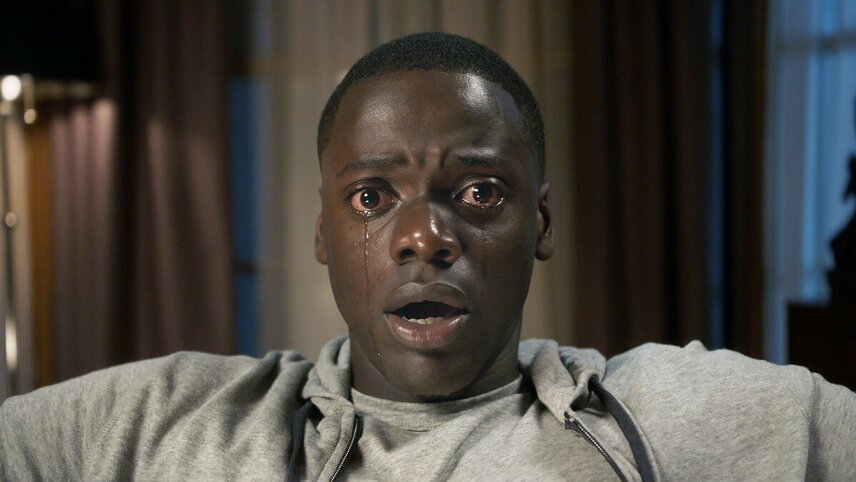
Director/Writer: Jordan Peele · Cinematographer: Toby Oliver · Composer: Michael Abels · Editor: Gregory Plotkin · Key Cast: Daniel Kaluuya (Chris Washington), Allison Williams (Rose Armitage), Catherine Keener (Missy Armitage), Bradley Whitford (Dean Armitage), Caleb Landry Jones (Jeremy Armitage), Betty Gabriel (Georgina), Marcus Henderson (Walter), LaKeith Stanfield (Andre Hayworth/Logan King), Lil Rel Howery (Rod Williams), Stephen Root (Jim Hudson) · Runtime: 104 minutes · Producers: Jason Blum, Sean McKittrick, Edward H. Hamm Jr., Jordan Peele · Studio: Blumhouse Productions / Universal Pictures · Budget: $4.5 million · Box Office: $255 million worldwide
The Horror of Being Seen and Not Believed
Chris Washington is a Black man visiting his white girlfriend’s parents for the first time. He asks Rose, on the drive upstate, whether her family knows he is Black. She assures him it will be fine. Her father would have voted for Obama a third time if he could. Everything will be fine.
Everything is not fine. Everything is, in fact, a conspiracy so baroque and so deeply embedded in the architecture of American racial pathology that describing it makes it sound like satire. Which it is. Jordan Peele’s Get Out is a horror film that operates simultaneously as a comedy of manners, a racial allegory, a body-snatching thriller, and a critique of white liberal self-congratulation so precise that it stings. The genius of the film is not in any one of these registers but in their coexistence: the audience laughs, flinches, and recognizes itself in the same breath.
The Armitage family runs a business. They identify desirable Black bodies, their daughter lures the targets home, the mother hypnotizes them into a paralyzed state called the Sunken Place, and the family’s neurosurgeon grandfather transplants the consciousness of wealthy white buyers into the Black hosts. The host’s original consciousness remains trapped, submerged, watching through eyes it no longer controls. This is the film’s central metaphor, and it works on every level Peele intended: as body horror, as a literalization of cultural appropriation, as an image of systemic racism’s most insidious quality (the consumption of Black bodies by white systems that admire them, desire them, and discard the personhood that inhabits them).
Peele, who built his career in sketch comedy on Key & Peele, understood that horror and comedy share structural DNA. Both depend on timing, misdirection, and the manipulation of audience expectations. Get Out exploits this shared mechanics with the efficiency of a first-time director who has been thinking about this film for years. The setup is a comedy of social discomfort. The middle act is a slow-burn mystery. The final act is a cathartic horror-action sequence that inverts every power dynamic the film has established. The tonal shifts are not jarring because Peele calibrates each one with the precision of a sketch comedian who knows exactly how long to hold a beat.
The film cost $4.5 million to make and grossed $255 million worldwide, making Peele the first African American writer-director to earn $100 million on a debut film. It was nominated for four Academy Awards, including Best Picture and Best Director, and won Best Original Screenplay. The Sunken Place entered the cultural vocabulary within weeks of the film’s release. “Get Out” became a phrase that meant what it had always meant, but louder.
Verdict: 9/10
Kaluuya’s Single Tear and the Performance of Visible Thought
Daniel Kaluuya’s performance as Chris Washington is built on a paradox: he must be simultaneously expressive enough for the audience to read his internal state and restrained enough to reflect the specific social condition of being a Black man navigating white space. Chris cannot say what he feels. He cannot react the way he wants to. He must modulate his responses, his tone, his face, because the social situation requires it, and because Peele understands that this modulation is itself a form of horror.
During his audition, Kaluuya performed a key scene in which Chris is hypnotized and must cry. He did five takes. In each one, a single tear fell at exactly the same moment. Peele cast him immediately.
The tear is not a trick. It is the visible expression of a performance so internally connected that the body produces the same response under the same emotional conditions every time. This consistency is the signature of Kaluuya’s work throughout the film. His face does not perform emotions for the camera. It registers them, the way a surface registers temperature. When Dean Armitage tells Chris he would have voted for Obama a third time, Kaluuya’s response is a smile that is also a wince, a socially required acknowledgment that something uncomfortable has just happened and that naming it would make things worse. The audience recognizes the expression because they have seen it on real faces, in real rooms, at real dinner tables.
Allison Williams, as Rose, accomplishes something technically difficult: she plays a character who is performing a character. Rose’s warmth, her defensiveness on Chris’s behalf, her apparent discomfort with her family’s microaggressions: all of it is an act. On first viewing, Williams is convincingly supportive. On second viewing, her performance reveals seams, tiny moments where Rose’s attention drifts, where her timing is slightly too perfect, where her reassurances are slightly too emphatic. The reveal in the third act, when Rose drops the mask and becomes flatly predatory, is effective not because it is surprising but because, in retrospect, it was always visible.
Betty Gabriel, in a small role as Georgina, the Armitages’ housekeeper, delivers the film’s most disturbing moment. When Chris asks if she is okay, tears roll down her face while her mouth forms a smile and her voice insists that everything is fine. The disconnect between face and voice is the Sunken Place made visible: the original consciousness is trying to break through, and the implanted consciousness is suppressing it. Gabriel holds both states simultaneously for a few seconds, and the effect is more unsettling than any jump scare in the film.
The Warm Light of a Trap: Oliver’s Visual False Security
Toby Oliver’s cinematography in Get Out operates on a strategy of visual deception that mirrors the film’s narrative deception. The Armitage estate is lit warmly. The interiors glow with amber light. The grounds are green, expansive, inviting. This warmth is a trap. Oliver and Peele wanted the audience to feel what Chris feels: a tentative comfort, a willingness to believe that these people are exactly as welcoming as they appear.
The visual approach is grounded in naturalism. Oliver shot on ARRI Alexa Mini cameras with Angenieux Optimo zoom lenses, a setup that favored speed and flexibility over visual stylization. The zoom lenses allowed Oliver to adjust framing without changing glass, essential on a 23-day shooting schedule. The resulting images have a clean, unobtrusive quality that avoids the exaggerated shadows and canted angles of conventional horror cinematography. The film looks like a drama. It looks like a comedy of manners. It does not look, for most of its runtime, like a horror film, and that visual normalcy is what makes the horror effective. When terrible things happen, they happen in spaces that look safe.
The Sunken Place sequence breaks the visual contract. When Missy hypnotizes Chris, the camera pulls back and the frame inverts: Chris falls into a void of black space, his body shrinking as the living room recedes into a rectangle of light above him. The image reverses figure and ground, placing darkness around the character and light at an unreachable distance. It is the film’s most explicitly symbolic composition, and Oliver achieves it through a combination of in-camera effects and minimal digital augmentation. The Sunken Place looks handmade, which contributes to its uncanniness. A more polished digital effect would feel like spectacle. This feels like drowning.
Oliver also uses depth of field as a narrative tool. In scenes where Chris is comfortable, the backgrounds are soft, unfocused, warmly blurred. In scenes where his suspicion increases, the backgrounds sharpen, pulling details into focus that were previously invisible. The garden party sequence, where dozens of wealthy white guests examine Chris with a predatory politeness, uses a slightly wider depth of field than the rest of the film, making the background figures more present, more encroaching, more difficult to ignore.
Michael Abels and the Sound of Being Hunted
Michael Abels’ score for Get Out opens with a Swahili chant. The voices are urgent, layered, and untranslated. Peele wanted the music to function as a warning from a perspective that the protagonist cannot access: the voices of people who have already been through what Chris is about to experience, crying out in a language the film does not subtitle.
This decision is characteristic of the score’s overall strategy. Abels, a concert composer with no prior film credits, was recruited by Peele specifically because he was not a genre specialist. Peele wanted a score that avoided horror conventions (shrieking strings, dissonant stingers) in favor of something that felt culturally specific and emotionally layered. Abels delivered a score that blends choral elements, percussion, and orchestral textures in a way that communicates dread without announcing it. The music does not tell you when to be scared. It tells you when something is wrong, and the distinction matters.
The score is most effective in its restraint. During the garden party, as Chris circulates among guests who comment on his physique, his posture, and his genetic suitability with a friendliness that is also an appraisal, the music recedes almost to nothing. The ambient sounds of the party (conversation, laughter, clinking glasses) become the score, and their normalcy is more disturbing than any orchestral crescendo could be. Peele and Abels understood that the film’s horror lives in the gap between what is said and what is meant, and the score occupies that gap without filling it.
The Swahili chant returns at moments of crisis, functioning as a sonic lifeline connecting Chris to a community and a history that the Armitages want to erase. Its presence insists that Chris is not merely a body. He is a person embedded in a culture, and the culture remembers him even when the film’s white characters see only his physical utility.
The Sunken Place as Political Metaphor and Personal Nightmare
The Sunken Place is the image that survived the film and entered the culture. Peele has described it as a metaphor for the marginalization of Black voices in America: a state in which you can see and hear the world but cannot participate in it, cannot influence it, cannot make yourself heard. The image is elastic enough to accommodate multiple readings, and it has been applied to everything from police violence to voter suppression to the specific experience of being the only Black person in a white professional environment.
Within the film, the Sunken Place operates on more personal terms. Chris falls into it through hypnosis, which Missy initiates without his consent. The violation is psychological: she enters his mind, accesses his guilt about his mother’s death, and uses that guilt to paralyze him. The Sunken Place is not a physical location. It is a state of emotional arrest, a place where your worst experience plays on a loop and your capacity to act is severed from your capacity to feel. Chris can see the living room above him, shrinking into a screen. He can hear Missy’s voice. He cannot move.
This is Peele’s most incisive metaphor, and it works because it is both fantastical and recognizable. The experience of being conscious but unable to act, of understanding what is happening to you and being unable to stop it, is not limited to the horror genre. It is the experience of systemic disempowerment rendered as sensation. The Sunken Place does not need to be explained. It is felt. And once felt, it becomes a framework for understanding experiences that previously lacked an image adequate to their reality.
The film’s original ending had Chris arrested by police after killing the Armitages. Peele shot this version but replaced it with the current ending, in which Rod arrives in a TSA vehicle to rescue Chris, after test audiences responded with devastation rather than catharsis. The original ending is more politically pointed: Chris does everything right, survives a nightmare, and is still destroyed by a system that sees a Black man at a crime scene and assumes the worst. The theatrical ending is more generous: Chris escapes, Rod saves him, and the audience is allowed to exhale. Peele has said both endings are valid, and that the theatrical cut reflects a post-Obama optimism that may or may not have been warranted.
The Comedian Who Understood Horror
Jordan Peele spent a decade making people laugh on Key & Peele before making them scream with Get Out. The transition seems unlikely until you examine what made Key & Peele work: it was sketch comedy that used genre structures (action movies, horror films, workplace dramas) as vehicles for racial satire. Peele did not abandon comedy when he moved to horror. He recognized that the two genres share mechanical foundations (timing, subversion, the manipulation of expectations) and that the content he wanted to explore (race, identity, the performance of social roles) could be more effectively delivered through horror’s emotional intensity than through comedy’s emotional distance.
Get Out is Peele’s first feature and his most disciplined. Its 104-minute runtime contains no fat. Every scene serves the plot, the theme, or the development of Chris’s growing unease, and most scenes serve all three simultaneously. The garden party sequence is a social comedy (Chris navigates awkward conversations), a horror scene (the guests are evaluating him as merchandise), and a piece of racial commentary (the microaggressions are real and the subtext is literal). Peele’s ability to sustain all three registers at once is the film’s defining formal achievement.
He has cited The Stepford Wives (1975), Rosemary’s Baby (1968), and Guess Who’s Coming to Dinner (1967) as influences, and the references are structural rather than superficial. Like Rosemary’s Baby, Get Out traps its protagonist inside a conspiracy that operates through domestic intimacy. Like The Stepford Wives, it imagines a community where conformity is enforced through bodily replacement. Like Guess Who’s Coming to Dinner, it places an interracial relationship at the center and examines what the white family’s acceptance actually costs.
$4.5 Million, 23 Days, and a Cultural Earthquake
Get Out was shot in 23 days on a budget of $4.5 million. These constraints, imposed by the Blumhouse Productions model (low budgets, high creative freedom, modest marketing, theatrical release), proved to be advantages. The tight schedule forced Peele and Oliver to plan obsessively: storyboards for complex scenes, still photographs of every shot in the house location, dual-camera setups to maximize coverage. The low budget eliminated the possibility of spectacle, which pushed the film toward psychological tension and performance rather than visual effects and set pieces.
The film premiered at the Sundance Film Festival on January 23, 2017, and was released theatrically on February 24. It opened at number one with $33 million, a figure that stunned everyone involved. By the end of its run, it had grossed $255 million worldwide against its $4.5 million budget, making it one of the most profitable films in modern history.
At the 90th Academy Awards, Get Out received four nominations: Best Picture, Best Director, Best Actor (Kaluuya), and Best Original Screenplay. Peele won the screenplay award, becoming the first African American to do so. The film was also honored by the National Board of Review, the American Film Institute, and Time magazine as one of the top ten films of 2017. Rotten Tomatoes records a 98% approval rating from critics, with near-universal praise for Peele’s screenplay, Kaluuya’s performance, and the film’s ability to function simultaneously as entertainment and social criticism.
The cultural impact extended beyond the film industry. “The Sunken Place” became shorthand for a specific kind of political disempowerment. “Get Out” was invoked in conversations about race with an immediacy that few films achieve. Peele had made a horror movie that was also a diagnostic tool, an image-generating machine that gave people new language for experiences they had always had but could not previously name.
What the Second Viewing Reveals About Who Was Watching
Get Out is one of the most rewarding second-viewing experiences in contemporary cinema, because the second viewing reverses the film’s perspective. On first viewing, the audience shares Chris’s uncertainty. Is this family merely awkward, or is something wrong? On second viewing, the audience knows the answer, and every scene becomes an exercise in watching the trap assemble itself.
Watch Rose. Every gesture of support, every defensive reaction on Chris’s behalf, every moment of apparent vulnerability is a rehearsed performance. On second viewing, pay attention to the scene where Rose confronts the police officer who asks for Chris’s ID. She appears to be defending him against racial profiling. She is actually preventing the creation of a record that would link Chris to the Armitage family. Her activism is camouflage.
Listen to what Dean says. His comment about Obama is not merely an awkward attempt at racial solidarity. It is a sales pitch. He is establishing that the family values Black people, which is true in the most horrifying way possible: they value Black bodies as vessels for white consciousness. Every compliment the family pays Chris is an appraisal. The garden party guests who admire his physique are prospective buyers.
Track the music. Abels’ Swahili chant appears and disappears according to a logic that becomes clear on second viewing: it surfaces when Chris is in danger, functioning as an alarm system that operates in a language the Armitages cannot understand. The choice of Swahili is deliberate. It is a language that connects Chris to an African heritage the Armitages want to colonize, and its presence in the score is an act of cultural resistance against the film’s own narrative of dispossession.
Notice Rod. On first viewing, Rod (Lil Rel Howery) is comic relief: the suspicious best friend whose paranoid theories about sex slaves turn out to be essentially correct. On second viewing, Rod is the film’s moral compass, the only character who trusts his instincts, acts on them, and is vindicated. His absurdity is not a weakness. It is a strength. In a world where politeness and reasonableness are tools of entrapment, Rod’s refusal to be reasonable is what saves Chris’s life.
Film Trivia
The tear that won the role. Daniel Kaluuya’s audition included a scene requiring his character to cry. He performed five takes. In each one, a single tear fell at precisely the same moment. Peele cast him on the spot, later describing the consistency as evidence of a performer whose emotional instrument was so finely calibrated that it could reproduce the same internal response under repeated conditions.
The ending Peele cut. The original ending had Chris arrested by police at the crime scene. The audience would have watched him survive a nightmare only to be consumed by the system that the entire film had been critiquing. Peele shot this version but replaced it after test audiences found it too devastating. He has said the original ending reflected the reality of racial injustice but that the theatrical ending, in which Rod rescues Chris, reflected the hope he wanted the film to leave behind.
A comedian’s horror education. Peele has said he watched horror films obsessively throughout his childhood and that the Key & Peele sketch “Continental Breakfast,” in which a character is so overwhelmed by the luxury of a hotel that he becomes suspicious, was an early test of the mechanics he would use in Get Out: the comedy of a Black man sensing danger in excessive white hospitality.
The twenty-three-day shoot. Get Out was filmed in just 23 days, a constraint imposed by the Blumhouse budget model. Peele and cinematographer Toby Oliver compensated through exhaustive pre-production, storyboarding complex scenes and photographing every planned shot at the house location before filming began.
This entry selects analytical dimensions from a pool. The five anchors are present: critical verdict, performances, visual craft, reception and legacy, and rewatchability guide. Earned sections cover Michael Abels’ score, Peele’s body of work and genre lineage (framing the comedy-to-horror transition as a formal argument), and the film’s production history. Two wildcard sections address qualities specific to this film: the Sunken Place as both political metaphor and experiential image, and the visual strategy of false warmth as a tool of narrative misdirection. A cultural context section on race in America is not presented as a standalone dimension because the racial argument is inseparable from every other aspect of the film and is threaded throughout. An adaptation section is omitted because the screenplay is original.

Leave a Reply