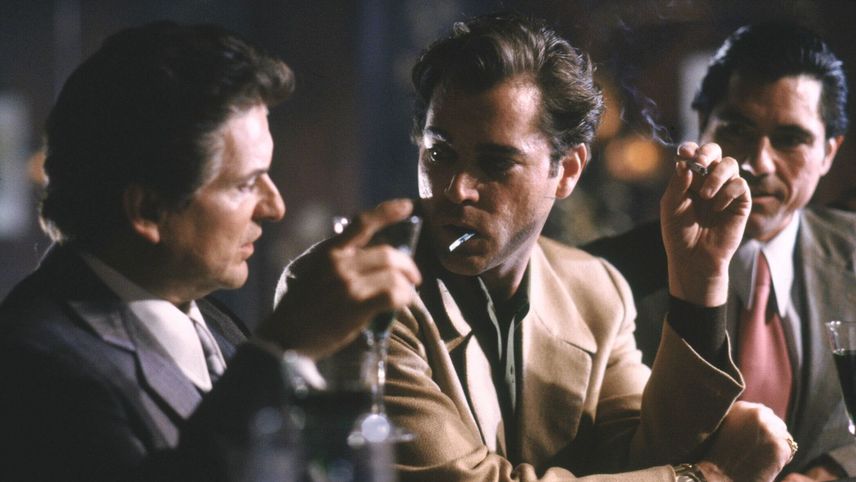
Director: Martin Scorsese · Cinematographer: Michael Ballhaus · Editor: Thelma Schoonmaker · Production Design: Kristi Zea · Key Cast: Ray Liotta, Robert De Niro, Joe Pesci, Lorraine Bracco, Paul Sorvino · Runtime: 146 minutes · Studio/Distributor: Warner Bros. · Budget: $25 million · Box Office: $47 million domestic
Goodfellas: The Mob Film That Made Crime Look Like the Best Job in the World, Then Took It Away
Henry Hill wanted to be a gangster. The first line of the film tells you this. The last scene shows you what wanting that costs. Everything between those two points is the education.
Goodfellas covers twenty-five years in the life of a mid-level associate of the Lucchese crime family, from his adolescent apprenticeship in 1955 through his arrest and entry into witness protection in 1980. Henry does not rise to the top. He is not Michael Corleone. He is not a king. He is a soldier, a earner, a guy who knows a guy. The film’s great innovation is to tell the gangster story not from the throne but from the street corner, where the real work happens and where the real consequences land.
Martin Scorsese adapted Nicholas Pileggi’s non-fiction book Wiseguy with the intention of making what he called a mob home movie. The result is the most kinetically alive film of his career. The camera never stops moving. The soundtrack never stops playing. The narration, shared between Henry and his wife Karen, never stops talking. The energy of the filmmaking mirrors the energy of the life it depicts: seductive, accelerating, addictive, and ultimately unsustainable.
The seduction is the key. Goodfellas makes crime look fantastic. The meals are enormous. The clothes are beautiful. The nightclubs part for you. Everybody knows your name. The famous Copacabana tracking shot, which follows Henry and Karen through the kitchen, past the coat check, down the corridor, and into the club where a table materializes in front of the stage, is not merely a technical achievement. It is a recruitment video. You watch that shot and you understand why a kid from Brooklyn would choose this life. The camera is in love with the world it is showing you, and the love is contagious.
Then the love turns. The second half of the film is a systematic dismantling of everything the first half built. The paranoia sets in. The coke sets in. The friends start disappearing. Tommy gets whacked instead of made. Jimmy starts killing everyone connected to the Lufthansa heist. And Henry, the narrator who made you fall in love with this world, turns informant and ends up in a suburban house in anonymity, eating egg noodles with ketchup, mourning a life that was going to kill him if he stayed in it.
Verdict: 10/10. Goodfellas is the greatest American crime film that is not The Godfather, and it achieves something The Godfather never attempted: it makes you complicit. You do not observe this world from a moral distance. You enjoy it. You miss it when it is gone. The film’s final accusation is directed at you, the viewer, who spent two hours having the time of your life watching terrible people do terrible things. Henry looks into the camera in the final shot. He is looking at you.
The Copacabana Shot and the Camera That Falls in Love
The tracking shot through the Copacabana nightclub lasts three minutes and eight seconds. It follows Henry and Karen from the street, through the back entrance, down a flight of stairs, through a kitchen corridor, past cooks and waiters and a coat-check station, into the main room, where a table is carried over the heads of the other patrons and placed in front of the stage. No cuts. No edits. One continuous movement.
Michael Ballhaus, who shot the sequence with a Steadicam, had to coordinate with dozens of extras, multiple set changes behind the camera, and the physical choreography of De Niro and Bracco moving through a real restaurant at a specific pace. Scorsese shot eight takes before he was satisfied. The eighth was the one that made the film.
The shot’s purpose is not to show off. It is to seduce. Karen is being seduced by Henry, and the audience is being seduced by the camera. The unbroken movement gives the sequence the quality of a dream: there are no cuts to break the spell, no reverse angles to introduce critical distance. You are inside the experience, moving through it as Karen moves through it, and the world that unfolds around you is so glamorous, so effortless, so clearly better than ordinary life that you understand, in your body, why Karen falls for it. The shot does not describe the attraction of the mob life. It produces it.
Ballhaus’s camerawork throughout the film operates on this principle of embodied energy. The camera pushes in during moments of excitement and pulls back during moments of threat. It circles the dinner table at Tommy’s mother’s house as the men eat and laugh. It locks onto Henry’s face during the final day of paranoia and cocaine and helicopter surveillance, matching the frantic rhythm of his disintegration. Scorsese and Ballhaus create a visual language in which the camera’s behavior communicates emotional states that the characters themselves cannot articulate.
Pesci’s Fury, Liotta’s Charm, and Bracco’s Unflinching Eyes
Joe Pesci won the Academy Award for Best Supporting Actor for Tommy DeVito, and his acceptance speech was five words long: “It’s my privilege. Thank you.” The brevity was appropriate. Tommy is a character who does not need words to communicate. He communicates through violence, delivered with a casualness that makes it more terrifying than any amount of theatrical menace could achieve.
The “How am I funny?” scene, which Pesci improvised based on a real incident from his pre-acting life, is a masterclass in the creation of fear through ambiguity. Tommy asks Henry whether he is funny, and the table goes silent. Nobody knows whether Tommy is joking or about to kill someone. Pesci plays the scene on a razor’s edge between comedy and murder, and Liotta’s response, a nervous laughter that gradually shifts from genuine amusement to genuine terror and back again, is the scene’s secret weapon. Scorsese filmed the exchange in a single medium shot rather than intercutting close-ups, which forces the audience to watch both actors simultaneously and eliminates the editorial safety net that conventional coverage would provide.
Ray Liotta carries the entire film on a voice. Henry Hill narrates roughly seventy percent of Goodfellas, and Liotta delivers the narration with an ease and warmth that make Henry’s world feel accessible, even desirable. This is the performance’s trap. Liotta makes you like Henry. He makes you root for Henry. He makes the mob life sound like the best thing that ever happened to anyone. And then, in the final act, when the narration becomes fragmented and paranoid and the ease is replaced by desperation, Liotta lets you see the cost of everything you were enjoying. The last-day sequence, in which Henry drives around New York cooking dinner and dealing cocaine while a helicopter follows him, is Liotta at his most physically committed: sweating, twitching, checking mirrors, coming apart in real time.
Lorraine Bracco’s Karen is the film’s moral compass, and the compass spins. She begins as a civilian who is horrified by Henry’s world and ends as a participant who flushes drugs down the toilet while federal agents bang on the door. Bracco plays the entire trajectory without ever losing Karen’s intelligence or agency. Karen does not drift into the mob life passively. She chooses it, repeatedly, with open eyes, because the alternative is ordinary life, and ordinary life, as the film has shown her, is not enough.
Thelma Schoonmaker’s Razor: How Editing Becomes the Film’s Heartbeat
Thelma Schoonmaker, who has edited every Scorsese film since Raging Bull, is the hidden architect of Goodfellas’ velocity. The film moves faster than any crime epic before or since, covering twenty-five years of narrative in 146 minutes without ever feeling rushed or abbreviated. Schoonmaker’s editing is the mechanism that makes this speed possible.
Her technique in Goodfellas is built on acceleration. The early sections, covering Henry’s childhood and apprenticeship, are cut at a relatively measured pace. Scenes are allowed to breathe. Conversations play out in long takes. As the film advances and the stakes increase, the cutting speed increases with them. By the Lufthansa heist and its aftermath, scenes are compressed into fragments: a phone call, a body in a car, a news broadcast, a reaction shot. The acceleration mirrors Henry’s experience. The faster the money comes in, the faster the consequences arrive, and Schoonmaker cuts the film to match.
The last-day sequence is the editing’s showpiece. Schoonmaker intercuts between Henry’s drug dealing, his sauce cooking, his helicopter surveillance, and his mounting paranoia across a single day, compressing hours of activity into minutes of screen time. The cuts come faster and faster. The continuity becomes hallucinatory. You lose track of which activity is happening when, which is precisely the state Henry is in. The editing does not represent paranoia. It produces it.
The freeze frames are Schoonmaker’s other signature in the film. At key moments, the image freezes and Henry’s narration identifies a character or a consequence. The device is borrowed from the French New Wave, but Schoonmaker and Scorsese use it for a purpose Godard never intended: the freeze frame becomes the moment when the narrator steps outside his own story to address the audience directly, breaking the fourth wall without technically breaking it. The image stops. The voice continues. The effect is simultaneously intimate and distancing, a reminder that this is someone’s version of events, not the events themselves.
Forty-Seven Songs and No Original Score: The Jukebox as Narrator
Goodfellas contains no original musical score. Every piece of music in the film is a pre-existing pop, rock, soul, or doo-wop recording, selected by Scorsese to match the era, the mood, and the moral position of each scene. There are roughly forty-seven songs across the film’s runtime, and their placement is as precise as any composed score.
Scorsese has described his approach to music as analogous to a novelist choosing the right word. Each song is not merely period-appropriate but thematically specific. “Rags to Riches” by Tony Bennett accompanies young Henry’s ascent into the mob. “Layla” by Derek and the Dominos, specifically its piano coda, plays over the montage of bodies being discovered after the Lufthansa aftermath. The choice of the coda rather than the famous guitar riff is crucial: the coda is melancholy, almost beautiful, and its elegance gives the sequence of murdered men a quality of sadness rather than spectacle. The violence is scored as loss, not excitement.
The Rolling Stones appear multiple times across the soundtrack, and their presence marks the timeline’s progression. Early Stones tracks accompany the 1960s sequences. “Monkey Man” accompanies the cocaine-fueled paranoia of the late 1970s. The band functions as a cultural clock, their evolution from blues-influenced rock to drugged-out excess paralleling Henry’s own trajectory from youthful excitement to chemical dissolution.
The absence of an original score is a philosophical decision as much as an aesthetic one. A composed score would provide emotional guidance. It would tell you how to feel. Scorsese’s needle drops do something different: they place you inside a specific historical moment and let the ironic distance between the song and the image generate meaning. When “Atlantis” by Donovan plays over a scene of violence, the pastoral beauty of the music and the brutality of the action exist in a tension that no composed score could replicate. The irony is the point. The mob life is set to the same music as everyone else’s life. The difference is what happens while the music plays.
Pileggi’s Wiseguy: The Journalist and the Filmmaker Build a Story Together
Nicholas Pileggi’s 1986 book Wiseguy was based on extensive interviews with the real Henry Hill after his entry into witness protection. Pileggi, a crime journalist with decades of experience covering New York’s organized crime families, approached the material with a reporter’s eye for the mundane mechanics of criminal life. The book’s strength is not in its drama but in its detail: how a hijacking works, how a restaurant is taken over, how protection money flows, how a typical Tuesday is spent.
Scorsese recognized in the book what he had been looking for: a mob story told from the inside, without the mythic grandeur of The Godfather, without the operatic sweep of the saga form. Pileggi’s Henry Hill is not a tragic hero. He is a working criminal who describes his daily life with the matter-of-fact precision of someone describing any other job. The extraordinary thing about the book, and the film, is how ordinary the work of organized crime turns out to be. The glamour is there. So is the tedium. So is the constant, low-grade anxiety of operating outside the law.
Scorsese and Pileggi co-wrote the screenplay across twelve drafts. Their collaboration was unusually intimate: Pileggi shared his raw interview transcripts, and Scorsese drew dialogue directly from Hill’s speech patterns. The voiceover narration preserves the cadence of Hill’s actual speech, which is fast, colloquial, and peppered with the kind of detail that only an insider would know. When Henry explains how the mob operates at JFK airport, the explanation has the quality of someone describing their workplace. The normalization of crime is communicated through diction before it is communicated through image.
The addition of Karen’s voiceover, which is absent from the book, was one of the screenplay’s most important inventions. By giving the audience a second narrator, Scorsese and Pileggi create a stereo effect: you hear the mob life from the inside (Henry) and from one step outside (Karen). The two perspectives do not agree. Karen’s version of events is colored by a moral awareness that Henry’s lacks, and the gap between them produces a tension that keeps the audience from fully surrendering to Henry’s seductive narration.
Scorsese’s Mother, Real Wiseguys, and the Texture of the Actual
Goodfellas achieves its documentary quality partly through casting choices that blur the line between performance and presence. Scorsese populated the film with people who knew the world being depicted. His mother, Catherine Scorsese, plays Tommy’s mother, serving a late-night dinner to men who have a body in the trunk of their car. His father, Charles Scorsese, plays a small role as Vinnie. The dialogue in the dinner scene was largely improvised, and Catherine Scorsese’s warmth and fussiness are not acting. They are the real social texture of an Italian-American kitchen at midnight.
Several actors in the film had genuine connections to organized crime or had grown up in neighborhoods where the mob was an ambient presence. Frank Sivero, Tony Darrow, and others brought a physical familiarity with the world that trained actors approximating mob behavior from the outside could not replicate. Scorsese encouraged improvisation from these performers, then transcribed the results and wove them into the screenplay. The line between scripted dialogue and recorded reality became genuinely porous.
The production design by Kristi Zea reinforced this texture. The social clubs, restaurants, and apartments in Goodfellas do not look designed. They look inhabited. The details are specific rather than generic: the right brand of beer on the table, the right pattern on the wallpaper, the right degree of wear on a leather booth. Scorsese’s insistence on environmental authenticity extends even to the extras, who were costumed not as generic period figures but as specific social types recognizable to anyone who grew up in the neighborhoods being depicted. The film’s world does not feel constructed because it was, in many of its details, remembered.
The Italian-American Trilogy: Mean Streets, Raging Bull, Goodfellas
Scorsese has described Goodfellas as the third film in an unplanned trilogy examining Italian-American life from different angles. Mean Streets (1973) is the street-level view: young men in Little Italy, small-time hustlers and loan sharks, Robert De Niro as a volatile loose cannon. Raging Bull (1980) is the personal view: Jake LaMotta, a man whose rage and jealousy destroy every relationship he values. Goodfellas is the systemic view: the mob as a business, its attractions and its costs, the way it metabolizes the people who serve it.
The trilogy tracks Scorsese’s artistic evolution. Mean Streets is raw, improvisational, powered by the energy of a young filmmaker still finding his visual language. Raging Bull is controlled, studied, its black-and-white photography and precise compositions reflecting a director in full command of his craft. Goodfellas synthesizes both modes: it has the kinetic energy of Mean Streets and the structural discipline of Raging Bull, and it adds a third element that neither predecessor possessed: pleasure. Goodfellas is fun. It is designed to be fun. The fun is the argument.
Scorsese followed Goodfellas with Casino (1995) and, much later, The Irishman (2019), extending the mob narrative into different registers. Casino is Goodfellas’ Las Vegas counterpart, flashier and more operatic. The Irishman is its elegy, slow and mournful and shot through with the regret that Goodfellas, in its velocity, never pauses to feel. Together, these films constitute the most sustained cinematic examination of American organized crime ever undertaken by a single director. Goodfellas remains the centerpiece: the one that moves fastest, seduces hardest, and leaves the sharpest mark.
Lost the Oscar, Won Everything Else: The Film the Academy Couldn’t Reward
Goodfellas was nominated for six Academy Awards: Best Picture, Best Director, Best Supporting Actress (Bracco), Best Adapted Screenplay, Best Film Editing, and Best Supporting Actor (Pesci, who won). It lost Best Picture and Best Director to Dances with Wolves, a decision that has been debated with increasing intensity in the decades since. The general consensus, which Scorsese himself has never publicly challenged, is that the Academy preferred Costner’s earnest, visually grand Western to Scorsese’s violent, morally ambiguous crime film.
The loss did not damage the film’s reputation. It may have enhanced it. Goodfellas became the standard-bearer for the argument that the Academy’s taste is systematically biased against films that refuse to comfort their audiences. It won the BAFTA for Best Film and Best Director. It won the Silver Lion at Venice. Roger Ebert wrote that no finer film had ever been made about organized crime, including The Godfather. The National Film Registry selected it for preservation in 2000. In virtually every subsequent poll of the greatest American films, Goodfellas appears in the top twenty. Dances with Wolves does not.
The film’s cultural impact is incalculable. It influenced The Sopranos, which populated its cast with Goodfellas alumni and adopted Scorsese’s technique of scoring violence with pop music and narrating criminal life in the register of domestic comedy. It influenced Quentin Tarantino, Paul Thomas Anderson, and virtually every filmmaker who has attempted to make crime feel simultaneously exhilarating and horrifying. The film did not create the modern crime genre. It defined its vocabulary.
What Changes When You Know Henry Ends Up Eating Egg Noodles
Goodfellas is a film that gets sadder on every viewing. The first time is a rush. The second time, you start noticing the exits that close.
Watch Tommy. On a first viewing, his violence is shocking and occasionally funny, which is the point: Pesci calibrates Tommy’s volatility so precisely that laughter and horror coexist in every scene he occupies. On a second viewing, Tommy becomes unbearable. You know where every joke leads. The Spider shooting. The Billy Batts murder. The final walk into the room where he expects to be made. The laughter curdles because you know the cost, and the cost is always someone’s life.
Track the food. Goodfellas is obsessed with eating, and the meals mark the trajectory of Henry’s life. The early meals are communal, generous, abundant. The prison meals are surprisingly good (Paulie slicing garlic with a razor blade). The late meals are desperate. The final meal, the egg noodles with ketchup in witness protection, is the film’s cruelest image: everything Henry gained and lost, reduced to a plate of mediocre food in an anonymous kitchen.
Listen for the shifts in the narration. Henry’s voiceover in the first half is warm, confident, almost boastful. In the second half, the tone changes. The confidence cracks. The narration becomes fragmented, its rhythm matching the cocaine paranoia that is eating Henry from the inside. Liotta performs these shifts vocally without drawing attention to them, and the gradual deterioration of the narrator’s authority is one of the film’s most sophisticated structural effects.
Watch the final shot. Tommy DeVito, dead for half an hour of screen time, fires a gun directly at the camera. The shot references the 1903 film The Great Train Robbery, one of the earliest narrative films, in which a cowboy similarly fires at the audience. Scorsese’s quotation is not merely cinematic homage. It is the film’s thesis in a single image: violence, directed at you, from inside the screen, by a man who is already dead. You spent two hours watching these people. Now they are watching you.
Film Trivia
The improvisation that became the film’s most famous scene. The “How am I funny?” exchange between Pesci and Liotta was based on a real incident from Pesci’s youth, when he told a mobster that he was funny and the man took offense. Scorsese had Pesci and Liotta improvise the scene during rehearsals, then transcribed and refined the dialogue for the final script. Liotta was not told in advance what Pesci would say, and his nervous laughter is at least partly genuine.
Five words at the podium. Joe Pesci’s Oscar acceptance speech for Best Supporting Actor was the shortest in Academy Award history at the time. He walked to the microphone, said “It’s my privilege. Thank you,” and walked off. The brevity was consistent with the character: Tommy DeVito would not have given a long speech either.
The book came first, then the friendship. Scorsese called Nicholas Pileggi after reading Wiseguy and said he had been waiting for this book his entire life. Pileggi responded that he had been waiting for this phone call his entire life. The two men collaborated on the screenplay across twelve drafts and later reunited for Casino. Pileggi’s journalistic precision and Scorsese’s visual imagination produced a partnership that neither could have achieved alone.
Eight takes through the kitchen. The Copacabana tracking shot required eight takes over the course of a single evening. The sequence was shot in the actual Copacabana nightclub, with the Steadicam operator following Liotta and Bracco through a route that had been rehearsed with military precision. The table that appears at the end of the shot was carried into position by a waiter who had been waiting offscreen for three minutes, timing his entrance to the actors’ arrival. One missed step by any participant would have ruined the entire take.
This entry selects analytical dimensions from a pool. All five anchors are present: the critical verdict, performances, visual craft, reception and legacy, and the rewatchability guide. Earned sections cover Thelma Schoonmaker’s editing, the needle-drop soundtrack as narrative strategy, the Pileggi adaptation, the documentary texture of the production (real-life casting, improvisation, environmental authenticity), and the film’s place within Scorsese’s Italian-American trilogy. One wildcard section addresses the Copacabana tracking shot as seduction mechanism rather than technical showcase. Genre lineage is embedded throughout the entry’s engagement with The Godfather rather than separated into its own section. Cultural context is omitted because the film’s concerns are personal and criminal rather than broadly sociopolitical, and its Italian-American milieu is better served by the trilogy section.

Leave a Reply