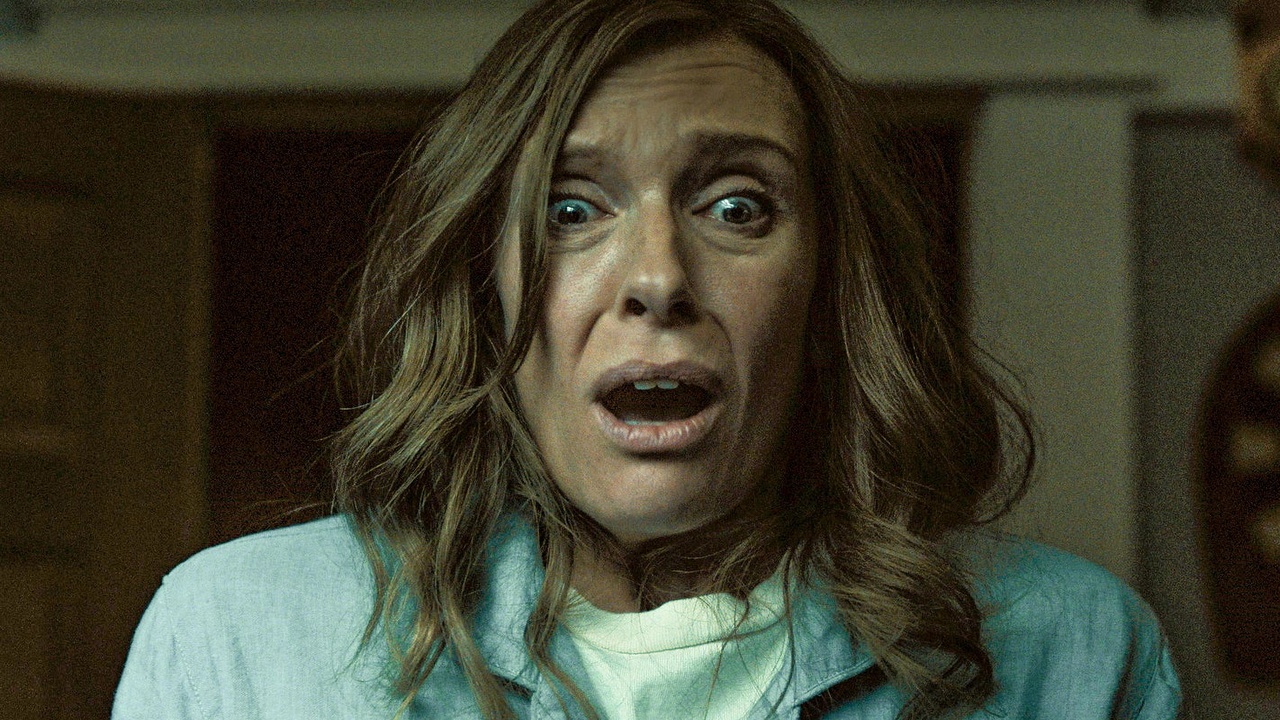
Director: Ari Aster · Cinematographer: Pawel Pogorzelski · Composer: Colin Stetson · Production Design: Grace Yun · Key Cast: Toni Collette, Alex Wolff, Milly Shapiro, Gabriel Byrne, Ann Dowd · Runtime: 127 minutes · Studio/Distributor: A24 / PalmStar Media / Windy Hill Pictures · Budget: $10 million · Box Office: $83 million worldwide
Hereditary: A Grief So Deep It Grows Teeth
Here is a horror film whose most terrifying idea has nothing to do with demons. It is the suspicion that your family’s history has already written your future. That the damage done generations ago, by people you never met, lives in your blood and your behavior and your children’s faces. That you were never free. The supernatural apparatus that arrives in Hereditary’s final act is almost beside the point. The real horror was always genetic. It was always inherited. It was always coming for you no matter what you did.
Annie Graham is a miniature artist who builds dollhouse-scale dioramas of scenes from her own life. Her mother has just died. The grief is complicated by a relationship that was itself complicated by mental illness, manipulation, and estrangement. Annie’s family absorbs the loss in different ways: her husband Steve retreats into steadiness, her teenage son Peter retreats into weed and girls, and her thirteen-year-old daughter Charlie, the grandmother’s favorite, retreats into making small clicking sounds with her tongue and cutting the heads off dead birds. The household hums with unspoken tension. The grandmother is gone but her presence has not left. Something is still in the house. Something that was invited in long before the film begins.
What Ari Aster accomplishes in his debut feature is a fusion so complete it defies easy genre classification. Hereditary is a family drama, a psychological study of grief, and a work of occult horror. These three modes do not alternate. They coexist in every scene, each one informing and amplifying the others. The grief feels supernatural. The supernatural feels domestic. The domestic feels cursed. Aster wrote the film as two halves that are, in his words, completely inextricable from each other. It begins as family tragedy and curdles into a nightmare. But the curdling is gradual, so expertly paced that you cannot identify the exact moment when realism slips away.
The film is not flawless. Its final fifteen minutes pivot into a mode of ritualistic horror that, while thematically coherent, requires a tonal leap not every viewer successfully makes. The occult machinery of Paimon, the demon king, is intricate but risks tipping into a campiness that undermines the rawness of everything that preceded it. There is a version of this film’s ending that trusts its audience more and explains less. Aster did not make that version, and the closing sequence is the single element that separates Hereditary from perfection.
But the first hundred minutes are among the finest horror filmmaking of the twenty-first century. And the performance at its center is one of the great screen performances of any genre.
Verdict: 9/10. Hereditary is a devastating debut: a horror film that earns its terror through character, patience, and an understanding of family dysfunction so precise it makes the supernatural elements feel almost redundant. The ending stumbles slightly under the weight of its own mythology. Everything before it is extraordinary.
The Scene That Breaks the Film’s Spine
It is necessary to discuss what happens roughly forty minutes into Hereditary because it is the structural event around which the entire film organizes itself. Everything before it is setup. Everything after it is fallout.
Charlie dies.
Not in a dramatic confrontation. Not in a scene telegraphed by musical cues or camera movements. She dies in a car, at night, after an allergic reaction to nuts at a party she did not want to attend, because Peter drove her there and then left her alone while he chased a girl. Peter drives frantically toward the hospital. Charlie, gasping for air, leans out the window. Peter swerves to avoid a dead animal in the road. Charlie’s head strikes a telephone pole.
The film does not show you the impact from the outside. It shows you Peter’s face. It shows you him sitting in the car, breathing, unable to turn around and look. The camera holds on him for what feels like an eternity. Then it holds on him going home, getting into bed, lying there all night, knowing what is in the back seat of the car. Then it holds on his face when his mother finds what is left.
No horror film in recent memory has deployed shock with this level of structural intelligence. The death of Charlie is not a scare. It is a demolition of the viewer’s assumptions about what kind of film they are watching. Up to this point, Charlie has been positioned as the protagonist, or at least as the film’s emotional center. Her death does not just remove a character. It removes the narrative framework the audience has been building. You are suddenly in a different film, and that film is much worse than the one you thought you were watching.
The aftermath, not the event itself, is where the horror lives. Peter’s silence. Annie’s discovery, played in a single take of Collette screaming from a part of herself that seems to exist below conscious control. The family dinner scene that follows, in which weeks of suppressed rage detonate across the table. The death is the fracture line. The rest of the film is the collapse.
Dollhouse Cinema: When the Walls Come Off and the Camera Stays
Ari Aster and cinematographer Pawel Pogorzelski conceived a visual strategy that is disarmingly simple in principle and deeply unsettling in practice. The Graham family home was built entirely on a soundstage. Every interior, from the bedrooms to the kitchen to both versions of the treehouse, was constructed as a set with removable walls. This allowed the camera to pull back to distances that would be physically impossible in a real house, framing rooms from far enough away that they begin to resemble the miniature dioramas Annie builds in her studio.
The effect is cumulative and chilling. In establishing shots, the camera sometimes approaches the house from an angle and distance that makes it genuinely difficult to tell whether you are looking at the full-scale set or one of Annie’s models. The boundary between the real house and the dollhouse dissolves. Characters move through rooms that look inhabited and also look arranged. You begin to feel, without being told, that someone is watching this family from above. That the Grahams are figures in a diorama being manipulated by a hand they cannot see.
Pogorzelski’s compositions reinforce this sense of observed helplessness. The framing is frequently wide, symmetrical, and still. Characters are placed within their environments rather than isolated from them. Doorways and windows create frames within frames, so that the act of watching becomes the film’s visual subject. When Annie sees a figure standing in the dark corner of a room, the camera does not zoom in or cut to a close-up. It holds its position and lets you find the figure yourself. The discovery belongs to the viewer, and the lack of editorial emphasis makes it infinitely more terrifying than a jump cut would.
Close-ups, when they arrive, feel almost invasive. Collette’s face fills the frame during the dinner scene and during her discovery of Charlie’s body, and the shift from the film’s clinical distance to sudden proximity creates a physical jolt. You have been watching from outside the dollhouse. Now you are inside it, and you cannot look away.
Toni Collette’s Unraveling, and the Family That Watches
Toni Collette was reluctant to take this role. She does not particularly enjoy horror films, and Annie Graham requires her to spend two hours disintegrating on screen. What convinced her was Aster’s script, which treated the horror not as a genre exercise but as an extension of family dynamics. Annie is not a horror movie mother. She is a woman whose entire psychological infrastructure collapses across the film’s runtime, and the collapse is rendered with the specificity of someone who understands exactly how grief, guilt, and inherited mental illness interact.
Collette performs at least three distinct registers that would each be sufficient to carry a lesser film. There is the controlled, slightly brittle Annie of the first act, managing her mother’s death with the focused competence of someone who learned early that falling apart was not an option. There is the shattered Annie of the middle section, after Charlie’s death, when the composure cracks and what emerges is a grief so physical it seems to reshape her face. And there is the Annie of the final act, who has crossed into a territory beyond grief, where the supernatural and the psychological become indistinguishable and her body is no longer entirely her own.
The dinner scene is the performance’s centerpiece. Annie, who has been swallowing her fury at Peter for weeks, finally erupts. What follows is not a dramatic monologue but a controlled demolition. She tells her son things a mother should never say, and Collette delivers them with a precision that makes clear Annie means every word and will regret every word and cannot stop saying them. The scene is devastating because it is not supernatural. It is the most realistic thing in the film. Anyone who has been in a family argument that goes too far will recognize the exact register.
Alex Wolff carries the second half of the film largely alone, and what he does with Peter’s shellshocked passivity is remarkable for an actor who was twenty years old during production. Peter does not process his guilt. He stores it in his body, in his frozen expressions, in the way he holds himself as though bracing for the next impact. Gabriel Byrne provides the film’s only anchor of normalcy as Steve, and his stubborn rationalism becomes its own form of tragedy: the man who insists there must be a reasonable explanation, right up until the moment when there isn’t one.
Milly Shapiro, cast from Broadway’s Matilda in her screen debut, creates something indelible in limited screen time. Charlie is strange and watchful and communicates in that tongue-click, a sound that Shapiro brought from her own habits and that becomes one of the most unnerving sonic motifs in modern horror. When the click recurs later in the film, after Charlie is gone, it carries the weight of everything the audience has lost.
Colin Stetson’s Breath: Scoring Dread from Inside the Instrument
Colin Stetson is an avant-garde saxophonist known for producing sounds that seem physiologically impossible from a single wind instrument. He uses circular breathing, multiphonic techniques, and close-miking of the instrument’s keywork to create textures that sound less like music and more like something organic struggling to breathe. Ari Aster chose him for Hereditary precisely because his work does not sound like a film score. It sounds like the noise a house makes when something is wrong inside it.
The score operates below the threshold of conventional musical recognition. Stetson’s bass saxophone drones and clicking key sounds do not announce themselves as music. They infiltrate scenes as texture, blending with the ambient sound design until the distinction between score and environment dissolves. You feel uneasy before you understand why. The dread arrives in your body before it arrives in your mind.
Restraint is the score’s most effective quality. Long stretches of the film are scored with near-silence or with sounds so quiet they register subliminally. When Stetson’s instruments rise to full volume in the final act, the contrast is enormous. The trumpets that herald Paimon’s arrival in the climax reference the demon’s mythology directly (Paimon is traditionally announced by trumpets), but they also function as the release of sonic pressure that has been building for two hours. The coronation sequence is loud in a way that feels earned precisely because the preceding ninety minutes were so quiet.
The placement of Judy Collins’ recording of Joni Mitchell’s “Both Sides, Now” over the end credits is a stroke of cruel genius. After everything you have witnessed, the film sends you out with a gentle folk song about the illusion of understanding. You thought you knew. You saw it from both sides. You were wrong. The song reframes the entire film as a story about people who never had access to the full picture, who were manipulated by forces they could not perceive, and who believed in a reality that was, from the beginning, a diorama built by someone else.
Annie’s Dioramas: The Art of Seeing Everything and Controlling Nothing
Annie Graham’s miniatures are not a character detail. They are the film’s thesis statement expressed in balsa wood and acrylic paint.
She builds tiny replicas of rooms and scenes from her own life: her mother’s hospital room, her family’s dining table, the moment she finds her mother breastfeeding her newborn daughter without permission. The models are exquisitely crafted and deeply disturbing. They represent Annie’s attempt to contain her experiences by shrinking them, to master her trauma by rendering it at a scale she can hold in her hands.
The irony, which the film sustains across its entire runtime, is that Annie’s art mirrors the film’s own visual strategy. She frames her life in tiny boxes. Aster frames her life in wide shots that make her house look like a tiny box. She is a miniaturist living inside a miniature. She builds dollhouses to feel in control while being controlled by forces she cannot see. The models are her version of narrative: she arranges the figures, sets the scene, decides the perspective. But she cannot change what happened. The models reproduce trauma. They do not resolve it.
As the film progresses and Annie’s grip on reality weakens, the miniatures begin to reflect scenes that have not yet happened or scenes that she could not possibly have witnessed. The models become predictive rather than retrospective. They stop being art and start being evidence. The line between Annie creating her reality and her reality being created for her collapses, and the miniatures are the hinge on which that collapse swings.
For a debut filmmaker, this is an extraordinarily sophisticated structural device. Aster uses a character’s art practice as a visual metaphor for his own directorial strategy, and he does it without ever making the connection explicit. You see the miniatures. You see the wide shots. The resemblance accumulates. Nobody explains it. Nobody needs to.
The Exorcist, Rosemary’s Baby, and the Horror Film That Grew Up
Hereditary belongs to a specific lineage of horror films in which the family unit is the site of the genre’s deepest terrors. The Exorcist (1973) imagined demonic possession as a crisis of parenthood: a mother watching her child become unrecognizable. Rosemary’s Baby (1968) imagined pregnancy as conspiracy: a woman’s body appropriated by people she trusted. The Omen (1976) imagined parenthood itself as damnation. In each case, the horror is domestic before it is supernatural. The demon is in the house.
Hereditary extends this tradition in a direction its predecessors could not have anticipated. Aster’s innovation is to treat the occult elements not as an intrusion into family life but as a continuation of it. The Graham family’s dysfunction does not attract evil. It is the mechanism through which evil operates. Ellen’s secret cult, Charlie’s predetermined role as Paimon’s vessel, Annie’s manipulation through grief support groups: all of these operate along family lines, exploiting bonds of loyalty, guilt, and obligation. The horror is not that a demon invades the family. The horror is that the family was built as the demon’s delivery system.
This is what makes Hereditary feel genuinely new despite its obvious debts to the canon. Previous domestic horror films maintained a boundary between the family and the threat. The family was good. The threat was external. The drama was in the defense. Aster dissolves that boundary. In Hereditary, the family is the threat. Not because they are evil, but because they have been instrumentalized, from the grandmother’s generation onward, in service of something they did not choose.
What followed Hereditary matters almost as much as the film itself. A generation of filmmakers began treating horror as a vehicle for processing genuine psychological material rather than delivering scares. The “elevated horror” label, however much Aster and his peers resist it, describes a real shift in ambition, and Hereditary, alongside The Witch and Get Out, is one of its foundational texts.
Building the Graham House: Soundstages, Removable Walls, and Domestic Prisons
The decision to build the Graham house entirely on a soundstage was not a budgetary concession. It was a creative necessity. Aster needed a home that could be photographed from distances and angles no real house would permit, one where walls could disappear to reveal the camera’s godlike perspective on the family trapped inside.
Grace Yun’s production design accomplishes something paradoxical: the house is simultaneously warm and suffocating. The kitchen has the cluttered authenticity of a real family home. The living room is comfortable, lived-in, filled with the accumulated objects of an upper-middle-class American life. But the spaces are also subtly wrong. Ceilings feel too low. Hallways are too narrow. The attic, which becomes the film’s final battleground, is a claustrophobic nightmare of exposed beams and stored secrets.
Annie’s studio sits within the house like a separate dimension. It is the one room that feels spacious, because it needs to accommodate her models and her worktable. But it is also the room where she reproduces her family’s worst moments in miniature, which gives it the character of both sanctuary and torture chamber. Yun designed the studio to feel like a space where observation becomes obsession, where the line between crafting a model and crafting a reality gets dangerously thin.
The treehouse is the design’s masterstroke. In a film where interior spaces are prisons, the treehouse initially reads as escape: a childhood structure, elevated, outdoors. By the final scene, it has been transformed into a chapel. Candles, kneeling figures, a crowned body. The childhood space has been colonized by the same force that colonized the family. Even the treehouse was never safe.
The film was shot in thirty-two days in Utah, with exterior locations chosen for their geographic isolation. Summit County’s landscape, stripped of identifying features by Pogorzelski’s framing, makes the Graham home feel like it exists outside of any particular place. The house could be anywhere. That is the point. It is a family’s home. Every family has one.
From Short Films to Sundance: Ari Aster Arrives Fully Formed
There is a particular kind of debut that announces a filmmaker’s sensibility so completely that their subsequent work feels like elaboration rather than discovery. Hereditary is that debut.
Ari Aster had been making short films at the AFI Conservatory, most notably The Strange Thing About the Johnsons (2011), a genuinely shocking work about domestic abuse that inverts every expectation about who the victim and perpetrator should be. The film leaked online and went viral, which brought Aster to the attention of PalmStar Media and, eventually, A24. When he pitched Hereditary, he described it as a family tragedy rather than a horror film, correctly intuiting that calling it horror might limit the funding and the talent willing to commit.
This framing was not a marketing strategy. It was an honest description of Aster’s method. He is fundamentally a dramatist who works in genre settings. The horror in Hereditary is real and effective, but it exists in service of character dynamics that would function in a non-genre context. Take away the demon. Take away the séances and the dark figures in the corners. What remains is still a devastating film about a woman who cannot escape her mother’s legacy, a son paralyzed by guilt, a husband who cannot hold his family together, and a daughter who was never given a chance to be anything other than what she was designed to be.
Toni Collette called Aster the most prepared director she had ever worked with. The script was precise to the point of totality; every scene, every prop, every camera angle had been determined before production began. For a filmmaker working with a modest budget and a thirty-two-day shoot, this level of preparation was not merely professional. It was the only way to achieve the control the film demands. Hereditary is a film about losing control. Making it required absolute control. The tension between the two is built into the project at every level.
A24, Horror, and the Film That Redrew the Genre’s Boundaries
When Hereditary premiered at Sundance in January 2018, the response was immediate and polarized. Critics were nearly unanimous in their praise, invoking The Exorcist and Rosemary’s Baby in a way that felt like genuine comparison rather than marketing hyperbole. Audiences were less united. The film’s deliberate pace and its pivot from psychological realism to supernatural horror in the final act divided viewers sharply. Some called it the scariest film in years. Others called it slow, pretentious, or tonally incoherent.
The box office settled the debate in one direction. Hereditary grossed $83 million worldwide against a $10 million budget, making it A24’s highest-grossing release at the time (a record held until Everything Everywhere All at Once surpassed it in 2022). For a studio that had built its identity on prestige independents, Hereditary demonstrated that literary ambition and commercial horror were not mutually exclusive. The film proved that audiences would pay to be disturbed rather than merely startled.
The critical legacy has only grown. Hereditary is now routinely cited as one of the greatest horror films of the twenty-first century, and frequently placed alongside the genre’s all-time landmarks. Its influence is visible in the wave of psychologically dense, aesthetically controlled horror films that followed: Midsommar (Aster’s own follow-up), The Lighthouse, Midsommar, Saint Maud, and Talk to Me all operate in territory Hereditary helped open.
The film’s most enduring impact may be its argument about what horror can carry. Not just scares, not just atmosphere, but genuine emotional weight. Grief, mental illness, family dysfunction, determinism. These are not toppings added to a genre formula. They are the film’s actual subject matter. The horror serves them, not the other way around. That inversion, more than any individual scare, is what Hereditary contributed to cinema.
What Changes When You Already Know About the Telephone Pole
The first time you watch Hereditary, Charlie’s death blindsides you. The second time, everything before it becomes unbearable.
On your rewatch, pay attention to the grandmother’s presence in the first act. She appears in photographs and at the funeral, but she also appears in places you missed the first time. Look for her in the shadows at the corners of rooms. Aster has placed her, or the suggestion of her, in backgrounds throughout the early scenes. The haunting begins before the death. It begins before the film begins.
Track the symbol. The triangle with the internal line that represents Paimon appears carved into the telephone pole before Charlie’s death. It appears on the necklace Ellen wears. It appears scratched into walls and furniture. On a first viewing, these are invisible. On a second, they form a map of the conspiracy that was always in place.
Watch Annie’s miniatures as a parallel narrative. Each model she builds or works on corresponds to her psychological state at that point in the film. In the early scenes, the models are detailed but contained. As the film progresses, they become more chaotic, more exposed, less like art and more like evidence of a mind trying to process what cannot be processed.
Listen for the tongue click. After Charlie dies, the clicking sound she makes with her tongue appears in scenes where Charlie is not present. It migrates from character to environment to something else entirely. Tracking when and where the click occurs reveals the film’s supernatural logic well before the plot makes it explicit.
And watch Peter. On a first viewing, he is a supporting character until Charlie’s death promotes him to protagonist. On a second viewing, he was always the target. Every scene in the first act positions him not as a bystander but as the designated host. The grandmother’s attention to Charlie, which seems like the central relationship on first viewing, is a misdirection. Charlie was the vessel. Peter was always the destination.
Film Trivia
The most prepared director. Toni Collette publicly called Ari Aster the most prepared director she had ever worked with. Every shot, every prop placement, every camera movement was predetermined before the thirty-two-day shoot began. Aster’s AFI training had produced a filmmaker who left nothing to chance, which is fitting for a film whose central theme is that nothing in life is left to chance either.
The tongue click heard round the world. Charlie’s distinctive clicking sound was Milly Shapiro’s own habit, something she did naturally. Aster recognized it during auditions and wrote it into the character. The sound became so identified with the film that audiences at screenings reportedly flinched whenever they heard anything resembling it in the theater’s ambient noise.
Cursed set, real consequences. During a Reddit AMA, Aster recounted that Alex Wolff warned him not to say the title of Shakespeare’s Macbeth aloud on set, citing the old theater superstition. Aster, self-described skeptic, said the name anyway. A light exploded during the following scene. Aster has not said whether he continued the practice.
The desk was not supposed to hurt. For the classroom scene in which Peter slams his face into his desk, Wolff was told the desk surface would be soft foam. When he struck it, only the top was padded; the underlying surface was hard. Wolff’s genuine pain and surprise are partially visible in the final cut. He has spoken about the physical and psychological toll the role took on him, describing months of depression after filming wrapped.
This entry selects analytical dimensions from a pool. All five anchors are present: the critical verdict, performances, visual craft, reception and legacy, and the rewatchability guide. Earned sections cover Colin Stetson’s score, Grace Yun’s production design, genre lineage, and Ari Aster’s career context. Two wildcard sections address elements unique to this film: the structural rupture of Charlie’s death, which reorganizes the entire narrative at its midpoint, and Annie’s miniatures as a self-referential device that mirrors the film’s own visual strategy. Cultural and historical context is omitted because Hereditary’s concerns are familial and metaphysical rather than sociopolitical. Awards history is omitted because the film, despite its acclaim, received no major awards nominations, a fact more revealing about institutional attitudes toward horror than about the film’s quality.

Leave a Reply