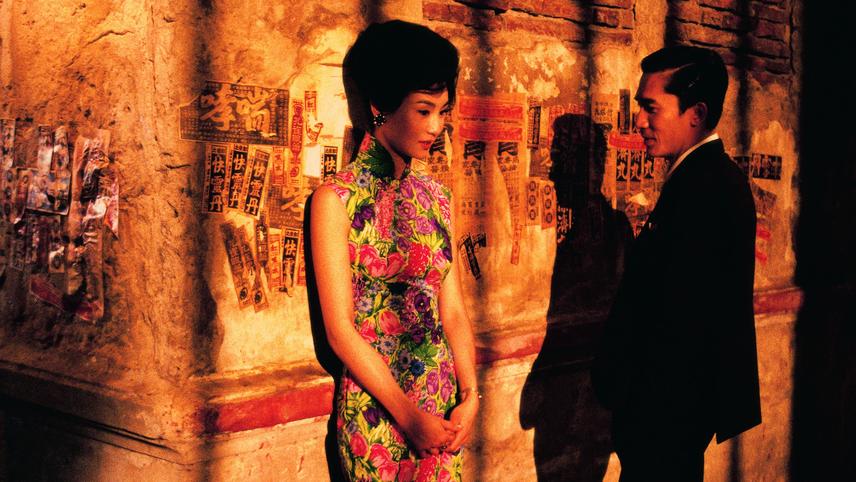
Director: Wong Kar-wai · Cinematographers: Christopher Doyle, Mark Lee Ping-bing · Music: Michael Galasso, Shigeru Umebayashi; featuring Nat King Cole · Starring: Tony Leung Chiu-wai, Maggie Cheung Man-yuk · Runtime: 98 minutes · Studio: Block 2 Pictures / Jet Tone Productions · Budget: Undisclosed (estimated $3–4 million) · Box Office: $12.9 million worldwide
1. In the Mood for Love: The Most Beautiful Film About Nothing Happening
Two married people discover that their spouses are having an affair with each other. They begin spending time together. They fall in love. They do not act on it.
That is the film. Ninety-eight minutes of two people not doing something. And it is, by a wide margin, the most achingly romantic film of its century.
Wong Kar-wai’s achievement is to have made a film about desire that is more potent than any film about consummation. Chow Mo-wan and Su Li-zhen never kiss. They never sleep together. They never declare their feelings in unambiguous terms. What they do instead is walk side by side down narrow corridors, eat noodles at the same stall, sit in adjacent chairs in a hotel room while one of them writes a martial arts serial and the other reads it. The film eroticizes proximity. The space between their shoulders becomes unbearable. A hand reaching for a handbag beside another hand becomes a scene of almost violent intimacy. Wong understood something that most love stories miss: desire is not the moment before satisfaction. Desire is the decision not to satisfy.
The filmmaking is exquisite in the literal sense of the word. Every frame looks like it was composed by someone who has spent years thinking about how color, light, fabric, and human geometry can express feelings that language cannot reach. Christopher Doyle and Mark Lee Ping-bing, two of the most accomplished cinematographers working in any language, shot the film together, and the visual result is one of the most consistently beautiful bodies of images in cinema history. The slow-motion passages, which in other films would register as affectation, here feel like the camera slowing down because it cannot bear to let these moments pass at normal speed.
The performances by Tony Leung and Maggie Cheung are so restrained, so precisely calibrated, that they require a different vocabulary than conventional acting criticism provides. These are not performances built on emotional display. They are built on emotional containment. The acting is in what is held back. The effort of not touching, not speaking, not admitting. The audience reads the characters’ feelings not through expression but through suppression, and the gap between what they feel and what they show is where the film’s heartbreak lives.
Is it slow? By some metrics, yes. Wong paces the film at the speed of longing, which is slower than the speed of narrative. Some viewers will find this meditative. Others will find it static. The film is unapologetic about this. It offers no plot complications, no external obstacles, no dramatic confrontations. The only obstacle is the characters’ own moral architecture, and moral architecture does not produce the kind of dramatic events that can be cut into a trailer.
There is no flaw in this film that does not feel deliberate. If it is too slow, that slowness is the experience of waiting for something that will not arrive. If it withholds too much, that withholding is the point. If it leaves you aching for a resolution it refuses to provide, then it has done exactly what it intended to do.
Verdict: 10/10
2. Corridors, Rain, and the Geometry of Longing
Christopher Doyle and Mark Lee Ping-bing split the cinematographic duties on In the Mood for Love, with Doyle shooting much of the early material and Lee Ping-bing joining later in production. The visual language they created, whether by collaboration or convergence, is one of the most distinctive in world cinema.
Frames within frames. The film is obsessed with enclosure. Nearly every shot is composed through some intervening structure: a doorway, a window, a curtain, a mirror, a gap between walls. The characters are rarely photographed in open space. They exist inside architectural containers that the camera peers into, as though the audience were observing them from an adjacent room, through a crack in the wall. The effect is double. It creates visual beauty (the layered compositions have a depth and richness that flat staging cannot achieve) and it creates the sensation of confinement. These two people are trapped: by their marriages, by their moral codes, by the narrow physical spaces of 1960s Hong Kong apartments. The framing never lets you forget the walls.
Slow motion as emotional dilation. Wong uses slow motion repeatedly throughout the film, most prominently in the corridor sequences where Chow and Su pass each other on the stairway or in the alley near the noodle stall. These passages are scored with Shigeru Umebayashi’s recurring waltz theme, and the combination of slowed movement and the languid melody creates a temporal pocket: time itself seems to thicken, to resist flowing at its normal speed. This is not slow motion used for spectacle (as in Fury Road) or for solemnity (as in a Malick film). It is slow motion used to represent the subjective experience of heightened awareness: the way time distorts when you are intensely conscious of another person’s physical presence.
Color and saturation. The palette is built on deep reds, warm ambers, forest greens, and the occasional intrusion of cool blue. Wong and his cinematographers pushed the color saturation to a point just short of artificiality, producing an image that feels both realistic and heightened, like a memory that has been polished by years of replaying. The reds, in particular, carry narrative weight. Su Li-zhen’s cheongsams move through the red spectrum across the film, and the wallpaper, the curtains, the lamplight in the hotel room all contribute to a visual field in which the color of desire saturates every surface.
The rain. It rains frequently in In the Mood for Love. The rain serves a practical function (it traps the characters together, forcing shared shelter and extended proximity) and a visual one (wet surfaces reflect light, doubling the already rich palette into streaked, luminous abstraction). But it also serves a temporal function. Rain in the film marks the passage of time, of seasons, of opportunities missed. Each rain sequence feels like a small elegy for the interval it accompanies.
The clock and the noodle stall. Two recurring visual motifs anchor the film’s sense of time. A clock face appears periodically, usually showing evening hours, marking the routine that structures Chow and Su’s encounters. The noodle stall, where they go separately and then together, is photographed with consistent framing that emphasizes repetition: the same angle, the same light, the same walk. These visual returns give the film its circular, almost musical structure. The audience is not moving through a plot. They are moving through variations on a theme.
3. Tony Leung’s Eyes, Maggie Cheung’s Shoulders
The performances in In the Mood for Love operate at a level of subtlety that is difficult to describe without sounding reductive. To say that Leung communicates longing through his eyes, or that Cheung communicates restraint through her posture, is accurate but insufficient. What these two actors achieve is the physical embodiment of a sustained emotional state that words cannot fully articulate, sustained across ninety-eight minutes without a single moment of melodramatic release.
Tony Leung Chiu-wai as Chow Mo-wan. Leung won the Best Actor prize at Cannes for this performance, and it is one of the most deserved awards in the festival’s history. Chow is a man who discovers betrayal, falls in love, and loses that love, and Leung plays the entire trajectory primarily through stillness.
His signature gesture in the film is the way he holds a cigarette. He smokes constantly, and the cigarette becomes a prop for emotional displacement: something for his hands to do when they want to reach for someone they cannot touch. Watch how the angle of the cigarette changes across the film. Early scenes: casual, functional. The hotel room scenes: held close to the face, a screen to hide behind. The late scenes: forgotten, burning to the filter, because his attention has left the physical world entirely.
Leung’s eyes do what his body will not. They track Maggie Cheung across rooms with an attention so focused it borders on physical contact. In the scenes where they sit together in his hotel room, supposedly collaborating on his serial novel, Leung’s gaze keeps drifting from the page to her face, then correcting itself, then drifting again. The movement is tiny, involuntary, and absolutely devastating, because it shows you a man losing a fight with his own discipline in real time.
Maggie Cheung Man-yuk as Su Li-zhen. Cheung’s performance is, if anything, even more restrained than Leung’s, and the restraint is the performance. Su Li-zhen has been betrayed by her husband, and she processes this betrayal not through confrontation or collapse but through an intensified formality. She becomes more composed, more polished, more perfectly presented. Her hair is always arranged. Her cheongsams are impeccable. Her posture in public spaces is upright, contained, correct.
The cracks appear in private. In the hotel room scenes, Cheung allows Su’s posture to soften incrementally. Her shoulders lower. She leans, barely perceptibly, toward Leung. The lean is so slight that on first viewing you may not consciously register it. On second viewing, it is the loudest gesture in the film: a body admitting what its owner will not say.
The rehearsal scene, where Chow and Su practice saying goodbye to each other in preparation for confronting their spouses, is the film’s emotional apex. They role-play the breakup conversation, and at first the tone is controlled, almost clinical. Then Su begins to cry. “I didn’t think it would hurt this much,” she says, and the line floats between the rehearsal and reality: is she rehearsing grief or experiencing it? Is she crying about her husband or about Chow? Cheung plays the ambiguity without resolving it. The tears are real. The context is undecidable. This is acting at its most refined: the creation of a moment that cannot be reduced to a single interpretation.
4. Umebayashi’s Waltz and Nat King Cole Singing in Spanish
The music of In the Mood for Love is inseparable from its emotional identity, and it achieves its power through an unusual combination: a recurring original theme, a set of pre-existing pop songs, and a specific acoustic quality that feels like hearing music through a wall.
Shigeru Umebayashi’s “Yumeji’s Theme.” This piece, a waltz originally composed for the 1991 Japanese film Yumeji, was adopted by Wong Kar-wai as the film’s leitmotif. It plays over the corridor sequences, the slow-motion passages, and the moments of closest proximity between Chow and Su. The melody is carried by a solo violin over a spare string arrangement, and it has a quality that is simultaneously romantic and melancholic: a dance for two people who will never dance together.
The waltz rhythm is significant. A waltz is partner music. It implies two bodies moving in coordination, in physical contact, following each other’s weight. By scoring these scenes with a waltz, Wong creates an auditory phantom: the dance that Chow and Su are not dancing. The music does what their bodies will not. It holds them together in three-quarter time while the image shows them walking separately down a corridor, close enough to touch, not touching.
Nat King Cole. Wong places three Nat King Cole recordings on the soundtrack, all of them sung in Spanish: “Te Quiero Dijiste,” “Aquellos Ojos Verdes,” and “Quizás, Quizás, Quizás.” The choice is specific and multilayered. Cole was enormously popular in Hong Kong during the 1960s, the period the film depicts, and his presence on the soundtrack anchors the film in its historical moment. The Spanish language adds a layer of displacement: the emotions expressed in the lyrics (desire, longing, uncertainty) arrive in a language that neither Chinese-speaking protagonist would understand literally, which means the songs’ meaning is carried entirely by tone, by melody, by the texture of Cole’s voice. The words become feeling unmoored from semantic content.
“Quizás, Quizás, Quizás” (“Perhaps, Perhaps, Perhaps”) is the most thematically pointed selection. The song is about waiting for an answer that never comes. Will you love me? Perhaps. Will we be together? Perhaps. The repetition of “perhaps” is the song’s subject and its structure, and it mirrors the film’s own condition of permanent irresolution. Chow and Su never arrive at a definitive answer. They live in the perhaps.
Michael Galasso’s score. Galasso’s contributions are sparser and more ambient than Umebayashi’s waltz, functioning as textural underlining rather than melodic statement. His string compositions appear in quieter transitional passages and in the Angkor Wat sequence that closes the film. They carry a quality of distance, of recollection, of events being remembered rather than experienced. This fits the film’s temporal structure: much of In the Mood for Love operates as memory, and Galasso’s music sounds like the score of a recollection.
5. The Lovers You Never See
In the Mood for Love contains four principal characters. You only see two of them.
Chow’s wife and Su’s husband, the two people whose affair sets the entire story in motion, are never shown clearly on screen. Their voices are heard occasionally, from another room or off-camera. A shoulder appears. The back of a head. A hand reaching for a bag. But their faces are never visible. They are the most important characters in the film, and they do not exist as images.
This is Wong Kar-wai’s most radical structural decision, and it transforms the film from a story about infidelity into something stranger and more powerful: a story about the negative space left by betrayal.
By refusing to show the spouses, Wong accomplishes several things simultaneously. He eliminates the possibility of the audience judging them. You cannot hate a person you have never seen. You cannot compare them to Chow and Su. You cannot evaluate their attractiveness, their personality, their worthiness. They remain abstractions, and their abstraction forces the audience to focus entirely on the two people left behind.
It also creates a formal echo of the characters’ own experience. Chow and Su know that their spouses are together, but they do not see it. They imagine it. They reconstruct it from evidence: late arrivals, wrong handbags, matching ties. The audience is placed in the same position. We know the affair is happening, but we never witness it. Our knowledge, like theirs, is inferential. We are trapped in the same epistemic condition as the protagonists.
The absent spouses also create a strange doubling. In several scenes, Chow and Su role-play as each other’s partners, rehearsing conversations they plan to have when they confront the affair. In these moments, Chow speaks as Su’s husband and Su speaks as Chow’s wife. The absent lovers are performed, inhabited, ventriloquized by the characters we can see. The people who are not in the film become present through the bodies of the people who are. This device is uncanny and emotionally vertiginous: you are watching two people pretend to be the people who have hurt them, and in pretending, they are also pretending to be in the relationship they secretly want.
6. Twenty-Three Cheongsams and the Costume as Emotional Score
Maggie Cheung wears a different cheongsam in nearly every scene of In the Mood for Love. Costume designer William Chang Suk-ping (who also served as production designer and editor) created or sourced over twenty variations, each distinct in fabric, pattern, color, and collar height.
This is not decorative excess. It is a narrative system.
The cheongsams track Su Li-zhen’s interior state across the film. Early in the story, when Su’s marriage is still intact and her public persona is carefully maintained, the cheongsams are bright, floral, high-collared: the wardrobe of a woman presenting herself correctly to the world. As the affair becomes known to her and her emotional landscape shifts, the patterns darken. Deep reds and blues replace the lighter florals. The cuts become slightly less rigid. The colors absorb the warmth that her social world is losing.
In the hotel room scenes, where Su is closest to admitting her feelings for Chow, the cheongsams reach their richest, most saturated tones: deep burgundy, forest green, midnight blue. These are the colors of interiority, of hidden feeling, of rooms with the curtains drawn. Chang chose fabrics that absorbed light rather than reflecting it, creating a visual texture that makes Cheung seem to pull the room’s warmth into herself.
The cheongsam also functions as armor. The garment is, by design, form-fitting but fully covering. It reveals the body’s shape while concealing its skin. It is a garment of display and restraint simultaneously, and this duality mirrors Su’s condition precisely: she is seen by everyone and known by no one. The high collar, the modest hemline, the precise tailoring that permits elegance but not freedom of movement. Su cannot run in these dresses. She cannot sprawl. She cannot physically occupy space in any manner that has not been anticipated and structured by the garment. The cheongsam is beautiful, and the beauty is a cage.
Chang’s decision to change the costume for nearly every scene gives the film a flickering quality, a sense of time passing through fabric. Because the viewer cannot always identify the chronological markers of the narrative (Wong deliberately obscures the timeline), the changing cheongsams become a private clock: each new dress is a new day, a new mood, a new chapter in Su’s unspoken emotional narrative. You can track the film’s arc through color alone.
7. Stairways, Smoke, and the Architecture of Almost
The corridors of In the Mood for Love are not settings. They are a dramatic technology.
Chow and Su live in adjacent rented rooms in a crowded Hong Kong apartment building. The building’s layout forces them to share a narrow stairway, a dim hallway, and a common landing. These transitional spaces, designed for passing through, become the film’s central stage. Nearly every significant encounter between the two characters occurs in these corridors: chance meetings, avoided glances, shared umbrellas, the slow walks to and from the noodle stall that become the film’s visual refrain.
Wong and his production team designed the corridor spaces with specific dimensions. They are narrow enough that two people cannot pass without adjusting their bodies in relation to each other. A slight turn of the shoulder. A half-step backward. A moment where both pause, not quite touching, deciding who will move first. These physical negotiations, these micro-choreographies of proximity and avoidance, are the film’s substitute for love scenes. The corridor is the bedroom that Chow and Su never enter.
The stairway functions differently. It is vertical where the corridor is horizontal, and it introduces the dimension of looking up and looking down. In several key scenes, one character ascends while the other descends, and they pass on the stairs with a glance that lasts exactly as long as the passing permits. These stairway encounters are the film’s clock: they mark the rhythm of daily life, the routine that brings two people together and apart with mechanical regularity. The stairway is a machine for producing encounters that both characters pretend are accidental and that neither character is willing to stop engineering.
The hallway outside Chow’s hotel room operates as a third kind of corridor: a private passage associated with secrecy and choice. When Su visits Chow at the hotel, the walk down the hotel hallway is photographed with a slower tempo, a warmer light, and a closer camera than the apartment corridors. The space has changed. The stakes have changed. These are not chance encounters. These are decisions. And the hallway’s length, the distance Su must cover between the elevator and Chow’s door, is the physical duration of her deliberation.
Smoke fills many of these corridor scenes. Chow smokes constantly, and the smoke does visual work: it softens the image, it creates depth, it makes the air itself visible. In a film about the unseen and the unspoken, the smoke is the only element that makes invisible things tangible. It is feeling made atmospheric. It hangs between the characters the way their desire does: present, shapeless, impossible to grasp.
8. Wong Kar-wai: The Director Who Shoots Without a Script
Wong Kar-wai does not write screenplays. Or rather, he writes them continuously, on set, between takes, in hotel rooms during production, revising and discarding and reinventing as the shoot progresses. His method is closer to a jazz musician’s than to a conventional filmmaker’s: he works from themes and emotional structures rather than from finished narratives, and he discovers the film in the process of making it.
This method has produced one of the most extraordinary filmographies in world cinema. Days of Being Wild (1990) established his preoccupation with time, memory, and romantic displacement. Chungking Express (1994) perfected his technique of using pop music, voiceover, and fragmentary narrative to create films that feel like emotions rather than stories. Fallen Angels (1995) extended that technique into nocturnal noir. Happy Together (1997) took it to Buenos Aires and applied it to a disintegrating gay relationship. In the Mood for Love, which he has described as a companion piece to Days of Being Wild, represents the distillation of everything he had been building toward: a film in which mood is not a component of narrative but its replacement.
The production of In the Mood for Love extended across fifteen months, a duration that reflects Wong’s improvisational working process. He shot enormous quantities of footage, much of which was discarded. Entire subplots were filmed and cut. The film originally included sequences set in the future, following the characters decades later, material that Wong eventually relocated to 2046 (2004), the film he considers In the Mood for Love’s sequel.
This working method produces a specific texture. Wong’s films feel not scripted but discovered, as though the camera stumbled upon these people and these moments and lingered because it could not look away. The hesitations, the incomplete gestures, the conversations that trail off before reaching their destination: these feel improvised because, in many cases, they were. Leung and Cheung were given scenarios rather than scripts, and their performances carry the specific quality of people figuring out what they feel in the moment of feeling it.
The risk of this method is shapelessness, and not all of Wong’s films avoid it. 2046 suffers from an excess of material that never fully coheres. My Blueberry Nights (2007) applies the technique to an American context with diminished returns. But when the method works, as it does in In the Mood for Love, it produces a kind of cinema that no amount of pre-planning could achieve: a film that feels like an experience remembered rather than a story constructed.
9. 1962, 1997, and the City That Was Disappearing
In the Mood for Love is set in Hong Kong in 1962. It was filmed in Hong Kong (and partly in Bangkok) in 1999 and 2000. Between those two dates falls 1997, the year Britain handed sovereignty of Hong Kong to China, and the year that haunts every frame of the film even though it is never mentioned.
The 1962 setting is not arbitrary. It represents a particular Hong Kong: colonial, densely populated, culturally layered (Shanghainese exiles living alongside Cantonese locals, Western jazz playing in Chinese restaurants, British law governing Chinese lives). It is a city of immigrants and transients, people who arrived from elsewhere and made homes in spaces not designed for permanence. Chow and Su are both part of this transplanted community, renting rooms from Shanghainese landlords, navigating a social world defined by proximity, gossip, and the careful performance of respectability.
Wong Kar-wai filmed this vanished city with the aching specificity of a man who knows it is gone. The production design, by William Chang, recreates the physical textures of 1962 Hong Kong with obsessive accuracy: the wallpaper patterns, the radio programs, the style of electric rice cookers, the particular shade of lipstick. But this accuracy is in service of something beyond nostalgia. Wong is reconstructing a world in order to grieve its disappearance. The film’s visual beauty is inseparable from its elegiac function: every gorgeous frame is also a memorial.
The 1997 handover hovers over this grief without being named. Hong Kong cinema of the late 1990s was saturated with handover anxiety, a pervasive cultural sense that a particular way of life was ending. Wong’s films from this period, Happy Together (1997) especially, address displacement and loss with an urgency that is clearly connected to the political moment. In the Mood for Love transposes this anxiety into a love story: two people who belong to each other but cannot be together, separated by forces (social convention, moral obligation, the structure of their world) that they cannot overcome. The analogy to Hong Kong’s own situation, a city that was being transferred to a sovereignty it had not chosen, is available without being insisted upon.
The film’s final sequence takes place at Angkor Wat, the Cambodian temple complex. Chow whispers his secret into a hole in the stone wall and seals it with mud. This gesture, which closes the film, has been interpreted as a metaphor for memory itself: the things we carry that we cannot share with anyone, the experiences that we can only deposit in places that will outlast us. Angkor Wat is ancient, enduring, indifferent. It will keep his secret. It does not care about it. This is the film’s final statement about loss: the things we lose are preserved only in the silence of structures that were built for other purposes.
10. Cannes, the Critics, and the Film That Rewrote the Rules of Romance
In the Mood for Love premiered in competition at the 2000 Cannes Film Festival. Tony Leung won the Best Actor prize. The film was not awarded the Palme d’Or (which went to Lars von Trier’s Dancer in the Dark), a decision that has been second-guessed by critics and cinephiles ever since.
The critical response was immediate and almost unanimously rapturous. The film was recognized instantly as a major work, and the conversation around it centered on its formal beauty, its emotional restraint, and its redefinition of what a romance could look like on screen. Reviews consistently reached for the vocabulary of music (variations, themes, refrains) rather than the vocabulary of drama (conflict, resolution, climax), recognizing that the film’s structure was closer to a musical composition than to a conventional narrative.
Its commercial performance was modest by mainstream standards ($12.9 million worldwide) but exceptional for a subtitled Chinese-language art film with no action sequences, no sex scenes, and no plot in the conventional sense. It played in art-house circuits for months, building an audience through critical advocacy and word of mouth. It became one of those films that cinephiles press upon their friends with a specific kind of urgency: you must see this, and you must see it in the right conditions.
The legacy has only deepened. In the Sight & Sound poll of 2012, In the Mood for Love appeared at number 24 on the critics’ list. In the 2022 poll, it rose to number five, the highest ranking for any film made after 1968. This ascent reflects a growing critical consensus that Wong Kar-wai’s film represents something essential about cinema’s capacity to communicate emotion through form rather than language.
Its influence on subsequent filmmaking is visible in the work of directors as diverse as Barry Jenkins (Moonlight, which borrows its color temperature and its restraint), Sofia Coppola (Lost in Translation, which echoes its treatment of proximity and disconnection in hotel spaces), and Céline Sciamma (Portrait of a Lady on Fire, which shares its conviction that love stories are most powerful when they are structured around what is denied rather than what is consummated). The film did not create a genre. It created a permission: the permission to make love stories about the space between two people rather than about the moment that space collapses.
11. What the Walls Remember: A Rewatch Guide
In the Mood for Love is one of those rare films that becomes more, not less, emotional on second viewing. The first time, you are learning the rhythm, adjusting to the pace, trying to understand the narrative. The second time, you know the rhythm. You have accepted the pace. And the feelings, unimpeded by the work of comprehension, arrive with their full weight.
The handbags and the ties. The first clue that the spouses are having an affair comes through objects: Su notices that Chow’s wife carries the same handbag she owns. Chow notices that Su’s husband wears the same tie he bought on a recent trip. On rewatch, track every appearance of these duplicated objects. They are the film’s detective story, told entirely through accessories.
The role-play scenes. On first viewing, it is sometimes difficult to tell when Chow and Su are speaking as themselves and when they are rehearsing conversations as each other’s spouses. On second viewing, with the emotional landscape clear, watch for the moments where the rehearsal slips into reality. The line “I didn’t think it would hurt this much” is the hinge. Listen to how Cheung delivers it. Decide for yourself when the performance ends and the confession begins. You will not be certain. That uncertainty is the point.
The landlords. Mrs. Suen and Mr. Koo, the respective landlords, function as a social chorus. They play mahjong, they gossip, they observe. On rewatch, notice how often they appear in the foreground of shots where Chow and Su are visible in the background. The landlords see everything. Their presence is a constant reminder of the surveillance culture that makes the love affair impossible: in a building where everyone shares walls, privacy is not a right but a performance.
The hotel room number. Chow rents room 2046 for his writing. This number, which means nothing on first viewing, becomes significant in the context of Wong’s subsequent work: 2046 (2004) is both the title of his next film and the year by which China promised to preserve Hong Kong’s existing system of governance. The hotel room is a sanctuary, a creative space, and a number that encodes the political future of the city the film mourns.
Cheung’s walk. Watch Maggie Cheung’s gait. In the corridor sequences, she moves with a specific rhythm, a slight sway dictated by the cheongsam’s fit and her character’s composure. The rhythm changes subtly across the film: slightly faster when she is anxious, slightly slower when she is near Chow and trying to extend the encounter’s duration. The walk is the film’s metronome. It tells you the emotional tempo of every scene it appears in.
The final shot at Angkor Wat. On first viewing, the Angkor Wat sequence can feel disconnected from the rest of the film. On second viewing, knowing that Chow is whispering his secret into the stone, watch the composition. He is alone. The temple is vast. The hole in the wall is small. The secret he deposits there is the size of a human life, and the structure that receives it is the size of a civilization. The disproportion is the point. Our private devastations are, in the scale of history, less than a whisper. But they are everything to us. Wong holds the shot long enough for both truths to register.
Film Trivia
The film was originally a short. Wong Kar-wai conceived In the Mood for Love as part of a three-segment anthology film. The other two segments evolved and spun off: one became part of 2046, and the other was abandoned. The feature-length version emerged organically from the short as Wong discovered that the material demanded more space. The film’s compressed, almost miniature quality, its sense of containing only what is essential, may be a residue of its origin as something even smaller.
Maggie Cheung’s cheongsams were not all vintage. While some were sourced from vintage collections, many were newly constructed by William Chang’s costume department using period-accurate fabrics and patterns. Chang sourced textiles from across Southeast Asia, and each cheongsam was tailored specifically to Cheung’s body to achieve the precise silhouette the role demanded. The fitting process for each dress took hours, and Cheung has described the physical restriction of the garments as a performance tool: the dresses dictated how she could sit, stand, and walk, which in turn shaped Su Li-zhen’s contained physicality.
Tony Leung prepared by listening to Nat King Cole for months. Before shooting, Leung immersed himself in the Nat King Cole recordings Wong planned to use in the film. He has spoken about absorbing the rhythms and emotional cadences of Cole’s voice as preparation for the character’s own restraint. The preparation is audible in the way Leung speaks as Chow: softly, with a musical deliberateness, as though every sentence were a lyric being delivered slightly behind the beat.
Wong shot enough footage for a much longer film. The fifteen-month production generated hundreds of hours of material, including entire narrative arcs that were cut. Among the deleted material: a subplot involving Chow and Su in the future, decades after their separation, which Wong later developed into 2046. The decision to cut this material, to end the film at the moment of loss rather than follow it into the future, is one of Wong’s most important editorial choices. The film is about longing. Longing, by definition, has no resolution. To show a resolution would be to betray the emotion the film exists to express.

Leave a Reply