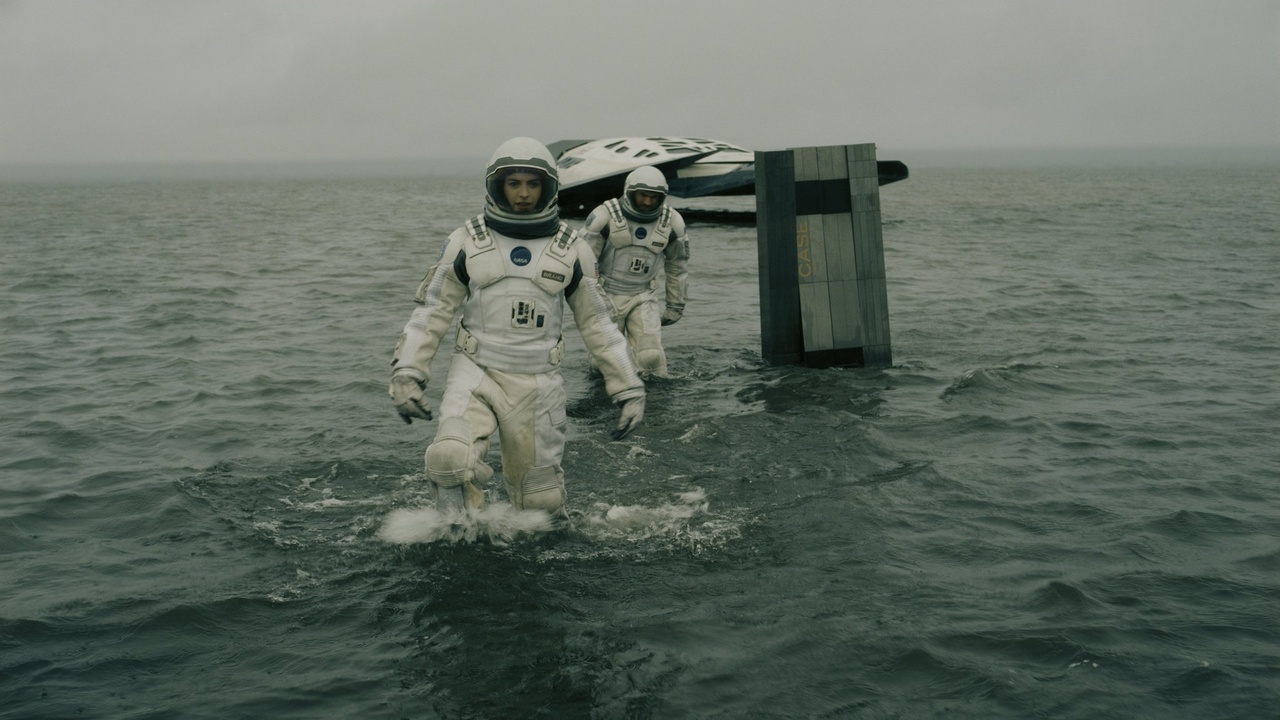
Director: Christopher Nolan · Cinematographer: Hoyte van Hoytema · Composer: Hans Zimmer · Editor: Lee Smith · Production Design: Nathan Crowley · Visual Effects: DNEG · Screenplay: Jonathan Nolan, Christopher Nolan · Scientific Consultant: Kip Thorne · Key Cast: Matthew McConaughey (Cooper), Anne Hathaway (Brand), Jessica Chastain (Murph), Michael Caine (Professor Brand), Matt Damon (Dr. Mann), Mackenzie Foy (Young Murph), Casey Affleck (Tom), Bill Irwin (TARS) · Runtime: 169 minutes · Studios: Paramount Pictures, Warner Bros., Legendary Pictures · Budget: ~$165 million · Box Office: ~$677 million worldwide
Magnificent and Broken in Exactly the Places It Matters
Interstellar contains some of the most awe-inspiring sequences in the history of science fiction cinema. It also contains some of the most frustrating screenplay decisions of Christopher Nolan’s career. These two facts are not incidental to each other. They are connected. The same ambition that drives Nolan to stage a docking sequence in a spinning spacecraft with an organ thundering on the soundtrack is the ambition that drives him to resolve his three-hour cosmic odyssey with the proposition that love is a quantifiable force capable of transcending the dimensions of spacetime. The grandeur and the overreach are products of the same impulse: a filmmaker who will not settle for “very good” when “overwhelming” is within reach, even when the reach exceeds the grasp.
The premise is magnificent. Earth is dying. Dust storms consume the American heartland. Crops fail one by one. Cooper, a former NASA pilot reduced to farming, discovers that a gravitational anomaly in his daughter’s bedroom is transmitting coordinates. The coordinates lead to a secret NASA facility where scientists have identified a wormhole near Saturn, placed there by unknown entities, offering passage to a distant galaxy where habitable planets may exist. Cooper leaves his children to pilot the mission, knowing that relativistic time dilation means he may return to find them older than he is.
The first two acts honor this premise with rigorous craft. The launch sequence is filmed with the documentary restraint of actual NASA footage. The wormhole transit is visualized using equations provided by Kip Thorne, the Caltech physicist who served as scientific consultant, and the resulting images have a physicality that owes nothing to prior science fiction. The water planet, where one hour equals seven years on Earth, generates the film’s most devastating scene: Cooper returns to the spacecraft after a disastrous landing and watches 23 years of accumulated video messages from his children. McConaughey’s face during this sequence does more than his dialogue does for the rest of the film.
The third act is where the film fractures. Cooper enters the black hole Gargantua and discovers a tesseract constructed by future humans, a five-dimensional space that allows him to communicate with his daughter across time through the gravitational anomaly in her childhood bedroom. The reveal is that the “ghosts” Murph perceived as a child were Cooper himself, sending data through gravity that will allow her to solve the equation for controlling gravity and saving humanity. Love, the film argues, is what led him here. Love is the variable. Love transcends.
The problem is not that this idea is wrong. Science fiction has every right to be speculative, and the notion that human connection might have physical consequences across spacetime is at least interesting. The problem is that the film has spent two hours earning the audience’s trust through scientific rigor and visual realism, and the tesseract sequence asks that audience to accept a metaphysical proposition that the film has not built a foundation for. The shift from physics to poetry is abrupt, and the poetry is not strong enough to bear the weight. “Love is the one thing that transcends time and space” is a line that Brand delivers earlier in the film, and the audience is clearly meant to dismiss it as sentimental before the third act retroactively validates it. But validation through plot mechanics is not the same as validation through emotional persuasion, and the film never quite closes the gap.
This is an 8/10 film. It is a film of extraordinary craft, genuine emotional power, and several sequences that rank among the finest in modern cinema. It is also a film whose ambition outpaces its screenplay, whose final act asks for a leap of faith that its first two acts have trained the audience not to take, and whose ideas about love and gravity, while sincere, are articulated with a bluntness that undercuts the subtlety of everything around them. It is a great film that is not quite a masterpiece, and the distance between those two things is the most interesting thing about it.
Verdict: 8/10
McConaughey’s Face Does the Work His Dialogue Cannot
Matthew McConaughey’s performance as Cooper is built on a contradiction that the actor navigates brilliantly: Cooper is written as a Nolan protagonist (cerebral, driven, articulate about ideas) but performed as an emotional animal. McConaughey brings to the role the same raw-nerve vulnerability that defined his work in Dallas Buyers Club and Mud, and it operates as a corrective to the screenplay’s tendency toward exposition. When Cooper explains wormholes to his crew, McConaughey delivers the dialogue competently. When Cooper watches his children age twenty-three years in the space of a few minutes, McConaughey delivers something that dialogue cannot contain.
The video message scene is the film’s peak. Cooper, having lost hours on the water planet, sits in the Endurance and plays back years of accumulated transmissions. His son grows up, gets married, has a child, loses a child, and gives up. His daughter, Murph, sends a message on her birthday, the age Cooper was when he left. Then she stops sending messages entirely. McConaughey does not speak during this sequence. He watches. His face collapses in stages, each message stripping away another layer of composure until what remains is a man confronting the full weight of what his mission has cost. It is the most emotionally devastating scene Nolan has ever directed, and it works entirely because of McConaughey’s willingness to be destroyed on camera.
Jessica Chastain, as the adult Murph, provides the earthbound counterweight. Her performance is angry where Cooper’s is grieving. Murph has been abandoned by her father for a mission she does not believe in, and Chastain plays the resentment with a specificity that grounds the film’s cosmic stakes in something personal. The scene where she burns the cornfield is melodramatic in isolation but earned by Chastain’s sustained intensity. She makes Murph’s fury feel lived-in rather than scripted.
The ensemble surrounding them is Nolan’s deepest. Michael Caine, in his seventh Nolan collaboration, delivers a deathbed confession that is more affecting than the film’s actual climax. Matt Damon, arriving unannounced as the astronaut Dr. Mann, provides the film’s most compelling villain precisely because he is not a villain but a coward, a man who sent a false beacon because he could not bear to die alone on a frozen planet. Bill Irwin, voicing the robot TARS, is the film’s best-written character: dry, funny, and calibrated to a humor setting that adjusts on command.
Van Hoytema, IMAX, and the Weight of Real Light
Hoyte van Hoytema’s cinematography in Interstellar is the film’s most consistently excellent element. Working with IMAX 70mm cameras for approximately a third of the film’s shots and 35mm Panavision anamorphic for the rest, van Hoytema created images that toggle between the intimate and the cosmic with a physicality that digital cinematography cannot replicate.
The IMAX sequences, which encompass the space exteriors, the planetary surfaces, and several key dramatic scenes, have a resolution and depth that justify Nolan’s insistence on large-format film. The approach to Saturn is filmed with a scale that makes the planet feel like a location rather than a visual effect. The wormhole, rendered from equations by Kip Thorne’s team and then translated into IMAX imagery, has a tangibility that owes everything to the format’s ability to capture light with a richness that digital sensors approximate but do not match. Van Hoytema’s IMAX work is not spectacle for its own sake. It is an argument that space, the real, physical vacuum of space, demands the highest possible resolution because anything less diminishes its presence.
The earthbound sequences are equally accomplished. The cornfield that surrounds Cooper’s farmhouse was actually planted by the production in Alberta, Canada, and van Hoytema photographs it with the golden, dust-hazed light of a world that is beautiful and dying. The dust storms, created through practical effects, fill the frame with particulate matter that catches the light in ways that would be difficult to achieve digitally. The interiors of Cooper’s home are warm, cluttered, and ordinary, establishing a domestic reality that the space sequences will eventually rupture.
The spacecraft miniatures, nicknamed “maxatures” by the crew for their enormous scale (the Endurance model spanned over 25 feet), were filmed by van Hoytema with IMAX cameras mounted directly on the models. This approach gave the ships the visual weight of physical objects moving through actual space, avoiding the weightless, too-clean quality that digital spacecraft often exhibit. The docking sequence, in which Cooper must match the rotation of a damaged Endurance, is the film’s greatest technical achievement: a scene that integrates miniatures, IMAX photography, practical sets, and Zimmer’s organ into a sustained crescendo of tension that operates entirely through physics, geometry, and time.
Zimmer’s Organ and the Sound of Human Smallness
Hans Zimmer’s score for Interstellar is centered on a pipe organ, an instrument whose associations with sacred music are neither accidental nor subtle. Nolan asked Zimmer to compose the score based on a single-page letter describing a father’s relationship with his child, without revealing the film’s genre or setting. Zimmer wrote the initial themes before learning the film involved space travel, and the parental emotion that informed those early sketches remained the foundation of the final score.
The organ works because it is the right instrument for the wrong context. In a cathedral, an organ’s sound is contained, directed upward, channeled toward the sacred. In a film set in the vacuum of space, the organ’s reverberations have nowhere to go. The sound fills the theater with a pressure that borders on physical, and the contrast between the instrument’s ecclesiastical grandeur and the emptiness it inhabits creates a dissonance that is the score’s defining quality. The organ says: this is holy. The silence around it says: nothing is listening.
The score’s most effective passage accompanies the docking sequence, where the organ’s ascending chords track the escalating tension of Cooper’s attempt to align with the spinning Endurance. The music does not underscore the scene. It drives it. The images and the score are locked in a mechanical relationship where each depends on the other for momentum, and the sequence builds to a climax that is simultaneously a narrative resolution and a musical one. When the docking succeeds, the organ releases, and the release functions as both relief and catharsis.
Zimmer’s quieter passages are less celebrated but equally important. The theme that accompanies the corn field sequences is sparse, plaintive, and built on intervals that suggest folk music without quoting any. It sounds like dust. It sounds like something remembered from a childhood that no longer exists. These cues provide the emotional groundwork that the louder passages depend on: without the quiet, the thunder would be noise rather than meaning.
The Science That Holds and the Screenplay That Doesn’t
Interstellar’s relationship with science is simultaneously its greatest strength and its most instructive limitation. Kip Thorne’s involvement ensured that the film’s depictions of relativistic time dilation, black hole physics, and gravitational lensing are grounded in actual theoretical physics. The visualization of the black hole Gargantua, generated by feeding Thorne’s equations into rendering software, produced images so scientifically accurate that they resulted in published academic papers. The water planet’s time dilation (one hour equals seven years) is a legitimate consequence of proximity to a massive gravitational body. The wormhole’s appearance is consistent with current theoretical models.
This scientific rigor is what makes the first two acts so compelling. The audience trusts the film because the film has earned trust through accuracy. When Cooper explains that entering a strong gravitational field causes time to pass more slowly, the audience believes him because the film has demonstrated its commitment to getting the physics right. This trust is the film’s most valuable asset, and it is also what makes the third act’s departure from scientific grounding so jarring.
The tesseract sequence posits that future humans have constructed a five-dimensional space inside a black hole, allowing Cooper to manipulate gravity across time and communicate with his daughter in the past. Thorne’s involvement extends to this sequence (he has described it as speculative but not impossible within the framework of theoretical physics), but the film presents it not as a scientific proposition but as an emotional one. Cooper does not solve an equation to reach his daughter. He is drawn to her by love. The tesseract is organized around her bedroom because love is what guided him there. The scientific framework that supported the film for two hours is, in this final act, subordinated to a metaphysical claim that the film has not built the philosophical infrastructure to support.
The screenplay’s other notable weakness is its handling of exposition. Nolan’s scripts have always relied on characters explaining concepts to each other, and Interstellar pushes this tendency past its breaking point. The briefing scenes, in which scientists explain the mission’s parameters, are functional but inert. Brand’s monologue about love is a critical piece of thematic scaffolding that sounds like a thesis statement rather than a human being speaking. The dialogue in the tesseract sequence (“It’s not a ghost. It’s gravity.”) announces its ideas rather than enacting them. These are screenplay problems, not directing problems, and they are the primary reason the film falls short of the standard set by its visual and musical craft.
Nolan’s Obsessions: Time, Fatherhood, and the Architecture of Scale
Christopher Nolan’s filmography is organized around a small number of obsessions: the manipulation of time (Memento, Inception, Tenet), the relationship between individual psychology and grand-scale events (The Dark Knight trilogy, Dunkirk, Oppenheimer), and the formal challenge of making conceptually complex narratives emotionally accessible. Interstellar sits at the center of these obsessions, and it is the film where their tensions are most visible.
The time manipulation in Interstellar is not structural (as in Memento) or perceptual (as in Inception) but physical. Time in this film is governed by gravity, and gravity is governed by proximity to mass. Cooper’s tragedy is not that he has been tricked or confused about time but that he has voluntarily entered a region of spacetime where his children will age faster than he does. The horror is not metaphorical. It is mathematical. And the mathematics is correct, which gives the horror a weight that purely fictional time manipulation cannot achieve.
The fatherhood theme is, alongside the organ score, Interstellar’s most successful element. Cooper’s relationship with Murph is the film’s emotional engine, and the screenplay wisely concentrates its best writing in their scenes together. The departure scene, where young Murph begs Cooper not to leave, is restrained and devastating. The video message sequence is the film’s peak. The tesseract sequence, for all its conceptual overreach, works emotionally because McConaughey’s performance conveys a father’s desperation to reach his child with a conviction that the screenplay’s metaphysics cannot match.
Nolan has described Interstellar as his most personal film, and the parental anxiety that drives it is palpable. The fear that you will miss your children’s lives, that the thing you left to do will not justify the cost of leaving, that the world you return to will no longer recognize you: these are not abstract concerns for any parent who has prioritized work over presence. Nolan channels them through science fiction’s largest possible canvas, and the result is a film whose emotional truth is more reliable than its scientific climax.
$677 Million, One Oscar, and the Films That Changed Afterward
Interstellar was released on November 5, 2014, initially on film stock before expanding to digital projection. It grossed $677 million worldwide against a $165 million budget, a commercial success by any measure, though not the phenomenon that Nolan’s Dark Knight films had been. The film received five Academy Award nominations: Best Visual Effects (which it won), Best Original Score, Best Sound Mixing, Best Sound Editing, and Best Production Design. It was not nominated for Best Picture or Best Director, omissions that reflected a critical reception that was admiring but divided.
The critical response followed a predictable fault line. The film’s visual craft, McConaughey’s performance, Zimmer’s score, and the docking sequence were near-universally praised. The third act, Brand’s love monologue, and the screenplay’s expository tendencies were points of genuine disagreement. Rotten Tomatoes records a 73% approval rating, a score that accurately reflects a film about which people feel strongly in different directions.
The film’s influence, however, has been more substantial than its awards would suggest. Interstellar demonstrated that hard science fiction could be commercially viable at blockbuster scale, paving the way for films like Arrival, The Martian, and Ad Astra. Its IMAX photography pushed the format further into mainstream filmmaking. The black hole visualization generated academic publications and changed how astrophysicists communicate their research to the public. Kip Thorne won the Nobel Prize in Physics in 2017 for work related to gravitational wave detection, and Interstellar’s cultural visibility played a role, however indirect, in making theoretical physics accessible to general audiences.
The film’s reputation has grown steadily since release, as is common with Nolan’s work. Initial critical reservations have softened, and the emotional core of the father-daughter story has proved more durable than the screenplay’s structural problems. Interstellar is now widely regarded as one of the defining science fiction films of the 2010s, a judgment that is correct even if the film’s ambition sometimes outruns its execution.
What the Second Launch Reveals
Interstellar rewards rewatching, though the rewards are different from what the first viewing provides. The emotional impact of the video message scene is, if anything, stronger on second viewing, because the audience knows what is coming and watches McConaughey’s face with the anticipatory dread of someone who cannot prevent a collision.
Watch the gravitational anomaly in Murph’s bedroom with knowledge of the tesseract. On first viewing, the falling books and the dust patterns are mysterious. On second viewing, they are Cooper, reaching backward through five dimensions to communicate with his daughter. Every object that falls is a message, and the specificity of the messages (coordinates, Morse code, gravitational data) reveals that the film’s opening act is also its climax, viewed from the other side of the temporal loop.
Listen to Zimmer’s score with attention to when the organ appears and when it does not. The organ is absent from the earthbound sequences in the first act. It enters gradually during the launch and becomes dominant during the space sequences. Its fullest expression accompanies the docking scene and the tesseract. The organ is the sound of departure, of leaving the human scale behind, and its absence in the early scenes creates the impression that Cooper’s world, before the mission, exists in a different sonic universe.
Pay attention to Dr. Mann. On first viewing, his arrival is a surprise. On second viewing, his behavior is legible from his first scene. The eagerness with which he embraces Cooper, the tears, the overwhelming gratitude: these are not the responses of a man welcoming rescuers. They are the responses of a man whose deception is about to end, and whose relief at no longer being alone temporarily overwhelms his guilt at what he has done. Damon plays the scene with a transparency that is visible only in retrospect.
Film Trivia
Zimmer composed blind. Nolan gave Zimmer a single page describing a father’s relationship with his child and asked him to compose music based on the emotional content. He did not tell Zimmer the film was about space. The themes Zimmer wrote before learning the film’s genre became the foundation of the final score, which is why the music feels more parental than cosmic.
The corn was real. Nathan Crowley planted 500 acres of corn in Alberta, Canada, for the farmhouse sequences. After filming, the corn was harvested and sold, reportedly turning a profit that offset a portion of the production budget. Nolan has described this as “the only time I’ve made money on a prop.”
The maxatures. The spacecraft models were so large that the crew nicknamed them “maxatures” rather than miniatures. The Endurance module spanned 25 feet at 1/15th scale. The Ranger and Lander models exceeded 46 and 49 feet respectively. Van Hoytema mounted IMAX cameras directly onto the models, replicating the look of actual NASA IMAX documentary footage.
A Nobel Prize connection. Kip Thorne, the theoretical physicist who served as scientific consultant and executive producer, won the Nobel Prize in Physics in 2017 for his contributions to the detection of gravitational waves. The equations he provided for the film’s black hole visualization produced images so scientifically precise that they were published in academic journals.
This entry selects analytical dimensions from a pool. The five anchors are present: critical verdict, performances, visual craft, reception and legacy, and rewatchability guide. Earned sections cover Zimmer’s score, Nolan’s body of work and thematic obsessions, and the film’s relationship to its scientific source material (which absorbs what would otherwise be a separate adaptation section). One wildcard section examines the screenplay’s structural fracture between scientific rigor and metaphysical resolution, treating the gap between the film’s physics and its poetry as the defining tension of the work. A production design section is absorbed into the visual craft discussion (the maxatures, the cornfield). A cultural context section is omitted because the film’s dystopian premise, while resonant with environmental anxieties, does not engage with any specific historical or political moment.


Leave a Reply