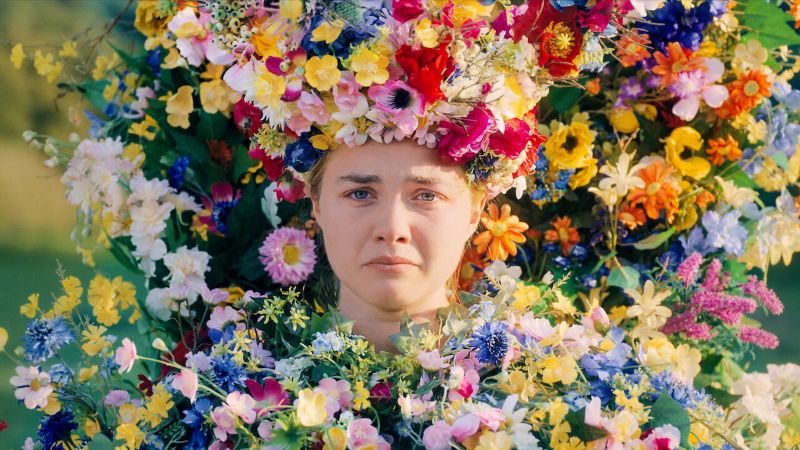
Director: Ari Aster · Cinematographer: Pawel Pogorzelski · Composer: Bobby Krlic (The Haxan Cloak) · Starring: Florence Pugh, Jack Reynor, Vilhelm Blomgren, William Jackson Harper, Will Poulter · Runtime: 147 min (Theatrical) / 171 min (Director’s Cut) · Studio: A24 / B-Reel Films · Budget: $9 million · Box Office: $48 million worldwide
1. Midsommar: The Worst Breakup Movie Ever Made
Strip away the pagan rituals, the floral crowns, the cliff jumps, and the bear suit, and what remains is a story almost offensively simple: a woman in a terrible relationship finally leaves. That’s it. That’s the film. Everything else, the Swedish commune, the hallucinogens, the ritual murders, is set dressing for a breakup.
This is Ari Aster’s great structural joke, and the fact that so many viewers miss it is part of the design. Midsommar presents itself as folk horror, and it is folk horror, meticulously researched and genuinely disturbing. But its emotional engine runs entirely on the dynamics of a dying relationship. Christian (Jack Reynor) is not a monster. He is something worse and more common: a boyfriend who lacks the courage to either commit or leave. He absorbs Dani’s grief with visible reluctance. He forgets her birthday. He resents her trauma for being inconvenient. He is, in every measurable way, inadequate to the moment. The film’s most radical move is arguing that a community of ritualistic pagans who murder outsiders is, for Dani, a healthier emotional environment than her boyfriend’s apartment.
The film is brilliant, though not uniformly. Its first act in Minnesota is overly compressed; the transition from family tragedy to Swedish road trip happens so quickly that the emotional weight of Dani’s loss does not fully register before the genre machinery takes over. The middle sections in the commune occasionally indulge in ethnographic detail at the expense of momentum, particularly in the Director’s Cut. And Aster’s fondness for symmetry, both visual and thematic, can veer into over-precision: the film sometimes feels so meticulously designed that its characters become mechanisms rather than people.
But the successes overwhelm the criticisms. Florence Pugh delivers one of the decade’s most physically committed performances. Pawel Pogorzelski’s cinematography invents a new visual grammar for horror. Bobby Krlic’s score achieves the near-impossible feat of making dread sound beautiful. And the final image, Dani’s smile amid the flames, is one of the most morally complex endings in recent American cinema.
Verdict: 9/10. A deeply original work of folk horror that also functions as the most extreme breakup movie ever committed to film. Its flaws are the flaws of ambition, not of laziness.
2. Horror in Broad Daylight: The Formal Inversion
Most horror films rely on darkness. Darkness conceals. Darkness generates suspense through what you cannot see. Midsommar rejects this foundational principle entirely: the film takes place almost exclusively in daylight, much of it under the midnight sun of a Swedish midsummer where the sky never darkens.
The unbroken daylight serves several functions simultaneously. It strips away the audience’s conditioned defense mechanisms, the ones that say “it’s dark, so something scary is about to happen.” When the Ättestupa sequence occurs in golden afternoon light, with birdsong and wildflowers, the audience has no tonal cue to brace against. The violence arrives in a context of beauty, and the dissonance is more sickening than any jump scare.
It also functions as a metaphor for exposure. Dani’s grief, Christian’s inadequacy, the group’s interpersonal rot: everything that would normally remain subtext, hidden in the dark spaces of polite interaction, is illuminated. The midnight sun is a truth light. Nothing survives it unexposed.
And there is a deeper irony: the Hårga hide nothing. Their rituals are conducted in the open. The sacred texts depicting the outsiders’ fates are displayed publicly. The violence is communal, witnessed, participatory. The horror of Midsommar is not that terrible things happen in secret. It is that terrible things happen in plain sight, with everyone watching, and no one who should object has the cultural framework to do so until it’s too late.
3. The Camera Breathes: Pogorzelski’s Empathetic Lens
Pawel Pogorzelski, returning from Hereditary, fundamentally changes his visual approach for Midsommar, and the change tells you everything about what Aster is after.
The Breathing Effect. In several sequences, particularly during the psychedelic trips, the image subtly pulses. Grass undulates, flowers seem to inhale, surfaces ripple as though the world itself is a living membrane. This is achieved through a combination of subtle digital warping and practical effects (real flowers were designed to move on pneumatic rigs in some shots). The technique does something no dialogue could: it places you inside Dani’s altered perception. You are not watching someone trip. You are tripping alongside her. The camera is no longer observing; it is empathizing.
Symmetry as Seduction. The Hårga commune is filmed with an almost obsessive bilateral symmetry: centered compositions, balanced framing, matching architectural elements on either side of the frame. This symmetry reads as beauty, as order, as harmony. It is also, of course, the visual grammar of totalitarianism. Every cult promises a world that makes sense, where everything is in its place. Pogorzelski’s symmetrical framing is the visual equivalent of that promise: everything looks right, feels right, seems designed. And it is. That’s the trap.
The Inversion Shot. The film opens with one of its most striking formal gestures: an upside-down tracking shot of the car driving through the Swedish countryside that slowly, smoothly rotates 180 degrees until the world is right-side up. This is not decorative. It is a thesis statement. The world Dani is entering will invert everything she knows: grief will become celebration, isolation will become community, death will become sacrament. The camera tells you this before a single word of Swedish is spoken.
Wide Shots and the Dissolution of the Individual. As the film progresses, Pogorzelski increasingly favors wide shots that diminish the characters within the landscape and within the group. Dani is progressively absorbed into compositions dominated by the commune, surrounded by women in white, swallowed by the maypole dance, crowned and enthroned by the collective. The camera charts her loss of individual identity in purely visual terms: she occupies less and less of the frame as a distinct figure and more and more of it as a member of the group.
4. Florence Pugh and the Architecture of a Wail
Florence Pugh was twenty-two when she made Midsommar, and her performance here is the one that announced her as a generational talent, more so than Lady Macbeth, which introduced her, and more definitively than Little Women, which earned her an Oscar nomination the same year.
The role requires her to do something extraordinarily difficult: sustain a state of grief across an entire film without ever letting it become monotonous, self-pitying, or actorly. Dani is grieving before the film begins; the opening tragedy simply intensifies a condition that was already chronic. Pugh plays this not as a single sustained note but as an unstable system: moments of forced normalcy punctured by sudden collapses, then reassembled, then punctured again. The rhythm is physiologically accurate. Anyone who has experienced sustained grief will recognize the pattern: the sudden ambush of feeling in an ordinary moment, the fake smile that almost works, the way exhaustion temporarily masquerades as peace.
The crying is the headline performance, and rightly so. Pugh’s wailing, both the initial phone call scene and the climactic communal grief scene, is physically committed in a way that transcends acting technique. These are not attractive movie tears. Her face contorts asymmetrically. Fluid appears. The sounds are guttural, involuntary, animal. And in the communal grief scene, when the Hårga women mirror her sobs, matching her pitch, her rhythm, her breathing, Pugh must navigate the most complex emotional beat in the film: the experience of being met in grief for the first time, the seduction of that mirroring, and the barely conscious surrender to a community that understands her pain better than her boyfriend ever did. She plays all of this simultaneously, and the smile that emerges through the tears in the final shot is the payoff, a smile that contains relief, madness, liberation, and damnation in equal measure.
Jack Reynor deserves recognition for the less celebrated but equally precise work of playing Christian. Reynor makes the brave choice to play him without any single redeeming burst of decency. Christian is not cruel; cruelty would at least be energetic. He is passively insufficient. Reynor communicates this through physical choices: the slight lean away when Dani needs closeness, the half-second delay before every expression of concern, the way his body language during the group conversations consistently orients toward his friends rather than his girlfriend. It is a performance built on the eloquence of what is withheld.
William Jackson Harper brings a specific intellectual anxiety to Josh, the only American who takes the Hårga seriously, but who takes them seriously as data, not as people. His violation of the commune’s trust (photographing the sacred text) is played not as villainy but as the reflexive entitlement of the academic gaze: the assumption that other cultures’ sacred objects are your research materials. Harper makes Josh sympathetic and culpable in the same gesture.
5. The Haxan Cloak’s Pastoral Dread
Bobby Krlic, recording as The Haxan Cloak, composed a score that is the precise inverse of Colin Stetson’s Hereditary work, and that inversion is conceptually perfect.
Where Stetson’s Hereditary score was claustrophobic, built on guttural low-end frequencies and the sound of instruments being tortured, Krlic’s Midsommar score is expansive, airy, and often hauntingly beautiful. It uses strings, choral voices, woodwinds, and Scandinavian folk instrumentation to create something that sounds, at surface level, like a pastoral idyll. The melodies are genuinely lovely. The harmonies are warm. And this is precisely what makes the score so effective: it refuses to tell you that you should be afraid.
The choral elements deserve particular attention. Krlic uses wordless vocal harmonies that evoke both Scandinavian folk tradition and sacred music. These voices sound communal, ancient, devotional. They are the sonic equivalent of the commune’s visual symmetry. They make the Hårga feel beautiful to listen to, which makes the violence they frame feel more disorienting. When the Ättestupa occurs, the score does not shift to horror mode. It continues to treat the ritual with sonic reverence. The music tells you this is sacred. Your eyes tell you it is murder. The gap between those two signals is where the film’s horror lives.
The opening sequence, the family tragedy in Minnesota, is scored with stark, frigid ambience: distant drones, the hiss of winter air, an absence that registers as suffocation. When the film transitions to Sweden, the score blooms into warmth and light. This musical arc mirrors and reinforces the film’s central argument: that the community Dani finds among people who practice human sacrifice is, emotionally and sonically, warmer than the life she left behind. Krlic’s score doesn’t judge this. It simply presents it, and lets the audience sit with the discomfort.
6. The Hereditary Mirror: Aster’s Inverted Diptych
Midsommar cannot be fully understood without Hereditary, and Hereditary retroactively deepens when viewed through Midsommar. They are not sequels. They are mirror images, the same obsessions refracted through opposite aesthetic strategies.
The inversions are systematic. Hereditary is set in darkness; Midsommar in perpetual daylight. Hereditary takes place in claustrophobic interiors; Midsommar in vast open landscapes. Hereditary’s horror is hidden, lurking in the backgrounds of frames; Midsommar’s horror is conducted publicly, in the center of the frame, with an audience. Hereditary’s protagonist loses everything against her will; Midsommar’s protagonist chooses to surrender everything, and the film frames that choice as something dangerously close to liberation.
But the underlying architecture is identical. Both films center on a woman devastated by family loss. Both films feature a community that exploits that grief for its own ritual purposes. Both films end with a coronation: Peter crowned as Paimon’s vessel, Dani crowned as May Queen. Both endings are, simultaneously, the culmination of a conspiracy and the resolution of the protagonist’s emotional arc. And in both cases, the resolution is deeply ambiguous: is the protagonist freed or destroyed? Aster refuses to answer, because the question itself is the point.
The crucial evolution between the two films is in Aster’s relationship to his protagonist. Annie Graham is a tragic figure with no agency, no choice, no escape. The cult wins; she loses. Dani Graham (the shared surname may not be coincidental) is given something Annie never received: the experience of catharsis. Dani’s final smile is earned. She has, within the logic of the narrative, genuinely found a community that mirrors her pain, validates her grief, and eliminates the source of her neglect. That this community is monstrous does not negate the emotional truth of her relief. Aster’s maturation between the two films lies in this added layer of moral complexity: in Midsommar, the cult doesn’t just use the protagonist. It gives her something real, and that is far more disturbing than simple predation.
7. Building Hårga: Anthropology as Art Direction
The Hårga commune is one of the most fully realized fictional cultures in modern cinema, and the production design, by Henrik Svensson, deserves a level of attention usually reserved for world-building in science fiction.
Aster and his team conducted extensive research into Scandinavian pagan traditions, Swedish midsummer celebrations, pre-Christian European fertility cults, and the work of ethnographers and folklorists who documented surviving folk practices across rural Sweden. The result is a commune that feels anthropologically plausible: not an accurate representation of any single real tradition, but a composite that obeys the internal logic of how real folk religions actually function.
The runic alphabet used by the Hårga is a modified Elder Futhark. The sacred text, the Rubi Radr, is presented as a hand-illustrated manuscript in a style consistent with medieval Scandinavian illuminated texts. The communal meals, the sleeping arrangements, the clothing, the agricultural cycles: all are designed to suggest a community that has maintained pre-industrial practices for centuries. Even the drug preparation (the tea made from psychoactive plants) is consistent with documented ethnobotanical practices in Northern Europe.
The commune was built as a practical set in Hungary (not Sweden), and the construction is worth noting: real timber buildings, real gardens, real functional kitchens. The actors lived in proximity to the set during production, and this immersion shows. The commune doesn’t feel like a set. It feels like a place where people have eaten, slept, argued, celebrated, and killed for generations.
The clothing design follows a specific logic: plain white linen for everyday wear (connoting purity, uniformity, and the erasure of individual identity), with increasingly elaborate floral embroidery for ritual occasions. Dani’s May Queen dress, an enormous, almost architectural garment made entirely of fresh flowers, is the visual climax of a costuming strategy that has been slowly building throughout the film. She doesn’t just wear the commune’s clothes. She becomes the commune’s art.
8. The Tapestries Tell You Everything
Midsommar is, alongside Hereditary, one of the most rewatch-rich films of the decade. But where Hereditary hides its details in shadows and backgrounds, Midsommar displays them in the open. The film’s deepest irony is that it shows you exactly what will happen, in advance, and you still don’t see it.
The Opening Mural. The very first image in the film, before the Minnesota prologue, is a painted mural depicting seasonal scenes. If you read it carefully (left to right, as a narrative), it illustrates the entire plot of the film: a journey from winter darkness to summer light, a love story aided by a potion, a sacrifice by fire, a woman crowned. The film tells you its own story in the first five seconds. You simply don’t have the visual vocabulary to decode it yet.
The Bathroom Painting. In the commune bathroom, there is a painting depicting a woman cutting her pubic hair and placing it in food she serves to a man. This foreshadows, with absolute literal precision, the scene in which Dani’s pubic hair is baked into the pie Christian eats. The painting is visible in several shots. No character comments on it.
The Love Ritual Tapestry. A tapestry near the sleeping quarters illustrates, step by step, the ritual that will be performed on Christian: the drugging, the mating ceremony, the entrapment. Again, displayed openly. Again, invisible to characters who lack the cultural context to read it.
The Rubi Radr Illustrations. The sacred text Josh photographs contains illustrated pages that depict the outsiders’ fates, including the blood eagle and the bear suit. These illustrations are briefly visible in the film. They are not hidden. They are simply presented in a context where the audience, like the characters, is too overwhelmed by novelty to parse them.
The Flower Language. The types of flowers used in different scenes correspond to actual Scandinavian floral symbolism. The May Queen crown is not a random arrangement; it is a specific composition with ritual significance. Aster consulted with botanists and folklorists to ensure accuracy.
Pelle’s Drawings. Early in the film, Pelle gives Dani a drawing he made for her birthday, a drawing that depicts her wearing a flower crown, surrounded by the commune. This is not a gift. It is a recruitment tool and a prophecy. Pelle has already selected Dani. The drawing tells you this. But on first viewing, it reads as kindness.
9. Two Films in One: The Director’s Cut and What 24 Minutes Change
Midsommar exists in two versions, the 147-minute theatrical cut and the 171-minute Director’s Cut, and the differences between them are not cosmetic. They produce meaningfully different films with different emotional textures.
The most significant addition in the Director’s Cut is an extended scene between Dani and Christian in their apartment, before the Sweden trip, in which their relationship dysfunction is laid out in granular, painful detail. The theatrical cut establishes that the relationship is bad; the Director’s Cut makes you sit inside the badness. Christian’s emotional unavailability is not summarized. It is demonstrated through sustained, uncomfortable minutes of non-communication. The scene is dramatically essential: it recalibrates the audience’s sympathy so completely that by the time the commune offers Dani an alternative, the audience is not horrified. They are relieved.
Other additions include extended ritual sequences, longer commune meals (which deepen the ethnographic texture), and a subplot involving a couple from London whose presence at the festival is more fully developed. These scenes slow the film’s pace but deepen its immersive quality. The commune feels more lived-in, more temporally real, more like a place you could actually be.
The Director’s Cut also includes a scene, entirely absent from the theatrical version, in which Christian plagiarizes Josh’s thesis topic. This scene transforms Christian from a passively inadequate boyfriend into someone capable of active intellectual theft, and it significantly shifts the audience’s moral calculus regarding his fate. In the theatrical cut, Christian’s punishment feels disproportionate. In the Director’s Cut, it begins to feel like a legitimate consequence.
The recommendation: watch the theatrical cut first, because its tighter pacing serves the horror more effectively. Then watch the Director’s Cut as a second viewing. It functions almost as an analytical companion piece, filling in the emotional and anthropological context that the theatrical cut compresses.
10. Toxic Codependency and the Seduction of Belonging
Midsommar arrived in 2019 at the intersection of several cultural conversations, and it participates in all of them without being reducible to any.
The Therapy Generation’s Horror Film. By 2019, the language of therapy (attachment styles, codependency, emotional labor, boundaries) had fully entered mainstream discourse, particularly among the millennial demographic that constitutes A24’s core audience. Midsommar is legible as a dramatization of these concepts pushed to their logical extremes. Christian is avoidant attachment personified. Dani is anxious attachment in crisis. The commune is the fantasy of secure attachment achieved through total surrender of autonomy. The film doesn’t endorse this framework. It dramatizes what happens when the therapeutic vocabulary of self-help runs into a situation where the “healthy” choice and the “safe” choice are no longer the same thing.
The Cult of Wellness. The Hårga commune, with its organic food, communal living, plant medicine, emotional openness, group ritual, and pastoral aesthetics, is an uncanny mirror of the contemporary wellness industry. The film can be read as a satire of the affluent Western desire to “reconnect” with pre-modern, nature-based living, a desire that conveniently ignores the violence, conformity, and sacrifice that such communities historically required. The Americans who arrive at Hårga are essentially wellness tourists. They consume the surface aesthetics of the commune, the flowers, the food, the drugs, without reckoning with its non-negotiable demands.
White People in Someone Else’s Culture. There is a quietly savage thread running through Midsommar about the particular entitlement of white American and British visitors who treat other cultures as experiences to be consumed. Josh wants to extract a thesis. Mark urinates on a sacred tree. Christian passively absorbs whatever is offered without reciprocating. Connie and Simon participate without comprehension. Only Pelle, who belongs, understands the commune on its own terms. The outsiders’ deaths can be read, uncomfortably, as the logical consequence of cultural tourism that takes without understanding.
The Feminine Reclamation Reading. Midsommar can also be read as a dark feminist fable. Dani begins the film trapped in a relationship defined by male indifference. The commune, led by women elders, organized around female fertility cycles, culminating in the coronation of a woman, offers her a gendered power she has never experienced. The communal wailing scene is the film’s emotional climax because it represents something Dani has been denied in every relationship she has: the experience of her pain being taken seriously, amplified, and shared rather than minimized and managed. That this experience is offered by a group that also practices murder does not diminish its emotional authenticity, and that is the film’s most provocative argument.
11. The Audience War: A24’s Most Polarizing Release
Midsommar repeated Hereditary’s pattern of critical acclaim and audience polarization, though the specific fault lines were different.
Critics broadly praised the film, and it holds an 83% score on Rotten Tomatoes. The critical consensus recognized the formal ambition, Pugh’s performance, and the originality of the daylight-horror concept. Dissenting critics, and there were several prominent ones, argued that the film was too long, too slow, too enamored of its own anthropological detail, and that the horror elements were undermined by the relationship-drama framing. These are not unreasonable criticisms. They describe real features of the film. Whether those features are flaws depends entirely on what you believe the film is trying to do.
Audience reception was more divided. CinemaScore gave it a C+, an improvement over Hereditary’s D+ but still reflecting significant audience dissatisfaction. The pattern was familiar: audiences expecting conventional horror found the pace punishing and the scares too infrequent. But a substantial subset of viewers, particularly women and particularly people who had experienced bad relationships, connected with the film on an almost uncomfortably personal level. The discourse around Midsommar was uniquely gendered: many female viewers described the ending as cathartic, while many male viewers described it as horrifying. Both responses are correct. The film is engineered to produce exactly this split.
Commercially, $48 million worldwide on a $9 million budget was a solid return, though less spectacular than Hereditary’s $80 million. The film’s cultural footprint, however, has exceeded its box office: the May Queen dress became a ubiquitous Halloween costume, the flower crown became a meme, and “he’s not your boyfriend, you’re his hostage” entered the discourse as a relationship maxim. Midsommar may be the rare film whose cultural influence outpaced its commercial performance.
12. What Changes When the Sun Never Sets: A Rewatch Guide
Midsommar, even more than Hereditary, is a film designed for second viewing. The first watch is an experience: visceral, disorienting, emotionally overwhelming. The second watch is an education. The film’s architecture becomes visible, its foreshadowing becomes legible, and the moral complexity deepens considerably.
The Art on the Walls. This is the single most important rewatch instruction. On second viewing, examine every painting, tapestry, and mural in the commune. Pause if you need to. These artworks collectively narrate the entire film’s plot before it happens. Once you see them, Midsommar transforms from a film about surprises to a film about inevitability, and that is far more disturbing.
Pelle’s Behavior. On first viewing, Pelle reads as the kindest of the male characters: gentle, attentive, emotionally present. On second viewing, track his behavior with the knowledge that he has orchestrated the entire trip. Every gesture of kindness is a calculated recruitment move. Every moment of emotional intimacy is grooming. Vilhelm Blomgren’s performance is calibrated to sustain both readings simultaneously; watch for the moments where his eyes don’t quite match his smile.
The Background Choreography. During communal scenes, pay attention to what the Hårga members are doing in the background. They are frequently watching the outsiders with a specific quality of attention: not hostile, but appraising. They are assessing their guests with the calm focus of people who have already made their decisions.
Christian’s Physical Orientation. Track Reynor’s body language throughout the film, specifically in relation to Dani. Note how often he angles away from her, positions himself closer to his friends, creates physical distance during moments of emotional need. This is a performance detail that works subliminally on first viewing and becomes almost unbearable to watch on second.
The Sound of Crying. Listen to the film’s landscape of weeping: Dani’s crying in the opening, her suppressed sobs in the bathroom, the communal wailing during the Ättestupa, and the collective grief scene near the end. There is a progression: from isolated and suppressed, to witnessed and shared, to communal and transcendent. The film’s emotional arc can be tracked entirely through the evolution of how crying sounds and how many voices join it.
The Final Smile, What You See the Second Time. On first viewing, Dani’s smile reads as catharsis, madness, or horror, depending on the viewer. On second viewing, knowing everything that has preceded it, the smile becomes something more complex: it is the face of a woman who has, for the first time in her life, been given permission to feel what she feels without apology. That this permission comes from a murderous cult is the film’s final, unresolvable provocation. The smile does not resolve. It radiates.
Film Trivia
A breakup movie born from a real breakup. Aster has acknowledged that Midsommar was inspired by the end of a personal relationship. When asked whether his ex realized they had inspired the film’s central dynamic, Aster told the San Antonio Current: “I don’t know. I imagine they might have some idea. I can’t imagine they’d be happy about it.” He described the project to Birth.Movies.Death as “a breakup movie dressed in the clothes of a folk horror film,” a concept that arrived fully formed before any of the Scandinavian research began.
Sweden’s labor laws sent the production to Hungary. Although set entirely in the Hälsingland region of Sweden, the film was shot near Budapest. Swedish law restricts film crews to eight-hour shooting days, which would have made the extended daylight sequences logistically impossible. Aster and production designer Henrik Svensson traveled to actual Hälsingland villages for research, then recreated the commune from scratch on Hungarian farmland. Swedish actors were flown to Hungary to play the Hårga villagers, preserving linguistic and physical authenticity even as the geography was faked.
Six weeks to avoid an NC-17 rating. Aster revealed during a Reddit Q&A that the MPAA’s initial response to the film was an NC-17 rating, largely due to the mating ceremony sequence. Six weeks of negotiation and minor edits were required to secure the commercially viable R rating. The full version of the scene survives in the Director’s Cut, which runs 24 minutes longer than the theatrical release and premiered at Lincoln Center in August 2019.
The breathing flowers were partly real. The psychedelic sequences, in which grass undulates and flowers appear to inhale, were achieved through a combination of digital effects and practical pneumatic rigs that physically moved real plants on set. The intention was to avoid the glossy artificiality of purely digital hallucination effects. Pogorzelski wanted the altered perception to feel organic, as if the landscape itself were alive, rather than overlaid with a visual filter.
Ariana Grande’s favorite film of 2019. Among the film’s unexpected champions was pop star Ariana Grande, who publicly cited Midsommar as her favorite film of the year. The endorsement was characteristic of the film’s unusual cultural reach: a $9 million folk horror film about Swedish paganism became a mainstream reference point for relationship discourse, Halloween costumes, and meme culture, outstripping its modest box office with a cultural footprint that continues to grow years after release.
This entry selects analytical dimensions from a pool, choosing only those that Midsommar earns through its specific craft, context, and thematic complexity. The five anchors are present: critical verdict, performances, visual craft, reception and legacy, and the rewatchability guide. Earned sections cover the score, the director’s body of work (treated as the Hereditary-Midsommar diptych), cultural context, the Director’s Cut comparison, and hidden details. Two wildcard sections, “Horror in Broad Daylight” and “Building Hårga,” address dimensions unique to this film: the daylight conceit that inverts the genre’s foundational principle, and the anthropological production design that no standard template would anticipate. Awards history is omitted because the film’s awards trajectory is thin. Source material and adaptation are omitted because this is an original screenplay; the folkloric research is addressed within the Hårga section.

Leave a Reply