Director/Writer: Darren Aronofsky · Cinematographer: Matthew Libatique · Sound Design: Craig Henighan · Editor: Andrew Weisblum · Production Design: Philip Messina · Key Cast: Jennifer Lawrence (Mother), Javier Bardem (Him), Ed Harris (Man), Michelle Pfeiffer (Woman), Domhnall Gleeson (Oldest Son), Brian Gleeson (Younger Brother), Kristen Wiig (Herald) · Runtime: 121 minutes · Studio: Protozoa Pictures / Paramount Pictures · Budget: $30 million · Box Office: $44.5 million worldwide
The Biblical Allegory That Bludgeons Where It Should Haunt
Mother! is two films fused at the spine. The first is a precise, suffocating psychological horror film about a woman whose home is invaded by strangers her husband insists on welcoming. The second is a biblical allegory so explicit that it does not require interpretation so much as identification: this character is God, this one is Mother Earth, these two are Adam and Eve, their sons are Cain and Abel, the crowd is humanity, the baby is Christ. The first film is excellent. The second film is ambitious, intermittently powerful, and ultimately undermined by its own insistence on being understood.
Aronofsky wrote the screenplay in five days, and it shows, in both the best and worst senses. The speed produced a script of ferocious momentum, a nightmare that accelerates without pause from domestic unease to apocalyptic carnage. It also produced a script that has not been refined by the kind of second-pass thinking that might have softened its allegorical bluntness. Every element maps so cleanly onto its biblical counterpart that the film eventually begins to feel less like a story and more like an illustrated lecture. The crystal is the forbidden fruit. The wound in Man’s side is Adam’s rib. The ink stain on the floor is original sin. The poet’s adoring fans are worshippers. The execution of the baby is the crucifixion. The mapping is airtight, and airtight is the problem. Great allegory breathes. It leaves gaps between the literal and the figurative that the viewer fills with personal meaning. Mother! seals those gaps shut.
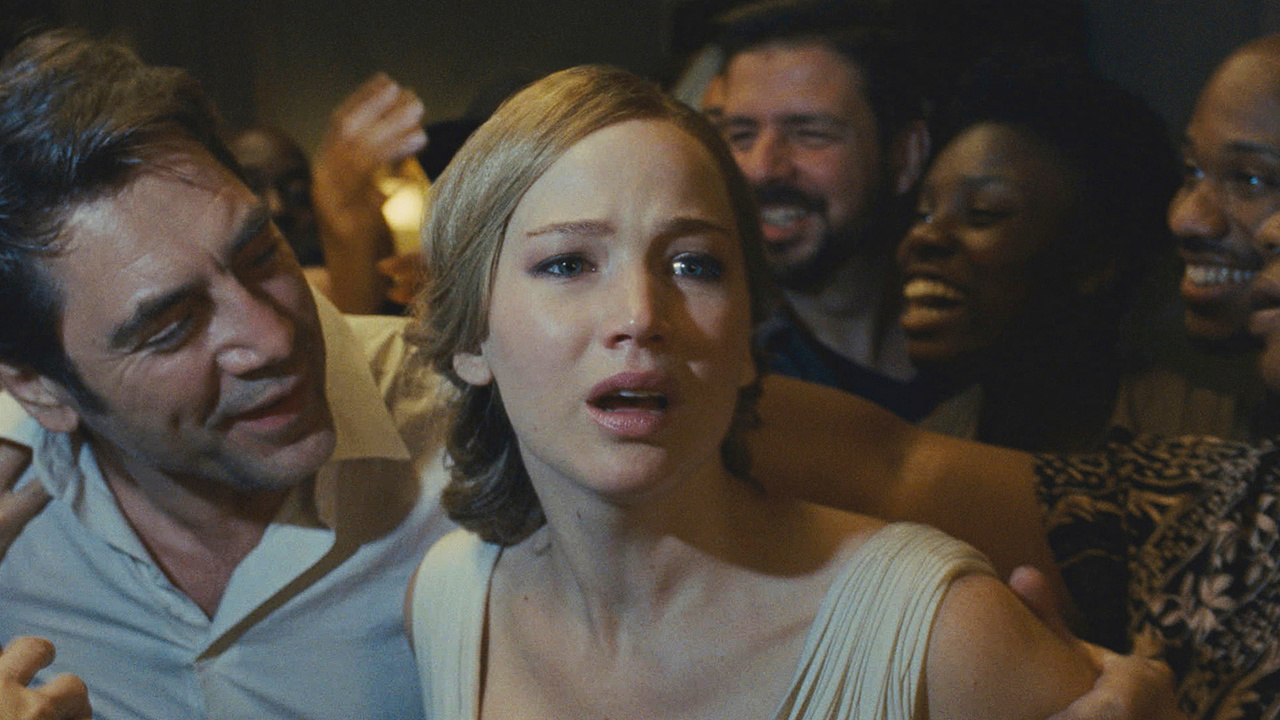
Jennifer Lawrence is extraordinary. Her face, filmed almost exclusively in close-up on grainy Super 16mm, carries the entire film’s emotional weight. She is confused, then frightened, then furious, then devastated, and Lawrence makes every transition feel organic. The performance is physically demanding (she reportedly hyperventilated during filming and cracked a rib), and her commitment gives the film a center that its script does not always deserve. Javier Bardem, as Him, has a harder task: he must play God as a charismatic narcissist, a creator who loves his creation’s love more than he loves the creation itself. Bardem is effective in individual scenes but constrained by a role that is more thesis than character. Ed Harris and Michelle Pfeiffer, as the first uninvited couple, are the film’s most entertaining presences, Pfeiffer in particular bringing a sly, invasive charisma that makes the first act’s domestic horror genuinely unsettling.
The final thirty minutes are the crux. Aronofsky compresses the entirety of human history into a single, escalating set piece: war, famine, slavery, ecological destruction, religious violence, and the murder of a child, all unfolding simultaneously in the rooms of a house that has become the world. It is virtuosic filmmaking. It is also exhausting, not in the productive way that great horror exhausts (by accumulating tension) but in the counterproductive way that spectacle exhausts (by piling sensation until the senses flatten). The final act mistakes intensity for profundity. It assumes that if the images are violent enough and the symbols clear enough, the audience will feel what the film intends. Some will. Many will not. The gap between intention and effect is wide enough to walk through, and that gap is what separates a 7/10 film from the masterpiece it wanted to be.
Verdict: 7/10
Lawrence’s Face as the Only Frame That Matters
Matthew Libatique and Aronofsky made a formal decision that defines the entire viewing experience: the camera would stay on Jennifer Lawrence’s face. Not metaphorically. Literally. The film is shot almost entirely in close-ups and over-the-shoulder shots anchored to Mother, and the visual grammar is restricted to three types of handheld framing: singles on her face, shots connecting her to whoever she is speaking to, and the back of her head following her through the house. Wide shots are used only when she is alone, and even then, they function to show the house as an extension of her body rather than as a location she inhabits.
This approach, rehearsed for three weeks in a Brooklyn warehouse before filming began, produces an intimacy that is indistinguishable from claustrophobia. The audience sees what Mother sees and cannot see what she cannot see. Strangers enter rooms behind her. Objects move at the edges of the frame. The house, which should be a refuge, becomes a space of encroachment. Libatique’s camera never establishes the geography of the house in a conventional master shot, so the audience (like Mother) is never certain what is happening in the rooms they are not in. This uncertainty is the film’s most effective horror tool. When the crowds arrive in the final act and the house becomes unnavigable, the visual disorientation is genuine because the film has never given the audience a spatial map.
Lawrence’s performance is calibrated to this framing with extraordinary precision. Because the camera is always on her face, every flicker of doubt, every suppressed irritation, every moment of terror registers at maximum scale. There is nowhere to hide. The performance cannot rely on blocking, on spatial relationships, on the editing rhythms that allow most film actors to rest between moments of intensity. Lawrence is always on, and she sustains the pressure for two hours without a single scene that allows her to decompress.
The decision to shoot on Super 16mm (using an ARRI 416 camera with Zeiss Ultra 16 lenses) gives the imagery a grain structure that contributes to the film’s unease. The texture is rougher than what modern audiences expect from a studio production, and the grain becomes more visible as the lighting deteriorates in the final act, so that the image itself seems to degrade along with the house and the characters within it. Libatique and Aronofsky referenced low-budget 1970s American horror productions as a visual touchstone, and the aesthetic connection to films like The Texas Chain Saw Massacre and The Last House on the Left is deliberate. The visual grammar says: this is not a beautiful film about terrible things. This is a terrible film about terrible things, and the ugliness is the point.
The Score That Was Discarded and the Silence That Replaced It
Mother! has no musical score. This was not the original plan. Johann Johannsson composed a 90-minute score, which Aronofsky synced with a rough cut of the film. Both men agreed it did not work. They reduced the score to a handful of moments, then reduced it further, then eliminated it entirely. What remains is sound design by Craig Henighan, a soundscape built from the noises of the house itself: creaking floors, breathing walls, the heartbeat that Mother hears when she presses her hands against the plaster.
This decision is the film’s most radical formal choice, and it is also its most successful. Without a score, the film has no emotional guidance system. There is no music telling the audience when to be afraid, when to feel sympathy, when the tension is rising. The sound design provides texture but not direction. It creates an acoustic environment that feels alive (the house breathes, literally, and the sound of that breathing is one of the film’s most disquieting elements) without telling the audience how to interpret what they are hearing.
The absence of music also strips the final act of the sublimation that a score would provide. In a conventional horror film, the carnage of the last thirty minutes would be scored with thundering percussion and dissonant strings, which would simultaneously intensify the violence and aestheticize it, converting brutality into spectacle. Without music, the violence in Mother! is unmediated. The screaming, the breaking, the gunfire, the crying: these sounds exist in the same acoustic register as the earlier domestic sounds (conversation, footsteps, cooking), and the continuity between them is what makes the escalation so disorienting. The house does not transition from peace to war. It transitions from one kind of noise to another, and the boundary between them is impossible to locate.
Henighan’s sound design deserves particular attention for the heartbeat. It is the film’s only recurring sonic motif, appearing when Mother touches the walls and when she is most attuned to the house’s condition. The heartbeat is both hers and the house’s, reinforcing the allegory (Mother is the Earth, the house is the world, the heartbeat is the planet’s vital signs) without requiring dialogue or exposition to communicate it. It is the film’s most elegant use of its conceptual framework, and it works because it operates below the threshold of conscious interpretation.
The Octagon House: A World with No Outside
Philip Messina’s production design for Mother! centers on a single, extraordinary achievement: a house that is simultaneously a home, a body, and a planet. The eight-sided structure was built as a complete set on a soundstage in Montreal, designed so that walls could be removed to accommodate Libatique’s handheld camera but maintained as a continuous physical environment that the actors could inhabit without interruption.
The house has no surrounding landscape. Aronofsky never shows an exterior establishing shot that places the building in a recognizable geography. The meadow that surrounds it is featureless. There is no road, no neighboring structure, no horizon line that orients the viewer. This absence is not a limitation of the set. It is the set’s defining feature. The house is the world, and nothing exists beyond it. When the crowds arrive in the final act and the rooms multiply and the violence escalates, the house accommodates everything because, within the film’s logic, there is nowhere else for events to occur.
The interior evolves over the course of the film. In the opening scenes, it is warm, sunlit, and orderly, the product of Mother’s painstaking restoration. The color palette is honey and cream. The woodwork glows. As the intrusions escalate, the house darkens, cracks, stains. The blood spot on the floor spreads. The walls leak. By the final act, the rooms have become a war zone: fires, barricades, bodies. The production design tracks the film’s allegorical timeline by degrading the physical environment in stages that correspond to the biblical narrative of creation, corruption, and apocalypse. The house does not merely contain the story. It is the story, and its destruction is the film’s subject.
Rosemary’s Baby, The Stepford Wives, and the Lineage of Domestic Horror
Mother! belongs to a specific tradition of horror filmmaking: the domestic invasion narrative in which a woman’s home becomes the site of her entrapment. Rosemary’s Baby (1968) is the most obvious ancestor, and Aronofsky has acknowledged the debt (the marketing campaign directly referenced Polanski’s film). Both films feature a pregnant woman whose partner has made a bargain she does not understand. Both use the home as a space of gradual, escalating threat. Both deny the protagonist agency until the final moments, when agency arrives too late.
The Stepford Wives (1975) is another structural ancestor, though the connection is less frequently noted. Both films depict a community that values the female protagonist’s labor while erasing her personhood. In The Stepford Wives, the erasure is literal (the women are replaced by automatons). In Mother!, it is allegorical (Mother is Earth, valued for what she produces and sustains but never consulted about what happens to her). Both films are about the horror of being useful without being respected.
What distinguishes Mother! from its predecessors is its scale. Rosemary’s Baby and The Stepford Wives operate within the boundaries of psychological realism. Their horror is social and domestic. Mother! begins in that register and then detonates it, expanding from domestic unease to civilizational collapse in a single unbroken trajectory. The expansion is the film’s most audacious formal move and also its most problematic. The earlier films sustain their horror by keeping it contained. Mother! loses containment, and with it, loses the intimacy that made its first half so effective. The final act is impressive as spectacle. It is less effective as horror, because horror depends on what you cannot see, and the final act shows everything.
Dream Logic, Biblical Structure, and the Problem of Legibility
Aronofsky has described Mother! as operating on “dream logic” and has cautioned against overexplaining it. The warning is appropriate in theory and contradicted by the film in practice. Dream logic implies resistance to interpretation, a narrative that moves by association and feeling rather than by cause and effect. Mother! does move by association and feeling in its first half, as the domestic intrusions escalate in ways that are emotionally coherent but rationally impossible. But by the second half, the biblical structure takes over, and the film becomes not a dream but a syllabus. Every event corresponds to a chapter of scripture. The allegory is so systematic that it replaces ambiguity with identification, and identification is the least interesting thing art can ask an audience to do.
The environmental reading is more productive. Mother as Gaia, the house as the Earth, Him as a Creator who values his worshippers’ adoration over his creation’s wellbeing: this framework generates genuine emotional resonance because it is not merely a set of correspondences but a critique. The film argues that creation is a cycle of exploitation in which the Creator takes, the creation gives, and the giving is never enough. Him writes a poem. The world loves the poem. The world comes to the house. The world destroys the house. The Creator harvests a crystal from the wreckage and begins again. The cycle is the point, and the cyclical structure (the film begins and ends with the same image, the same burning, the same renewal) makes the argument formal as well as thematic.
The problem is that the film runs both readings simultaneously, and they compete for the same narrative space. The biblical allegory demands specificity: this character must be this figure, this event must be this chapter. The environmental allegory demands resonance: the emotions must feel universal, not referential. When Mother holds her baby and the crowd takes it from her and kills it, the scene is simultaneously the sacrifice of Christ (specific) and the destruction of innocence by collective greed (universal). The universal reading is devastating. The specific reading is, at this point, predictable. The audience has been solving the equation for an hour, and the answer, when it arrives, has the deflating quality of a punchline rather than the explosive quality of a revelation.
Aronofsky’s Obsessions and the Film He Made About Himself
Darren Aronofsky’s filmography is organized around a single theme: the self-destruction of obsessive creators. The mathematician in Pi destroys his mind pursuing a number. The addict in Requiem for a Dream destroys her body pursuing a television appearance. The wrestler in The Wrestler destroys his body pursuing glory. The dancer in Black Swan destroys her sanity pursuing perfection. The biblical patriarch in Noah destroys his family pursuing divine instruction. In every case, the creative or spiritual drive consumes the vessel that contains it.
Mother! is the most explicit treatment of this theme because it is, in addition to everything else, a film about Darren Aronofsky. Him is a writer. He is charismatic, self-absorbed, and willing to sacrifice his partner’s comfort for his art and his audience’s approval. Mother is his muse and his domestic infrastructure, the person who maintains the house (the life, the conditions for creation) while he retreats into his study and produces the work that the world will celebrate. The film does not excuse Him. It indicts him. It shows a Creator whose need for adoration is so consuming that he will sacrifice his own child to feed it. This self-portrait is either bracingly honest or insufferably narcissistic, depending on whether you believe Aronofsky has earned the right to cast himself as God.
The self-awareness is genuine. Aronofsky knows that Him is monstrous, and the film’s structure ensures that the audience identifies with Mother, not with Him. But self-awareness is not the same as self-correction. The film critiques the male artist’s exploitation of female labor and female devotion without altering the dynamic. Mother is exploited for two hours, and then the cycle begins again. The critique exists entirely within the frame. It does not propose an alternative. It does not imagine a world in which the Creator’s need and the creation’s suffering are reconciled. It simply observes the cycle and presents it as inevitable. This fatalism is either truthful or self-serving, and the film does not help the audience decide which.
Libatique, who has shot six of Aronofsky’s films, has described their collaboration as one built on shared instincts. The partnership has produced some of the most visually distinctive American cinema of the past two decades: the grainy, subjective intensity of Pi and Requiem for a Dream, the cold precision of Black Swan, the biblical grandeur of Noah. Mother! combines the subjective handheld approach of the early films with the thematic ambition of the later ones, and the combination is not entirely harmonious. The intimacy of the camerawork asks the audience to feel Mother’s experience. The allegory asks the audience to decode it. These are different cognitive modes, and the film asks for both at once, which is one reason it exhausts rather than devastates.
The CinemaScore F and What It Actually Measured
Mother! premiered at the Venice Film Festival on September 5, 2017, where it received a polarized response. It was released theatrically by Paramount Pictures on September 15 and received a CinemaScore grade of F, one of only a handful of wide-release films in history to receive the lowest possible audience grade. It grossed $44.5 million worldwide against a $30 million budget, making it a commercial disappointment.
The CinemaScore F is revealing, but not in the way it is usually cited. CinemaScore measures the gap between audience expectation and audience experience. The F does not mean that Mother! is a bad film. It means that the audience who bought tickets on opening weekend expected a conventional horror film (the marketing, featuring Lawrence in poses reminiscent of Rosemary’s Baby, strongly encouraged this expectation) and received a biblical allegory that kills a baby on screen. The F measures betrayal, not quality. It is a metric of failed marketing rather than failed filmmaking.
Critical reception was genuinely divided. Rotten Tomatoes records a 69% approval rating, with the split running along predictable lines. Critics who valued ambition, formal innovation, and the sheer audacity of making a $30 million studio film that functions as a two-hour allegory for the destruction of the planet tended to admire it. Peter Bradshaw gave it five stars in The Guardian. Peter Travers gave it three and a half out of four in Rolling Stone. Critics who found the allegory heavy-handed, the violence excessive, or the final act incoherent were less forgiving. Rex Reed gave it zero stars.
The film’s reputation has evolved since its release, as is common with divisive work. It has found a devoted cult following among viewers who appreciate its formal daring and its willingness to alienate. Aronofsky’s statement that the film’s exclamation point “reflects the spirit of the film” is accurate: Mother! is loud, emphatic, and uninterested in modulating its intensity. Whether this constitutes artistic courage or artistic self-indulgence is the question the film will always provoke, and the inability to answer it definitively is either the film’s limitation or its legacy.
What the House Shows You on the Second Visit
Mother! is a different film on second viewing, though whether it is better or worse depends on what you valued the first time. The allegorical framework, which may have generated surprise or confusion on a first viewing, is settled. The identifications are made. The biblical mapping is complete. What remains is the filmmaking itself, stripped of interpretive suspense, and the filmmaking is often remarkable.
Watch Lawrence’s performance with attention to the micro-expressions that precede her verbal responses. In nearly every scene, her face registers a reaction a fraction of a second before she speaks, and the reaction is invariably more complex than the words that follow. This gap between feeling and articulation is the performance’s secret engine. Lawrence’s Mother feels everything before she can name it, and the close-up framing makes this temporal gap visible.
Listen to the sound design. Without the distraction of plot mechanics, the acoustic texture of the house becomes legible as a character in its own right. The creaking, the breathing, the heartbeat: these sounds establish a baseline of organic presence against which the human intrusions register as violations. The house is alive, and it is in pain, and the sound design communicates this before the allegory confirms it.
Track the escalation pattern. The film follows a precise structure of incursion: one stranger, then two, then a family crisis, then a crowd, then a society, then a war, then an apocalypse. Each stage is triggered by Him’s inability to refuse admiration. On second viewing, this pattern is visible from the first knock on the door, and the inevitability of the escalation gives the film a structural clarity that its chaotic imagery might obscure on first encounter.
Pay attention to what is not shown. For all its graphic content, Mother! is a film of significant absences. The world outside the house is never seen. The house has no address, no context, no neighbors. Him’s poetry is never quoted. Mother’s identity before the marriage is never established. These absences are deliberate: the film takes place in a mythological space, not a realistic one, and the absence of external context reinforces the sense that the house is the world and nothing exists beyond it.
Film Trivia
Five days to write, ninety minutes to reject. Aronofsky wrote the screenplay for Mother! in five days, the fastest he has ever worked. Johann Johannsson composed a full 90-minute score for the film. After syncing the score to a rough cut, both Aronofsky and Johannsson agreed it did not work, and the score was discarded entirely. The finished film uses no music, only sound design.
The lowercase m and the uppercase H. In the credits, all character names are lowercase except one: “Him” is capitalized. Aronofsky explained the title’s lowercase “m” by directing audiences to the credits: “Ask yourself what’s another name for this character?” The capitalization is the allegory’s signature, visible from the first frame to anyone looking for it.
A rib cracked in character. Jennifer Lawrence was so physically committed to the role that she hyperventilated during several scenes and cracked a rib during production. Aronofsky has said that he “didn’t get to know the character until we started shooting, and she showed up,” suggesting that Lawrence’s embodiment of Mother was intuitive rather than constructed.
The most expensive art film Paramount has ever regretted. Mother! cost $30 million and received a CinemaScore of F, one of only a handful of wide-release films to achieve the grade. The F does not measure quality. It measures the gap between what the audience expected (a horror film starring Jennifer Lawrence) and what they received (a biblical allegory that kills a baby on screen). Paramount CEO Jim Gianopulos later defended the film, saying the studio was proud to have supported it.
This entry selects analytical dimensions from a pool. The five anchors are present: critical verdict, performances (treated primarily through the Lawrence close-up framework), visual craft, reception and legacy, and rewatchability guide. Earned sections cover the discarded score and its replacement by sound design, Aronofsky’s body of work and thematic obsessions, genre lineage within the tradition of domestic horror, and production design (the octagon house as a world without an outside). One wildcard section examines the problem of allegorical legibility, arguing that the film’s specificity weakens rather than strengthens its impact, while the competing biblical and environmental frameworks are treated as a structural tension rather than as separate analytical topics. A cultural context section is omitted because the film’s environmental themes operate at the level of universal allegory rather than specific historical engagement.

Leave a Reply