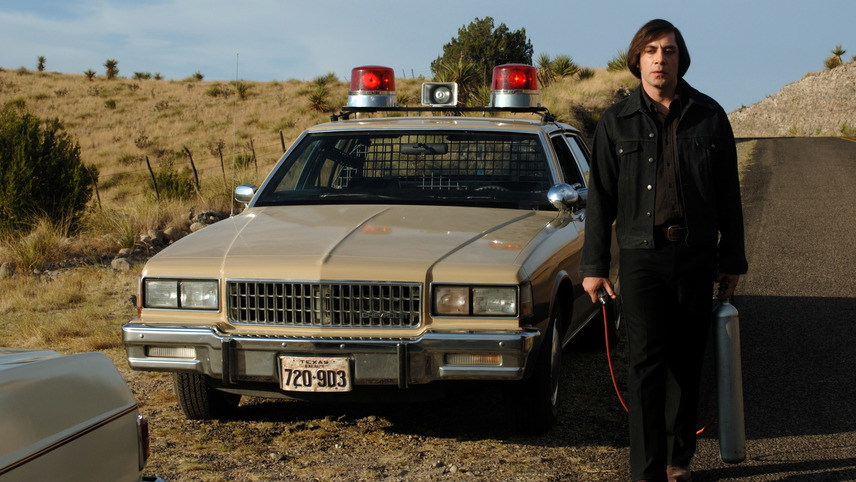
Director: Joel Coen & Ethan Coen · Cinematographer: Roger Deakins · Composer: Carter Burwell (16 minutes total) · Sound Design: Skip Lievsay, Craig Berkey · Production Design: Jess Gonchor · Key Cast: Tommy Lee Jones, Javier Bardem, Josh Brolin, Kelly Macdonald, Woody Harrelson · Runtime: 122 minutes · Studio/Distributor: Paramount Vantage / Miramax / Scott Rudin Productions · Budget: $25 million · Box Office: $171 million worldwide
No Country for Old Men: The Thriller That Stops Thrilling and Becomes Something Worse
For most of its runtime, No Country for Old Men is the finest thriller of the twenty-first century. A welder named Llewelyn Moss finds two million dollars at a desert drug deal gone wrong. A hitman named Anton Chigurh is sent to retrieve it. A sheriff named Ed Tom Bell follows the trail of bodies. The mechanics are impeccable, the pacing relentless, the tension suffocating. If the film ended as a thriller, it would be one for the ages.
It does not end as a thriller. It does something far braver and far more unsettling. It stops.
The protagonist dies offscreen. The villain walks away from a car accident. The sheriff retires. The final scene is an old man at a kitchen table, telling his wife about two dreams he had. Then the screen goes black. No resolution. No justice. No catharsis. The film that spent ninety minutes teaching you to grip your armrest spends its last fifteen minutes explaining, quietly and without apology, that the thing you were gripping for was never going to arrive.
This is the Coen brothers’ masterpiece, and it is a masterpiece partly because of how many people it infuriates. The ending is not a failure of nerve or a narrative miscalculation. It is the entire point. Cormac McCarthy’s novel, from which the Coens adapted their screenplay with almost word-for-word fidelity, is built around the same structural betrayal: the thriller plot is a vehicle for a meditation on violence, aging, and the limits of comprehension. Sheriff Bell is not trying to catch Chigurh. He is trying to understand a world that has become illegible to him. He fails. The film’s refusal to provide closure is its answer to his question.
The craft is staggering. Roger Deakins’s cinematography treats the West Texas landscape with the severity of a Cormac McCarthy sentence: spare, precise, and completely indifferent to human comfort. Skip Lievsay’s sound design, working in near-total absence of conventional score, makes silence itself into a weapon. The performances are among the finest in any Coen brothers film, and the Coen brothers have made sixteen films with remarkable casts.
Verdict: 10/10. No Country for Old Men is a perfect film that disguises itself as a genre piece for long enough to let you get comfortable, then removes the floor. Its ending is its greatest strength. Every element of craft serves a single, devastating argument: that violence does not explain itself, that evil does not owe you a confrontation, and that the old country the title mourns was never as comprehensible as its sheriffs believed.
Roger Deakins and the Light That Refuses to Comfort You
This was Roger Deakins’s ninth collaboration with the Coen brothers, and it represents some of the most disciplined work in a career defined by discipline. Deakins shot No Country on 35mm film, in the Super 35 format, using natural and practical light sources whenever possible. The result is a West Texas that looks exactly the way West Texas looks at two in the afternoon or eleven at night: bleached, flat, indifferent to the tiny figures moving across it.
The landscapes are not romanticized. There is no golden-hour desert photography here, no warmth in the sunsets, no visual poetry in the emptiness. The emptiness is simply empty. When Moss stumbles onto the drug deal massacre, the scene is lit with the hard, overhead Texas sun that eliminates shadow and eliminates mystery. Everything is visible. The dead men, the blood, the heroin, the money. There is nothing hidden and nothing beautiful. Deakins presents the carnage with the clinical indifference of an evidence photograph.
The interiors are where the tension lives. The hotel room sequences, where Chigurh hunts Moss through a series of increasingly desperate accommodations, are studies in how lighting creates dread. Deakins uses the flickering quality of cheap motel fluorescents and the hard slash of parking lot light through venetian blinds to create spaces that feel both overexposed and deeply unsafe. You can see everything in these rooms. That is what makes them terrifying. There is nowhere to hide.
One of Deakins’s most celebrated decisions was to light the nighttime driving sequences with nothing more than the glow of dashboard instruments and the headlights reflecting off road signs. The darkness is almost total. You cannot see what is coming. Neither can the characters. The visual logic matches the thematic logic exactly: in this film, you will not be given enough light to see what is approaching, and you will not be warned.
Bardem’s Haircut, Brolin’s Nerve, and Tommy Lee Jones’s Exhaustion
Javier Bardem’s Anton Chigurh is one of the great screen villains, and part of what makes him so effective is how little Bardem does with the role. There is no scenery-chewing, no relish in the killing, no theatrical villainy. Chigurh speaks in a flat, almost polite register. He asks questions and waits for answers. He explains his philosophy with the patience of a teacher who has covered this material many times before. The haircut, which Bardem has said he found humiliating, strips him of conventional attractiveness and replaces it with something alien. Chigurh does not look like a movie villain. He looks like a man from a place you have never been and do not want to visit.
The performance’s power lies in its stillness. When Chigurh offers the gas station proprietor a coin flip for his life, Bardem sits motionless while the other man struggles to understand what is happening. The silence stretches. The tension is unbearable. And Bardem does nothing. He waits. He has already decided that the coin will decide, and his patience is the most frightening thing about him. It is the patience of someone who is not angry or sadistic but simply operating according to a logic that has no room for mercy.
Josh Brolin’s Llewelyn Moss is the thriller’s engine, a resourceful, tough, prideful man who makes one catastrophic decision (returning to the massacre site with water for a dying man) and spends the rest of the film outrunning its consequences. Brolin plays Moss without self-pity or heroic posturing. Moss is smart, but he is not smart enough. He is brave, but bravery is irrelevant against what he is facing. The performance is physical, reactive, stripped of the interiority that a more conventional film would provide through voiceover or confession. You watch Moss act. You never hear him explain.
Tommy Lee Jones performs the film’s emotional center with the weariness of a man who has been thinking the same thoughts for thirty years. Sheriff Bell narrates the film’s opening and closes its final scene, and Jones delivers both with the cadence of someone talking to himself. His voice is the voice of the old country, the country that believed law and decency could prevail. By the final scene, that voice has nothing left to say except the content of two dreams, and Jones delivers them as though the dreams themselves are the only truthful thing left.
Sixteen Minutes of Music in a Two-Hour Film: The Sound of Nothing Coming
Carter Burwell has scored every Coen brothers film since Blood Simple. For No Country for Old Men, he composed approximately sixteen minutes of music for a film that runs over two hours. Most of that music is inaudible on first viewing. Some of it is designed to be inaudible.
Burwell’s approach was to create tones rather than melodies. He used singing bowls, the standing metal bells from Buddhist meditation practice, to produce sustained frequencies that sit beneath the ambient sound mix. During the gas station coin-flip sequence, a low hum rises almost imperceptibly and disappears when Chigurh reveals the coin. Burwell tuned this hum to sixty hertz, the frequency of a refrigerator compressor, so that it would register subliminally rather than consciously. You feel the tension increase. You do not understand why. The music is doing its work below the threshold of awareness.
The concept originated with Ethan Coen, who suggested during editing that the film might not need music at all. Joel was initially skeptical but agreed after watching the rough cut. Burwell then composed material that existed at the boundary between score and sound design, sounds that could be mistaken for wind, engine noise, or electrical hum. His goal was to deepen tension without providing the emotional guidance that conventional scoring supplies. When a horror film cues a dissonant chord, you know something bad is coming. No Country offers no such warning.
This placed extraordinary pressure on the sound design. Skip Lievsay, the Coens’ sound editor since Blood Simple, described the film as a remarkable experiment. Every ambient sound had to carry the emotional weight that music would normally handle. The creak of a floorboard in a hotel corridor. The electronic beep of a tracking device growing louder. The screech of a light bulb before a shootout. The suppressed blast of Chigurh’s shotgun, a sound specifically engineered for this film. Lievsay constructed a sonic landscape in which silence itself generates dread, and the intrusion of any sound into that silence feels like a violation.
The end credits play over a quiet guitar piece Burwell originally wrote for the film’s opening. It is the first unambiguous music the audience has heard in two hours. After everything the film has put you through, a simple guitar melody feels almost unbearably tender.
McCarthy’s Sentences, the Coens’ Silences
The adaptation is so faithful that sections of the screenplay read as direct transcriptions of Cormac McCarthy’s novel. Dialogue is lifted nearly verbatim. Scene structures follow the book’s sequence with minimal rearrangement. The Coens have called it one of the easiest adaptations they have ever done, and the ease is itself revealing: McCarthy’s prose, with its spare dialogue and visual precision, reads like a screenplay before anyone has formatted it.
But the adaptation is not merely transcription. What the Coens understood is that McCarthy’s novel achieves its effects partly through what it refuses to describe. The violence in the book is reported rather than dramatized. Characters die between chapters. Interior monologue vanishes at the moments where conventional fiction would provide it. McCarthy withholds the satisfactions of narrative completion as a philosophical position: the world does not owe you an ending, and neither does this book.
The Coens translate this withholding into cinematic terms. Moss’s death occurs offscreen, reported to the audience through the evidence Bell encounters when he arrives at the motel. The most significant event in the thriller plot is not shown. In any other film, this would be a failure. In No Country, it is the moment the film declares its true subject. The thriller was never the point. The sheriff’s incomprehension was always the point. And the sheriff’s incomprehension is best communicated by denying the audience the scene they have been trained to expect.
Where the adaptation diverges from the novel, it does so through addition rather than subtraction. The Coens give Carla Jean’s confrontation with Chigurh a physical specificity the book leaves more ambiguous. They add visual gags and moments of dark humor that are characteristic of their sensibility but not of McCarthy’s. And they emphasize, through Deakins’s camera and Lievsay’s sound, the vast emptiness of the landscape in ways that prose can evoke but cannot reproduce. The silence between sentences on a page becomes the silence between sounds in a theater, and the effect is different in kind: you sit inside it.
1980: The Border, the Drug Trade, and the End of the Old Country
The film is set in 1980, and the specificity of the year matters. This is the moment when the drug trade along the Texas-Mexico border escalated from a regional problem into an industrial enterprise. The cocaine and heroin moving through West Texas in 1980 carried with it a scale of violence that the region’s law enforcement was not equipped to comprehend, let alone contain.
Sheriff Bell is not merely an aging lawman. He is a man whose entire framework for understanding criminality has been made obsolete. The criminals he grew up policing operated within recognizable patterns: motive, opportunity, predictability. Chigurh operates outside those patterns. His violence is not passionate or greedy. It is systematic, philosophical, almost bureaucratic. He kills because his principles require it. Bell has no category for this kind of evil. He cannot fight what he cannot classify.
The Coens and McCarthy both understand that the nostalgia Bell feels for the old country is partly a fiction. The opening monologue, in which Bell describes lawmen who never carried guns, romanticizes a past that was itself violent and unjust. The old country had its own brutalities. But Bell’s nostalgia is emotionally truthful even if it is historically selective. He is mourning not a real past but the possibility of comprehension. He believed the world could be understood. He no longer believes this. The drug trade, with its anonymous violence and inexplicable cruelty, has destroyed his confidence in legibility.
The border is not merely a geographic feature. It is the line between the known and the unknown, between the country Bell recognizes and the country he cannot navigate. When Moss crosses into Mexico and when Chigurh crosses back, the border marks a threshold of intelligibility. On Bell’s side, the law means something. On the other side, or in the spaces Chigurh occupies, the law is simply one more system among many, and not the most powerful one.
Blood Simple to No Country: The Coens’ Long Walk Home
Joel and Ethan Coen began their career with Blood Simple, a Texas noir about greed, murder, and catastrophically poor decisions. Twenty-three years and fourteen films later, they returned to Texas with a story about greed, murder, and catastrophically poor decisions. The circularity is not accidental. No Country for Old Men is the film Blood Simple was reaching toward, the version of the story in which the Coens’ technical mastery and thematic maturity are finally in complete alignment.
Between those two films, the Coens built one of the most distinctive bodies of work in American cinema. Raising Arizona, Barton Fink, Fargo, The Big Lebowski, O Brother Where Art Thou, A Serious Man. Their range is extraordinary. But a consistent thread runs through everything they have made: the conviction that human plans are fragile and that the universe is under no obligation to respect them. Their characters scheme and strive and believe they are in control. They are wrong. The Coens find this both funny and devastating, sometimes in the same scene.
No Country marks the moment when the devastation overtakes the comedy. There are flashes of the Coens’ characteristic dark humor: Chigurh’s haircut, the deputy’s baffled face, Carla Jean’s mother complaining about her health. But the dominant register is grief. Bell’s narration carries the weight of a man who has been looking at the evidence of human cruelty for decades and has finally reached the limit of what he can absorb. The comedy is still present. It has simply been outweighed.
Deakins was instrumental in the film’s existence. When the Coens were considering handing the project to another director and serving only as screenwriters, Deakins told Joel that he would never speak to them again if they did not direct it themselves. The threat was sufficient. The Coens committed, and the result is their greatest achievement. It is a film that contains everything they had learned about suspense, about landscape, about the way ordinary people encounter extraordinary violence, and about the limits of human understanding.
Neo-Western: When the Frontier Has Already Been Lost
No Country for Old Men belongs to the tradition of the neo-Western, but it occupies a peculiar position within it. Most neo-Westerns are set in the contemporary or near-contemporary American West and use the landscape and iconography of the Western to tell stories about the frontier’s afterlife. Unforgiven examines the myth of redemptive violence. Hell or High Water examines economic dispossession. Wind River examines the abandonment of Indigenous communities. All of them operate on the assumption that the frontier is gone but its consequences remain.
No Country does something different. It sets its story in 1980, which places it at the exact hinge between the old West and the new one. Bell’s generation still rides horses and remembers lawmen who patrolled without firearms. Moss’s generation drives pickup trucks and hunts pronghorn with scoped rifles. Chigurh’s generation uses satellite tracking devices and captive bolt pistols. Three eras of American violence coexist in the same story, and the film’s argument is that the newest era has made the previous ones not just obsolete but incomprehensible.
The Western genre has always been about the tension between civilization and wildness, between law and the gun. No Country collapses that tension. Chigurh is neither civilized nor wild. He is something else entirely: a methodical, principled agent of destruction who follows his own code with absolute consistency. He is not chaos. He is a different kind of order. And Sheriff Bell, the representative of the old order, cannot even articulate what the new order is, let alone oppose it.
This is why the film’s ending is structurally necessary. A conventional Western ends with a confrontation between the lawman and the outlaw. No Country cannot end this way because its argument is that the confrontation is no longer possible. Bell and Chigurh never meet. They exist in different films, different genres, different centuries. The sheriff walks through the aftermath of the killer’s passage and tries to read the evidence. He cannot. He goes home. He tells his wife about his dreams. The frontier is not lost. It has become unrecognizable.
Sheriff Bell’s Dreams and the Film’s Refusal to Finish
The ending of No Country for Old Men is the most debated conclusion of any major American film released this century, and the debate itself is part of the film’s design.
Bell retires. He sits at his kitchen table. His wife asks him about his dreams. He describes two. In the first, he lost some money his father gave him. In the second, he and his father were riding through a cold mountain pass in the dark, and his father rode ahead carrying fire in a horn, and Bell knew that when he arrived wherever his father was going, his father would be waiting there. Then the film cuts to black.
The dreams are not symbols to be decoded. They are experiences to be felt. The first dream is about losing what was given to you, about failing to preserve what mattered. The second is about following your father into the dark, about the hope that someone who came before you has prepared a place where you can rest. Together, they describe the interior landscape of a man who has failed at his life’s work and is searching for a way to understand that failure as something other than defeat.
What makes the ending so powerful, and so infuriating to viewers who wanted the thriller resolved, is that it replaces plot with interiority. For two hours, the film has been about external action: running, chasing, shooting, hiding. In its final minutes, it moves entirely inside one man’s mind. The transition is abrupt and total. There is no bridge between the thriller and the elegy. The film simply becomes something else, and you either go with it or you don’t.
Those who go with it tend to recognize that the dreams are the most honest thing in the film. Everything else has been a genre exercise, brilliantly executed but ultimately a genre exercise. The dreams are the only scene in which a character speaks without strategy, without self-protection, without trying to accomplish anything. Bell is simply describing what he saw in his sleep. For the first time in the film, no one is lying. No one is running. The violence has stopped. What remains is an old man trying to find his father in the dark.
Call It: Chance, Fate, and Chigurh’s Instrument of Philosophy
The coin toss is the scene everyone remembers, and it is the scene that contains the film’s entire philosophical architecture in miniature.
Chigurh stops at a gas station. He buys cashews. He asks the proprietor what time he closes, what the most he’s ever seen lost on a coin toss is, and then he places a quarter on the counter and asks the man to call it. The man does not understand what is happening. Chigurh explains, with icy patience, that the man needs to call it. The man calls it. He wins. Chigurh tells him not to put the coin in his pocket, because then it will become just a coin, which it is not.
The scene works on multiple levels simultaneously. As drama, it is unbearably tense because Bardem’s stillness communicates that the man’s life is genuinely at stake. As philosophy, it crystallizes the debate between free will and determinism that runs through the entire film. Chigurh believes the coin is fate. He has been carrying it for years, through every encounter that led him to this gas station. The coin is not random. It is the accumulated weight of every prior event expressing itself through a binary outcome. When Chigurh says the man has been putting his life up his whole life, he means that every decision the man ever made brought him to this counter, at this moment, facing this coin.
But Chigurh also offers a choice. He asks the man to call it. The call is the man’s. The outcome is the coin’s. Chigurh’s philosophy requires both: the individual must participate in the mechanism that will decide their fate. The coin does not land without someone calling it. This is not pure determinism. It is a system in which agency and chance are both present and neither is sufficient.
Sheriff Bell, who never learns about the coin toss, would not understand it even if he did. His worldview has no room for Chigurh’s logic. Bell believes in cause and effect, in motive and consequence, in a world where violence has reasons. Chigurh’s coin suggests otherwise. Violence does not require a reason. It requires only a quarter and someone willing to flip it.
Best Picture, National Film Registry, and the Ongoing Argument
No Country for Old Men premiered at the 2007 Cannes Film Festival, where it was nominated for the Palme d’Or, and opened in American theaters in November. The critical response was immediate and overwhelming. The film won four Academy Awards: Best Picture, Best Director (the Coens), Best Supporting Actor (Bardem, the first Spanish actor to win an Oscar), and Best Adapted Screenplay. It received eight nominations in total. Deakins was nominated for Best Cinematography but lost, one of the most lamented losses in that category’s history.
The audience response was more divided. The ending produced genuine anger in some viewers, who felt the film had violated an implicit contract: you do not build the most effective thriller in years and then refuse to deliver the climax. Walk-outs were reported. Heated arguments in theater lobbies became a minor cultural phenomenon. The Coens, who have never displayed much interest in audience satisfaction as a guiding principle, did not apologize.
Time has been kind to the ending and to the film. In 2024, No Country was selected for preservation in the United States National Film Registry by the Library of Congress. It is now routinely cited not only as the finest Coen brothers film but as one of the greatest American films of the twenty-first century. The backlash against the ending has receded as the film’s philosophical ambitions have come into clearer focus. Viewers who initially wanted the thriller resolved have, on repeat viewings, discovered that the film they were watching was never really a thriller. It was an elegy wearing a thriller’s clothes.
The film’s influence has been pervasive and largely invisible, which is the mark of a work that changed expectations rather than styles. After No Country, the idea that a genre film could abandon its genre obligations in the final act and become something else no longer seemed radical. It seemed like a possibility.
What You Notice When You Know Moss Doesn’t Make It
No Country for Old Men rewards rewatching not because it has hidden details (though it does) but because knowing the ending changes the meaning of everything that comes before it.
On your second viewing, watch Bell. He is in far more scenes than you remember, and his presence in each one carries a different weight when you know he is narrating a story of his own defeat. Track his posture across the film. In the early scenes, he stands straight and speaks with the dry authority of a man who knows his territory. By the final act, he is hunched, slower, quieter. The physical decline mirrors the psychological one, and Jones communicates it entirely through his body.
Listen for what is not there. The absence of score is obvious on a first viewing, but the specific moments where music would traditionally appear become fascinating on a second. The aftermath of the river shootout. The hotel corridor before the door lock explodes. Moss’s death. Each of these moments is scored with nothing but ambient sound, and the silence is not merely the absence of music. It is an active presence, a refusal to guide your emotional response.
Watch Chigurh’s interactions with ordinary people. The gas station owner, the boys on bicycles after the car accident, the woman in the office building. Each of these encounters follows the same pattern: Chigurh speaks calmly, the other person senses danger without understanding its source, and the scene ends with the person shaken but alive. These encounters are Chigurh’s version of mercy, and they reveal more about his philosophy than the killings do. He does not kill arbitrarily. He kills according to principles. The coin toss is not random. It is his method of deferring to something larger than himself.
Pay attention to the imagery of doors. Doors opening, doors being breached, doors with their locks blown out. Doors are the film’s recurring visual motif: the boundary between safety and danger, between the known and the unknown. Chigurh’s captive bolt pistol is a tool for opening doors. His entire function in the film is to remove the barriers that separate people from the violence they believed they were protected from.
Film Trivia
The cinematographer who saved the film. Roger Deakins was not merely the director of photography. He was the reason the film was directed by the Coens at all. When Joel and Ethan were considering serving only as screenwriters, Deakins read McCarthy’s novel independently and told Joel he would never speak to him again if they did not direct it themselves. The bluff worked. The Coens directed. The film won Best Picture.
Two masterpieces, one smoke column. Paul Thomas Anderson’s There Will Be Blood was shooting in Marfa, Texas, simultaneously with No Country. The productions were close enough that the Coens had to scrap an entire day of filming when the oil derrick scene in Anderson’s film produced a column of smoke visible in their shots. Both films were nominated for Best Picture at the same ceremony. No Country won.
Bardem’s most humiliating haircut. Javier Bardem has spoken repeatedly about how much he hated Chigurh’s haircut, which he found genuinely embarrassing. The hairstyle was deliberately designed to strip Bardem of conventional attractiveness and create a look that defied cultural placement. Bardem reportedly avoided looking in mirrors during production. He later joked in his Oscar acceptance speech, thanking the Coens for being crazy enough to put one of the most horrible haircuts in history on his head.
The coin that almost wasn’t. The gas station coin toss scene, now widely regarded as one of the greatest scenes in American cinema, almost did not make it into the film. The Coens debated whether the scene slowed the narrative momentum. They kept it, recognizing that the scene was not a digression from the story but a distillation of it. The quarter used in the scene was not a prop. It was a real coin from 1958.
This entry selects analytical dimensions from a pool. All five anchors are present: the critical verdict, key performances, visual craft, reception and legacy, and the rewatchability guide. Earned sections cover the near-absent score and sound design, the McCarthy adaptation, cultural and historical context, the Coens’ body of work, and genre lineage within the neo-Western tradition. Two wildcard sections address elements unique to this film: the structural refusal of the ending, which replaces thriller resolution with philosophical elegy, and the coin toss as a self-contained expression of the film’s argument about fate. Awards history is folded into the reception section rather than treated separately. Production design is omitted because, while excellent, the location-driven visual strategy is better addressed within the cinematography section.


Leave a Reply