Director/Writer: Guillermo del Toro · Cinematographer: Guillermo Navarro · Composer: Javier Navarrete · Editor: Bernat Vilaplana · Production/Costume Design: Eugenio Caballero · Creature/Makeup Effects: David Marti, Montse Ribe (DDT Efectos Especiales) · Key Cast: Ivana Baquero (Ofelia), Sergi Lopez (Captain Vidal), Maribel Verdu (Mercedes), Doug Jones (the Faun / the Pale Man), Ariadna Gil (Carmen) · Runtime: 118 minutes · Producers: Guillermo del Toro, Alvaro Augustin, Alfonso Cuaron, Bertha Navarro, Frida Torresblanco · Budget: ~$19 million · Box Office: ~$83 million worldwide
The Fairy Tale That Refused to Look Away
Fairy tales, in their oldest forms, are not kind. They are negotiations with dread. A child walks into a forest. The forest contains something that wants to eat her. She survives by obeying rules, or she does not survive at all. The sweetened versions, the Disney adaptations, the bedtime stories scrubbed of blood and consequence: these came later. The originals were warnings. Pan’s Labyrinth returns to the originals.
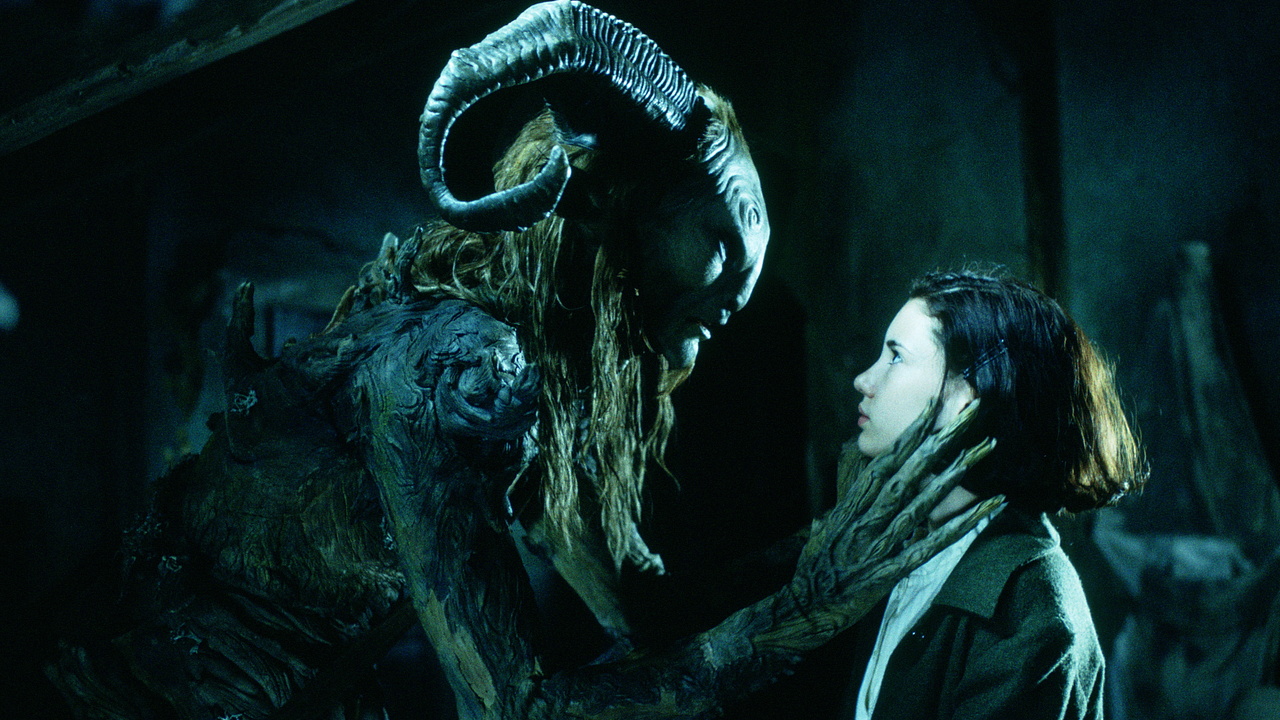
Guillermo del Toro’s 2006 film is set in Spain in 1944, five years after the Civil War, during the early consolidation of Franco’s dictatorship. Ofelia, an eleven-year-old girl who reads fairy tales, is brought by her pregnant mother to live with her new stepfather, Captain Vidal, a Falangist officer tasked with eliminating the remnants of the Republican resistance. The Captain is a monster in uniform. The forest surrounding his outpost contains a different kind of monster: a faun, ancient and ambiguous, who tells Ofelia she is a princess from an underground kingdom and must complete three tasks to return to her father’s realm.
The film runs these two narratives in parallel. In the real world, Vidal tortures prisoners, Mercedes the housekeeper smuggles supplies to the guerrillas, and Carmen grows weaker as her pregnancy progresses. In the fantasy world, Ofelia retrieves a key from the belly of a giant toad, resists (and then fails to resist) the temptation of a feast guarded by a child-eating Pale Man, and is ultimately asked to sacrifice her infant brother’s blood. The real world is brutal in ways that are historically specific. The fantasy world is brutal in ways that are mythologically universal. Neither world is safe. Neither is entirely legible. And the question that sustains the film from its opening image (a girl bleeding, time reversing) to its closing one (a flower blooming on a dead fig tree) is whether the fantasy exists at all, or whether Ofelia has invented it as the only livable response to a world designed to destroy her.
Del Toro has stated, with characteristic generosity, that both readings are valid. The fantasy is real. The fantasy is a dying child’s final dream. The film supports both interpretations with equal conviction, and the refusal to settle the question is not evasion. It is the film’s deepest commitment to the logic of fairy tales, which have never distinguished between the real and the imagined because, for a child, the distinction does not exist.
Pan’s Labyrinth is a film of extraordinary visual imagination, ferocious political conviction, and emotional brutality. It is also, beneath its creatures and its violence, a story about the moral education of a child who is asked to choose between obedience and conscience. Ofelia disobeys the Faun. She disobeys Vidal. She disobeys everyone who claims authority over her, and her disobedience is the film’s definition of heroism. In a world ruled by fascists and fauns, the only ethical act is refusal.
Verdict: 10/10
Sergi Lopez and the Banality of Cruelty
Captain Vidal is one of the most frightening villains in modern cinema, and his terror derives not from excess but from precision. Sergi Lopez plays him as a man for whom violence is administrative. He does not rage. He does not lose control. He tortures a prisoner with the same focused attention he brings to shaving or repairing his father’s pocket watch. The violence is not pleasure for Vidal. It is procedure.
Lopez, a Catalan actor whose prior work had been primarily in French-language comedy, transforms himself so completely that the performance feels like a possession. Vidal’s posture is rigid. His uniform is immaculate. His table manners are impeccable. He is the kind of man who would murder you and then complain that you had bled on his boots. Lopez finds the horror in competence: Vidal is terrifying because he is so good at his job, and his job is control. He controls his soldiers, his household, his wife’s body (the unborn son is more important to him than Carmen herself), and the population he has been assigned to pacify. Every act of violence is an act of administration. This is fascism rendered as personality, and Lopez makes it sickeningly convincing.
The bottle scene establishes Vidal’s capacity early. A farmer and his son are stopped by soldiers and accused of being guerrillas. The farmer explains that they were hunting rabbits. Vidal, barely listening, smashes the farmer’s face with a bottle, then shoots the son. When the rabbits are found in their bag, confirming their innocence, Vidal is untroubled. He simply instructs his men to search people more carefully before bringing them to him. The brutality is not the point. The indifference is the point.
Against this monument of cruelty, Ivana Baquero’s Ofelia is a study in vulnerable intelligence. Baquero was eleven during filming, and she carries the entire emotional weight of the narrative without a single false note. Ofelia is not a brave child in the Hollywood sense. She is frightened. She hesitates. She makes mistakes (the grapes, the forbidden feast). But she possesses a moral instinct that operates beneath and beyond her fear, and when the final test comes, she refuses to harm her brother. The refusal costs her life. Whether it earns her a kingdom is the film’s unanswered question.
Maribel Verdu, as Mercedes, provides the adult counterpart to Ofelia’s resistance. Del Toro cast her because he saw a sadness in her that he felt was right for the role. Mercedes is the film’s true revolutionary: not the men in the forest with their guns, but the woman in the kitchen with her knife, invisible to Vidal because he cannot conceive of a servant as a threat. Her final line to the dying Captain is the film’s most devastating act of defiance.
Navarro’s Two Worlds: Gold for the Fantasy, Blue for the War
Guillermo Navarro won the Academy Award for Best Cinematography for Pan’s Labyrinth, and the award was deserved for one specific achievement: making two entirely different visual worlds coexist within a single film without the transition between them ever feeling jarring.
The real world of Captain Vidal’s outpost is rendered in cold blues, greys, and the khaki tones of military fabric. The light is hard and directional, often coming from a single source: a lamp, a window, a fire. Shadows are deep. The color palette is drained of warmth. This is a world that has been stripped of comfort, and Navarro’s cinematography ensures that the audience feels the chill. The interiors of the mill that serves as Vidal’s headquarters have the quality of a bunker: low ceilings, thick walls, no decoration. The camera rarely moves quickly in these spaces. It observes with the patient attentiveness of someone who knows that violence could erupt at any moment.
The fantasy world is different in every respect. Its palette is built on golds, ambers, and the warm oranges of candlelight and ancient stone. The Faun’s labyrinth is lit with a glow that seems to emanate from the stone itself, as though the walls remember sunlight from centuries ago. The Pale Man’s banquet hall is suffused with a sickly red-orange that transforms the abundance of the feast into something threatening. The tree that houses the giant toad is dark but organic, its textures suggesting decay and growth simultaneously.
Navarro and del Toro made a deliberate choice to keep the fantasy sequences predominantly practical, avoiding the glossy sheen of digital imagery wherever possible. The resulting images have a tactile quality that CGI-heavy fantasy films rarely achieve. You can feel the dampness of the labyrinth, the weight of the Faun’s horns, the slipperiness of the mud inside the toad’s tree. This physicality grounds the fantasy in sensation rather than spectacle, which is essential to the film’s project. If the fantasy world felt artificial, the question of its reality would be irrelevant. Because it feels physical, the question remains open.
Navarrete’s Lullaby and the Music That Remembers Childhood
Javier Navarrete’s score for Pan’s Labyrinth is built entirely around a single lullaby. The melody, tender and simple, first appears as Ofelia hums it, and it recurs throughout the film in variations that range from gentle piano to full orchestral statements. The structural decision is elegant: a fairy tale should have a lullaby at its center, and this one does.
The lullaby operates differently depending on which world it inhabits. In the fantasy sequences, it carries the warmth of homecoming. It suggests that the underground kingdom is real, that Ofelia belongs there, that the melody is an ancestral memory encoded in her body. In the real-world sequences, the same melody becomes unbearably poignant, because it sounds like something a child would sing to comfort herself in the dark. The same notes mean hope in one context and desperation in another, and the score never resolves the ambiguity.
Navarrete’s orchestration favors woodwinds, piano, and strings in the middle register. There are no bombastic brass fanfares, no percussive action cues. Even during the film’s most violent sequences, the score maintains a restraint that contrasts sharply with the images. When Vidal tortures a prisoner, the music does not heighten the horror. It withdraws, leaving the sound design (bone, fabric, breath) to do the work. When Ofelia faces the Pale Man, the score tightens but does not erupt. Navarrete understood that the film’s power lies in the gap between what the eye sees and what the ear hears, and he kept the gap open.
The score was nominated for the Academy Award for Best Original Score. Much of it was cut during post-production, but del Toro insisted on including the complete score on the soundtrack album, recognizing its standalone beauty. It is one of the great film scores of the 2000s, and its simplicity is its greatest sophistication.
Flesh, Latex, and the Case Against Digital Monsters
Pan’s Labyrinth’s creatures are, with minor exceptions, physically present on set. The Faun is Doug Jones in five hours of latex foam makeup, walking on stilts concealed beneath prosthetic goat legs, his ears remotely operated by technicians, his horns weighing ten pounds. The Pale Man is Jones again, this time in six hours of body makeup, with marionette legs attached over green-screened limbs, seeing through the creature’s nostrils because the face has no eyes. The giant toad is a combination of animatronics and the voice of del Toro himself. The mandrake root is a screaming puppet. The fairies are CGI, but they are dirty fairies, designed to look like monkeys with leaf-wings rather than the luminous sprites of conventional fantasy.
This commitment to practical effects is not nostalgia. It is a philosophical position. Del Toro has spoken extensively about his belief that creatures built from physical materials occupy screen space differently than digital constructions. A latex mask interacts with light. It casts shadows. It has weight. An actor inside a suit breathes, and the suit breathes with them. The audience may not consciously register these differences, but the body does. Practical creatures feel dangerous in a way that digital ones do not, because some part of the viewer’s brain recognizes that the thing on screen is physically present.
Jones’s dual performance as the Faun and the Pale Man represents the pinnacle of creature acting. Del Toro told Jones to play the Faun like a rock star: less David Bowie, more Mick Jagger. The result is a character with a swagger that contradicts his ancient body, a being who is both decrepit and vital, trustworthy and threatening. Jones moves through the Faun’s latex prison with a grace that makes the prosthetics seem like skin. The creature’s personality emerges not from the mask but from the body beneath it: the tilt of the head, the curl of the fingers, the way he leans toward Ofelia as though sharing a secret and a threat simultaneously.
The Pale Man is a different kind of achievement. Inspired by del Toro’s own weight loss and by Goya’s painting Saturn Devouring His Son, the creature is a collapsed human form: sagging skin, empty eye sockets, hands with stigmatic eyes that he raises to his face to see. Jones could not see while performing the role, navigating by memory and the muffled directions of crew members. The Pale Man’s banquet hall sequence is one of the most purely terrifying scenes in modern cinema, and its terror is inseparable from the physicality of the creature. A digital Pale Man would be scary. This one, made of latex and sweat and a man who cannot see, is nightmarish.
Fascism as the Monster That Needs No Mask
Pan’s Labyrinth is set in 1944, during the mopping-up operations that followed Franco’s victory in the Spanish Civil War. The Maquis, Republican guerrillas, operate in the forests surrounding Vidal’s outpost. They are supplied by sympathizers in the local population, including Mercedes and Doctor Ferreiro. Vidal’s assignment is to destroy them, and he prosecutes this assignment with methodical savagery.
Del Toro, a Mexican filmmaker with no personal connection to the Spanish Civil War, approached the historical material with the same imaginative precision he brought to the fantasy sequences. The Spain of the film is not a documentary reconstruction. It is a fairy-tale version of fascism: simplified, heightened, rendered in the bold strokes of a story that children might tell about monsters. Vidal is not a psychologically complex portrait of a Francoist officer. He is the wolf in the fairy tale, the ogre in the castle, the stepfather who must be defeated. Del Toro does not apologize for this simplification because he recognizes that fairy tales are not obligated to be nuanced. They are obligated to be clear.
The political argument of the film is inseparable from its fantasy structure. The Faun tells Ofelia that she is a princess. Vidal tells her that she is a stepdaughter. Both claims are assertions of authority, and both require obedience. The Faun’s tasks demand that Ofelia follow instructions without question. Vidal’s regime demands the same thing from everyone in his domain. The parallel is deliberate: blind obedience, whether to mythological creatures or to military officers, is the enemy. Ofelia’s heroism lies in her capacity to disobey both. She eats the grapes. She refuses to hand over her brother. She fails the Faun’s test and passes the film’s test, because the film’s moral framework privileges conscience over compliance.
This is not a subtle political film. It does not aspire to subtlety. It aspires to moral clarity, and it achieves it with a force that more ambiguous films cannot match. Del Toro understood that fascism is not interesting. It is not a complex philosophical position that requires careful analysis. It is a system for the organization of cruelty, and the appropriate response to it is not understanding but refusal.
Del Toro’s Notebooks and the Art of Obsessive Preparation
Guillermo del Toro keeps notebooks. They are filled with drawings, doodles, plot fragments, creature designs, and stray ideas, accumulated over decades. Pan’s Labyrinth emerged from these notebooks, and the film’s visual density reflects twenty years of accumulated imagination compressed into two hours.
The notebook for Pan’s Labyrinth was nearly lost. Del Toro left it in the back of a London taxi during pre-production. The notebook contained every sketch, every design, every plot note for the film. For two days, he believed the project was dead. The cab driver found the notebook, recognized its importance (or at least its intensity), and returned it. Del Toro has described this recovery as a sign that the film was meant to exist.
This story reveals something essential about del Toro’s creative process. He is not a director who works from screenplay to screen in a linear fashion. He works from images. The creatures come first. The story grows around them. The Faun, the Pale Man, the mandrake root, the fairy insects: these are not illustrations of a narrative. They are the narrative’s origin. Del Toro imagined the Pale Man before he imagined the scene the Pale Man inhabits. He drew the Faun’s face before he wrote the Faun’s words. The film was designed from the inside out, starting with the monsters and building outward toward the humans.
Del Toro also forfeited his entire director’s salary to retain final cut. American producers had offered to double the budget if he would shoot the film in English with American actors. He refused, stating that the film would become a “Euro-trash production” if removed from its linguistic and cultural context. The decision was expensive and correct. Pan’s Labyrinth works because it is rooted in Spanish soil, Spanish history, and the specific rhythms of the Spanish language. An English-language version would have been a different film. It would almost certainly have been a lesser one.
The Longest Standing Ovation and the Awards That Followed
Pan’s Labyrinth premiered at the 2006 Cannes Film Festival and received a standing ovation that lasted 22 minutes, the longest in the festival’s history. Whether this record is precisely accurate or slightly mythologized, the reception established the film as an event. It was not simply admired. It was celebrated with a fervor that surprised even del Toro.
The film went on to win three Academy Awards: Best Cinematography (Guillermo Navarro), Best Art Direction (Eugenio Caballero), and Best Makeup (David Marti, Montse Ribe). Navarrete’s score was nominated but did not win. The film was not nominated for Best Picture or Best Director, omissions that reflect the Academy’s historical reluctance to honor foreign-language fantasy films in the top categories. It did win the BAFTA for Best Film Not in the English Language. It won the Ariel for Best Picture in Mexico. It won the Hugo Award for Best Dramatic Presentation.
Critically, the film was received as del Toro’s masterpiece, a judgment that has not been significantly revised. Rotten Tomatoes records a 95% approval rating. A. O. Scott, reviewing for the New York Times, described it as a fairy tale of uncommon savagery and beauty. Roger Ebert gave it four stars and called it one of the greatest fantasy films ever made.
The commercial performance was remarkable for a Spanish-language film. Against a budget of roughly $19 million, it grossed $83 million worldwide, including $37.6 million in the United States. For a subtitled film with graphic violence and a child protagonist who dies, these numbers represent a genuine crossover success, driven by word of mouth and critical advocacy.
What the Labyrinth Reveals the Second Time Through
Pan’s Labyrinth is structured as a fairy tale, and fairy tales, by their nature, change on repetition. The first time through, the plot exerts its pull: will Ofelia complete the tasks? Will Mercedes escape? Will Vidal be defeated? On a second viewing, the answers are known, and the film reveals its deeper architecture.
Watch the opening narration with knowledge of the ending. The story of Princess Moanna, told over the image of Ofelia bleeding, is the film’s thesis: a princess left the underworld, forgot who she was, and died. The narration is not a prelude. It is a spoiler delivered in the language of myth, and it tells you everything that will happen while disguising itself as backstory.
Track the visual parallels between the real world and the fantasy world. The Pale Man’s banquet table mirrors Vidal’s dinner table. Both are sites of abundance guarded by monsters. Both punish those who take what is not offered. The Faun’s labyrinth mirrors Vidal’s outpost: both are enclosed spaces governed by rules, both demand obedience, and both destroy those who comply as readily as those who resist.
Pay attention to Mercedes’ knife. She carries it throughout the film, hidden in her apron. Del Toro introduces it casually, almost as a prop, but it becomes the instrument of her most decisive action. On a second viewing, every scene in which Mercedes touches the knife becomes charged with the knowledge of what she will do with it.
Watch Ofelia’s face during the final task. She has been told to bring her brother to the labyrinth and offer a drop of his blood. She refuses. The refusal is quiet. There is no speech, no dramatic gesture. She simply holds the baby and says no. On a second viewing, this moment is the entire film compressed into a single word.
Film Trivia
The notebook in the taxi. Del Toro’s creative process depends on handwritten notebooks filled with sketches, designs, and story notes accumulated over decades. During pre-production for Pan’s Labyrinth, he left the notebook containing every visual concept for the film in the back of a London cab. He believed the project was finished. The driver found the notebook and returned it two days later. Del Toro interpreted the recovery as a sign and became even more determined to complete the film.
An American who learned Spanish through latex. Doug Jones, who plays both the Faun and the Pale Man, does not speak Spanish. When del Toro told him the entire film would be in Spanish, Jones refused to simply mouth words phonetically. He used the five hours he spent each day in the makeup chair to learn his lines with proper pronunciation and meaning. His dialogue was ultimately dubbed by Spanish theater actor Pablo Adan, but Jones’s lip movements and vocal rhythms shaped the final performance.
Seeing through nostrils. As the Pale Man, Jones could see only through the creature’s nostrils, and even then, he had to look through the left nostril with his right eye and vice versa. It was impossible to use both eyes simultaneously. The Pale Man’s lurching, uncertain gait in the banquet hall is partly a performance choice and partly the consequence of an actor navigating a set he cannot properly see.
The salary del Toro gave up. American producers offered to double the film’s budget if del Toro would shoot it in English with American actors. He turned them down. To retain final cut and creative control over the Spanish-language production, he forfeited his entire director’s salary. The film went on to gross over $83 million worldwide.
This entry selects analytical dimensions from a pool. The five anchors are present: critical verdict, performances, visual craft, reception and legacy, and rewatchability guide. Earned sections cover Navarrete’s score, del Toro’s creative process and body of work, and the cultural-political context of Francoist Spain. Two wildcard sections address qualities specific to this film: the practical creature effects as a philosophical position about the relationship between physical materials and cinematic belief, and fascism as the monster that requires no mask, examining how the film’s political argument is inseparable from its fairy-tale structure. A standalone adaptation section is omitted because Pan’s Labyrinth is an original screenplay with no source material. A production history section is absorbed into the discussion of del Toro’s notebooks and creative methodology.

Leave a Reply