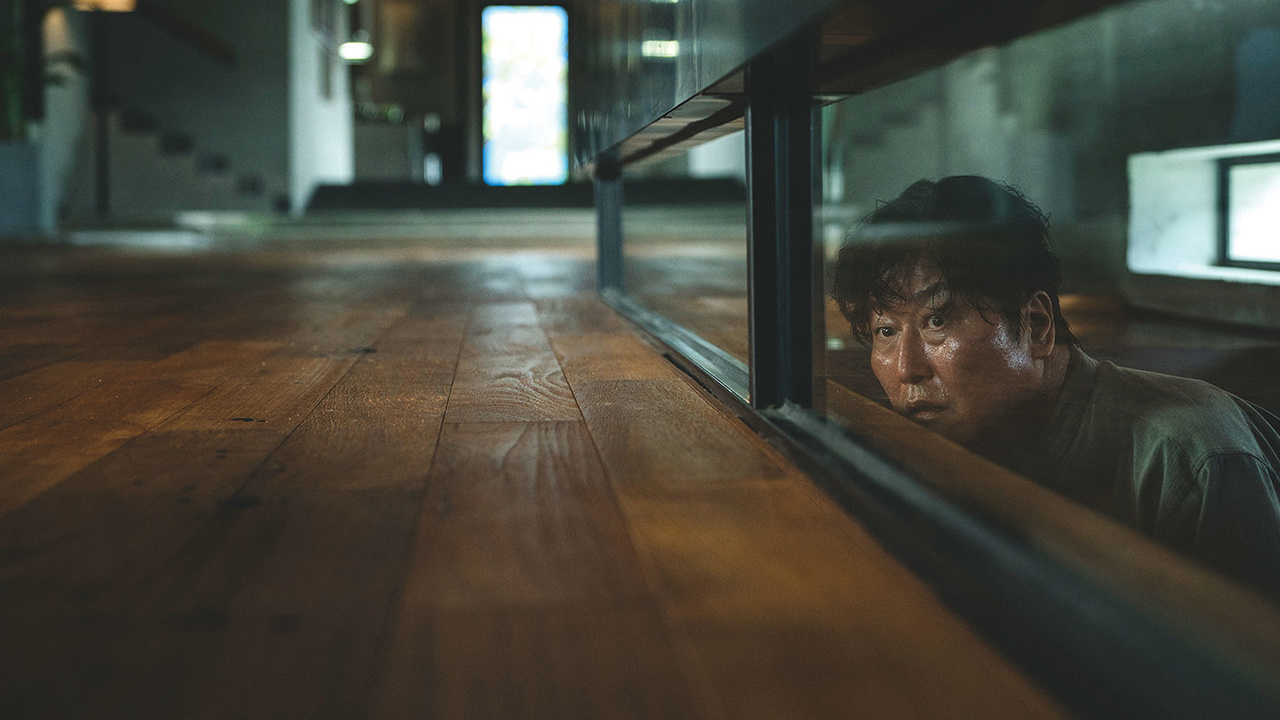
Director: Bong Joon-ho · Cinematographer: Hong Kyung-pyo · Composer: Jung Jae-il · Starring: Song Kang-ho, Lee Sun-kyun, Cho Yeo-jeong, Choi Woo-shik, Park So-dam, Jang Hye-jin, Lee Jung-eun, Park Myung-hoon · Runtime: 132 minutes · Studio: Barunson E&A / CJ Entertainment · Budget: $11 million · Box Office: $266.9 million worldwide
1. Parasite: The House Always Wins
Ask ten people what Parasite is about and you will get ten answers. A con artist story. A class satire. A home invasion thriller. A pitch-black comedy about capitalism. A horror film about what happens when the floor gives way.
All of them are correct. None of them are sufficient.
Parasite is about the physical architecture of inequality. Not the idea of inequality, not the feeling of it, but the literal, spatial, stone-and-concrete reality of living above or below someone else. Every major event in the film is organized around a vertical axis. The Kim family lives in a semi-basement, half-sunk below street level. The Park family lives in a house designed by a fictional architect, elevated and pristine, all glass and clean lines and imported lawn. Between them runs an endless series of stairs: climbed, descended, collapsed upon in exhaustion, flooded with sewage. Bong Joon-ho does not argue that class is a problem. He builds a set that is the problem and then lets you walk through it.
The screenplay, co-written by Bong and Han Jin-won, is constructed with the precision of a heist film and the inevitability of a Greek tragedy. The first half plays as comedy: the Kim family’s infiltration of the Park household is clever, funny, and genuinely satisfying to watch. You root for them. They are resourceful, talented, and desperately poor. Their plan works. And then a doorbell rings, and the film drops through a trapdoor into a different genre entirely. The tonal shift is so abrupt that audiences in theaters audibly gasped. It is one of the great structural surprises in modern cinema, and it works because Bong has spent an hour earning your trust in one set of narrative rules before revealing that the actual rules are far crueler.
There are no villains in Parasite. This is essential to the film’s power. The Parks are not evil. They are oblivious, which is worse, because obliviousness cannot be confronted or corrected. They are kind in the way that people who have never questioned their position can afford to be kind: generously, casually, and without the slightest awareness that their generosity is built on the labor of people they will never truly see. The Kims are not heroes. They are survivors whose survival strategies inevitably require the displacement of other survivors. Bong’s moral framework refuses to assign blame to individuals. The system is the villain. The house is the system. And the house always wins.
Is there a flaw? Perhaps the final stretch, after the birthday party violence, extends slightly beyond its natural endpoint. The coda, with Ki-woo’s fantasy of buying the house, could be read as over-explaining a point the film has already made visually. But this is arguable. The coda’s emotional function, its quiet devastation, may justify its narrative redundancy.
This is a perfect film. Or so close to perfect that the distance is academic.
Verdict: 10/10
2. The House That Bong Built: Architecture as Class Diagram
No standard template for film analysis includes a section on residential architecture. Parasite demands one, because the Park house is not a setting. It is the film’s thesis rendered in concrete.
The house was designed by production designer Lee Ha-jun in collaboration with Bong, and it was built as a complete, functional set on a backlot in Jeonju. Not a facade. Not a partial construction with CGI extensions. A full house with rooms that connect, stairs that lead somewhere, and a garden that grows real grass. This decision was essential to Bong’s spatial storytelling: the camera needed to move through the house continuously, tracking characters between levels, through hallways, down into the hidden basement, in ways that would be impossible in a fragmented set.
The house is organized vertically with absolute intention. The living room sits at ground level, flooded with natural light through floor-to-ceiling windows. The kitchen is slightly lower, a half-step down. The boy’s bedroom is upstairs. The garden slopes up to meet the surrounding hillside. Everything about the house’s legitimate architecture communicates elevation, openness, and access to sunlight.
Then there is the basement. Hidden behind a shelf in the housekeeper’s quarters, accessible only through a concealed door, the basement descends into a space the house’s current owners don’t even know exists. It is damp, cramped, lit by fluorescent tubes, and it contains a man who has been living there for four years. The house, in other words, has a secret unconscious. Above the surface: beauty, order, wealth. Below the surface: desperation, debt, madness.
Bong has said that the house was designed so that you could understand the entire class structure of South Korea by studying its cross-section. The Parks live in the light. The Kims arrive from a semi-basement and aspire upward. The former housekeeper’s husband exists in a sub-basement, invisible and forgotten. Three economic tiers, three architectural levels, one building. The house is a model of a society, and the film’s violence erupts when the levels are breached, when the people who belong in the basement force their way into the garden and the people in the garden are forced to confront what their house is built on top of.
3. Hong Kyung-pyo and the Geometry of Inequality
Hong Kyung-pyo, who also shot Bong’s Snowpiercer and Mother, brings a visual precision to Parasite that operates through spatial logic rather than atmospheric mood. This is not a film that uses cinematography to create “beautiful images” in the conventional sense. It uses cinematography to diagram relationships.
The Horizontal and the Vertical. In the Kim family’s semi-basement apartment, the camera sits low. It looks up at the street-level window where drunk men urinate and fumigation trucks spray pesticide. The framing establishes the Kims’ literal position in the world: below the line of ordinary life, looking up at a world that doesn’t know they exist. When the film moves to the Park house, the camera rises. It tracks horizontally across wide, clean spaces. It looks out through windows at a manicured garden. The shift in camera height between the two locations is subtle but physiologically effective. You feel the difference in elevation before you think about it.
Symmetry and Asymmetry. The Park house is photographed with balanced, often symmetrical compositions. The living room, the lawn, the kitchen island: everything is centered, ordered, harmonious. The Kim apartment, by contrast, is photographed in cramped, asymmetrical frames. Characters crowd into corners. The toilet sits on an elevated platform, higher than everything else in the room, a comic indignity that also functions as a visual thesis: even inside poverty, there are hierarchies.
The Long Take and the Flood. The flooding sequence is the film’s most technically ambitious visual setpiece. Hong follows the Kim family as they descend from the Park house through the city to their semi-basement, the camera tracking their journey down staircase after staircase as the rain intensifies. The sequence is designed as a continuous downward movement. They are physically falling through the city’s class strata, from the elevated Park neighborhood to the low-lying neighborhood that floods first because it was built where water collects. Hong doesn’t editorialize this with dramatic angles or slow motion. He simply follows them down. The water does the rest.
Light as Wealth. Sunlight in Parasite is a class marker. The Park house is drenched in it. Every room is designed to maximize natural light, and Hong photographs these spaces with a warm, golden quality that makes the house look almost edenic. The Kim apartment receives whatever light filters down through a ground-level window: thin, grey, insufficient. When Ki-woo first enters the Park house and stands in the living room, Hong lets the sunlight hit his face fully for the first time in the film. The boy is, literally, stepping into the light. The image is beautiful. It is also the image of someone standing in a space that does not belong to him, bathed in warmth he has not earned by any metric the economy recognizes.
4. Song Kang-ho’s Basement Grin and the Ensemble Around It
Song Kang-ho is South Korea’s greatest living screen actor, and his performance as Kim Ki-taek is a masterclass in controlled ambiguity. Ki-taek is a man who has been defeated by the economy so thoroughly that he has stopped formulating plans. “You know what kind of plan never fails?” he asks his son. “No plan.” This is not wisdom. It is the philosophy of a man who has learned that hoping for anything specific is a form of cruelty to himself.
Song plays Ki-taek as a man of immense competence and zero ambition. Watch how quickly he adapts to his role as the Park family’s driver. He is good at it. He is good at everything the film asks him to do: folding pizza boxes, impersonating a chauffeur, staying in character under pressure. His family’s con succeeds because the Kims are genuinely capable. The tragedy is not that they lack talent. It is that talent, without capital, buys you nothing more than a semi-basement and the ability to fold pizza boxes faster than anyone else.
The birthday party scene is where Song’s performance reaches its summit. Ki-taek has spent the previous night sleeping in a gymnasium after the flood destroyed his home. He has been forced to smell his own poverty, literally, when Mr. Park recoils from his scent. He has watched his daughter stabbed. And in the moment when Park, stepping over a dying body, recoils from the smell of the basement man’s corpse, something in Ki-taek’s face shifts. It is not rage. Rage would be legible, manageable, even expected. What crosses Song’s face is something closer to recognition: a man finally understanding, at the cellular level, that he will never be seen as fully human by the people he serves. The stabbing that follows is not a decision. It is a reflex that has been building for a lifetime.
Choi Woo-shik as Ki-woo carries the film’s aspirational energy. He is the Kim who believes the plan will work, who believes the scholar’s rock will bring wealth, who believes he can cross the class boundary permanently. Choi plays this hope not as naivety but as the desperate optimism of a young man who has watched his father give up and refuses to do the same. His final voiceover, in which he imagines buying the Park house and freeing his father, is devastating precisely because Choi delivers it with genuine conviction. He believes it. The film has already shown you, architecturally and economically, that it will never happen.
Park So-dam as Ki-jung is the family’s sharpest weapon. She is the fastest thinker, the best liar, the most natural performer. Park plays her with a cool, almost amused detachment that masks how much she enjoys the con. Ki-jung is the Kim who could have been anything, given the opportunity, and the film kills her for it. Her death at the birthday party is not random. She is the family member most capable of actually crossing the class line, which makes her the most threatening, which makes her the one the narrative cannot allow to survive.
Lee Sun-kyun as Park Dong-ik does something quietly extraordinary: he makes Mr. Park sympathetic and repulsive in the same breath. Park is not cruel. He is cordial, generous with pay, considerate within the frame of his own experience. He simply cannot perceive the Kims as equals. His repeated references to “the smell,” always delivered with the unconscious wince of a man encountering something unpleasant in a world designed to eliminate unpleasantness, are the film’s most precise weapon. Lee plays these moments without malice. That is the point. The most destructive forms of class contempt don’t require malice. They only require comfort.
5. Jung Jae-il’s Tonal Trapdoor
The score for Parasite has a structural problem that is also its greatest achievement: it must serve two entirely different films stitched together at the midpoint.
Jung Jae-il, who previously scored Bong’s Okja, builds the first half of Parasite’s score around a theme he has described as a “belated boléro.” The piece accumulates layers incrementally, adding instruments one at a time, building momentum that mirrors the Kim family’s escalating infiltration. It is witty, propulsive, and playful. It sounds like a caper.
When the doorbell rings and the former housekeeper appears, the score changes completely. The playfulness evaporates. The orchestration thins. The melodies darken. Jung doesn’t transition between the two modes. He drops through the floor, the same way the film does. The tonal rupture in the music mirrors the tonal rupture in the narrative, and it is so sudden that audiences who hadn’t been consciously aware of the score suddenly feel its absence, the way you notice air conditioning only when it shuts off.
The “Belt of Faith” composition, which accompanies Ki-woo’s journey to the Park house carrying the scholar’s rock, deserves specific attention. It uses a solo vocal line with sparse orchestral accompaniment, and it carries a quality that is difficult to name: sincerity that the film itself doesn’t quite endorse. The music takes Ki-woo’s hope seriously even as the narrative is quietly undermining it. Jung scores the character’s interiority rather than the film’s irony, and the gap between the two becomes heartbreaking in retrospect.
The flood sequence is scored with a descending string motif that mirrors the family’s physical descent through the city. As they run down staircase after staircase, the music falls with them. It is one of the most literal examples of Mickey Mousing (scoring physical movement directly) in recent cinema, but it works because the literalness is the point. Gravity, in this film, is not a metaphor. It is the operating principle of an entire class system, and Jung lets the orchestra obey it.
6. Up the Stairs, Down the Stairs: Bong’s Vertical Cinema
Count the staircases in Parasite. You will lose track.
Stairs from the semi-basement up to the street. Stairs up to the Park house. Stairs down within the Park house to the hidden basement. Stairs down through the city during the flood. Stairs in the gymnasium. Stairs to the garden during the birthday party. The film is organized around the act of ascending and descending, and Bong uses this vertical movement with a consistency that amounts to a visual grammar.
Going up means aspiration, infiltration, the performance of class mobility. When the Kims climb to the Park house, the stairs are shot from behind them, the camera following their ascent. We climb with them. The framing encourages identification.
Going down means exposure, collapse, the return to reality. When the Kims descend from the Park house after the flood, the stairs are shot from above, the camera looking down as they fall through the urban landscape. We watch them shrink.
The most disturbing staircase in the film is the one that leads to the secret basement. It is narrow, steep, and lit with the cold fluorescence of a space never intended for living. When Moon-gwang descends these stairs for the first time in front of the Kims, the camera follows her down in a single continuous movement, and the air in the theater changes. You feel, physically, that you are going somewhere you were not supposed to go. The revelation at the bottom of those stairs (a man has been living beneath the house for years, invisible, surviving on food smuggled by his wife) is the film’s hidden thesis made literal: there is always someone further down. There is always a lower floor. The bottom of the class structure is not the semi-basement. The bottom is wherever someone is willing to disappear.
Bong has spoken about his fascination with the way Korean cities are built on hills, creating natural vertical separation between neighborhoods. The wealthy live high. The poor live low. Rainwater flows downhill, and so does sewage, and so does social indifference. Parasite takes this geographic fact and turns it into cinema. Every flight of stairs in the film is a class boundary. Every step is a negotiation.
7. Bong Joon-ho: Genre Is a Word Other People Use
Before Parasite, Bong Joon-ho had already built one of the most eclectic filmographies in contemporary world cinema. What makes him unusual is not range alone but his refusal to respect genre boundaries even within a single film.
Memories of Murder (2003) is a serial killer procedural that is also a political allegory about South Korea’s authoritarian past. The Host (2006) is a monster movie that is also a family comedy and a satire of American military presence. Mother (2009) is a detective story in which the detective is a middle-aged woman whose investigation reveals truths she would rather not know. Snowpiercer (2013) is a dystopian action film organized, like Parasite, along a spatial axis (horizontal in that case, vertical in this one). Okja (2017) is a children’s adventure film about industrial meat production that includes a sequence in a slaughterhouse.
In each case, Bong begins in one genre and migrates to another without warning the audience. He has compared this to the experience of living in South Korea, where, as he puts it, comedy and tragedy coexist in the same afternoon. His films feel like life in this specific sense: they refuse to maintain a consistent emotional register because life doesn’t either.
Parasite is the fullest expression of this philosophy. It contains, within its 132 minutes, a heist comedy, a domestic thriller, a social satire, a horror film, a Greek tragedy, and a melodrama. None of these modes dominates. They flow into each other without seams. The tonal shifts that disoriented some viewers on first viewing are not accidents or inconsistencies. They are the method. Bong is telling you that the lives of the poor contain all of these genres simultaneously: the comedy of hustle, the thriller of exposure, the horror of the basement, the tragedy of the knife. To flatten this into a single genre would be to lie about what poverty feels like.
His position in Korean cinema is unique. He emerged from the same New Korean Cinema generation as Park Chan-wook (Oldboy) and Lee Chang-dong (Burning), but his sensibility is more populist, more formally playful, and more comfortable with commercial entertainment as a vehicle for serious ideas. Parasite’s Best Picture win was not just a victory for Korean cinema. It was a validation of the principle that a film can be simultaneously entertaining and profound, accessible and complex, funny and devastating. That this needed validating at all says more about the Academy’s historical limitations than it does about Bong’s achievement.
8. The Smell You Can’t Wash Off
There is no standard analytical dimension for olfactory storytelling. Parasite needs one.
Smell is the film’s most radical narrative device, and it operates in a register that cinema, a visual and auditory medium, cannot directly represent. You cannot smell a film. Bong knows this. He uses smell as dialogue, as characterization, and ultimately as the catalyst for murder, forcing the audience to imagine what they cannot sense and to understand a form of class violence that leaves no visible mark.
Mr. Park notices the smell first. It is subtle. He wrinkles his nose when Ki-taek drives him. He mentions it to his wife in bed, not as a complaint but as a curiosity: the driver, the housekeeper, the tutor, they all have the same smell. He cannot place it. He describes it as the smell of people who ride the subway. He says it with the mild distaste of a man noticing something slightly off about the wine.
For Ki-taek, hearing this observation is annihilating. He scrubs himself. He changes clothes. He cannot eliminate it, because the smell is not personal hygiene. It is the smell of the semi-basement: mildew, damp concrete, stale air, the accumulated odor of a space that never fully dries, never receives enough sunlight, never quite reaches the temperature of comfortable living. It is the smell of his economic position, absorbed into his skin and his clothes, and no amount of washing will remove it because the source is not dirt but architecture.
Bong has spoken about smell as the most honest marker of class. You can buy new clothes. You can learn to speak differently. You can perform the mannerisms of wealth. But you cannot fake your smell, because smell is the product of where you live and how you live, and it broadcasts information that no performance can override. The Kims can infiltrate the Park household through skill, intelligence, and audacity. They cannot infiltrate it through their pores.
The smell becomes the detonator for the film’s climax. When Mr. Park, crouching over the stabbed body of the basement man at the birthday party, pinches his nose in disgust, Ki-taek sees the gesture. It is a small movement. A reflex. And it condenses every humiliation, every wrinkled nose, every casual aside about “that smell” into a single, unbearable image: a rich man gagging at the scent of the poor even as the poor man lies dying. Ki-taek’s response is the only response left to a man who has exhausted every other option. He eliminates the source of the disgust. He stabs the man who cannot stop smelling him.
This is Bong’s most savage insight: that class contempt is not ideological. It is sensory. It lives in the body, not the mind. And because it lives in the body, it cannot be reasoned with, argued against, or corrected through education. It can only be endured or ended.
9. Hell Joseon: Semi-Basements, Exam Culture, and South Korea’s Hidden Floor
Parasite is legible as a universal parable about wealth and poverty. It is also, in its details, a specifically Korean film, and the specificity matters.
The semi-basement apartment (banjiha) is a housing type unique to South Korean urban architecture. Originally mandated by law in the 1970s as emergency bunkers in case of a North Korean invasion, these half-underground units were gradually converted into cheap housing as Seoul’s population exploded and real estate became unaffordable for low-income families. They are defined by their ambiguity: half above ground, half below, with windows at ankle height that let in limited light and unlimited street noise. To live in a banjiha is to exist in an architectural limbo, neither fully inside nor fully outside, neither housed nor homeless.
Bong chose this specific housing type because it embodies the Kim family’s class position. They are not destitute. Ki-taek is not on the street. The family has shelter, wi-fi (stolen from a neighbor), a toilet (elevated absurdly on a platform), and enough food to eat. They are the working poor, the precariat, the people who fold pizza boxes for cash and still cannot accumulate enough to climb one rung. The banjiha says all of this without a single line of dialogue.
The phrase “Hell Joseon” (헬조선) entered Korean popular discourse in the mid-2010s as a term for the feeling that South Korea’s class structure had become a sealed system. The word “Joseon” refers to the feudal dynasty that governed Korea for five centuries, and the implication is clear: modern South Korea, despite its democratic institutions and technological development, operates on the same rigid hierarchy. Education is theoretically the escape route, but the cost of private tutoring (exactly the service Ki-woo provides) has become so extreme that it functions as a class barrier rather than a class solvent. The rich hire tutors to ensure their children stay rich. The poor who are talented enough to tutor can access the homes of the rich but not their lives.
The flooding sequence carries a specifically Korean resonance. In Seoul, low-income neighborhoods are disproportionately located in flood-prone areas because land value determines elevation. When heavy rains hit, water flows downhill, collecting in the same neighborhoods where the banjihas sit. The Parks’ house, built on a hill, stays dry. The Kims’ neighborhood submerges. This is not metaphor. It is municipal infrastructure reflecting economic priority, and Bong films it with the calm factuality of a news report: this is what happens, this is who it happens to, and this is who it doesn’t happen to.
10. The Set That Was Built to Flood
The production history of Parasite is dominated by one extraordinary fact: nearly every space in the film was built from scratch.
The Park house, the Kim semi-basement, the street outside the semi-basement, and the connecting neighborhood were all constructed as purpose-built sets. Lee Ha-jun’s production design team spent months on architectural planning before construction began, treating the project with the rigor of an actual building commission. The Park house had functioning plumbing, wired electricity, and a garden planted with real grass that required months of growth before filming could begin. The semi-basement had a working toilet and a window that looked out onto a constructed street.
This investment in physical authenticity served Bong’s directorial method. He needed to shoot long, fluid takes that moved through connected spaces without cutting. The camera’s ability to follow Ki-woo from the garden through the living room, down the hallway, past the kitchen, and toward the basement door in a single unbroken movement depends on these spaces being contiguous. A conventional set with removable walls and discontinuous rooms would not have permitted the spatial choreography that gives the film its feeling of architectural inevitability.
The flooding of the Kim neighborhood was achieved practically. The entire set was built in a water tank capable of being filled to specific levels. The production team flooded the semi-basement in stages, calibrating water height for each shot. The toilet eruption (sewage geysering up as the flood overwhelms the plumbing) was a practical effect using compressed air and a mixture designed to look sufficiently revolting. Choi Woo-shik and Park So-dam performed the scene while standing in actual rising water, and their physical reactions, the panic of trying to save possessions while sewage climbs their legs, required no augmentation.
The scholar’s rock, the landscape stone that Ki-woo carries throughout the film, was carved from real stone and weighed enough that Choi Woo-shik’s strain when carrying it is genuine. Bong wanted the rock to feel like a real object with real mass, not a prop. Its weight is part of its meaning: aspiration is heavy, class symbols are burdensome, and the faith Ki-woo places in the stone is something he must physically carry.
11. The Subtitle Barrier and the Night It Broke
Parasite’s reception history is, without exaggeration, the story of a single film reshaping the global film industry’s assumptions about language, access, and audience.
It premiered at the 2019 Cannes Film Festival, where it won the Palme d’Or unanimously, the first Korean film to do so. The Cannes victory established the film’s prestige credentials, but it was the subsequent commercial rollout that confounded expectations. Parasite grossed $266.9 million worldwide, an extraordinary figure for a subtitled Korean film with no stars recognizable to Western audiences and no franchise affiliation. It outperformed most Hollywood studio releases of the same year.
The Academy Awards on February 9, 2020, marked the culmination. Parasite won Best Picture, Best Director, Best Original Screenplay, and Best International Feature Film. The Best Picture win was historic: no non-English-language film had ever won the Academy’s top prize in its 92-year history. Bong’s acceptance speech at the Golden Globes, delivered weeks earlier, had already framed the cultural argument with elegant precision. He observed that once audiences overcome the barrier of subtitles, they would discover a vast world of cinema waiting for them. The line became a rallying cry.
The critical consensus was as close to universal as any film achieves. Rotten Tomatoes records a 99% approval rating with 542 reviews counted. The lone dissenting review became, briefly, a minor internet event. More substantively, the film generated an unusual volume of critical engagement that went beyond evaluation into genuine analysis. Critics wrote about the architecture, the smell motif, the staircase imagery, the class dynamics, in ways that treated the film as a text worthy of sustained intellectual attention rather than a consumer product to be rated.
The cultural legacy extends beyond awards. Parasite’s success accelerated the globalization of the Korean entertainment industry that was already underway through K-pop and Korean television. It gave commercial validation to distributors and exhibitors who had previously treated subtitled cinema as a niche concern. And it provided a permanent, unarguable counter-example to the industry assumption that American audiences would not watch foreign-language films in significant numbers. They would. They did. They needed to be given the opportunity, and they needed the film to be good enough. Parasite was good enough.
12. What the Basement Knows: A Rewatch Guide
Parasite is a film designed to be seen twice. The first viewing delivers surprise. The second delivers architecture.
The opening shot. The film begins with a shot of socks hanging on a drying line in the semi-basement, framed through the half-window at street level. On rewatch, this image becomes a thesis statement: the Kims’ domestic life is literally on display to anyone walking past, while the Parks’ domestic life is hidden behind walls, gates, and elevation. Privacy is a luxury. Exposure is a condition of poverty.
Moon-gwang’s first appearance. On first viewing, the housekeeper who opens the Park house door seems like a minor character. On rewatch, knowing what she conceals (her husband living in the basement), watch her face every time she moves through the kitchen, every time she glances at the basement entrance. Lee Jung-eun is performing two characters simultaneously: the dutiful housekeeper the Parks see and the desperate wife the Parks do not.
The peach. Ki-jung discovers that Moon-gwang is allergic to peaches and weaponizes this information to get her fired. On rewatch, track every mention and appearance of peaches. They appear early and often, planted as set dressing that reveals itself as Chekhov’s fruit. Bong uses food as a narrative device throughout (the ram-don, the birthday cake), but the peach is the most structurally loaded.
Mr. Park’s hand. In the car, when Ki-taek reaches to adjust the rearview mirror and his hand passes near Mr. Park, watch Park’s micro-reaction. A fractional lean away. A momentary stillness. These physical flinches accumulate across the film, and on rewatch they form a pattern: Mr. Park’s body registers the class boundary even when his words do not.
The light in the basement. When Geun-sae (the hidden husband) flickers the lights in the basement, the signal is visible from the Park house’s garden. On rewatch, look for earlier scenes where the garden lights seem to flicker or shift. The signals have been happening throughout the film. Nobody above ground thought to ask why.
Ki-woo’s letter. The closing voiceover, in which Ki-woo describes his plan to make money, buy the house, and free his father, is devastating on first viewing. On second viewing, it is even worse. Watch the images that accompany the voiceover carefully. The film cuts from Ki-woo’s fantasy (him opening the front door, his father walking out into sunlight) back to the reality: Ki-woo sitting in his semi-basement, writing a letter that will never be sent to a father who will never read it. The visual language tells you the truth that the voiceover cannot bring itself to say.
A note on the two viewings. The first time, Parasite is a thriller. You watch it leaning forward, wondering what happens next. The second time, Parasite is a tragedy. You watch it leaning back, watching the machinery assemble itself, knowing every gear’s destination, unable to stop any of them.
Film Trivia
The Park house doesn’t exist. Not one exterior or interior of the Park residence was filmed on location. Every room, every hallway, every window and garden was built as a purpose-designed set. Production designer Lee Ha-jun worked with Bong for over two months on architectural plans before construction began, and the garden lawn required real sod that had to grow for several months before it looked convincingly established. The house was designed so precisely that architectural firms have since published floor-plan analyses of the layout.
Bong storyboarded the entire film. Every shot in Parasite was drawn in advance. Bong produces detailed storyboards for all of his films, but the Parasite boards were so comprehensive that they were later published as a standalone graphic novel. The published version reveals how closely the finished film matches his original drawings, down to camera angles and character placement within frames.
The flooding cost more than most Korean films. The semi-basement flooding sequence, which lasts approximately seven minutes on screen, consumed a disproportionate share of the production budget. The set was built inside a water tank, and the practical flooding required multiple takes with complete draining and resetting between each one. The toilet geyser alone required days of engineering and testing to achieve the specific volume and trajectory Bong wanted.
Ram-don is not a real dish. The “ram-don” that Mrs. Park asks the housekeeper to prepare (instant ramen mixed with udon noodles, topped with expensive sirloin) was invented for the film. In Korean, the dish is called “jjapaguri,” a combination of two popular instant noodle brands. Bong created it as a class signifier: a cheap convenience food dressed up with luxury ingredients, mirroring the Kims’ own performance of class they don’t belong to. After the film’s release, the dish became a genuine cultural phenomenon, with convenience stores across South Korea selling pre-packaged versions.

Leave a Reply