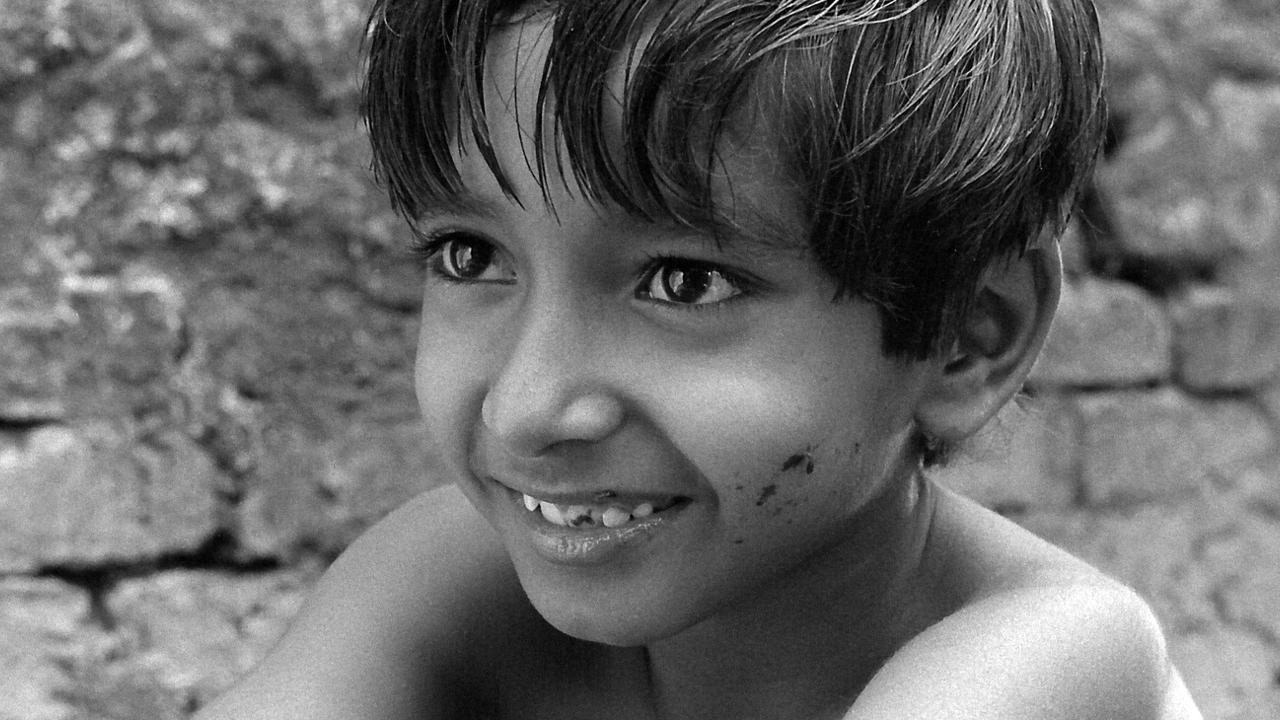
Director/Writer: Satyajit Ray · Cinematographer: Subrata Mitra · Editor: Dulal Dutta · Composer: Ravi Shankar · Art Director: Bansi Chandragupta · Key Cast: Subir Banerjee (Apu), Uma Dasgupta (Durga), Kanu Banerjee (Harihar), Karuna Banerjee (Sarbajaya), Chunibala Devi (Indir Thakrun) · Runtime: 125 minutes · Format: 35mm, black and white · Language: Bengali · Producer: Government of West Bengal · Budget: ~₹150,000 (~US$45,000)
1. Pather Panchali: A Song of the Road That Changed How the World Sees India
Before Pather Panchali, the Western world had no idea what Indian cinema could be. After it, the conversation was permanently altered.
Satyajit Ray’s debut tells the story of a poor Bengali family: Harihar, an impractical Brahmin priest and aspiring playwright; his exhausted wife Sarbajaya, holding the household together on almost nothing; their wilful daughter Durga; their wide-eyed son Apu; and old Indir, the ancient aunt whom the family can barely afford to feed. They live in a crumbling house in a village that is slowly forgetting them. The father leaves to find work. The mother stays and suffers. The children discover the world. The aunt dies. The daughter dies. The family leaves. That is the plot. It is also, in some sense, the plot of every human life: birth, wonder, loss, departure.
What Ray achieves with this material is not social realism in the documentary sense, though Italian neorealism was his primary influence. It is something richer: a realism of attention. He films a caterpillar crawling across a leaf with the same care he films a mother weeping over her dead daughter. A water insect skimming a pond receives the same compositional precision as the family’s most devastating argument. This equality of attention is Ray’s signature and his deepest moral statement. Nothing in the world is too small to be seen. Nothing in the life of the poor is too ordinary to be beautiful.
The film was made under conditions that would have defeated most directors. Ray was an advertising art director with no filmmaking experience. His cinematographer, Subrata Mitra, was twenty-one and had never operated a film camera. The budget was so small that shooting stretched over nearly three years because money kept running out. Ray pawned his wife’s jewellery to fund the early footage. No producer would touch the project because it had no stars, no songs, and no action. The West Bengal government eventually provided a loan to complete the film, which premiered at the Museum of Modern Art in New York in May 1955 before opening in Calcutta to acclaim that has never dimmed.
Verdict: 10/10. One of the supreme works of art in the history of cinema. It is proof that a film can be made with almost nothing and contain almost everything.
2. Subrata Mitra at Twenty-One: The Invention of Natural Light
Subrata Mitra had never operated a motion picture camera when Ray hired him to shoot Pather Panchali. He was twenty-one years old, trained as a stills photographer, and his primary qualification was that he had spent months watching Jean Renoir work on The River in Calcutta in 1951, taking notes from the sidelines. Ray, who had also observed Renoir at work, later speculated that he chose Mitra precisely because the young man had no established habits to unlearn. They could invent their approach together.
What Mitra achieved with this freedom is one of the great visual accomplishments in cinema. The film was shot almost entirely on location in Boral, a village near Calcutta, using available light. The interiors, lit by whatever sun came through the windows, have a soft, diffused quality that feels completely natural: you see the dust in the air, the way shadows pool in corners, the warmth of afternoon light on a mud wall. There is no sense of studio illumination. The poverty of the setting is not dramatised through dark, oppressive lighting. It is presented in the same warm, equitable light that falls on every house in Bengal, rich or poor.
During the shooting of the sequel, Aparajito, Mitra would formalise this approach into a technique he called “bounce lighting”: reflecting artificial light off white cloth to simulate the quality of diffused daylight. The technique, born of necessity (bad weather had forced outdoor scenes indoors), became standard practice worldwide. But in Pather Panchali, the technique does not yet exist in its codified form. What exists is something rawer and more beautiful: a young cameraman responding intuitively to the light he found, using it as it was, trusting that reality was enough.
Mitra’s framing shares this quality of responsive intelligence. The compositions are never showy. Characters are placed within their environment, not extracted from it. When Apu and Durga run through a field of kash flowers, Mitra lets the tall white grasses fill the frame, the children emerging through them like swimmers breaking the surface of water. When Sarbajaya sits alone after learning of Durga’s death, Mitra holds a medium shot that includes the empty courtyard, the walls, the silence. He does not push in for a close-up. He does not isolate her grief from its context. He shows a woman in a place, and the place is part of the grief.
3. Amateurs, a Retired Actress, and the Most Natural Child Acting in Cinema
Ray cast Pather Panchali almost entirely with non-professionals. No established actor would have accepted the fee, and Ray had no interest in the polished performance styles of commercial Indian cinema. He wanted faces that belonged to the world the film depicts. He got them, and several of the performances he drew from his amateur cast rank among the finest in the medium.
Subir Banerjee, who plays Apu, was a neighbourhood boy spotted by Ray’s wife. He had no training and no ambition to act. What he brought was the thing no training can produce: the capacity to be genuinely present, to look at the world with real curiosity rather than performed wonderment. His Apu does not act like a child in a movie. He acts like a child. The distinction is everything. When he watches a puppet show through a gap in a fence, his fascination is not constructed for the camera. He is fascinated. When he first sees a train, his face registers astonishment that no direction could manufacture. Ray understood that the best child performances are not performances at all. They are acts of observation, captured by a camera that knows when to be still.
Uma Dasgupta’s Durga is the film’s most complex characterisation. She is wilful, mischievous, generous, and possessed of a physical vitality that the film both celebrates and, eventually, destroys. Dasgupta plays her with a freedom that suggests Ray gave her room to move and let the camera follow. Her Durga steals fruit. She teases Apu. She dances in the rain. Each of these actions is performed with the unselfconsciousness of a child who does not know she is being watched, and the accumulation of these small, vivid moments is what makes her death so devastating. We do not mourn a character. We mourn a specific girl whose specific movements we have come to know.
Chunibala Devi, who plays Indir Thakrun, the ancient aunt, was a retired stage actress living in poverty in Calcutta when Ray found her. She was in her eighties, frail, nearly forgotten by the profession she had served. Her performance is one of the most remarkable in Indian cinema: a portrayal of old age, hunger, and marginalisation so authentic that it ceases to feel like acting. Indir’s scenes have the quality of documentary: a real old woman, eating stolen fruit, shuffling through a village that has no place for her, dying in a field while the world continues around her. Devi died shortly after the film’s release. Pather Panchali preserved her, the way cinema preserves the people it pays attention to.
4. Through the Kash Field: The Train, the Children, and the Filming of Wonder
Apu and Durga hear a sound. They run. Through the village, across a field of kash flowers, the tall white grasses whipping past them, the camera tracking alongside in a lateral movement that transforms their run into a kind of flight. They reach the far edge of the field. They stop. In the distance, beyond the tree line, a train passes. Smoke rises. The engine’s whistle sounds. They watch.
This is the scene that made Pather Panchali famous, and its power resides in a quality that critics have called the “epiphany of wonder.” Ray films two children seeing a train for the first time, and he does it in such a way that the audience sees a train for the first time alongside them. The familiar becomes miraculous. The everyday becomes revelatory. This is not a special-effects sequence. It is a child’s face and a distant engine and the vast, flat landscape between them. The wonder is not in the object. It is in the act of seeing.
Mitra’s framing is essential to the effect. He shoots the kash field at the children’s eye level, so that the grasses tower above them and the world becomes a forest of white plumes through which they must navigate. When they emerge on the other side, the horizon opens up and the train appears as a small, dark line trailing smoke. The contrast between the intimate, enclosed space of the field and the sudden openness of the vista is what produces the feeling of discovery. The children have crossed a boundary. On the other side is something they have never seen: speed, machinery, modernity. The life they know is behind them, and the life they will eventually join is ahead, passing through their village without stopping.
Ray returns to the train motif throughout the Apu Trilogy. In each film, trains mark transitions: departures, arrivals, the passage of time. But the first sighting, in Pather Panchali, is the purest. The children do not yet know what the train means. They do not know that it will eventually carry them away from everything they have known. They stand in the field and watch, and what the camera records is the exact moment before knowledge replaces innocence. It is one of the great shots in cinema because it captures something that cannot be repeated: the first time.
5. Durga in the Rain: The Sequence That Breaks the World Open
Durga dances in the rain. This is a moment of joy. She has been established throughout the film as a girl of physical energy and defiance, and the monsoon is her element: she runs into it, lifts her face, lets the water pour over her. Mitra films her in the downpour with a documentary immediacy that makes the rain feel like a character. You can hear it. You can almost feel it.
Durga catches a fever. She does not recover. She dies.
Ray does not show the death itself. He shows Sarbajaya wrapping her daughter’s body. He shows Harihar, who has been away for months, returning to discover what has happened. Karuna Banerjee’s performance in this scene is one of the most harrowing in cinema: a mother who cannot speak, whose grief is expressed entirely through her body and through a wail that rises from somewhere deeper than acting technique can reach. Harihar collapses. The room is dark. Rain continues outside. The scene is unbearable because it is so specific. This is not a generalised image of suffering. It is this mother, this father, this girl, this house, this rain.
The connection between the rain and the death is not symbolic in any heavy-handed sense. Ray does not present the monsoon as a punishment or a metaphor. He presents it as a fact of life in rural Bengal: rain comes, children play in it, sometimes children die. The cruelty is not in the rain. It is in the coincidence, the terrible randomness that links a moment of joy to a moment of annihilation. Durga was alive and dancing. Then she was not. The world did not adjust itself. The rain continued.
Shankar’s score for this sequence, based on the raga Todi, is among the most emotionally precise pieces of film music ever composed. The sitar does not weep. It holds a sustained, sombre tone that gives the audience space to feel without telling them what to feel. The restraint is characteristic of the entire film: Ray and Shankar trust the image. They do not supplement it. They accompany it, the way a friend sits beside someone who is grieving and does not speak.
6. Ravi Shankar’s Sitar and the Sound of Bengal’s Soul
Ravi Shankar composed the score of Pather Panchali using classical Indian ragas, each chosen for its traditional emotional associations. Desh, associated with rain and the monsoon, accompanies the scenes of the Bengali countryside in its wet season. Todi, a morning raga of serious, introspective character, scores Durga’s death. Patdeep, played on the tar shehnai by Dakshina Mohan Tagore, accompanies the scene where Harihar learns of his daughter’s death. The ragas are not arbitrary. They carry centuries of accumulated emotional meaning, and Ray uses them the way a European filmmaker might use a Bach cantata: as vessels of feeling that exceed what any composed-for-film score could achieve.
The soundtrack is sparse. Long stretches of the film play without music, relying instead on the ambient sounds of the village: birdsong, insects, the creak of bamboo, children’s voices, the distant clang of a temple bell. When Shankar’s sitar enters, it enters as a specific event, and its presence transforms the scene it accompanies. The first notes of the sitar in the film sound like a voice joining a conversation that has been conducted in whispers. The instrument’s timbre, bright and slightly melancholy, becomes the film’s emotional signature: the sound of beauty and impermanence held in the same phrase.
Shankar was not yet internationally famous when he composed this score. His later renown, which would include collaborations with George Harrison, performances at Woodstock, and a Grammy-winning career, began in part because of the global visibility that the Apu Trilogy gave him. The trajectory is fitting: the music found the film, and the film found the world, and the world, hearing Shankar’s sitar for the first time, recognised something it had never known it was missing.
7. The Rhythm That Nature Dictated: Time in Pather Panchali
Ray described his approach to pacing with characteristic directness: “The cinematic material dictated a style to me, a very slow rhythm determined by nature, the landscape, the country.” This statement is more precise than it might appear. The film does not choose to be slow the way an art-house film might choose slowness as an aesthetic posture. It is slow because rural Bengal in the 1920s was slow. Time in the village is not measured by deadlines or appointments. It is measured by seasons, by meals, by the length of an afternoon when there is nothing to do except exist.
Ray films this existence without compressing it. When Apu sits on the front step of the house and watches the world go by, the camera sits with him. When the sweet-seller passes through the village, the film follows his entire progress, the sound of his bell receding gradually as he moves away. When Indir walks slowly through the village, her footsteps marking the rhythm of the scene, Ray does not cut to accelerate her journey. He lets her walk at the speed she walks, which is the speed of an old woman with nowhere to go.
This is not the extended duration of Tarkovsky, where time becomes a spiritual practice. It is the duration of lived experience, unedited and unaccelerated. The effect is cumulative rather than individual. No single scene in Pather Panchali is difficult to sit through. But the accumulation of many scenes observed at the pace of life creates a texture that commercial cinema almost never achieves: the feeling that you are not watching a story but inhabiting a place. When the family leaves the village at the film’s end, the departure is devastating partly because of the narrative events that preceded it and partly because you have spent two hours living in this village at its own speed, and leaving it feels like leaving somewhere real.
8. From Bicycle Thieves to Boral: Neorealism and the Birth of Parallel Cinema
Ray has spoken openly about the influence of Italian neorealism on Pather Panchali. A screening of Vittorio De Sica’s Bicycle Thieves in Calcutta in 1948 convinced him that cinema could tell stories about ordinary people in real locations with non-professional actors and achieve an emotional power that studio productions could not match. Jean Renoir’s The River, shot in Calcutta in 1951, confirmed the lesson. Ray served as an assistant director on Renoir’s film and observed the French master’s method at close range: his naturalistic lighting, his respect for locations, his willingness to let scenes breathe.
But Pather Panchali is not an imitation of neorealism. The Italian films that inspired Ray are urban, political, focused on the systemic causes of poverty. De Sica’s Rome is a city that has failed its citizens. Ray’s Bengal is not a failed system. It is a world, full of beauty and cruelty and indifference, and poverty is one of its conditions, not its defining characteristic. Where neorealism tends toward social critique, Ray tends toward something closer to lyrical humanism: a vision of life in which suffering and joy coexist in the same frame, the same scene, the same person.
This distinction matters because it defines the movement that Pather Panchali launched. Indian parallel cinema, the loose grouping of art-house filmmakers who emerged in the 1950s and 1960s as an alternative to the commercial Bollywood system, took Ray’s example as its founding text. Mrinal Sen, Ritwik Ghatak, and the generation that followed understood from Ray that Indian stories could be told with the formal sophistication of European cinema without surrendering their cultural specificity. The train that Apu sees in the kash field is a train in Bengal, not a train in Rome or Paris. Its significance is local. Its impact is universal. That combination is what Ray gave to Indian cinema, and it has never been taken back.
9. Pawned Jewellery, Three Years, and a Government Loan: How the Film Got Made
No producer in Calcutta would finance Pather Panchali. The project had no stars, no songs, no dance numbers, no action sequences. It was based on a literary novel by a Bengali author known primarily to readers, not to film audiences. Its director was an advertising art director with no filmmaking credentials. Its cinematographer was a twenty-one-year-old who had never touched a motion picture camera. Everything about it signalled commercial failure.
Ray began shooting on October 27, 1952, using his personal savings. When those ran out, he borrowed from friends. When that ran out, he pawned his wife Bijoya’s jewellery. When that ran out, he sold her life insurance policy. Shooting became intermittent: a few weeks of filming when money appeared, then months of waiting while Ray returned to his advertising job and tried to raise more funds. The process dragged on for nearly three years. The production was so precarious that the village of Boral, where exterior scenes were filmed, changed visibly between shooting periods. Trees grew. Walls crumbled. The child actors aged.
The West Bengal government, persuaded by early footage that the film had artistic merit, eventually provided a loan that allowed Ray to complete post-production. The film was rushed to completion in time for a screening at the Museum of Modern Art in New York, part of an exhibition on Indian art and culture. It arrived without subtitles, billed as “The Story of Apu and Durga.” The MoMA audience, who had come for an exhibition of textiles and ornamental arts, watched a Bengali film about a poor family and were astonished.
The paradox of the production is that the poverty of its making became one of its greatest assets. The film looks the way it does because Ray could not afford to make it look any other way. The natural light, the real locations, the amateur actors, the ambient sound: all of these are products of necessity that became aesthetic choices. What Ray proved, with irreversible force, is that the relationship between budget and quality in cinema is not linear. You do not need money to make a great film. You need vision, patience, and the stubbornness to continue when every reasonable calculation says you should stop.
10. The Apu Trilogy and the Filmmaker Who Emerged from Nothing
Pather Panchali is the first panel of a triptych. Aparajito (1956) follows Apu through adolescence and education. The World of Apu (1959) follows him into marriage, fatherhood, and the beginnings of artistic consciousness. Together, the three films constitute one of the great narrative achievements in cinema: a single life, observed from childhood to adulthood, with a consistency of vision and a depth of compassion that make the trilogy feel less like three films than like one continuous act of attention spanning a decade.
Ray did not originally plan a trilogy. Pather Panchali was conceived as a standalone film. Its success, both critical and commercial, created the opportunity to continue Apu’s story, and Ray recognised that the character and the world he had built could sustain further exploration. Each subsequent film is formally distinct: Aparajito is more structured, more urban, more concerned with the tension between tradition and modernity. The World of Apu is more intimate, more romantic, more focused on the inner life of a man who has begun to write. The trilogy’s arc traces not only Apu’s growth but Ray’s own development as a filmmaker, from the naturalistic lyricism of Pather Panchali to the more controlled, psychologically complex work of the later films.
Ray went on to direct thirty-six films over a career spanning nearly four decades. He received an Honorary Academy Award in 1992, presented to him in his hospital bed by Audrey Hepburn. He died shortly afterward. Martin Scorsese, who championed Ray’s work throughout his career, said that “without a doubt, in Ray’s films the line between poetry and cinema dissolved.” The dissolution began here, in Boral, with a boy and his sister running through a field of white flowers toward a train they had never seen.
11. From MoMA to the World: Reception and Legacy
Pather Panchali won the Best Human Document award at the 1956 Cannes Film Festival, a prize created specifically for the occasion. It went on to collect eleven international prizes and was nominated for the BAFTA for Best Film. Its success was unprecedented for Indian cinema: no Indian film had previously achieved significant international distribution or critical recognition.
In India, the response was more complex. The Calcutta premiere was enthusiastically received, and the film ran for extended engagements in Bengal. But its relationship to the Indian mainstream was never comfortable. Commercial Indian cinema, with its songs, dances, and melodramatic narratives, regarded Ray’s naturalistic approach with suspicion. Some critics accused him of exporting poverty, of showing Western audiences the India they wanted to see rather than the India that existed. Ray’s response was characteristically measured: he was not interested in selling India to anyone. He was interested in telling a story about a family, and the family happened to be poor.
The film’s critical standing has been remarkably stable. Sight & Sound’s critics’ poll has ranked it among the greatest films ever made in every edition since 1962. In the 2022 poll, it placed thirty-fifth overall. The Apu Trilogy, considered as a single work, would rank considerably higher. Academic study of the film spans disciplines: it is taught in film schools, literature courses, postcolonial studies programmes, and courses on South Asian culture. Its influence on subsequent Indian filmmakers, from Mrinal Sen to Mira Nair to the contemporary Bengali art-house tradition, is foundational and ongoing.
What Pather Panchali proved, and what no subsequent development in cinema has disproved, is that a film made with no money, no stars, no technical experience, and no industry support can be one of the greatest works of art ever produced. The barriers to entry in cinema are lower than the industry claims. All you need is something worth seeing and the willingness to see it clearly.
12. What the Little Road Shows You the Second Time: A Rewatchability Guide
Pather Panchali rewards rewatching not with hidden plot details but with accumulated emotional knowledge. Here is where to look.
Watch the edges of the frame. Ray’s compositions include environmental details that are easy to overlook on a first viewing: animals moving in the background, light shifting on a wall, the distant sound of a temple bell that places the scene in a specific time of day. On a rewatch, let your eye drift to the margins. The village is alive in the edges, and the life at the edges is what makes the central drama feel inhabited rather than staged.
Track Sarbajaya. Karuna Banerjee’s performance as the mother is the film’s most sustained piece of acting, and much of it is conducted in the background of scenes that focus on other characters. On a rewatch, watch her face when she is not the centre of attention. She is carrying the weight of the household in every scene, and the accumulation of small gestures of exhaustion, frustration, and suppressed tenderness constitutes one of the great portraits of motherhood in cinema.
Listen to the silence before the sitar. Shankar’s score is sparse, and the long stretches without music are as carefully composed as the musical passages. On a rewatch, notice how the ambient soundscape of the village changes across the film: denser and more alive in the early scenes, quieter and emptier after the deaths. The village sounds are telling you what has been lost before the narrative does.
Watch Indir’s last walk. Chunibala Devi’s final scene, in which the old aunt leaves the house for the last time and wanders into the countryside, is filmed at the pace of her own movement. On a second viewing, the slowness of this scene acquires a weight it did not have the first time. You know she will not return. The camera knows it too. It follows her with a patience that is itself a form of mourning.
Return to the train. On a first viewing, the train scene is a moment of pure wonder. On a second, it is a foreshadowing. The train that fills Apu and Durga with amazement is also the machine that will carry the family away from their home. The wonder and the loss are contained in the same image. On a rewatch, notice Durga’s face alongside Apu’s. She is watching with equal fascination, but she will not live to ride the train. The scene, seen with this knowledge, transforms from a celebration of discovery into something closer to an elegy.
Film Trivia
The wife who financed Indian cinema’s greatest debut. When every producer in Calcutta refused to fund Pather Panchali, Ray turned to his wife Bijoya. He pawned her jewellery and later sold her life insurance policy to keep the production alive. Bijoya supported the film throughout its three-year production without complaint, a sacrifice that Ray acknowledged for the rest of his life. The most important Indian film ever made exists because one woman believed in it enough to give up everything she owned.
The actress who was found and lost. Chunibala Devi, who plays the ancient aunt Indir Thakrun, was a retired stage actress living in near-destitution in Calcutta’s Pike-Para Lane when Ray discovered her. She was in her eighties and had been largely forgotten by the theatre community. Her performance in Pather Panchali is widely regarded as one of the most remarkable in Indian cinema. She died shortly after the film’s release, and the film remains the only significant record of her art. Ray did not find a character. He found a person whose life already contained the character.
The boy who never acted again. Subir Banerjee, who plays Apu, was a neighbourhood child with no acting experience and no interest in the profession. Ray’s wife spotted him and suggested he be auditioned. After completing Pather Panchali, Banerjee did not pursue acting. A different boy, Pinaki Sengupta, played Apu in the sequel Aparajito, and a third actor, Soumitra Chatterjee, played the adult Apu in The World of Apu. Banerjee’s performance remains one of the most celebrated child performances in cinema history, achieved by a boy who simply showed up, was himself, and then returned to his ordinary life.
The raga that knew its purpose. Ravi Shankar chose each raga in the score for its traditional emotional associations. The raga Desh, associated with the monsoon and the feeling of longing for home, accompanies the scenes of the Bengali countryside. For the scene where Harihar learns of Durga’s death, Shankar selected Patdeep, played on the tar shehnai, an instrument whose nasal, plaintive tone is traditionally associated with grief and separation. The score was not composed to match the emotion of each scene. It was selected from centuries of musical tradition that had already encoded those emotions.
This entry selects analytical dimensions that Pather Panchali earns through its foundational importance, its visual and musical beauty, and its transformative impact on world cinema. Three wildcard sections exist because the film demands them: “Through the Kash Field” (because the train scene is one of cinema’s defining images of wonder and requires standalone analysis of how Ray constructed it), “Durga in the Rain” (because the death sequence is the film’s emotional and structural climax, and its relationship between joy and annihilation cannot be folded into a broader discussion without diminishing it), and “The Rhythm That Nature Dictated” (because Ray’s approach to cinematic time, shaped by landscape and season rather than narrative convention, constitutes a formal contribution that influenced filmmakers worldwide). A standalone awards section is omitted because the recognition history is addressed within the reception discussion. Production-design and costume sections are omitted because the film’s visual world is inseparable from Mitra’s cinematography and the reality of the locations themselves.

Leave a Reply