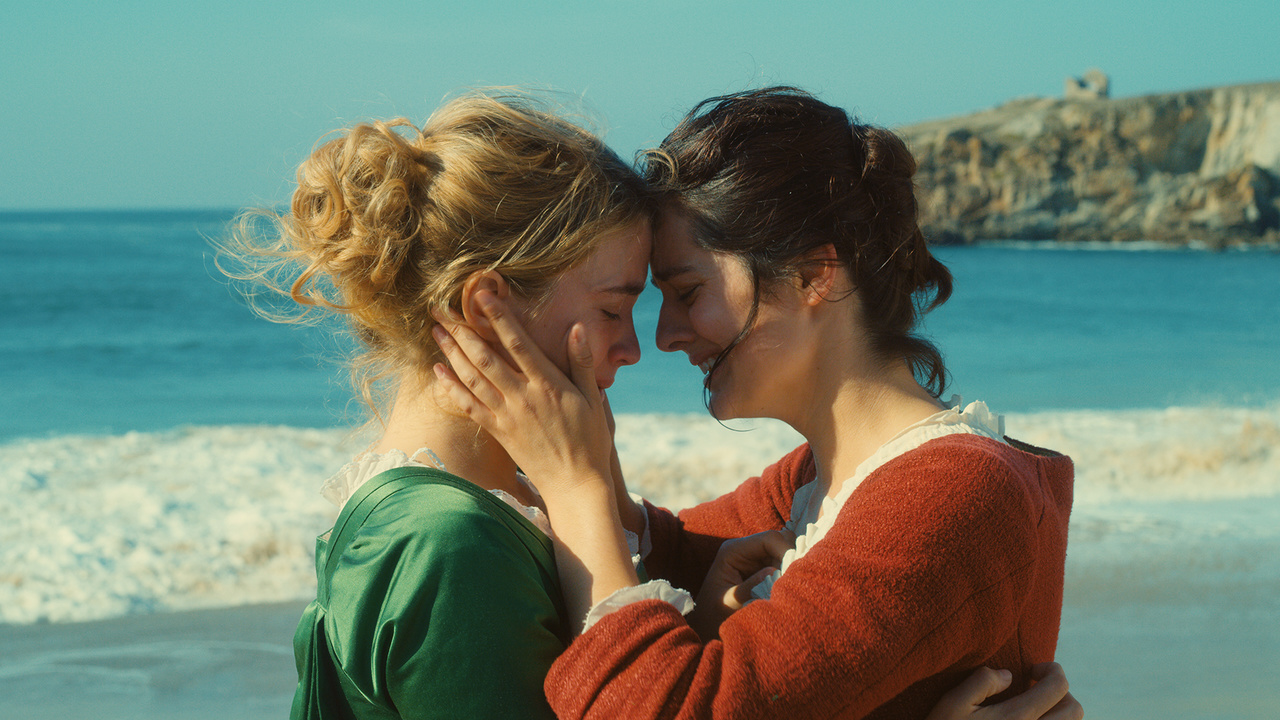
Director/Writer: Céline Sciamma · Cinematographer: Claire Mathon · Editor: Julien Lacheray · Music: Para One & Arthur Simonini · Paintings: Hélène Delmaire · Key Cast: Noémie Merlant (Marianne), Adèle Haenel (Héloïse), Luàna Bajrami (Sophie), Valeria Golino (The Countess) · Runtime: 122 minutes · Studio: Lilies Films / arte France Cinéma · Budget: €4.86 million · Box Office: ~$26 million worldwide
1. Portrait of a Lady on Fire: The Most Precise Film Ever Made About the Act of Looking
Marianne is a painter. She has been commissioned to produce a wedding portrait of Héloïse, a young aristocrat who refuses to sit for the painting because sitting would mean accepting the marriage. So Marianne must observe Héloïse in secret: memorise her face during their walks on the Breton cliffs, then return to the studio to paint from memory. She must look without being seen to look. She must study a face that does not know it is being studied.
This is the premise of a love story, and it is also the premise of cinema itself. A camera studies a face. The face does not know it is being studied, or pretends not to. The person behind the camera falls in love with the image, and the image, eventually, looks back. Céline Sciamma has built her entire film around this parallel, and the result is one of the most intellectually rigorous and emotionally devastating romances ever put on screen.
Portrait of a Lady on Fire takes place on an island off the coast of Brittany in 1770. There are almost no men in the film. The Countess (Valeria Golino) departs early, leaving Marianne, Héloïse, and the maid Sophie (Luàna Bajrami) alone in the house. What follows is a self-contained world of women: painting, cooking, reading, walking on cliffs, discussing Orpheus, assisting with an abortion, falling in love. The absence of men is not a political statement imposed on the narrative. It is the condition that makes everything else possible. Without the male gaze, without the structures of patriarchal observation, these women are free to look at each other. And looking, in this film, is the most intimate act imaginable.
Sciamma has called the film “a manifesto about the female gaze.” It earns that description. Every formal choice serves the argument: the cinematography, which treats every frame as a portrait; the near-total absence of non-diegetic music, which forces the audience to attend to faces and silences rather than emotional cues; the Orpheus myth, which provides the structural metaphor; the final shot, which may be the most devastating closing image in twenty-first-century cinema. Nothing is accidental. Nothing is decorative. The film is a demonstration of what cinema can do when every element is aligned in service of a single question: what does it mean to truly see another person?
Verdict: 10/10. A perfect film. Not a frame is wasted, not a beat is missed, and the final minutes will leave you as wrecked as any spectacle ever could, using nothing more than a woman’s face and a piece of music she did not choose to hear.
2. Claire Mathon and the Light That Comes from Inside the Face
Claire Mathon’s cinematography achieves something that few films have attempted and none have matched: it makes digital photography look like oil painting without sacrificing the intimacy of cinema. Shot on a RED MONSTRO 8K with Leitz THALIA lenses, the film captures skin, fabric, and firelight with a warmth and tactility that feel painted rather than photographed. This was deliberate. Mathon and Sciamma visited galleries to study portraits by female painters of the period, paying particular attention to how skin was rendered: its redness, its translucence, the way emotion manifests as colour before it manifests as expression.
The lighting strategy was radical in its simplicity. For the interior scenes, shot at the Château de La Chapelle-Gauthier (a historical monument that had never been restored, which gave it the authentic wear that polished period locations lack), Mathon lit from outside the windows, using flags and diffusion to shape the light so that it appeared to emanate from the faces themselves rather than from any visible source. No matter where the actresses moved, the light seemed to follow them, gentle, warm, without directionality. Mathon described her goal as eliminating the feeling of light altogether, as if the faces were glowing from within. The Bergman influence is explicit: Mathon and Sciamma re-watched Bergman’s films to study how he filmed women with proximity and intimacy. What they took from Bergman was not his compositions but his closeness. The camera in Portrait of a Lady on Fire does not frame faces. It inhabits the space between them.
The exterior scenes, shot on the Brittany coast, were meant to be overcast and grey. Instead, the weather provided unbroken sunshine. Sciamma embraced it. The coastal sequences are luminous, the cliffs and ocean rendered in rich greens, blues, and golds that contrast with the muted interiors. The effect is of two registers: the private, candlelit world of the house, where looking is furtive and loaded, and the open, sun-drenched world of the cliffs, where the women walk and their bodies exist in space without enclosure. Both registers are beautiful. Both serve the story. The light is not decoration. It is argument.
3. Merlant Watches, Haenel Burns: Two Performances That Refuse the Muse
Sciamma set out to dismantle the concept of the muse. In the traditional narrative, the muse is a passive, silent object whose beauty inspires the (male) artist. She does not create. She does not speak. She exists to be looked at. Portrait of a Lady on Fire inverts this entirely: Héloïse is not Marianne’s muse. She is her collaborator. The portrait changes as Marianne learns more about Héloïse, because the painting is not a record of appearance. It is a record of knowledge. And knowledge requires two people.
Noémie Merlant’s Marianne is defined by professional discipline and emotional restraint. She watches. She memorises. She returns to the studio and paints what she remembers, and the first version of the portrait is technically competent and emotionally dead. Héloïse sees it and says, with quiet devastation, “Is that how you see me?” The question cracks Marianne’s professional detachment. From that point, Merlant plays every scene as a woman who is trying to observe with professional accuracy while being slowly overwhelmed by what she sees. The tension between the painter’s discipline and the lover’s desire is visible in Merlant’s hands, in the way she holds a brush, in the way she does not quite look at Héloïse when Héloïse is looking at her.
Adèle Haenel’s Héloïse is a performance of gradual emergence. In her first scenes, she is closed, guarded, resistant. She walks with her hood up. She refuses to sit. She barely speaks. As the film progresses and the relationship deepens, Haenel opens Héloïse incrementally: a smile that lingers a fraction longer, a gaze held a beat past convention, a physical ease that replaces the early rigidity. The transformation is so gradual that you cannot identify the moment it begins. You can only look back and realise that the woman at the end of the film is not the woman at the beginning, and that the change happened in the space between glances.
This was Haenel’s final film role. She retired from the industry in 2023. The knowledge that this is her last performance adds a dimension of loss that the film itself already contains: the awareness that what you are witnessing is temporary, unrepeatable, and already ending.
4. “If You Look at Me, Who Do I Look At?”: The Female Gaze as Form
Héloïse asks Marianne this question early in the film, and it restructures everything. In conventional cinema, the person behind the camera looks, and the person in front of the camera is looked at. The gaze flows one way. The subject does not look back. Laura Mulvey theorised this in 1975 as the “male gaze,” a visual economy in which women exist as objects of male spectatorial pleasure. Sciamma does not merely reverse the gender of the gazer. She dismantles the one-way structure entirely.
In Portrait of a Lady on Fire, looking is reciprocal. When Marianne observes Héloïse in secret, Héloïse is also observing her. When Marianne paints, Héloïse watches her paint. The camera moves between their faces with the steady rhythm of a conversation, giving equal weight and equal screen time to each. Neither woman is the object. Both are subjects. The film’s visual design enforces this: Mathon frames them in compositions of careful balance, often facing each other across the frame, their eyes at the same height, their bodies occupying equivalent space. When one speaks, the camera does not cut away to show the listener’s reaction in a subordinate shot. It holds. It lets both faces exist simultaneously.
This is what Sciamma means by “the female gaze.” Not simply a woman behind the camera, but a restructuring of the visual economy so that looking becomes an act of mutual recognition rather than unilateral consumption. The film argues that portraiture, at its best, is this kind of looking: not the capture of an image but the creation of a relationship between the one who sees and the one who is seen. Marianne does not paint Héloïse. They paint each other. The portrait is not a product. It is a collaboration.
The implications extend beyond the film’s narrative. Sciamma is also describing the ideal relationship between filmmaker and audience: not consumption but exchange, not spectacle but attention. Portrait of a Lady on Fire asks its viewers to look the way Marianne looks, with patience, with curiosity, with the willingness to be changed by what they see.
5. Page 28: The Myth of Orpheus as the Film’s Hidden Architecture
Midway through the film, the three women read the story of Orpheus and Eurydice together. Sophie asks why Orpheus turns around. He has been told not to look back at Eurydice as he leads her out of the underworld. If he looks, she will be lost forever. He turns. She vanishes. Why?
Marianne offers an interpretation: he turns because he makes the choice of the poet, not the lover. He chooses the memory over the person. He chooses to see her one last time, knowing that the last look will be the last, and that the memory of that look will fuel his art forever. Héloïse offers a counter-interpretation: perhaps Eurydice said, “Turn around.” Perhaps the choice was hers. Perhaps she chose to be remembered rather than rescued.
This scene is the film’s structural key. The Orpheus myth organises the entire narrative. Marianne is Orpheus, the artist who must eventually turn and look, knowing that the look will end everything. Héloïse is Eurydice, the beloved who will be lost. The final act of the film plays out this myth with heartbreaking precision: Marianne turns. She sees Héloïse, in a white dress, standing in a doorway. Héloïse says, “Turn around.” Marianne does. When she looks back, Héloïse is gone. The myth has been completed. The artist has the memory. The lover is lost.
But Sciamma complicates the myth even as she enacts it. In the Orpheus story, the turn is a failure. In Portrait of a Lady on Fire, it is a choice. Héloïse asks Marianne to turn. She wants to be seen one last time. She wants the final image to be deliberate, not accidental. The turn is an act of collaboration, like the portrait: both women agree on the terms of the farewell. The memory that Marianne will carry is not stolen from life. It is given by the person she loves.
6. Silence, Vivaldi, and the Bonfire: What Happens When Music Finally Arrives
Portrait of a Lady on Fire contains almost no music. Sciamma decided early in the production to work without a conventional score. The effect is extraordinary: for the vast majority of the film’s two hours, the only sounds are voices, footsteps, wind, ocean, the scratch of charcoal on paper, the crackle of fire. The audience becomes hypersensitive to these textures. Every sound registers. Silence, in the film, is not the absence of something. It is the presence of attention.
This makes the two moments when music appears feel like physical events. The first is the bonfire scene. The women of the island gather at night around a fire. They begin to sing: a Latin chant, “Non possunt fugere” (“They cannot escape”), written by Sciamma and composed by Para One and Arthur Simonini for female choir with rhythmic clapping. The sound builds from a single voice to a full chorus, the harmonies layering and thickening until the music becomes a wall of female voices, ecstatic and solemn simultaneously. Marianne and Héloïse lock eyes across the fire. The hem of Héloïse’s dress catches a flame. She does not notice. She is on fire. The title manifests.
The second is the final shot. Years later. Marianne, seated in a concert hall, watches Héloïse across the auditorium. Héloïse does not see her. The orchestra plays the “Summer” movement of Vivaldi’s Four Seasons, the piece that Marianne once played for Héloïse on a harpsichord in the cottage. Héloïse listens. Her face moves through a sequence of emotions that Haenel plays without a single word: recognition, memory, grief, and something that might be joy or might be the final acceptance that joy is over. The camera holds on her face for the duration of the piece. She weeps. The film ends.
Sciamma understood that in a film without music, the arrival of music carries the force of revelation. The bonfire scene works because the silence before it has made the audience desperate to hear. The Vivaldi scene works because the silence after it, the hard cut to black, the absence of any epilogue or resolution, refuses to process the emotion for you. You are left with a face, a piece of music, and everything you have carried from the previous two hours. It is, measured by impact per formal element, one of the most efficient endings in cinema.
7. The Canvas and the Screen: What Portraiture Teaches Cinema About Looking
The paintings in Portrait of a Lady on Fire were created by the artist Hélène Delmaire, who worked closely with Merlant to develop the physical vocabulary of painting on camera: how to hold a brush, how to mix pigment, how to look at a subject with a painter’s analytical eye. Merlant studied with Delmaire before filming and performed many of the painting gestures herself. The result is a film in which the act of painting is not merely depicted but embodied. You believe that Marianne is a painter because Merlant moves like one.
But the film’s deeper interest is in what painting and cinema have in common and where they diverge. Both are arts of looking. Both translate the three-dimensional world into a two-dimensional surface. Both require the artist to make decisions about what to include and what to exclude. The difference is time. A painting freezes a single moment. Cinema unfolds across duration. Marianne must choose one expression, one angle, one quality of light, and commit it to canvas forever. Sciamma, filming Marianne’s process, can show the accumulation of looks that lead to that single choice.
This structural contrast illuminates the love story. Marianne’s task is to capture Héloïse in a single image that will represent her to a man she has never met, a stranger who will judge her suitability for marriage based on paint and canvas. The portrait is a transaction. But the process of creating it, the hours of looking, the incremental acquisition of knowledge about another person’s face, becomes something the portrait cannot contain. The finished painting is a record of appearance. The film is a record of falling in love. The distance between the two is the distance between the surface and everything beneath it.
Sciamma was explicit about dismantling the concept of the muse. In her formulation, the traditional muse is a construction that hides the model’s active participation in the creation of art. Héloïse does not merely sit. She reveals herself in stages, and each revelation changes the portrait. The painting is not what Marianne sees. It is what Marianne and Héloïse have built together, a collaboration between the one who looks and the one who chooses what to show.
8. A World Without Men: Equality, Abortion, and the Island as Temporary Utopia
The near-total absence of men from the film is not merely a narrative convenience. It is the condition that makes the story possible. On the island, with the Countess departed, three women live together in a state of domestic equality that their century does not permit. Marianne paints. Héloïse reads. Sophie cooks and cleans, but the class hierarchy between them softens as the days pass. They eat together. They play cards. They read aloud. They assist each other.
The abortion subplot, handled with extraordinary matter-of-factness, is central to this vision of female solidarity. Sophie is pregnant and does not want to be. Marianne and Héloïse accompany her through the process without judgment, without melodrama, without the moral hand-wringing that period films typically impose on this subject. Sophie lies on a bed. A local woman performs the procedure. Héloïse holds Sophie’s hand. The camera does not flinch. It does not dramatise. It witnesses. Sciamma then does something remarkable: she has Marianne paint the scene afterward, not as documentation but as art, incorporating Sophie’s experience into the visual record alongside the portrait of Héloïse. The abortion is not a subplot. It is an assertion of female autonomy that the painting, and the film, refuse to exclude.
The island is a temporary utopia, and the film knows it. The Countess will return. Héloïse will be married. Sophie will resume her position as servant. Marianne will leave. The freedom these women experience is borrowed, and its impermanence is part of its value. Sciamma does not pretend that the eighteenth century was kind to women. She shows, with aching specificity, what becomes possible in the brief intervals when the structures of control recede, and she lets the viewer carry the knowledge that those intervals always end.
9. From Girlhood to the 18th Century: Sciamma’s Arc
Céline Sciamma’s filmography before Portrait of a Lady on Fire is a compact series of films about girls and young women navigating identity, desire, and the social structures that constrain both. Water Lilies (2007) explores adolescent sexuality in a Parisian swimming club. Tomboy (2011) follows a ten-year-old who presents as a boy during a summer in a new neighbourhood. Girlhood (2014) tracks a Black teenager in the Parisian banlieues finding agency through a gang of girls.
Each film is small, precise, and attentive to the specific textures of female experience at different ages and in different social contexts. What connects them is Sciamma’s method: she builds her films around the act of observation, around the camera’s relationship to female faces and bodies, and she consistently centres the perspective of the person being looked at rather than the person doing the looking. By the time she arrived at Portrait of a Lady on Fire, this method had been refined into something approaching a theory of cinema.
The period setting was new territory. Sciamma has cited Barry Lyndon’s candlelit interiors as an influence, along with The Piano’s exploration of female agency through art, and Bergman’s close-up work with women. But the film does not feel like pastiche. It uses the eighteenth century not as a costume drama backdrop but as a laboratory: a setting in which the constraints on women’s autonomy are so explicit and so visible that the question of who gets to look and who gets to be looked at becomes inescapable. The period is not decoration. It is the argument made architectural.
10. Brittany, Candlelight, and a Castle That Hadn’t Been Restored
The exterior scenes were shot on the coast of Brittany, chosen for its dramatic cliffs and the quality of its coastal light. The interiors were shot at the Château de La Chapelle-Gauthier in Seine-et-Marne, a seventeenth-century castle that, unlike most châteaux available for filming, had not been restored or used for weddings and events. Its walls were worn. Its surfaces were authentic. It gave Mathon a set that did not need to be distressed or aged, because time had already done the work.
Lighting the château consumed a significant portion of the €4.86 million budget. The historical monument status of the building restricted where equipment could be placed, and Mathon’s approach, lighting from outside the windows to create the illusion of sourceless interior radiance, required elaborate setups of flags, diffusion, and LED ribbons. The candlelight scenes, inspired by Kubrick’s Barry Lyndon, used practical flames supplemented with carefully matched tungsten sources. Sciamma described the experience of filming inside the lit château as magical: “There was no light in the room, but it was so accurate.”
Sciamma and Mathon chose to shoot digitally rather than on film, a decision that surprised some critics given the period setting. Their reasoning was deliberately contemporary: 35mm, they felt, would create a timeless, classical texture that would distance the audience from the story. The RED 8K’s crisp resolution and dynamic colour range allowed them to capture the granularity of skin tones and the subtlety of candlelight with a precision that felt modern. The past, they argued, should not look old. It should look present. It should look like it is happening now.
11. The Masterpiece the Oscars Would Not See: Reception and Legacy
Portrait of a Lady on Fire premiered at the 2019 Cannes Film Festival, where it competed for the Palme d’Or. Sciamma won Best Screenplay, and the film won the Queer Palm, making Sciamma the first woman to receive the honour. Reviews were rapturous: Rotten Tomatoes registers a 97% score from over 340 reviews, and Metacritic gave it a 95, indicating universal acclaim.
France submitted a different film (Les Misérables) for the Best International Feature Film Oscar, a decision that was widely criticised and that many attributed to the César establishment’s discomfort with the film’s queer content, Sciamma’s feminism, or both. At the César Awards themselves, where the film received ten nominations, it won only Best Cinematography, an evening overshadowed by controversy over the ceremony’s other honourees. The Oscar snub and the César outcome became a story about institutional bias, and that story has, fairly or not, become part of the film’s legacy.
The critical consensus, by contrast, has only solidified. Portrait of a Lady on Fire appears routinely on lists of the best films of the 2010s and the best films of the twenty-first century. It has become a touchstone for discussions of the female gaze in cinema, for queer representation in period film, and for the formal possibilities of working without a conventional score. Its influence on subsequent filmmaking is already visible in the way certain directors approach the close-up, the relationship between painter and subject, and the use of silence as a compositional tool.
Haenel’s retirement from acting in 2023 gives the film an additional weight. This is her final screen performance, and it is among the finest of the century. What was always a film about impermanence and loss has acquired, outside its frame, another layer of the same: a woman who set fire to a screen and then walked away from the industry, leaving only the portrait.
12. The Final Shot and What It Contains: A Rewatchability Guide
Portrait of a Lady on Fire is a film that deepens on every viewing. Here is where to look.
Watch the first portrait, then the second. Marianne paints Héloïse twice. The first portrait, created from covert observation, is technically accurate and emotionally vacant. The second, painted after Héloïse agrees to sit and after the two women have fallen in love, is alive. On a rewatch, compare the two not for compositional differences (they are subtle) but for what Merlant’s body language tells you about the difference between painting someone you are studying and painting someone you know.
Track Héloïse’s hands. Haenel uses her hands throughout the film as an indicator of emotional state. Early scenes: hands clasped, hidden in fabric, withdrawn. Middle scenes: hands reaching, touching objects, opening. Late scenes: hands on Marianne’s body, on paint, on paper. The progression is never emphasised by the camera. It happens in the periphery of scenes about other things. On a second viewing, the hands become a parallel narrative.
Listen to the ocean. In the absence of a score, the ocean functions as the film’s ambient emotional register. It is loud and crashing during scenes of tension. It is distant and rhythmic during scenes of intimacy. It withdraws almost entirely during interior scenes, where silence and firelight replace the outdoor world. Track the ocean’s presence and absence. It is as carefully designed as any score.
Count how many times they look at each other simultaneously. In the first half of the film, Marianne looks at Héloïse while Héloïse looks away. The relationship is one-directional. At a specific point in the narrative, Héloïse begins to look back. From that moment, their gazes meet, and the film’s visual structure shifts from observation to reciprocity. Identifying the exact moment this shift occurs is one of the most rewarding exercises a rewatch can offer.
Sit through the final shot without looking away. On a first viewing, the Vivaldi scene is devastating because of its emotional surprise. On a second, it is devastating because of its precision. Every element of the film converges in Haenel’s face: the music Marianne once played for her, the act of looking that defined their relationship, the memory that has replaced the person, and the knowledge that this is the last time we will see this actress on screen. The shot lasts exactly as long as it needs to. Not a frame more.
Film Trivia
The dress that actually caught fire. During the bonfire scene, Haenel’s dress genuinely caught a flame. The moment was unplanned but not dangerous, as the costume department had flame-retardant measures in place. Sciamma kept the take. The accident gave the film its title image: the lady, literally on fire, looking across the flames at the woman she loves. Sometimes cinema gives you a metaphor you did not ask for.
The painter who refused to pose. The paintings in the film were created by artist Hélène Delmaire, who worked closely with Merlant to develop the physical technique of painting on camera. Haenel, however, refused to pose for the actual paintings, as she hated being static. Delmaire painted from photographs of Haenel instead, which adds a layer of irony to a film about the politics of posing: the actress playing the woman who refuses to sit for a portrait also refused to sit for the paintings that represent that portrait.
The song Sciamma wrote. The bonfire chant, “Non possunt fugere” / “Nos resurgemus” (“They cannot escape” / “We rise”), was written by Sciamma herself and composed by Para One and Arthur Simonini. They researched eighteenth-century music but ultimately recommended to Sciamma “a modern sound” inspired by Ligeti’s Requiem. The resulting piece, scored for female choir a cappella with rhythmic clapping, sounds like it could belong to any century. Sciamma intended this temporal ambiguity: the women singing around the fire are not performing a period piece. They are performing solidarity.
Page 28. In the scene where the three women discuss the Orpheus myth, Héloïse asks Marianne to turn to page 28 in the book. The number recurs throughout the film: it is the page on which Orpheus makes his choice. Sciamma embedded it as a structural marker. On a rewatch, look for the number 28 in unexpected places. It appears more often than you think, and each appearance is a reminder that the choice is coming.
This entry selects analytical dimensions that Portrait of a Lady on Fire earns through its formal precision, its intellectual ambition, and the depth of its central performances. Three wildcard sections exist because the film demands them: “If You Look at Me, Who Do I Look At?” (because the film’s restructuring of the cinematic gaze is a formal innovation that cannot be reduced to a technique within the visual-craft discussion), “Page 28” (because the Orpheus myth is not merely referenced but structurally embedded, governing the film’s narrative arc and its climactic choices), and “Silence, Vivaldi, and the Bonfire” (because the near-total absence of music and the devastating impact of its two appearances constitute a compositional strategy that requires standalone examination). A standalone production-design section is omitted because the visual world of the film is inseparable from Mathon’s cinematography and is addressed within that discussion. An awards section is folded into reception because the story of what the film did not win is inseparable from the story of what it means.

Leave a Reply