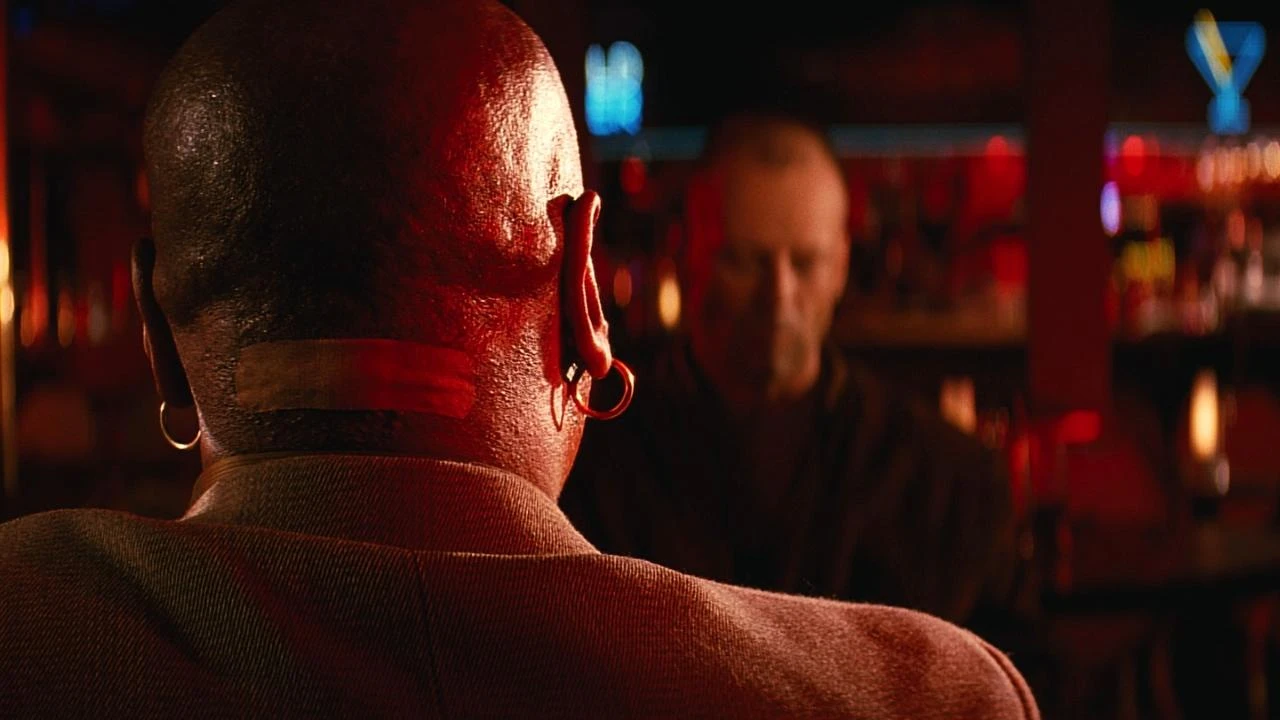
Director/Writer: Quentin Tarantino (story by Tarantino & Roger Avary) · Cinematographer: Andrzej Sekuła · Editor: Sally Menke · Production Designer: David Wasco · Costume Designer: Betsy Heimann · Key Cast: John Travolta (Vincent Vega), Samuel L. Jackson (Jules Winnfield), Uma Thurman (Mia Wallace), Bruce Willis (Butch Coolidge), Tim Roth (Pumpkin), Amanda Plummer (Honey Bunny), Ving Rhames (Marsellus Wallace), Harvey Keitel (The Wolf), Christopher Walken (Captain Koons) · Runtime: 154 minutes · Studio: Miramax Films / A Band Apart / Jersey Films · Budget: $8 million · Box Office: $213.9 million worldwide
1. Pulp Fiction: The Film That Reshuffled American Cinema and Dealt It Again
Two hitmen talk about hamburgers on the way to kill someone. A boxer double-crosses a crime lord over a fixed fight. A gangster’s wife overdoses on heroin and is revived with an adrenaline needle to the heart. A pair of amateur bandits rob a diner. These events are told out of order, looping back and forward through time, so that a man who is dead in one scene is alive in the next, and the film’s final image is two killers walking out of a restaurant in which they have just experienced what might be a divine intervention.
Pulp Fiction is a film about nothing and everything. Its plot, if straightened into chronological order, is unremarkable: gangsters do gangster things, people die, some are saved. What Tarantino does with this material is what makes it one of the defining American films of its century. He takes the conventions of crime fiction, the pulp magazines and hardboiled novels that the title references, and submits them to a formal rearrangement so audacious that the act of reshuffling becomes the story. The film is not about what happens. It is about the order in which you learn what happened, and the way that order transforms meaning.
The result is a film that operates simultaneously as a crime thriller, a black comedy, a philosophical argument about redemption and chance, and a love letter to the history of American pop culture. Tarantino’s characters discuss foot massages with the same intensity that other film characters reserve for life-and-death decisions, because in Tarantino’s world, the texture of ordinary conversation is more interesting than the mechanics of plot. The film’s most celebrated scenes are not its acts of violence. They are its acts of talk: Vincent and Jules debating the significance of a Quarter Pounder with Cheese, Mia and Vincent dancing the twist at Jack Rabbit Slim’s, Captain Koons delivering a monologue about a gold watch that has been hidden in two men’s rectums across two wars.
The film is not flawless. The Butch and Fabienne scenes in the motel room test the audience’s patience with a preciousness that the rest of the film avoids. Some of the shock material, particularly in the basement sequence, has aged into a kind of provocation that feels less daring now than it did in 1994. And the question of whether Tarantino’s relationship to violence is critical, celebratory, or simply aesthetic has never been satisfactorily resolved, because Tarantino himself seems unable or unwilling to answer it.
But these are minor fractures in a monumental achievement. Pulp Fiction revived John Travolta’s career, launched Samuel L. Jackson into permanent stardom, redefined independent cinema’s commercial potential, and produced a visual and verbal vocabulary that the culture has been quoting, sampling, and imitating for three decades.
Verdict: 10/10. The most influential American film of the 1990s. It did not change what stories cinema could tell. It changed the order in which cinema could tell them, and that change proved permanent.
2. Andrzej Sekuła’s Lustrous Lowlife: 50 ASA and the Look of Cool
Tarantino wanted Pulp Fiction to look like an $8 million film pretending to be a $25 million film. He and cinematographer Andrzej Sekuła achieved this through a counterintuitive technical choice: they shot on 50 ASA film stock, the slowest available, which produces an almost grainless image with rich, saturated colour and a lustrous surface quality that Tarantino compared to 1950s Technicolor. In a decade when most independent films embraced grainy, handheld aesthetics as a badge of low-budget authenticity, Tarantino went the opposite direction. His criminals look expensive. His diners look glamorous. His sleaze looks polished. The visual disconnect between the beauty of the image and the squalor of the content is part of the film’s central joke.
Sekuła and Tarantino used Panavision anamorphic lenses, giving the film a widescreen aspect ratio that frames even the smallest scene with the compositional ambition of an epic. The influence of Sergio Leone is visible in the use of extreme foreground objects against deep backgrounds, creating compositions that feel simultaneously intimate and expansive. A syringe filling the lower right of the frame while a face sweats in the upper left. A gun barrel dominating the foreground while a terrified man cowers in the distance. These compositions give the film a graphic-novel quality that matches its pulp-magazine title.
The lighting is warm, often amber, with a preference for practicals (table lamps, neon signs, the glow of Jack Rabbit Slim’s themed restaurant) over conventional studio setups. Interiors feel lived-in rather than lit. Exteriors, shot around Los Angeles, have the flat, bright quality of a city that is beautiful and ugly at the same time. Sekuła never glamorises the settings, but he never makes them gritty either. The look is neutral in a way that allows the dialogue and performances to carry the emotional register entirely. The camera does not tell you how to feel about what you are seeing. It shows you and steps back.
3. Travolta’s Resurrection, Jackson’s Revelation, Thurman’s Dare
John Travolta had not been a leading man in a decade. His career after Saturday Night Fever and Grease had declined through a series of unsuccessful films, and by the early 1990s he was considered a has-been. Tarantino cast him as Vincent Vega, a heroin-using hitman with a gentle manner and a gift for small talk, and the performance reignited Travolta’s career overnight. What Travolta brings to Vincent is a quality of bemused physical ease: he moves through the film’s violence and chaos with a druggy looseness that makes even the most extreme situations feel navigable. His dance with Thurman at Jack Rabbit Slim’s is the film’s most iconic scene, and its power comes from the simplicity of two people performing a twist with complete, unselfconscious pleasure. Travolta was Oscar-nominated for the role.
Samuel L. Jackson’s Jules Winnfield is the performance that made Jackson a star and that remains, by most accounts, the finest work of his career. Jules is a hitman who quotes a (partly fabricated) passage from Ezekiel before killing his victims, and Jackson delivers the speech with a cadence and intensity that turn it into one of cinema’s great set pieces. But the performance’s depth lies in what happens after the violence: Jules experiences something in the diner that he interprets as a miracle, and his decision to walk away from the criminal life gives the film its only genuine arc of transformation. Jackson plays this conversion with a seriousness that the rest of the film’s ironic cool never quite permits, and the tension between Jules’s sincerity and the film’s knowingness is what makes the ending resonate.
Uma Thurman’s Mia Wallace appears in one major sequence and dominates every frame of it. Her dinner with Vincent at Jack Rabbit Slim’s is a masterclass in screen chemistry achieved through withholding: Mia and Vincent circle each other verbally, each performing coolness, each aware that the evening’s rules (she is the boss’s wife, he is the boss’s employee) make any genuine connection dangerous. Thurman plays Mia with an intelligence and self-awareness that prevent the character from becoming a gangster-moll archetype. When the evening goes catastrophically wrong, with Mia’s heroin overdose and the adrenaline-needle revival, Thurman’s shift from composed sophistication to slack-jawed unconsciousness is physically shocking. The sequence works because Thurman has made you invest in Mia’s style, and watching that style collapse is like watching a performance shatter.
4. Shuffled Time: Why the Story Is Not in Order and Why It Matters
Pulp Fiction tells its story in a non-chronological sequence that was, in 1994, radical enough to redefine audience expectations for narrative cinema. The film’s events, rearranged into chronological order, would proceed as follows: Vincent and Jules retrieve the briefcase, survive a miraculous near-death, and go to the diner where Jules decides to quit. Vincent takes Mia out, she overdoses, he saves her. Butch double-crosses Marsellus, flees, returns for his watch, and encounters Marsellus in the basement ordeal. Vincent is killed by Butch. None of this is how the film presents it.
Instead, the film opens with Pumpkin and Honey Bunny in the diner, cuts to Vincent and Jules on their way to the briefcase retrieval, then follows Mia and Vincent’s evening, then shifts to Butch’s story (in which Vincent dies), then returns to the diner where Jules confronts Pumpkin. The film’s final scene is Vincent and Jules walking out of the diner, alive and together, even though the audience knows from a previous section that Vincent will soon be dead. The last image of the film is a dead man walking.
This structure is not a gimmick. It is a philosophical argument. By placing Jules’s spiritual transformation at the end of the film rather than in the middle (where it falls chronologically), Tarantino makes redemption the film’s final word. A chronological telling would end with Butch and Fabienne riding away on a motorcycle, a relatively minor resolution. The shuffled version ends with a man choosing to change, choosing mercy over violence, walking out of a diner into sunlight. The rearrangement does not merely change the order of events. It changes what the film is about.
Sally Menke’s editing is the invisible architecture that holds this structure together. Menke, who edited every Tarantino film until her death in 2010, understood that nonlinear narrative requires more precision, not less. Each transition between time periods must be seamless enough to avoid confusion but jarring enough to remind the audience that the order is deliberate. She achieves this with a consistency of visual tone that makes all three storylines feel like they belong to the same film, even as the characters and settings shift. The film never uses title cards or date stamps to orient the viewer. It trusts them to keep up. Menke’s cutting is what makes that trust justified.
5. Royales with Cheese: How Tarantino Made Talk the Action
The most imitated and least replicable element of Pulp Fiction is its dialogue. Tarantino writes conversation the way other filmmakers stage action sequences: with rhythm, escalation, surprise, and a precise sense of when to cut. His characters talk about things that have no bearing on the plot, and these conversations are the best scenes in the film.
Vincent and Jules discuss the metric system, the naming conventions of European fast food, and whether a foot massage constitutes a sexual act. These conversations occur on the way to a murder. They are funny, specific, and seemingly trivial. They are also doing essential work: they establish character, create the illusion of a world that extends beyond the frame, and build a rhythm of normality against which the eventual violence will detonate. If you do not know these men as people, if you have not spent time inside the cadence of their speech, the violence will be merely spectacular. Because you have listened to them argue about quarter pounders, the violence lands differently. It punctures something you cared about.
This technique has antecedents. Tarantino has cited Howard Hawks, whose characters in His Girl Friday and The Big Sleep talk faster and with more personality than their plots strictly require. He has acknowledged the influence of Jean-Luc Godard, whose characters in Breathless and Band of Outsiders break from narrative to discuss art, philosophy, and nothing in particular. But Tarantino’s dialogue has a quality that neither Hawks nor Godard achieves: it sounds like the way people actually talk while also sounding like no one has ever talked before. The rhythm is heightened but the vocabulary is not. The characters speak in the diction of everyday American English, and the elevation comes from the structure of the conversation rather than from the language itself.
Christopher Walken’s Captain Koons monologue about the gold watch is the film’s purest demonstration of this principle. A man tells a child the history of a wristwatch that has been hidden inside human bodies across three wars. The speech is absurd, disgusting, and strangely moving. It works because Walken plays it with absolute sincerity, and because Tarantino writes it with a specificity so granular that you cannot doubt that every detail is true within the film’s world. The monologue has no plot function that a shorter explanation could not serve. Its function is pleasure: the pleasure of hearing a story told well, by a performer who understands that the story’s value lies not in its information but in its telling.
6. Surf, Soul, and the Jukebox That Replaced the Score
Pulp Fiction has no original score. The soundtrack is assembled entirely from pre-existing recordings, and the selection is so precise that each song feels like it was written for the scene it accompanies, even when the song predates the film by decades.
The opening credits play over Dick Dale’s “Misirlou,” a surf-rock instrumental whose manic energy and Middle Eastern melodic line establish the film’s tonal register: American, retro, eclectic, and slightly unhinged. The choice is significant. Surf rock is the music of 1960s California, of beach culture and hot rods, of a white American pop aesthetic that has nothing obvious to do with gangsters and hitmen. By scoring a crime film with surf music, Tarantino announces that his relationship to genre will be one of creative misapplication. He will take the sounds and images of one cultural register and apply them to another, and the friction between them will generate energy.
Dusty Springfield’s “Son of a Preacher Man” accompanies Vincent’s arrival at Mia’s house. Al Green’s “Let’s Stay Together” plays over Marsellus’s first appearance. Urge Overkill’s cover of Neil Diamond’s “Girl, You’ll Be a Woman Soon” scores Mia’s overdose. Each selection works on multiple levels: as period evocation, as ironic commentary, and as emotional texture. The songs do not tell you what to feel. They tell you what the characters are feeling, or what they wish they were feeling, and the gap between the song’s sentiment and the scene’s reality creates the film’s characteristic blend of coolness and menace.
The absence of an original score is itself a statement. A conventional film score provides emotional continuity, guiding the audience through tonal shifts with a consistent musical voice. Pulp Fiction deliberately lacks this continuity. Each scene gets its own music, drawn from its own era and genre, and the transitions between songs are often abrupt. The effect mirrors the film’s nonlinear structure: just as the narrative refuses to flow in one direction, the soundtrack refuses to settle into one mood. The jukebox is the film’s musical principle. You never know what song is coming next, and neither do the characters.
7. Pulp Magazines, Godard, and the Art of the Loving Theft
The title announces the film’s relationship to its sources. Pulp fiction was the literature of cheap thrills: crime stories, detective tales, and exploitation narratives printed on rough paper and sold for pennies. Tarantino takes the raw materials of this tradition, the hitmen, the femmes fatales, the boxing fixes, the gangster bosses, and elevates them through formal sophistication. The stories themselves are B-movie material. The execution is A-list. This tension between lowbrow content and highbrow form is the engine of Tarantino’s entire career, and Pulp Fiction is where it was first fully realised.
The influences are wide and worn openly. The trunk-shot (camera looking up from inside an opened car boot) references dozens of crime films. Mia and Vincent’s dance references Fellini’s 8½ and Godard’s Band of Outsiders. The briefcase whose glowing contents are never revealed echoes Kiss Me Deadly. Jules’s Ezekiel speech, though partly invented, channels the tradition of righteous sermonising that runs through American literature from Melville to Flannery O’Connor. Tarantino does not hide these borrowings. He celebrates them. His cinema is a cinema of recombination, in which the entire history of popular culture is a library from which any element can be checked out, rearranged, and returned with new meaning.
This approach has been called postmodern, and the label fits if postmodernism means the creative rearrangement of existing cultural material. But Tarantino’s relationship to his sources is warmer than the term usually implies. He is not deconstructing pulp fiction. He is reconstructing it, rebuilding its cheap thrills with better dialogue, better actors, and a structural intelligence that the originals never possessed. The result is a film that feels simultaneously new and ancient, as if someone had discovered a lost masterpiece in a secondhand bookshop and realised that it had been waiting for the right reader all along.
8. Miramax, Sundance, and the Earthquake That Changed Independent Cinema
Pulp Fiction was released in October 1994 by Miramax, at a moment when independent cinema was on the verge of becoming a mainstream cultural force. The film’s commercial performance, grossing $213.9 million worldwide against an $8 million budget, demonstrated that independent films could generate blockbuster-scale revenue without blockbuster-scale investment. This proof of concept changed the economics of the American film industry.
Before Pulp Fiction, independent cinema was a niche market: critically respected, commercially marginal, sustained by festival circuits and art-house theatres. After Pulp Fiction, it became a viable business model. Studios created or expanded specialty divisions. Miramax’s power grew exponentially. The Sundance Film Festival, already important, became the primary marketplace for independent acquisitions. A generation of filmmakers, from Wes Anderson to Paul Thomas Anderson to David Fincher, benefited from the expanded commercial space that Pulp Fiction opened. Not all of these filmmakers share Tarantino’s sensibility, but all of them work in an industry that his film’s success made more receptive to unconventional voices.
The film also demonstrated the commercial power of the director as brand. Tarantino became, after Pulp Fiction, one of the most recognisable filmmakers in the world, a figure whose name above the title guaranteed a certain kind of experience: sharp dialogue, nonlinear narrative, curated soundtracks, and a treatment of violence that was simultaneously disturbing and entertaining. This personal brand, which Tarantino cultivated through prolific public appearances and unfiltered interviews, became a model that subsequent independent directors would follow or react against. The auteur was no longer a figure confined to European art cinema. He was a pop star.
9. From Reservoir Dogs to the Second Film That Changed Everything
Reservoir Dogs (1992), Tarantino’s debut, established his signature elements: male ensemble, crime narrative, nonlinear structure, extended dialogue scenes, graphic violence, and a curated soundtrack of pop and soul. The film was a festival sensation and a modest commercial success, earning Tarantino the reputation and the leverage to make Pulp Fiction on his own terms.
The leap between the two films is enormous. Reservoir Dogs is essentially a chamber piece: a single location, a small cast, a tight timeline. Pulp Fiction explodes outward in every direction. Multiple storylines, a sprawling ensemble, locations ranging from a boxing ring to a pawn shop basement to a 1950s-themed restaurant. The dialogue, which in Dogs could occasionally feel like a playwright testing material, achieves in Pulp Fiction a fluency and a range that justify the film’s 154-minute runtime. Tarantino’s visual confidence also grows: where Dogs relies heavily on long takes and minimal camera movement, Pulp Fiction employs a wider range of shots, more varied compositions, and a kinetic energy that matches the ambition of its structure.
The key collaborator in this evolution was editor Sally Menke, who cut both films and who understood Tarantino’s rhythms better than anyone. Menke’s contribution to Pulp Fiction is impossible to overstate. The nonlinear structure required an editor who could manage parallel timelines without losing coherence, who could hold a ten-minute dialogue scene without making it feel long, and who could cut a violent sequence with the precision that Tarantino’s tonal shifts demand. Menke did all of this and made it look effortless. She continued to edit every Tarantino film through Inglourious Basterds, and her death in 2010 was, by Tarantino’s own account, the most significant professional loss of his career.
10. Jack Rabbit Slim’s, the Gold Watch, and a Syringe: How the Film Was Made
Tarantino wrote the screenplay in Amsterdam in late 1992 and early 1993, drawing on story ideas he had developed with Roger Avary (who receives a story credit and co-wrote the section that became the gold watch sequence). He wrote the script in longhand, as was his practice, and completed it in a matter of weeks. The speed is evident in the writing’s energy: it feels like a sustained improvisation captured at velocity, even though every line is precisely calibrated.
The production budget was originally set at $10 million. Universal, which was distributing through Miramax, negotiated it down to $8 million in exchange for creative non-interference. The largest single expense was the Jack Rabbit Slim’s set, a 1950s-themed restaurant built from scratch in a Culver City warehouse at a cost of $150,000. The set doubles as a statement of intent: a lovingly detailed recreation of an era that never quite existed, populated by celebrity impersonators (Marilyn Monroe as a waitress, Buddy Holly as a waiter), the entire environment functioning as a temple to pop-culture nostalgia. It is the film’s aesthetic condensed into a single location.
Tarantino originally wanted Robert De Niro or Michael Madsen for the role of Vincent Vega (Madsen’s character in Reservoir Dogs, Vic Vega, is written as Vincent’s brother). Travolta was suggested, and Tarantino, recognising the narrative potential of casting a faded star as a character who is himself slightly out of time, embraced the choice. The casting proved transformative: Travolta received his second Oscar nomination, and the performance revived a career that Hollywood had written off.
Principal photography began September 20, 1993, and proceeded efficiently despite the film’s complexity. Tarantino shot roughly in script order, which is unusual for a film with a nonlinear structure but allowed the actors to track their characters’ emotional arcs even when those arcs were presented to the audience out of sequence.
11. The Palme d’Or, the Gump Problem, and a Permanent Cultural Footprint
Pulp Fiction premiered at the 1994 Cannes Film Festival, where Miramax mounted an aggressive promotional campaign that brought the entire cast to France. The film screened at a midnight showing and caused a sensation. It won the Palme d’Or, the festival’s highest honour, generating a wave of international publicity that carried through to its American release in October.
At the 67th Academy Awards, the film received seven nominations: Best Picture, Director, Actor (Travolta), Supporting Actor (Jackson), Supporting Actress (Thurman), Original Screenplay (Tarantino and Avary), and Film Editing (Menke). It won only Best Original Screenplay. Best Picture went to Forrest Gump, Robert Zemeckis’s nostalgic tour through American history via a simple-minded protagonist. The contrast between the two films became a cultural flashpoint: Gump’s sentimental reassurance versus Pulp Fiction’s cool, violent, morally ambiguous provocation. Thirty years later, the consensus has tilted decisively toward Tarantino’s film.
The film’s cultural footprint is difficult to overstate. “Tarantino-esque” became an adjective applied to any film featuring nonlinear structure, pop-culture-heavy dialogue, curated soundtracks, or stylised violence. Dozens of imitators appeared in the late 1990s. The vast majority failed, because they copied the surface (the cool talk, the retro music, the casual brutality) without understanding the underlying architecture (the precise control of information, the emotional investment in character, the moral seriousness beneath the ironic surface). The films that succeeded in Pulp Fiction’s wake, from The Usual Suspects to Memento to Amores Perros, were the ones that absorbed its structural lesson rather than its style.
In 2013, the Library of Congress selected Pulp Fiction for preservation in the National Film Registry. The film appears on virtually every credible list of the greatest American films. Its dialogue has entered the language. Its structure has entered the toolkit of every screenwriter working today. It is, in the most literal sense, a film that changed the rules.
12. What the Shuffle Reveals the Second Time: A Rewatchability Guide
Pulp Fiction is engineered for rewatching. Its nonlinear structure guarantees that a second viewing produces a fundamentally different experience from the first, because the audience now possesses the information that the structure withheld. Here is where to focus.
Watch Jules, not Vincent. On a first viewing, Travolta’s charisma dominates their scenes together. On a second, Jackson’s performance reveals layers that were invisible the first time. Knowing that Jules will choose redemption changes how you hear every line he delivers. His recitation of the Ezekiel speech, delivered twice in the film with crucial differences, gains enormous weight when you know where it leads. The second recitation, in the diner, is a different speech from the first, even though the words are identical. The difference is in what Jules now believes about them.
Track the briefcase. The briefcase passes through multiple hands across the film’s shuffled timeline. On a rewatch, follow its physical journey and note which characters possess it at which points. The briefcase functions as a narrative thread that the nonlinear structure deliberately tangles, and untangling it reveals the chronological skeleton beneath the shuffled surface.
Listen to the silences. Tarantino is famous for his dialogue, but his use of silence is equally precise. There are moments in the Mia and Vincent sequences where the conversation pauses and neither character fills the gap. On a second viewing, these silences become the most revealing moments in their scenes: the points where the performance of coolness fails and something genuine, something vulnerable, threatens to surface.
Watch the diner scene as an ending. On a first viewing, the diner confrontation between Jules and Pumpkin is a tense, exciting climax. On a second viewing, knowing that it is chronologically the end of Jules’s story, the scene becomes something else entirely: a man choosing, in real time, to become a different person. The film’s structural gamble pays off here. By placing this scene last, Tarantino ensures that the final image is not death or violence but mercy. The last thing Pulp Fiction shows you is grace.
Count how many conversations are about nothing. Then reconsider whether they are about nothing. On a second viewing, the seemingly trivial discussions often contain compressed character information that the plot never states directly. Vincent’s description of Amsterdam tells you everything about his relationship to pleasure and risk. Jules’s reaction to the “miracle” tells you everything about his latent spirituality. Mia’s “Fox Force Five” anecdote tells you everything about her need to perform. The conversations are about everything. They just don’t look like it.
Film Trivia
The career that came back from the dead. John Travolta had not had a significant hit in over a decade when Tarantino cast him as Vincent Vega. Travolta’s career after Grease and Saturday Night Fever had declined through a string of unsuccessful films, and by the early 1990s, most of Hollywood considered him finished. The role earned him a Best Actor nomination and relaunched his career entirely. Travolta later said that Tarantino was the only director in Hollywood who wanted to work with him at the time. The casting is itself a thematic statement: Pulp Fiction is a film about second chances and resurrection, and Travolta’s presence embodies both.
The stock that looks like Technicolor. Tarantino and Sekuła shot on Eastman 50 ASA film, the slowest stock available, to produce an image with almost no grain and a lustrous, saturated colour palette. Tarantino compared the look to 1950s Technicolor and said it was the closest contemporary stock could come to that era’s visual richness. The choice was counterintuitive for an independent film in the 1990s, when grainy, rough aesthetics signalled authenticity. Tarantino wanted the opposite: a film about lowlifes that looked like a million dollars. The stock cost more and required more light, eating into the modest budget, but the visual payoff defined the film’s identity.
Sally Menke’s invisible masterpiece. Editor Sally Menke cut every Tarantino film from Reservoir Dogs through Inglourious Basterds. Her work on Pulp Fiction, managing three interlocking timelines without title cards, date stamps, or any conventional signposting, is one of the great editing achievements of the 1990s. Menke died in 2010 during a hike in Los Angeles. Tarantino has said repeatedly that her death was the most significant professional loss of his career and that no subsequent editor has matched her understanding of his rhythms. The Oscar nomination for editing that Pulp Fiction received was one of the few pieces of recognition her work achieved during her lifetime.
The Bible verse that doesn’t exist. Jules’s Ezekiel 25:17 speech, delivered before he kills his victims, is largely invented. The actual biblical verse is a single sentence about vengeance. Tarantino expanded it into a full monologue incorporating language from various sources, including the 1976 martial arts film Karate Kiba. Jackson’s delivery is so authoritative that many viewers assumed the passage was genuine scripture, and it has been cited in sermons, quoted in graduation speeches, and tattooed on bodies. The monologue is the film in miniature: a fabrication so well performed that it becomes more real than the original.
This entry selects analytical dimensions that Pulp Fiction earns through its structural innovation, its dialogue craft, and its permanent impact on American cinema. Three wildcard sections exist because the film demands them: “Shuffled Time” (because the nonlinear structure is not merely a technique but a philosophical argument about redemption that requires standalone analysis), “Royales with Cheese” (because Tarantino’s dialogue constitutes a formal innovation in how cinema uses conversation, distinct from and irreducible to the screenplay discussion), and “Surf, Soul, and the Jukebox” (because the absence of an original score and the curation of pre-existing recordings represents a compositional strategy that fundamentally changed film soundtracking). A standalone production-design section is omitted because Jack Rabbit Slim’s is addressed within the production discussion. A genre-lineage section is folded into the source-material analysis because Tarantino’s relationship to genre is recombinatory rather than linear.


Leave a Reply