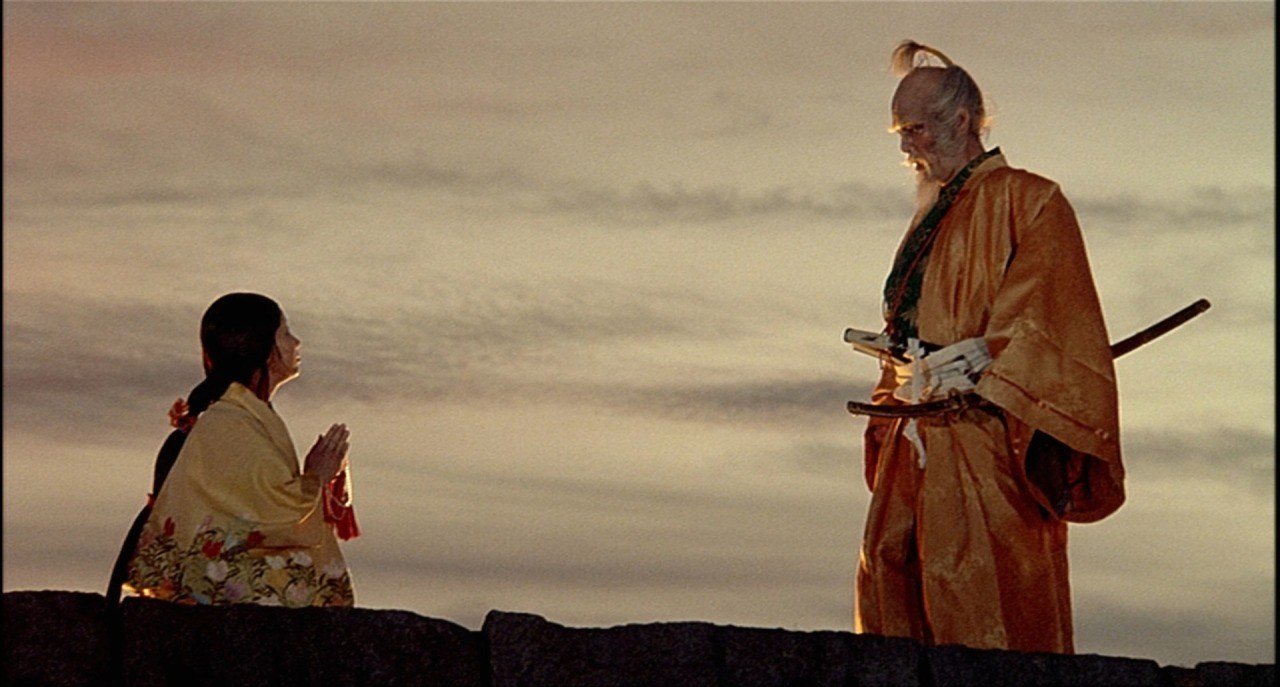
Director: Akira Kurosawa · Cinematographers: Takao Saitō, Asakazu Nakai, Masaharu Ueda · Composer: Tōru Takemitsu · Production Design: Yoshirō Muraki & Shinobu Muraki · Costume Design: Emi Wada · Key Cast: Tatsuya Nakadai, Akira Terao, Jinpachi Nezu, Daisuke Ryū, Mieko Harada · Runtime: 162 minutes · Studio/Distributor: Herald Ace / Nippon Herald Films / Greenwich Film Productions · Budget: $11–12 million · Box Office: $4.3 million (US)
Ran: The Fury of a Seventy-Five-Year-Old Man Who Has Seen Everything
Akira Kurosawa was seventy-five years old when Ran was released. He had been making films for over four decades. He had directed Rashomon, Seven Samurai, Ikiru, Yojimbo, High and Low, and Kagemusha. He had been imitated by every major filmmaker in the West. He had attempted suicide. He had been abandoned by the Japanese studio system and rebuilt his career with foreign financing. He had lost friends, colleagues, and, during the production of Ran itself, his wife of thirty-nine years. He halted filming for one day to mourn, then returned to work.
When asked what his best film was, Kurosawa’s standard answer throughout his career was “the next.” During the production of Ran, he changed his answer. He simply said: “Ran.”
He was right. Ran is Shakespeare’s King Lear transplanted to sixteenth-century Japan, stripped of its reconciliatory undertones and rebuilt as a vision of total annihilation. Hidetora Ichimonji, a warlord who has spent his life conquering through violence, decides to divide his kingdom among his three sons and retire in comfort. The two eldest flatter him and accept their inheritances. The youngest, Saburo, tells his father the truth: that a man who built his power through cruelty should not expect loyalty from sons raised in its shadow. Hidetora banishes Saburo. The elder sons betray Hidetora. The kingdom collapses. Everyone dies.
The film is visually staggering. Kurosawa hand-painted storyboards for every shot, and the compositions have the quality of painted screens brought to life. The battle sequences, filmed with 1,400 hand-stitched costumes and 200 horses on the slopes of Mount Aso, are among the most extraordinary ever committed to film. The color coding of the three armies (yellow, red, blue) turns warfare into a terrible form of choreography: you can read the tactical situation of every shot through its palette alone.
But the grandeur is not the point. The point is the rage. Ran is the work of a man who has watched human beings repeat the same catastrophic mistakes for seventy-five years and has concluded that they will never stop. It is a film without hope. The gods, if they exist, are either absent or weeping, and the humans are too busy killing each other to notice either way.
Verdict: 10/10. Ran is Kurosawa’s final masterpiece and one of the supreme achievements in cinema. It is a film that combines the emotional intensity of Shakespeare with the visual ambition of the greatest Japanese art, filtered through the accumulated wisdom and bitterness of a director who had seen everything and decided to put all of it on screen before he was done.
Painting War: Kurosawa’s Storyboards and the Third Castle Massacre
Kurosawa’s pre-production process for Ran was unlike any other filmmaker’s. During the seven years between conceiving the film and beginning to shoot it, he painted hundreds of watercolor storyboards depicting every major scene. These paintings are not technical blueprints. They are works of art in their own right, rich with color, atmosphere, and emotional intensity. They served as the visual bible for the production, and the finished film reproduces them with a fidelity that makes the storyboards feel less like preparation and more like prophecy.
The Third Castle massacre is the sequence that justifies every painting. Hidetora, abandoned by his retainers and surrounded by his son’s invading army, retreats into the keep. The soldiers outside set it on fire. The women inside commit suicide rather than be captured. Hidetora sits in the burning room, his white hair wild, his face frozen in an expression that has moved beyond grief into a kind of geological desolation. The walls collapse around him. He does not move. He walks out of the burning castle carrying no weapon and no purpose, and the soldiers who see him are so horrified by what he has become that they part to let him pass.
Kurosawa films this sequence in a way that no other director before or since has attempted. The battle itself is shown almost entirely without sound effects. The clash of arms, the screams, the thunder of hooves: all of it is removed and replaced by Tōru Takemitsu’s score, a slow, mournful orchestral piece that transforms the carnage into something closer to funeral rite than action sequence. The effect is devastating. By removing the visceral satisfaction of battle sounds, Kurosawa denies the audience any access to the adrenaline that combat cinema usually provides. What remains is pure image: bodies falling, arrows flying, fire spreading, all of it as beautiful and as meaningless as a field of flowers crushed under a wheel.
Color as Army, Color as Doom: The Palette That Tells the Plot
Kurosawa’s use of color in Ran is systematic, legible, and emotionally operative. Each of Hidetora’s three sons is assigned a color: Taro wears yellow, Jiro wears red, Saburo wears blue. Their armies carry banners and wear armor in the corresponding hue. The result is a visual grammar so clear that the film’s political and military dynamics can be read from the color composition of any given frame.
This clarity is not merely functional. It is expressive. When the yellow and red forces combine against the blue, the image communicates alliance through color mixing. When Hidetora, dressed in white, wanders through the battlefield, his colorlessness marks him as outside the system entirely, a man who has surrendered his power and received nothing in return. White, in Japanese culture, is the color of death and mourning. Hidetora’s costume telegraphs his fate from the moment he cedes his kingdom.
Costume designer Emi Wada, who won the Academy Award for her work on Ran, created over 1,400 costumes for the production. Each was handmade by master tailors over a period of more than two years. The armor is historically grounded but stylized: Kurosawa wanted costumes that looked real enough to inhabit and bold enough to read on screen at vast distances. The result is a visual system in which every figure on the battlefield is simultaneously a character and a color. The individual is absorbed into the pattern. The pattern is the story.
The landscapes reinforce the chromatic logic. The green of the grass and the gray of the clouds provide a neutral field against which the colored armies move. When the sky darkens before battle, the colors of the costumes burn brighter against the muted background, as though the approaching violence is generating its own light. It is painterly in the most literal sense: Kurosawa was a painter before he was a filmmaker, and Ran is the film in which the two practices become indistinguishable.
Tatsuya Nakadai’s Hidetora: King Lear Through the Mask of Noh
Tatsuya Nakadai, who had previously starred in Kurosawa’s Kagemusha, plays Hidetora with a technique drawn from Noh theater, the classical Japanese dramatic form in which performers communicate emotion through stylized gesture and mask-like facial expression. The approach is deliberate. Kurosawa wanted Hidetora’s descent into madness to register not as psychological realism but as something older and more formal, a performance of suffering rather than a simulation of it.
Nakadai’s face becomes progressively more mask-like as the film advances. In the early scenes, where Hidetora is still in command, the face is mobile, imperious, capable of anger and affection. After the betrayal and the destruction of the Third Castle, the face freezes. The mouth opens but produces no coherent speech. The eyes widen into a fixed stare that looks past the camera and past the viewer and into a void that only Hidetora can see. The transformation is physical and total: by the film’s final act, Nakadai appears to have aged decades. The character’s madness is not performed through outbursts or incoherence. It is performed through the absence of expression, as though the human capacity for response has been burned out of him.
Mieko Harada’s Lady Kaede is the performance’s counterweight. Where Hidetora is destroyed by the consequences of his own cruelty, Kaede has been nursing her revenge for years. She is the wife of Taro, but she was the daughter of a lord whose clan Hidetora conquered and whose castle Hidetora now occupies. Her smile is a weapon. Her politeness is a blade. In the scene where she seduces Jiro immediately after Taro’s death, Harada plays the seduction as a military operation, each gesture calculated, each word aimed. Kaede is the film’s most frightening character not because she is evil but because her evil is entirely rational. She has been wronged, and her response is proportional to the wrong, and the proportionality is terrifying.
Takemitsu’s Lament: When the Score Replaces the Battle
Tōru Takemitsu’s score for Ran is one of the most unconventional uses of music in any war film. Takemitsu, who cited Gustav Mahler as a primary influence for this project, composed music that is slow, mournful, and almost liturgical. The score does not accompany action. It replaces it. In the Third Castle battle, the natural sounds of combat are stripped away and Takemitsu’s orchestra takes their place, transforming the massacre into something that registers as grief rather than spectacle.
The approach was Kurosawa’s, and Takemitsu initially resisted it. A composer of considerable reputation in both classical and film music, Takemitsu was accustomed to writing scores that existed in dialogue with the sound design rather than supplanting it. Kurosawa overruled him. The director understood that the silence of combat, the removal of the sounds that make violence feel exciting, would communicate his moral position more effectively than any amount of realistic audio. War, in Ran, is not exciting. It is a catastrophe observed from a height too great for the screams to reach.
When the score recedes and natural sound returns, the contrast is shocking. The quiet scenes between battles are full of ambient noise: wind, footsteps, the creak of wood, the distant cawing of crows. These sounds, which would be unremarkable in another film, become almost unbearably present after the orchestral surreality of the battle sequences. The alternation between silence and noise, between music and world, creates a rhythm that maps the film’s moral landscape: beauty and horror, beauty and horror, endlessly alternating, neither resolving.
Shakespeare in Sengoku: What Lear Gains by Becoming Japanese
Kurosawa claimed he was unaware of King Lear when he first conceived Ran. He had been reading about the Sengoku-period warlord Mōri Motonari, who was famous for having three loyal sons. Kurosawa’s creative impulse was to invert the legend: what if the sons were not loyal? The Lear connection emerged later, and Kurosawa has said the two sources merged in a way he could never fully explain. Whether the claim is entirely accurate is debatable, but the synthesis of Shakespeare and Japanese feudal history produces something that neither source could achieve alone.
Lear is a play about a father who makes a terrible mistake and is destroyed by it. The play contains reconciliation: Cordelia returns, the bond between father and honest child is restored, and the tragedy is that the restoration comes too late. Ran removes the reconciliation. Saburo, the Cordelia figure, is killed by a sniper’s bullet in a moment of arbitrary violence that the play never contemplated. There is no redemption. There is no late-arriving wisdom. There is only destruction, followed by more destruction, followed by a final image of a blind man standing alone on the edge of a precipice.
The Sengoku setting gives Lear’s domestic tragedy a political and military scale that the play’s English court cannot provide. Lear’s division of his kingdom is a political act with personal consequences. Hidetora’s division of his kingdom is a military act with civilizational consequences. The armies are real. The battles involve thousands. The castles burn. The scale transforms the personal into the historical, and the historical is even bleaker than the personal, because the historical has no audience for its suffering. Nobody learns. Nobody is improved. The kingdom simply ceases to exist.
Kurosawa also imports elements that Shakespeare could not have imagined. Lady Kaede has no equivalent in Lear. The Fool, reimagined as the androgynous Kyoami (played by the performer known as Peter), combines elements of Lear’s Fool with traditions from Japanese kabuki and Noh theater. The result is an adaptation so thorough that it becomes an original work: Shakespeare is present in the architecture but absent from the surface. You can watch Ran without knowing Lear and lose nothing.
The Painter Who Made Films: Kurosawa’s Visual Language at Seventy-Five
By the time Kurosawa made Ran, he had been developing his visual language for over forty years. The deep-focus staging of Seven Samurai, the wipe transitions of The Hidden Fortress, the telephoto compression of Kagemusha: each film refined a technique that would find its fullest expression in Ran. This is not a director learning. This is a director concluding.
The compositions in Ran are organized around two principles: symmetry and its violation. The early scenes, in which Hidetora holds court and his kingdom appears stable, are filmed with balanced, centered framing. Characters are arranged with the geometric precision of a formal portrait. As the kingdom fractures, the symmetry breaks. Characters drift toward the edges of the frame. Compositions become unbalanced, asymmetric, weighted toward one side. The visual order mirrors the social order, and when the social order collapses, the images collapse with it.
Kurosawa’s use of landscape is equally considered. He shot much of Ran on the slopes and plains of Mount Aso, Japan’s largest active volcano. The terrain is vast, windswept, and indifferent. Characters are frequently shot against enormous expanses of sky and grass, their smallness emphasized by the scale of the environment. The landscape does not care about the human drama unfolding upon it. The clouds move. The wind blows. The grass bends. The humans fight and die and the landscape remains.
This compositional strategy enacts the film’s philosophical position. The gods, if they exist in Ran’s universe, are spectators, not participants. They watch from the same distance as Kurosawa’s camera: far enough away to see the pattern, too far away to intervene. The human figures, for all their passion and fury, are small. The landscape, which will outlast every army and every kingdom, is large. The disproportion is the film’s final statement.
The Most Expensive Film in Japanese History: Production at the Edge of Ruin
Ran’s production was an ordeal commensurate with its ambitions. At $11–12 million, it was the most expensive Japanese film ever made at the time of its release, and the financing was only possible because French producer Serge Silberman agreed to co-produce. The Japanese studio system had largely abandoned Kurosawa after the commercial disappointments of his 1970s work, and his previous film, Kagemusha, had required financial intervention from George Lucas and Francis Ford Coppola to be completed.
The 1,400 costumes were handmade over more than two years. Two hundred horses were used for the battle sequences. The castles at Kumamoto and Himeji, among the most famous landmarks in Japan, were made available for filming. A full-scale castle set was constructed on the slopes of Mount Aso and then burned to the ground in a single take for the Third Castle sequence. When Mount Aso’s unpredictable weather produced fog during a day scheduled for clear-sky shooting, Kurosawa improvised by incorporating the fog into the battle scene, turning a disruption into what many consider one of the film’s most striking visual effects.
Kurosawa’s wife, Yōko Yaguchi, died during production. His longtime recording engineer, Fumio Yanoguchi, also died before the film was completed. Kurosawa’s second-unit director was Ishiro Honda, the director of Godzilla, and a lifelong friend. The production was staffed by the remnants of Kurosawa’s inner circle, men who had been working with him for decades and who understood that Ran was likely to be his last film of this scale. The atmosphere on set was one of valediction. Everything was being done for the last time, and everyone knew it.
The Academy Nominated Him Once and It Took This Film to Do It
Ran was released in Japan on June 1, 1985, previewed at the Tokyo International Film Festival, and subsequently distributed internationally to widespread acclaim. The American critical response was nearly unanimous in its praise. The National Board of Review named Kurosawa Best Director. The New York Film Critics Circle awarded it Best Foreign Language Film. The film won multiple cinematography and directing prizes from critics’ organizations across the United States.
At the Academy Awards, Ran received nominations for Best Director, Best Cinematography, Best Art Direction, and Best Costume Design. Emi Wada won for costumes. Kurosawa lost Best Director to Sydney Pollack for Out of Africa. The nomination was historic: it was Kurosawa’s first and only nomination for Best Director, arriving in his seventy-fifth year, after a career that had influenced virtually every filmmaker nominated alongside him. The Academy had given him an Honorary Award in 1990, a lifetime achievement recognition that came five years after Ran, and that many interpreted as an apology for the decades of neglect that preceded it.
The film’s commercial performance was modest. It earned $4.3 million in the United States, respectable for a subtitled Japanese epic but not remotely proportional to its critical stature. Time has corrected the imbalance. Ran is now routinely listed among the greatest films ever made, and its battle sequences remain the benchmark against which all subsequent filmed warfare is measured. The Criterion Collection released a definitive restoration that Kurosawa personally supervised. The film is as close to permanent as cinema allows.
What Burns Differently When You Know Everyone Dies
Ran is a film whose tragic structure is declared in its opening scenes. Hidetora divides his kingdom. Saburo objects. Saburo is banished. The rest is consequences. There are no surprises in Ran’s plot. There is only the accumulation of inevitability, and that accumulation is what changes on a second viewing.
Watch the early court scenes for the performances that are not performing. Taro and Jiro accept their inheritances with expressions that, on first viewing, read as dutiful gratitude. On second viewing, they read as calculation. The sons already know they will betray their father. The politeness is strategy. The deference is theater. Kurosawa stages these scenes with the formality of Noh, and the formality is the disguise.
Track Lady Kaede’s position in every frame she occupies. She is rarely in the center of a composition during the first act. She sits to the side, watches, says little. On a rewatch, her peripheral position is itself a performance of patience. She is waiting. She has been waiting since her family was destroyed. Her centrality in the film’s second half does not arrive suddenly. It was always there, at the edge of the frame, biding its time.
Listen for what happens when the music stops. Takemitsu’s score enters and exits the film at deliberate moments, and the transitions are always meaningful. When the music plays during battle, the violence is aestheticized and distanced. When the music stops and natural sound returns, the violence becomes immediate and real. Track these transitions across the film and you will find that Kurosawa is modulating your emotional relationship to the carnage with the precision of a conductor.
Watch the final shot. A blind man, Tsurumaru, stands alone on the edge of a ruined fortress, the Buddha’s scroll that once comforted him fallen from his hands into the abyss below. The image is the film’s thesis compressed to a single composition: humanity, stripped of its illusions, standing at the edge of nothing, with no guidance and no ground beneath its feet.
Film Trivia
One day of mourning. Kurosawa’s wife, Yōko Yaguchi, died during the production of Ran. He suspended filming for a single day, attended the funeral, and returned to set the following morning. Colleagues described the decision as characteristic: Kurosawa’s commitment to the work was absolute, and the work was nearly complete. He channeled his grief into the film’s final sequences, which are among the bleakest passages in any of his films.
The costumes took longer than the shoot. Emi Wada’s 1,400 costumes were handmade by master tailors over a period exceeding two years. The battle armor was designed to be historically plausible while visually bold enough to read at the distances Kurosawa’s wide compositions required. Wada’s Academy Award was Ran’s only Oscar win, and it remains one of the most celebrated costume achievements in film history.
The fog that became genius. When unpredictable weather on Mount Aso produced heavy fog during a day scheduled for clear-sky battle filming, Kurosawa adapted on the spot. Rather than halt production, he incorporated the fog into the scene, using it as natural smoke to enhance the atmosphere of the combat. The resulting footage is now considered one of the film’s most visually arresting sequences. His ability to transform obstacles into opportunities was a hallmark of his working method throughout his career.
The Godzilla director as second unit. Ishiro Honda, creator of the original Godzilla and director of numerous Toho monster films, served as Ran’s second-unit director. Honda and Kurosawa had been close friends since their youth in the 1930s. Honda’s participation on Ran was one of the last major projects of his career, and Kurosawa considered his presence essential. The collaboration extended across several of Kurosawa’s late films and represented one of Japanese cinema’s longest creative partnerships.
This entry selects analytical dimensions from a pool. All five anchors are present: the critical verdict, performances, visual craft, reception and legacy, and the rewatchability guide. Earned sections cover Takemitsu’s score, the Shakespeare adaptation, the production history, and Kurosawa’s career context. One wildcard section addresses the film’s systematic use of color as a narrative language, a technique so central to Ran’s identity that it required its own analysis rather than being folded into the cinematography section. Cultural and historical context of Sengoku-period Japan is embedded throughout rather than separated, because the historical period is inseparable from the adaptation’s dramatic logic. Genre lineage is omitted because Ran sits at the summit of the samurai epic rather than in conversation with peers.

Leave a Reply