Director: Hirokazu Kore-eda · Cinematographer: Ryuto Kondo · Composer: Haruomi Hosono · Key Cast: Lily Franky, Sakura Ando, Kirin Kiki, Mayu Matsuoka, Kairi Jyo, Miyu Sasaki · Screenplay: Hirokazu Kore-eda · Runtime: 121 min · Studio: Fuji Television Network / Gaga Corporation / AOI Pro. · Box Office: $68 million worldwide
1. The Beach
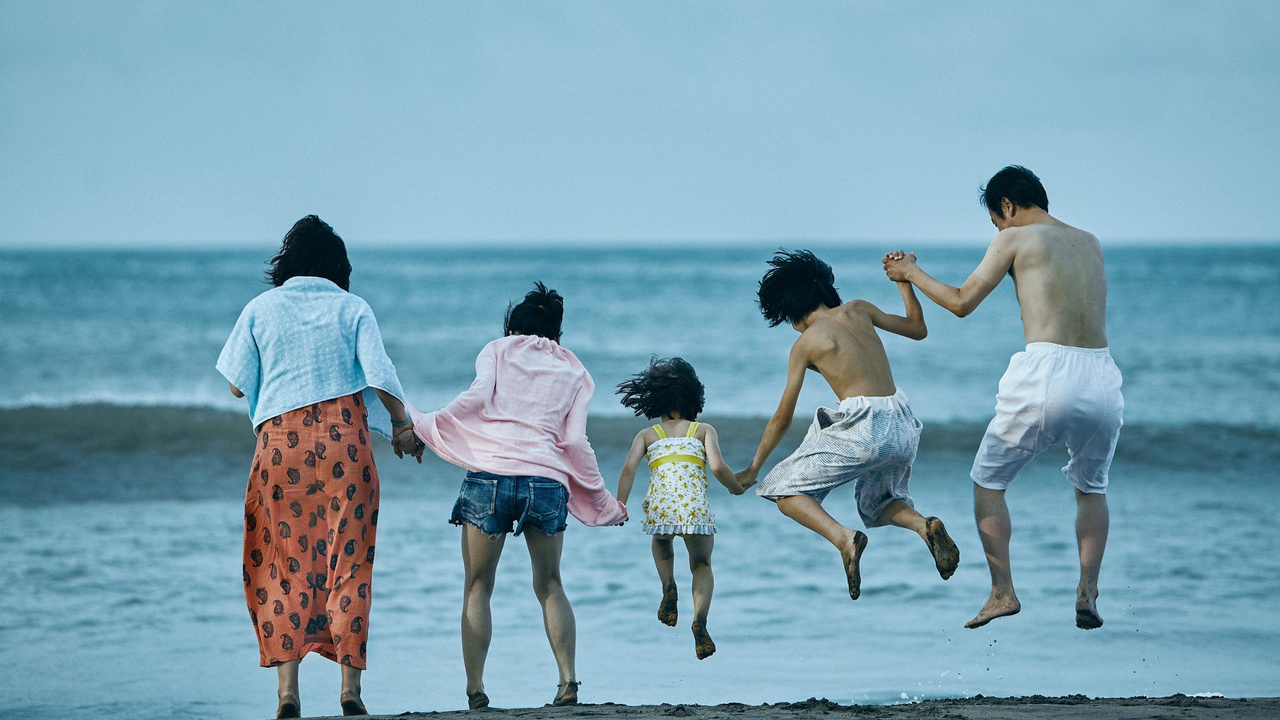
There is a scene near the middle of Shoplifters where the family goes to the beach. It is the happiest scene in the film. The children play in the waves. Osamu and Nobuyo sit together in the sand. Hatsue watches from a distance, murmuring words the camera cannot hear, and what she says, we learn later, is “thank you.”
She will be dead within days. The family she is thanking does not share her blood. The children she is watching are not legally hers, or anyone’s. The man and woman beside her are not married. And the happiness on screen, radiant and genuine and unmistakable, is built on a foundation of kidnapping, fraud, identity theft, and the ongoing concealment of a corpse.
This is the scene that tells you what Kore-eda is doing. He is not making a film about crime. He is making a film about the conditions under which love becomes real, and he is arguing, quietly and without polemic, that the conditions include illegality, deception, and the deliberate refusal to participate in the systems that the state provides for people who have been failed by those systems. The family in Shoplifters is not a real family. It is better than a real family, and that is the problem.
2. What Makes a Family (When the Answer Is: Not Blood)
Kore-eda has said he spent ten years thinking about the question that animates Shoplifters: what makes a family? His previous film, Like Father, Like Son (2013), approached it through a hospital baby-swap that forces two couples to choose between biological and emotional parenthood. Shoplifters pushes the question to its most uncomfortable extreme by constructing a family in which every bond is chosen rather than given, and in which every choice involves a crime.
Hatsue (Kirin Kiki) is not the grandmother of anyone in the house. She took in Nobuyo (Sakura Ando) to collect emotional companionship and, eventually, pension fraud revenue. Osamu (Lily Franky) is not Shota’s father; the boy was found in a car. Yuri, the little girl they take in from the cold, is not rescued in any legal sense; she is abducted from neglectful parents who will eventually report her missing and trigger the family’s destruction. Aki (Mayu Matsuoka), who works in a peep show, is related to nobody and drifted into the household through proximity rather than plan.
None of these relationships are legitimate. All of them are functional, warm, and more nurturing than any of the “real” family structures the film briefly shows us (Yuri’s biological parents are violent and indifferent; Hatsue’s legitimate relatives visit only to pay her off and keep their distance). Kore-eda does not editorialize this contrast. He simply presents both kinds of family and lets the audience sit with the disparity. The state recognizes one. The children are safer in the other. The film never reconciles these facts.
3. Kondo’s Rooms: Cinematography as Architecture of Intimacy
Ryuto Kondo shot Shoplifters on 35mm film, a deliberate choice in an era of digital production that gives the image a grain and warmth inseparable from the story’s emotional texture. The grain softens edges, absorbs harsh light, and produces skin tones that feel tactile rather than clinical. You do not watch these characters. You sit with them.
The house is the film’s primary set, and Kondo photographs it with a specificity that transforms a cramped, cluttered space into a complete psychological environment. The rooms are small. The camera is placed low, often at child height, and the compositions are organized around bodies in proximity: shoulders touching, legs overlapping, faces close enough to whisper. The visual effect is claustrophobia reframed as closeness. The family’s poverty forces physical intimacy, and that forced intimacy produces genuine connection. Kondo’s framing argues that there is no difference between the two.
The exterior shots operate on a different principle. Outside the house, the family members are small within the frame: diminished by the city, by the supermarket aisles where they steal, by the institutional buildings where they will eventually be interrogated. The contrast between the warm, tight interiors and the cold, expansive exteriors is the film’s visual argument in miniature: inside this house, among these people, you are seen. Outside it, you disappear.
The beach scene uses both registers simultaneously. The family is outdoors, in a wide shot, exposed. But they are together, and Kondo frames them with the same compositional warmth he uses for the interior scenes. For this one sequence, the warmth of the house extends beyond its walls. It is the only time this happens in the film, and Hatsue’s quiet “thank you” is addressed to the moment as much as to the people.
4. Six Performances, No Stars
Kore-eda is known for drawing naturalistic performances from his actors, and Shoplifters contains his most remarkable ensemble, one in which no single performance dominates and every actor operates at the same frequency of understatement.
Sakura Ando’s Nobuyo is the film’s moral center, though the film is careful never to announce this. She makes decisions that are simultaneously criminal and compassionate (keeping Yuri, burying Hatsue, taking full legal blame for the family’s crimes), and Ando plays each decision with a flatness that refuses dramatic emphasis. The interrogation scene near the end, where a social worker asks Nobuyo whether the children called her “Mom,” is the film’s emotional climax. Nobuyo’s face barely moves. A single tear falls. She does not wipe it. Ando holds the moment without performing grief, and the restraint is what makes it unbearable.
Lily Franky’s Osamu is the family’s most likeable and least reliable member: warm, funny, affectionate with the children, and utterly incapable of providing for them through any means other than theft. Franky plays him without judgment, which is Kore-eda’s consistent direction: do not evaluate your character, simply inhabit them. The result is a man who teaches a child to steal and then takes him to the beach and calls him “Dad,” and neither gesture feels false.
Kirin Kiki, in one of her final performances before her death in 2018, plays Hatsue with a quality that might be described as contented exhaustion. She has lived long enough to understand exactly what her household is and to value it anyway. Her performance is built on small gestures: the way she adjusts a blanket, the way she holds Yuri’s hand at a temple, the way she sits at the beach watching her family with a stillness that contains both gratitude and farewell.
The child performances deserve specific mention. Kairi Jyo’s Shota carries the film’s crisis of conscience: he is the child who begins to question the family’s moral foundations, and his decision to get caught shoplifting (deliberately, as a way of forcing a reckoning) is the act that destroys everything. Jyo plays this with an emotional intelligence that is startling in a young performer. Miyu Sasaki’s Yuri speaks almost no dialogue and communicates primarily through physical presence: the way she flinches when adults raise their hands, the way she gradually stops flinching as the family’s warmth teaches her that not all hands are weapons.
5. Poverty Is Not a Metaphor: Japan’s Invisible Underclass
Kore-eda has described Shoplifters as his “socially conscious” film, and the social dimension, while never didactic, is foundational. The film is set in a Japan that official discourse prefers not to acknowledge: a country with significant urban poverty, inadequate child welfare systems, and a cultural emphasis on blood ties that makes foster care and chosen families structurally invisible.
The family’s crimes are not the result of moral failure. They are survival strategies in a system that offers no alternatives. Osamu works as a day laborer whose employment is terminated after an injury; there is no meaningful safety net. Nobuyo works in an industrial laundry for wages that cannot sustain a household. Hatsue’s pension is insufficient for one person, let alone six. The shoplifting, the pension fraud, the concealment of Yuri’s identity: these are rational responses to an irrational situation, and Kore-eda presents them without either glamour or apology.
The interrogation scenes in the final act bring the institutional perspective into direct conflict with the emotional one. Social workers and police officers ask reasonable questions and receive answers that are technically criminal and emotionally correct. “Did you want the children to call you Mom?” is a question designed to establish whether Nobuyo groomed the children into attachment. The answer, delivered through Ando’s devastating restraint, is that she did not need to. The attachment was real. The crime was real. Both things are true, and the system has no mechanism for holding both truths simultaneously.
6. The Third Act Demolition
Shoplifters is structured as a slow, warm accumulation that the final thirty minutes systematically destroys. The destruction is Kore-eda’s most formally daring choice, and it produces a tonal whiplash that is the film’s defining emotional experience.
For ninety minutes, you are inside the family. You eat with them. You sleep in their pile of futons. You accompany them on shoplifting runs that feel more like games than crimes. You begin to forget, or at least to stop caring, that none of this is legal. The warmth is genuine. The love is real. The film has persuaded you.
Then Shota gets caught. The police arrive. The family is separated. And the film, which has been shooting in warm 35mm tones in intimate spaces, shifts to institutional interiors: interrogation rooms, police stations, courthouses. The color cools. The spaces widen. The family members are photographed alone, in isolation, framed by walls rather than by each other. The visual language reverses completely, and the reversal is how you feel the loss.
Each interrogation reveals a secret that the film had withheld: Hatsue’s real relationship to the family, Nobuyo’s criminal past, the circumstances of Shota’s “adoption,” the fact that Osamu and Nobuyo are not legally married. These revelations do not change what the audience felt during the first ninety minutes. They change what the audience is allowed to feel going forward. The system has intervened, and the system requires categories: parent or kidnapper, family or fraud, love or crime. Kore-eda’s argument is that these categories are inadequate to human experience. His final act is what happens when they are enforced anyway.
7. Kore-eda and Ozu: The Comparison He Cannot Escape
Critics have been comparing Kore-eda to Yasujiro Ozu since his earliest films, and the comparison is both accurate and limiting.
The similarities are real. Both directors make films about Japanese families in domestic spaces. Both favor static or near-static camera positions. Both are interested in the small rituals of daily life (meals, conversations, arrivals and departures) as the material of drama. Both trust silence. Both resist melodrama. Both believe that the most important things in a family are said between the lines, or not said at all.
But Kore-eda’s project is fundamentally different from Ozu’s in one crucial respect. Ozu’s families are legitimate. They are bound by blood, marriage, and social convention, and Ozu’s drama arises from the tensions within those bonds. Kore-eda’s families, increasingly across his career, are illegitimate. They are constructed from choice, accident, and necessity, and his drama arises from the question of whether bonds formed outside social convention can be as real, as durable, as worthy of the name “family” as the ones formed inside it.
Shoplifters is the film where this question reaches its fullest and most painful expression. The answer Kore-eda provides is: yes, the bonds are real. And: the world will destroy them anyway.
8. The Palme, the Oscar Snub, and What the World Saw
Shoplifters won the Palme d’Or at Cannes in 2018, awarded by a jury led by Cate Blanchett that included Ava DuVernay, Denis Villeneuve, and Kristen Stewart. Blanchett’s statement at the ceremony described the film as one “where all the elements come together: the acting, the direction, the mise-en-scene, the cinematography, seamlessly interwoven.” The Palme was Kore-eda’s first, on his fifth appearance in Cannes Competition.
The film went on to gross $68 million worldwide, extraordinary for a Japanese-language drama with no stars recognizable outside Japan. It received an Academy Award nomination for Best Foreign Language Film (losing to Roma) and won numerous international prizes. On Rotten Tomatoes, it holds a 99% approval rating from 230 reviews. Peter Bradshaw of the Guardian initially gave it four stars and then, on second viewing, upgraded to five, a correction that says something about how the film works: its full power is not visible on first contact.
In Japan, the reception was more complex. The film became a commercial hit but also generated controversy: some critics accused Kore-eda of presenting an unflattering image of Japanese society to an international audience, of focusing on poverty and dysfunction rather than on the country’s strengths. Kore-eda’s response was characteristically quiet: “I’m not making films to represent Japan. I’m making films about people.”
9. A 9/10 That Earns Every Decimal
The flaws are minor but real. The middle section occasionally settles into a rhythm of domestic vignette that, while individually lovely, creates a slight sense of repetition. Some of the revelations in the final act (particularly Nobuyo’s backstory) arrive with a convenience that slightly undercuts the film’s otherwise rigorous naturalism. And the Ozu comparison, however apt, can make the film feel like it belongs to a tradition rather than standing alone, which slightly diminishes its originality for viewers already familiar with the lineage.
But these are the criticisms of a film operating at an extremely high level. Shoplifters achieves something that almost no other film about poverty manages: it makes the audience love the characters without sentimentalizing their situation, feel the injustice without being lectured about it, and experience the ending’s devastation not as narrative surprise but as institutional violence observed from the inside. The performances are uniformly extraordinary. The cinematography is purposeful in every frame. And the final image, Yuri standing alone on a balcony, looking out at a world that has returned her to the parents who hurt her, is one of the most quietly horrifying shots in recent cinema.
Verdict: 9/10.
10. Return to the House: A Rewatch Guide
Second viewing transforms Shoplifters from a story about a family into a study of how that family was built, and why it was always going to fall apart.
Watch Hatsue in every scene. Kirin Kiki knew this was likely her final role (she was diagnosed with cancer during production), and there is a quality of farewell in her performance that becomes legible only when you know the ending. The beach scene, in particular, changes completely: her murmured “thank you” is not a casual expression of happiness. It is a woman saying goodbye to everything she managed to assemble before the end.
Watch Shota’s eyes during the shoplifting scenes. On first viewing, they read as excitement. On second viewing, they read as observation: he is watching Osamu’s technique, yes, but he is also watching Osamu’s morality, testing it, and arriving at a conclusion the adults cannot see coming. His decision to get caught is not impulsive. It is the result of a moral calculus that has been running silently throughout the film.
Watch the meals. Kore-eda stages them with a documentary patience that rewards attention. Who sits where. Who serves whom. Who speaks and who listens. The seating arrangements encode the family’s power structure and its emotional priorities, and they shift subtly across the film as relationships deepen and Yuri is integrated into the household.
And when the interrogation scenes arrive, watch Nobuyo’s hands. Ando’s face is carefully controlled. Her hands are not. They grip the table. They press against her thighs. They betray what her face refuses to show, and the disconnect between the composure above and the anguish below is where Ando’s performance lives.
Film Trivia
Kore-eda cast children who could not act, on purpose. Miyu Sasaki (Yuri) and Kairi Jyo (Shota) were non-professional child actors whose inexperience was a deliberate casting choice. Kore-eda has said he prefers working with children who have not been trained to perform, because their reactions are instinctive rather than constructed. He directed them by creating situations and observing their responses rather than by giving them conventional direction.
The house was a fully functional set. Production designer Keiko Mitsumatsu built the family’s cramped home as a complete, livable space rather than as a series of separate sets. The actors could move from room to room without interruption, which allowed Kore-eda to shoot long, continuous scenes in which the family’s physical closeness was not choreographed but organic. The clutter in the house was accumulated over the shooting period rather than pre-arranged.
Kirin Kiki’s farewell. Kirin Kiki, one of Japan’s most beloved actresses, was battling cancer throughout the production of Shoplifters. She died in September 2018, three months after the film’s Japanese release. The beach scene, where Hatsue watches her family and whispers “thank you,” was understood by cast and crew as carrying a significance beyond the script. Kore-eda has said he did not direct Kiki in that moment. She simply did what the scene required, and what she required.
The Swimmy scene came from an orphanage. To research the film, Kore-eda visited a Japanese orphanage. During his visit, a girl took a copy of Leo Lionni’s children’s book Swimmy from her backpack and began reading it aloud, unprompted. The moment moved Kore-eda deeply, and he wrote a scene in which Yuri reads from the same book. The scene made it into the finished film and functions as one of its quietest emotional anchors.
Japan’s mixed feelings about the Palme. While the Palme d’Or generated significant pride and commercial success in Japan, some commentators criticized Kore-eda for presenting Japanese poverty to an international audience. The debate reflected a broader tension in Japanese culture between the desire for international recognition and discomfort with narratives that challenge the country’s self-image. Kore-eda responded simply: “I’m not making films to represent Japan.”


Leave a Reply