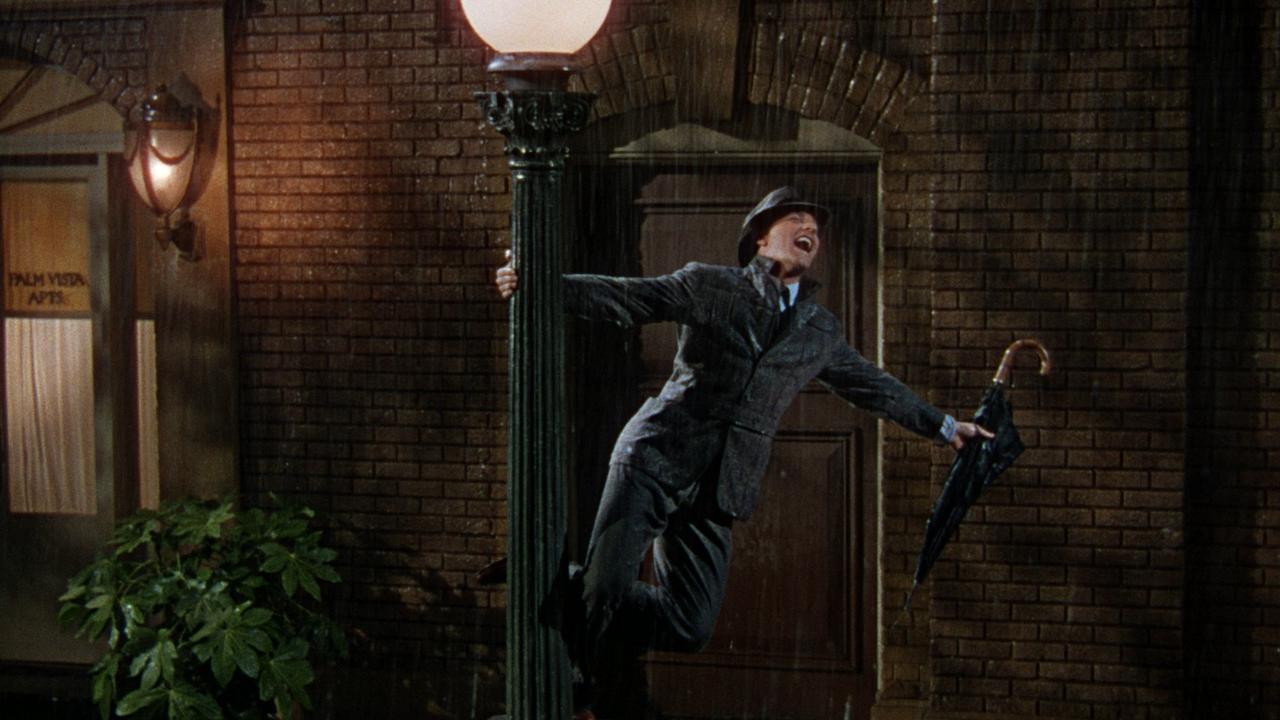
Directors: Gene Kelly, Stanley Donen · Cinematographer: Harold Rosson · Music: Nacio Herb Brown (composer), Arthur Freed (lyrics), Lennie Hayton (musical direction) · Key Cast: Gene Kelly, Donald O’Connor, Debbie Reynolds, Jean Hagen, Millard Mitchell, Cyd Charisse · Runtime: 103 minutes · Studio: Metro-Goldwyn-Mayer · Budget: $2.54 million · Box Office: $7.7 million (initial release)
1. The Happiest Film Ever Made About an Industry Eating Itself
Singin’ in the Rain is often described as the greatest musical ever made, and that description, while accurate, undersells what it actually accomplishes. This is not merely a collection of brilliant musical numbers strung together by a charming plot. It is a film about the violence of technological change, the cruelty of the entertainment industry, and the fragility of fame, disguised so thoroughly as a comedy that most audiences never notice the blade.
Set in 1927 Hollywood during the catastrophic transition from silent films to sound, the story follows Don Lockwood, a silent film star whose career survives the revolution, and Lina Lamont, his screen partner whose career does not. The reason Lina fails is her voice. She is a skilled silent performer, beautiful, expressive, capable of communicating across the wordless distance between screen and audience. None of that matters once the microphone arrives. One technological shift renders an entire skill set worthless, and the film, while inviting us to laugh at Lina’s screeching vowels, never entirely obscures the brutality of what is happening to her.
Gene Kelly, Donald O’Connor, and Debbie Reynolds form a trio so perfectly calibrated that it is easy to forget how difficult the calibration was. Kelly is the consummate professional: athletic, precise, almost intimidatingly competent. O’Connor is the anarchist: loose-limbed, clownish, willing to throw his body into walls for a laugh. Reynolds is the newcomer: earnest, talented, slightly overwhelmed by the company she is keeping. The three together produce a chemistry that no subsequent musical has replicated because the chemistry depends on a specific balance of dominance, rebellion, and innocence that is almost impossible to cast.
The musical numbers are, individually, among the finest ever filmed. “Singin’ in the Rain” itself is pure cinema: a man alone on a wet street, delirious with love, communicating through his body what words cannot express. “Make ‘Em Laugh” is a virtuoso comedy performance that reportedly left O’Connor hospitalized from exhaustion. “Moses Supposes” is a duet of such infectious energy that it makes the destruction of a diction teacher’s office feel like an act of liberation. “Good Mornin’” is three people negotiating a problem through movement and joy, solving the unsolvable by dancing at it.
The film is not perfect. The “Broadway Melody” ballet, while visually stunning and choreographically ambitious, stops the narrative cold for fourteen minutes and belongs more to Kelly’s ambitions as an artist than to the story Comden and Green built around him. It is the kind of sequence that directors insert when they have earned enough institutional capital to indulge themselves, and indulgence, however brilliant, is still indulgence.
Verdict: 10/10. Seventy years old and not a single frame has aged. Singin’ in the Rain is the rare film that is simultaneously a perfect entertainment and a genuine work of art, and the ease with which it carries that dual identity is itself a kind of genius.
2. Kelly’s Body, O’Connor’s Bones, Reynolds’s Survival
Gene Kelly did not dance like Fred Astaire. Astaire was elegance. Kelly was force. Where Astaire appeared to float, Kelly appeared to fight gravity and win, and the physical effort was always visible. You could see the muscles working. You could hear the shoes hitting the floor. Kelly’s dancing communicated labor, which paradoxically made it more joyful. The joy was earned, not effortless, and earned joy is the deeper kind.
In Singin’ in the Rain, Kelly is at the absolute peak of his physical powers. The title number required him to dance on a waterlogged street for hours while running a fever of 103 degrees. The water had to be mixed with milk to make it visible on camera. Kelly performed in a wool suit that absorbed rain until it weighed several times its dry weight. He made all of this look like the most natural act in the world: a man so happy he cannot walk, only dance, and the rain is not an obstacle but a partner. The technical demands behind the sequence (two city blocks rigged with overhead sprays, precisely calibrated lighting to make each drop of water visible) are invisible in the finished film, which is exactly how they should be.
Donald O’Connor’s “Make ‘Em Laugh” is the single most physically punishing comedy performance on film. He runs up walls. He back-flips off them. He crashes through scenery. He wrestles a headless dummy across a soundstage. The sequence was so demanding that O’Connor required bedrest afterward. When he learned that a camera malfunction had ruined the footage and the number would need to be reshot, he reportedly had to be persuaded not to leave the production entirely. He reshot it. It is better the second time.
Debbie Reynolds was nineteen years old, a former gymnast with almost no dance training. Kelly, a perfectionist who had trained since childhood, worked her so hard that she later recalled hiding under a piano to cry. Fred Astaire reportedly found her there and told her not to worry, that Kelly was simply demanding. The story captures something essential about the production: the joy on screen was manufactured through discipline that bordered on cruelty, and Reynolds’s ability to keep up with Kelly and O’Connor while possessing a fraction of their experience is itself a kind of heroism.
Jean Hagen’s Lina Lamont is the performance that should have won the Academy Award. Lina is written as a comic villain, but Hagen plays her with a vulnerability that complicates every laugh. Lina’s screeching voice is funny. Lina’s genuine belief that she and Don are a real couple is not. Lina’s outrage at being replaced is presented as vanity, but underneath the vanity is a woman watching her career dissolve because of a physical characteristic she cannot control. Hagen finds the tragedy inside the comedy without ever disrupting the comedy, which is the hardest thing an actor can do.
3. Technicolor, Rain, and Milk: Rosson’s Palette of Manufactured Joy
Harold Rosson, who had previously shot On the Town for Kelly and Donen, replaced John Alton early in production. Alton had won an Oscar for An American in Paris but was removed at Kelly and Donen’s insistence. The replacement was significant: Alton’s style was moody, noir-inflected, built on shadows and contrast. Rosson’s approach was cleaner, brighter, more saturated. Singin’ in the Rain needed to glow, and Alton was not the man to make it glow.
The three-strip Technicolor process used by MGM in the early 1950s produced colors of an almost hallucinatory intensity. Rosson and production designer Cedric Gibbons exploited this capacity systematically. The costumes by Walter Plunkett, which cost $157,000 (more than the budget of many independent films), were designed to pop against the relatively neutral sets. Kelly’s grey suit in the rain number is a deliberate contrast: by muting the performer, the color of the rain and the gleam of the wet street become the visual event. The restraint of the costume amplifies the spectacle of the setting.
The title number required solving a problem that sounds trivial and was anything but: rain is nearly invisible on camera unless it is backlit or thickened. Water falls in drops too small and too fast for standard film stock to capture clearly. Rosson’s solution involved two components. First, the rain was mixed with milk to increase its opacity. Second, every drop was backlit by a carefully positioned grid of overhead lights, so that each falling bead of liquid caught the light and became a visible streak. The resulting image, rain transformed into luminous lines against a dark street, is one of the most beautiful effects in the history of Technicolor, and it was achieved through dairy products and electrical engineering, not post-production manipulation.
The “Broadway Melody” ballet, whatever its narrative merits, is a showcase of what Technicolor could do at its most ambitious. The color shifts from the warm golds and greens of a realistic urban setting to the cold, abstract blues and purples of a fantasy environment. Cyd Charisse’s entrance in a green dress against a purple-lit void is color theory in motion. The palette tells the emotional story: warmth is reality, cold is fantasy, and the boundary between them is drawn in light.
4. The Freed-Brown Catalogue: Songs Written Before Their Movie Existed
Here is the fact that transforms the film from a conventional musical into something far more interesting: the songs came first. Singin’ in the Rain was constructed around a pre-existing catalogue of songs written by Arthur Freed and Nacio Herb Brown in the late 1920s and early 1930s. These were not songs composed for a specific story. They were songs that had already lived in other films, in other contexts, serving other narratives. Betty Comden and Adolph Green’s assignment was to build a screenplay that justified their existence in a new configuration.
This reversal of the normal creative process, story built around songs rather than songs built around story, produced the film’s most distinctive quality: the musical numbers do not advance the plot so much as they transcend it. “Singin’ in the Rain” does not tell us anything about Don Lockwood that we do not already know. It expresses a feeling that the narrative has already established, but it expresses it in a medium (movement, water, light, rhythm) that narrative cannot access. The number exists because the feeling cannot be contained by dialogue. It overflows into dance.
“Make ‘Em Laugh” was a new composition for the film, and its melody bears a suspicious resemblance to Cole Porter’s “Be a Clown.” Whether this constitutes homage or theft depends on your generosity. What is not debatable is that the song’s placement in the film is structural. Cosmo performs it to cheer up Don during a moment of professional crisis, and the physical comedy of the performance mirrors the film’s larger argument: when everything is falling apart, you survive by entertaining. The song is about resilience disguised as slapstick.
“Good Mornin’” is the hinge number. Three characters have been up all night trying to solve a narrative problem (how to save Don’s film from Lina’s voice), and the solution arrives not through dialogue but through the energy the musical number generates. By the end of the song, Cosmo has the idea: dub Lina’s voice with Kathy’s. The solution does not come from thinking. It comes from moving. The film argues, through its structure, that physical joy produces intellectual clarity. Dance is not decoration. It is cognition.
5. Lina Lamont and the Cruelty the Film Won’t Admit
This is the section that no standard analysis of Singin’ in the Rain provides, because the film’s reputation as a joyous celebration makes it uncomfortable to examine the mechanism of its cruelty.
Lina Lamont is destroyed. This is presented as comedy. She is vain, possessive, manipulative, and her voice is genuinely terrible. The film invites the audience to enjoy her humiliation, and most audiences accept the invitation without reservation. But consider what actually happens to her. She is a successful performer. She has built a career on skills that were valuable in the silent era: beauty, physical expressiveness, screen presence. A technological change outside her control renders those skills insufficient. Her colleagues, rather than helping her adapt, replace her with a younger woman, humiliate her in front of a live audience, and end her career.
Lina’s voice is not her fault. She did not choose it. She cannot change it. The film knows this, which is why it gives her genuine grievances. When she tells R.F. that she has a contract and legal rights, she is correct. When she objects to being dubbed without her knowledge, she has a legitimate complaint. When she demands credit for her own image, she is asserting a form of intellectual property that the modern entertainment industry would recognize instantly. The film dismisses all of these claims because Lina’s personality makes them easy to dismiss. She is unpleasant, so her rights do not matter.
Jean Hagen understood this. Her performance contains a layer of pathos that the screenplay does not authorize. When Lina is publicly exposed, singing onstage while Kathy is revealed behind the curtain, Hagen’s face in that moment carries something beyond embarrassment. It carries the knowledge of ruin. Her career is over. The audience is laughing. Her co-star, the man she believed loved her, engineered the entire humiliation. Hagen lets you see all of this in a flicker of expression that the comedy rushes past, and if you catch it, the film becomes considerably darker.
The film’s genius is that none of this diminishes the joy. Singin’ in the Rain can be simultaneously one of the happiest films ever made and a quietly brutal portrait of how industries discard people when they become inconvenient. The happiness is real. The brutality is also real. They coexist in the same frames, and the film trusts the audience to feel both, or to feel only the happiness if that is what they need.
6. Kelly and Donen: The Partnership That Built the Musical and Broke Itself
The co-directing credit was unusual in classical Hollywood and has generated decades of debate about who actually directed the film. The consensus among historians is that Kelly handled the musical numbers and Donen handled the dramatic scenes, but this division is too clean. Both men were present throughout production. Both contributed ideas across the boundary. Both claimed credit for elements the other considered his own.
Kelly was the star, the choreographer, and the creative force whose vision shaped the musical numbers. His approach to dance on film was revolutionary in its integration of camera movement with physical movement. Where earlier musicals had filmed dance from a fixed position, as though the audience were watching from a theater seat, Kelly insisted that the camera be a participant. It moves with the dancer. It shares the dancer’s momentum. It communicates the kinetic experience of dancing, not just the visual spectacle of watching someone dance.
Donen was the technician, the problem-solver, the man who figured out how to execute Kelly’s visions within the constraints of budget, schedule, and physics. He was also, by most accounts, the sharper narrative filmmaker. The dramatic scenes in Singin’ in the Rain have a pace and a comic timing that Kelly’s solo directorial efforts often lack. The interplay between Don and Lina, the industry satire, the screenplay’s structural elegance: these bear Donen’s fingerprints more than Kelly’s.
The partnership dissolved after their third collaboration, It’s Always Fair Weather (1955). By then, the relationship had soured. Donen wanted recognition as a director in his own right, not as Kelly’s facilitator. Kelly felt that Donen was claiming too much credit for work that Kelly’s choreographic genius had driven. The truth, as with most creative partnerships, is that neither man could have made Singin’ in the Rain alone. Kelly without Donen would have produced brilliant musical numbers disconnected from a functioning narrative. Donen without Kelly would have produced a well-constructed comedy without the transcendent physical performances that elevate it to art. The partnership was necessary, painful, and irreplaceable.
7. MGM’s Machine: $2.54 Million and 237 People
Singin’ in the Rain was, by the standards of its studio, a routine production. MGM’s musical division, under Arthur Freed’s supervision, was the most prolific and accomplished in Hollywood. The studio had produced The Wizard of Oz, Meet Me in St. Louis, An American in Paris, and dozens of other musicals. The infrastructure was in place: soundstages, costume departments, orchestras, choreographers, technicians who had been making musicals for decades. The assembly line was well oiled.
The budget of $2.54 million overran MGM’s initial allocation by $665,000, largely because of the “Broadway Melody” ballet, which alone cost $600,000 and took a month to rehearse and two weeks to shoot. The overage was significant but not catastrophic by MGM standards. The film returned $7.7 million in its initial release, a comfortable profit that validated the investment without generating the kind of excitement that An American in Paris had produced the year before.
The credit list includes 237 names. This is not an error or an exaggeration. It is the reality of how MGM musicals were made. Twenty people worked in the music department. Eight worked in the makeup department. Fifteen in the camera and electrical department. Walter Plunkett’s costumes, which consumed six percent of the total budget, required their own small army. The film was a factory product, and acknowledging this does not diminish it. It contextualizes the achievement. Singin’ in the Rain emerged from an industrial process and transcended it, which is more impressive, not less, than if it had been the vision of a single auteur working in isolation.
The water shortage that coincided with the title number’s filming has become part of the film’s mythology. Culver City was under water restrictions on the day the rain sequence was shot. Two city blocks of MGM’s backlot were rigged with overhead sprays while the surrounding community was asked to conserve. The irony was not lost on anyone involved, but the studio’s needs prevailed. Hollywood has always consumed more than its share of everything, including water. Singin’ in the Rain simply made the consumption visible.
8. Two Nominations, Zero Wins, and a Slow Climb to Immortality
The Academy’s response to Singin’ in the Rain is one of the more puzzling episodes in Oscar history. The film received exactly two nominations at the 25th ceremony: Best Supporting Actress for Jean Hagen and Best Scoring of a Musical Picture. It won neither. No nomination for Best Picture. No nomination for Best Director. No nomination for Kelly’s performance or choreography. Donen, Comden, and Green publicly expressed feeling “ignored.”
The neglect is partly explained by timing. The Academy had awarded An American in Paris, Kelly’s previous film with a lavish ballet sequence, the Best Picture award at the ceremony held just weeks before Singin’ in the Rain opened. Voters may have felt they had already honored Kelly’s approach to the musical. The Greatest Show on Earth, Cecil B. DeMille’s circus epic, won Best Picture for 1952, a decision that has aged poorly.
The film’s ascent to canonical status was gradual. In 1989, it was among the first twenty-five films selected by the Library of Congress for the National Film Registry. It topped the American Film Institute’s list of the greatest movie musicals. It ranked tenth on AFI’s original 100 Greatest American Films list in 1998 and rose to fifth in the 2007 update. These rankings reflect a critical reassessment that took decades to complete. Singin’ in the Rain was not ignored on release. It was simply not recognized as exceptional. The recognition came later, slowly, and then all at once, as subsequent generations of critics and audiences measured every musical against it and found every musical wanting.
The film’s cultural penetration is total. Kelly’s lamppost has become an icon that people who have never seen the film can identify. The image of a man dancing in the rain with an umbrella is one of the three or four most recognized images in American cinema, alongside the shower curtain from Psycho, the beach kiss from From Here to Eternity, and Chaplin’s tramp walk. The image has been parodied so many times that it has transcended parody and become simply part of the visual vocabulary of joy.
9. Dubbing, Deception, and the Film That Plays Its Own Trick
The most delicious irony of Singin’ in the Rain requires a section of its own, because the film about dubbing was itself dubbed, and the layers of deception run deeper than most viewers realize.
The plot hinges on Kathy Selden dubbing Lina Lamont’s speaking and singing voice. The film presents this as morally straightforward: Lina cannot speak or sing on camera, Kathy can, and the deception is justified because the audience deserves quality. But the production of Singin’ in the Rain enacted the same deception it satirizes.
Debbie Reynolds did not sing all of her own songs in the film. Her speaking voice was sometimes dubbed by Jean Hagen herself, creating a situation of extraordinary circularity: in the film’s plot, Kathy (Reynolds) dubs Lina (Hagen); in the film’s production, Hagen dubbed Reynolds. The actress playing the woman with the terrible voice actually provided the “good” voice for the actress playing the woman with the good voice. The film’s central joke about the artificiality of cinema was being performed in real time by its own production.
Reynolds’s singing voice was also supplemented. Betty Noyes provided the singing voice for “Would You?” The dubbing was standard MGM practice and was not considered controversial at the time. But it means that the film’s moral framework, in which dubbing is either a necessary professional tool or a form of fraud depending on who is doing it and why, applies to its own production. Singin’ in the Rain argues that the audience should know the truth about who is performing. Singin’ in the Rain’s own audience did not know the truth about who was performing.
This is not a flaw. It is the point, whether the filmmakers intended it as such or not. Cinema is always an act of deception. Lighting creates moods that do not exist. Editing compresses time. Music manufactures emotion. Dubbing replaces one voice with another. Singin’ in the Rain, by satirizing the deceptions of its own medium while simultaneously practicing them, becomes a film about the impossibility of authenticity in an art form built on illusion. The rain is not rain. It is water mixed with milk. The joy is real. The rain is fake. Both things are true.
10. What the Joy Conceals: A Rewatch Guide
Singin’ in the Rain is so immediately pleasurable that most viewers never look beneath the pleasure. The rewatch is where the architecture reveals itself.
Watch Lina’s face in the dubbing reveal scene. The audience is laughing. Don is triumphant. Kathy is exposed behind the curtain. But watch Hagen in the split second before Lina storms offstage. There is genuine devastation there, a woman realizing that she has been publicly destroyed by the people she trusted. The comedy does not pause for this moment. Hagen puts it there anyway.
Track the color of Don’s clothes across the film. In the early scenes, he wears the bright, exaggerated costumes of a silent film star. As the transition to sound threatens his career, his wardrobe becomes muted. In the rain number, he wears grey. After the crisis resolves and his future is secure, color returns. The costume design charts his emotional arc without a word of dialogue.
Listen to the silence in “Singin’ in the Rain.” The arrangement drops out at key moments, leaving nothing but Kelly’s voice, his footsteps, and the sound of water. These silences are rhythmic events. They create space inside the number for the audience to feel the emotion that the music, if it continued uninterrupted, would process for them. The silences make you do the emotional work yourself, which is why the number moves you in a way that more fully orchestrated sequences do not.
Count the mirrors and reflections in the “Broadway Melody” ballet. The sequence is full of reflective surfaces: polished floors, glass, water. Kelly’s image is multiplied, fragmented, stretched. The ballet is about a man’s fantasy of success, and the reflections suggest that the fantasy is a distortion, an image of the self that looks like the self but is not. The ballet may stop the narrative, but it deepens the film’s argument about performance, identity, and the gap between who you are and who the screen says you are.
Revisit the final shot. Don and Kathy standing in front of a billboard advertising their film. They have won. They are in love. The billboard bears their names. But the billboard is an advertisement, not a truth. It is the film industry doing what the film industry does: turning people into images, turning love into publicity, turning life into product. The happy ending is also a billboard. Both things are true.
Film Trivia
Kelly danced with a 103-degree fever. The title number was filmed while Kelly was genuinely ill. The wool suit absorbed water until it was enormously heavy, and the filming lasted an entire day. Kelly later downplayed the difficulty, saying the technicians who rigged two city blocks with rain sprays had the harder job. He made it look effortless. It was not.
O’Connor was hospitalized, then had to reshoot. “Make ‘Em Laugh” was so physically demanding that O’Connor required medical attention after filming. When a camera malfunction ruined the footage, the entire number had to be reperformed from scratch. O’Connor did it. He later said that few people outside the production ever knew about the reshoot.
Reynolds hid under a piano to cry. At nineteen, with minimal dance training, Reynolds was expected to keep pace with two of the finest dancers in film history. Kelly’s perfectionism pushed her to the point of tears. Fred Astaire, visiting the set, reportedly found her hiding beneath a piano and offered reassurance. Reynolds later called the film and childbirth the two hardest things she had ever done.
Hagen provided the “good” voice for the character she was dubbing. In one of cinema’s most recursive ironies, Jean Hagen’s natural speaking voice was used to dub some of Debbie Reynolds’s dialogue in scenes where Kathy is supposedly providing the “real” voice behind Lina’s dubbing. The actress playing the bad voice was, in production, the good voice.
The rain was mixed with milk. Pure water is nearly invisible on camera. To make the raindrops register on Technicolor film stock, the water was mixed with milk to increase its opacity and reflectiveness. Every luminous streak of rain in the title number is partly dairy. The most iconic image of cinematic joy is made of something you pour on cereal.
This entry selects analytical dimensions from a pool. The five anchors are present: critical verdict, performances, visual craft, reception and legacy, and rewatchability guide. Earned sections cover the pre-existing song catalogue, the Kelly-Donen directorial partnership, and production history. One wildcard section, “Lina Lamont and the Cruelty the Film Won’t Admit,” examines the moral complexity hidden inside the comedy, and a second wildcard, “Dubbing, Deception, and the Film That Plays Its Own Trick,” addresses the recursive irony of a film about dubbing that was itself dubbed. Sections on cultural context and genre lineage are omitted: the film’s Hollywood setting provides its own context, and its position as the consensus greatest musical is addressed throughout the entry.


Leave a Reply