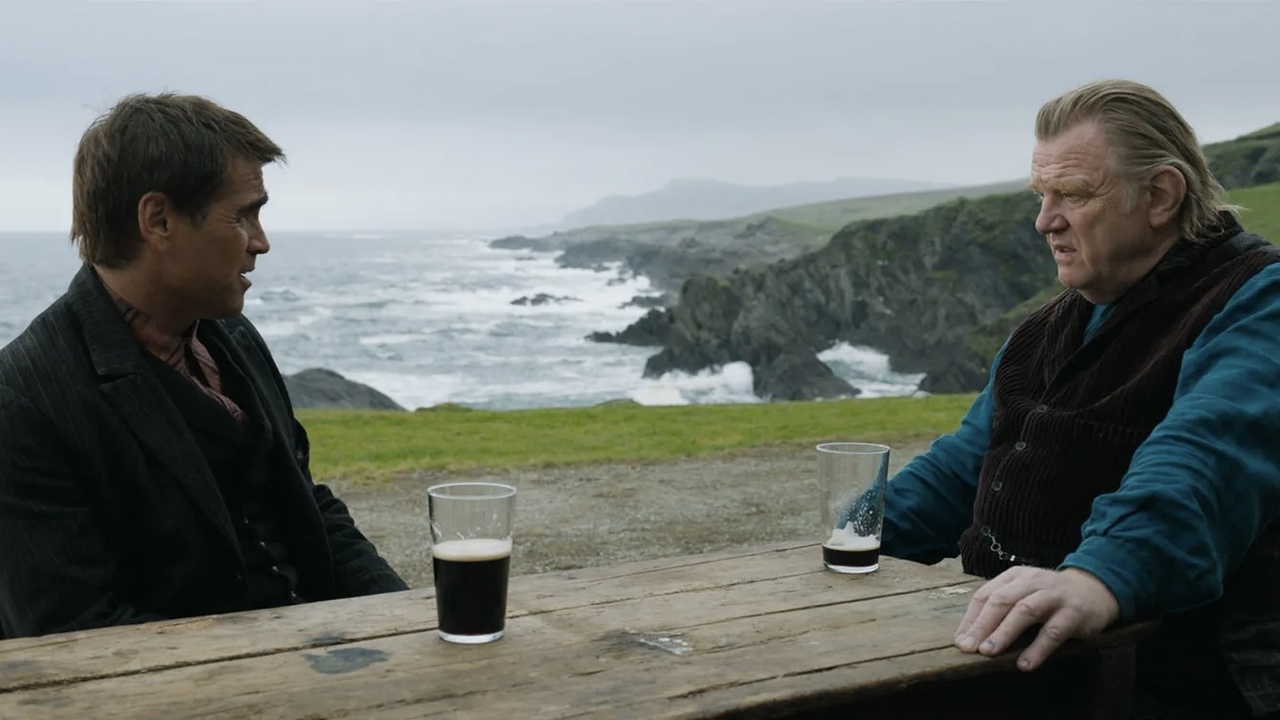
Director: Martin McDonagh · Cinematographer: Ben Davis · Composer: Carter Burwell · Key Cast: Colin Farrell, Brendan Gleeson, Kerry Condon, Barry Keoghan, Pat Shortt, Sheila Flitton · Runtime: 109 minutes · Studio: Searchlight Pictures / Blueprint Pictures / Film4 · Budget: $20 million · Box Office: $52.3 million worldwide
1. The Banshees of Inisherin: A Breakup Film for the Ages, Set on the Edge of the World
Martin McDonagh’s fourth feature is about two men on a small island who stop being friends. That is the entire plot. From this premise, which sounds like a short story at best, McDonagh extracts a film of such accumulating emotional devastation that it leaves you hollowed out. The Banshees of Inisherin is the funniest deeply sad film of the decade, or the saddest deeply funny one. The distinction does not matter. Both descriptions are accurate.
Pádraic Súilleabháin (Colin Farrell) is a farmer on Inisherin, a fictional island off the west coast of Ireland. Every day at two o’clock, he walks to his friend Colm Doherty’s cottage, and they go to the pub together. They have done this for years, perhaps for their entire adult lives. One day, Colm tells Pádraic he does not want to be friends anymore. No explanation. No fight. No precipitating event. He simply does not want to spend any more time listening to Pádraic talk about nothing. He would rather compose music, play his fiddle, and be left alone. Pádraic, bewildered and hurt, refuses to accept the rejection. Colm issues an ultimatum: every time Pádraic speaks to him, Colm will cut off one of his own fingers.
The escalation from social awkwardness to self-mutilation is the film’s structural engine, and McDonagh calibrates it with the precision of a dramatist who understands that absurdity and tragedy are separated by exactly one step. The fingers are simultaneously shocking and logical. Colm is a musician. His fingers are his livelihood, his art, his means of leaving something behind. By cutting them off, he is destroying the very thing he claims to value more than Pádraic’s friendship. The gesture is irrational, and it is also the most eloquent statement of desperation the film offers. Colm would rather maim himself than continue living a life he considers meaningless.
The setting is 1923. The Irish Civil War rages on the mainland, visible as distant artillery fire and occasional smoke on the horizon. Inisherin is too small and too remote to participate in the war, but the war participates in it. The metaphor is not subtle, and McDonagh does not intend it to be. Two men who were once allies are destroying each other for reasons that neither can fully articulate, while a nation does the same thing at larger scale. The personal and the political mirror each other without the film ever becoming a political allegory. It is an allegory of stubbornness, of the inability to let things go, of what happens when pride becomes more important than survival.
The film is nearly flawless. The only element that does not entirely work is the Mrs. McCormick subplot, the old woman who functions as a banshee figure predicting death. She is effective as atmosphere but occasionally heavy as symbolism, and her appearances can feel like the script reminding you that it has mythological ambitions in case you forgot.
Verdict: 9/10. A masterpiece of compression. The Banshees of Inisherin takes the smallest possible canvas, two men, one island, one broken friendship, and finds in it everything that matters: loneliness, mortality, the fear that your life will leave no trace, and the terrible cost of trying to make it matter.
2. Farrell’s Kindness, Gleeson’s Silence, Keoghan’s Wound
Colin Farrell won the Volpi Cup at Venice for this performance, and it represents the culmination of a career-long evolution from handsome leading man to character actor of extraordinary range. Pádraic is a simple man. He is kind, well-meaning, somewhat boring, and entirely unaware that his ordinariness is the thing Colm cannot bear. Farrell plays the simplicity without condescension. Pádraic is not stupid. He is uncomplicated, which is a different quality, and the distinction is everything. When Colm tells him he is dull, the hurt on Farrell’s face is not the hurt of someone who has been insulted. It is the hurt of someone who has been seen accurately for the first time and cannot bear the portrait.
The physical transformation continues Farrell’s pattern of dissolving his star presence into character work. In The Lobster, he gained weight. Here, he shrank himself differently: the posture is slightly rounded, the walk is slightly shuffling, the face carries a perpetual expression of mild bewilderment. Farrell makes Pádraic lovable, which is necessary for the film to work, because if the audience did not care about Pádraic, Colm’s rejection would feel justified rather than cruel.
Brendan Gleeson’s Colm is the harder performance because it operates primarily through refusal. Colm says less than Pádraic. He explains less. He withholds. The audience must read his motivations from silences, from the way he holds his fiddle, from the angle of his gaze when he looks at the mainland. Gleeson communicates a lifetime of suppressed artistic ambition in the way he positions his body at the pub table: slightly turned away, slightly disengaged, already somewhere else. The performance is an exercise in what remains visible when a person has decided to stop participating.
Kerry Condon’s Siobhán is the film’s emotional conscience and its sharpest intelligence. She is the only character who can see all the others clearly, and Condon plays this clarity as a burden rather than a gift. Siobhán understands that her brother is kind but limited. She understands that Colm is brilliant but destructive. She understands that Inisherin is too small for her. Her decision to leave the island is the film’s most pragmatic act, and Condon makes it feel like both liberation and betrayal.
Barry Keoghan’s Dominic is the performance that haunts. Dominic is the town fool, abused by his father, ignored by everyone, in love with Siobhán, and too damaged to express that love in any form she can accept. Keoghan plays Dominic with a twitchy vulnerability that makes every scene he appears in feel slightly dangerous, not because Dominic is violent but because he is so unprotected that the world’s cruelty toward him feels physically uncomfortable to watch. His final scene is the film’s most devastating moment, and McDonagh stages it off-screen, which makes it worse.
3. Davis, the Atlantic, and the Cinematography of Isolation
Ben Davis, in his third collaboration with McDonagh, delivered the most visually accomplished work of either man’s career. The Banshees of Inisherin is the first McDonagh film where the visual composition is not merely functional but essential to the meaning. Previous McDonagh films were powered by dialogue. This one is powered by landscape.
The film was shot on Inishmore and Achill Island, and Davis photographs the Atlantic coast with a reverence that avoids sentimentality. The cliffs are not pretty. The sea is not romantic. The sky is grey, the grass is green-grey, the stone walls are grey. The palette is almost monochromatic, and the occasional burst of color (Pádraic’s green jacket, the golden light of the pub interior) stands out against this neutral background like a living thing against stone. The color strategy mirrors the film’s emotional structure: warmth exists, but it is small and surrounded by vast expanses of indifference.
The wide shots of the island are composed with a stillness that makes the landscape feel geological rather than scenic. The characters move through frames that dwarf them, walking along paths that curve toward horizons they will never reach. Davis uses the 2.39:1 aspect ratio to emphasize horizontal space, the distance between Pádraic’s cottage and Colm’s, the expanse of water between Inisherin and the mainland. Every composition says the same thing: the island is finite. There is nowhere to go. The two men will keep encountering each other because the geography will not let them separate.
The interior lighting is warm and low, built from practical sources: candles, oil lamps, the glow of peat fires. The pub, which is the island’s only public space and therefore its only theater of social performance, is lit with a golden intimacy that makes it feel like a refuge. When the friendship collapses, the pub becomes a site of tension rather than comfort, and Davis does not change the lighting. The warmth remains. The safety is gone. The disjunction between the cozy visual register and the emotional hostility within it is one of the film’s most effective techniques.
4. Carter Burwell and the Fiddle’s Lament
Carter Burwell’s score does something unusual for a comedy: it takes the material more seriously than the dialogue does. Where McDonagh’s script finds humor in absurdity, Burwell’s music finds melancholy. The dissonance between word and music is deliberate, and it is what gives the film its distinctive emotional texture: funny on the surface, aching underneath.
Burwell composed distinct musical identities for the two leads. Pádraic’s theme is, in Burwell’s words, “child-like,” evoking the simple, domestic pleasures that define his character. It is warm, major-key, slightly naive. Colm’s theme is built around the fiddle, the instrument that represents his artistic ambitions, and it carries a weight that Pádraic’s theme does not. The fiddle music is beautiful and lonely, and it sounds like something that might survive after the person playing it has been forgotten. Colm’s fear of insignificance is embedded in the music itself.
The film’s most striking musical choice is not Burwell’s score but the traditional Irish music performed live by the cast and actual musicians during the pub sessions. Brendan Gleeson plays the fiddle himself (he learned for the role), and the session scenes have an authenticity that a studio recording could not replicate. The music breathes. It falters. It recovers. The fiddle sounds like what it is: a human being making art in real time, imperfectly and therefore honestly. When Colm begins cutting off his fingers, the knowledge that these are the hands that made that music transforms every subsequent pub scene into a elegy.
The film opens with a Bulgarian folk song, “Polegnala e Todora,” performed by the Bulgarian State Television Female Vocal Choir. The choice is arresting: an Eastern European choral piece over images of the Irish Atlantic. The displacement is intentional. The song introduces a tone of formal grief, of ritual mourning, that prepares the audience for a film that is, beneath its comedy, a funeral. The friendship is already dead when the film begins. What we are watching is the burial.
5. Two Men, One Island: The Friendship Breakup as Existential Crisis
This is the section the film demands and no standard template provides. The Banshees of Inisherin is, at its core, an examination of why friendships end and what the ending costs, a subject that cinema has explored far less thoroughly than romantic breakups.
The default assumption is that Colm is the aggressor and Pádraic is the victim. Colm ends the friendship. Colm issues the ultimatum. Colm mutilates himself. The violence flows in one direction. But McDonagh is more precise than this reading allows. Pádraic is also an aggressor, though his aggression takes a subtler form. He refuses to accept Colm’s decision. He violates Colm’s boundaries repeatedly. He enlists the community in pressuring Colm to relent. His persistence, which he experiences as loyalty, is from Colm’s perspective a form of harassment. The film is careful to make both men simultaneously sympathetic and culpable.
Colm’s motivation is the one the film treats with the most seriousness: the fear that he will die without having created anything that lasts. He is in his sixties. He plays the fiddle well. He composes pieces that the islanders enjoy. But enjoyment is not permanence. No one will remember his music after he dies unless he completes something substantial, and he cannot complete anything substantial while spending his afternoons listening to Pádraic describe what his miniature donkey did that morning.
This is a legitimate artistic dilemma, and the film does not mock it. The question of whether ordinary human connection is more valuable than extraordinary artistic achievement is posed sincerely, and the film’s answer is complicated. Colm’s music improves after he isolates himself, but his life deteriorates. The art gets better. The artist gets worse. Pádraic, stripped of his best friend, becomes angrier, harder, less kind. The friendship was the thing keeping both men human, and without it, both move toward versions of themselves they would not have chosen.
The fingers literalize the cost. Each severed finger is a piece of musical ability permanently lost. Colm is paying for his freedom with the currency that made freedom desirable in the first place. By the time he has cut off enough fingers to make fiddle-playing impossible, he has achieved the solitude he wanted and destroyed the reason he wanted it. The irony is mathematical, and McDonagh constructs it with a playwright’s precision.
6. 1923: The Civil War as Background Music
The Irish Civil War of 1922-1923, fought between pro-Treaty and anti-Treaty forces over the terms of Irish independence from Britain, occurs entirely off-screen. It is visible only as distant sounds and smoke from the mainland, observed by the islanders with the detached interest of people watching weather they cannot control. This structural choice is essential to the film’s meaning.
The Civil War is the film’s second breakup. Two groups of people who were allies during the War of Independence are now killing each other over a disagreement about the terms of the peace. The parallels to Pádraic and Colm are unmistakable and deliberately drawn. A policeman on the island mentions casually that “free-staters” have executed prisoners on the mainland. Pádraic asks which side is which, and the policeman admits he is not sure. The confusion is the point. In a civil war, as in a friendship breakup, the combatants are too similar for the distinction between them to hold.
McDonagh uses the Civil War not as historical context but as emotional weather. The distant artillery fire creates an ambient anxiety that colors every scene without dominating any of them. The islanders discuss the war the way people discuss any conflict that is near enough to notice and far enough to ignore: with a mixture of concern, boredom, and a faint hope that it will not come any closer. The war never does come to Inisherin. It does not need to. The island generates its own destruction from purely domestic materials.
The 1923 setting also removes the possibility of modern escape. There is no internet, no telephone, no easy way off the island. Pádraic and Colm cannot avoid each other by moving to different neighborhoods or blocking each other’s social media. They must coexist in a space of approximately seven square miles, seeing each other daily, drinking in the same pub, attending the same church. The historical setting creates a pressure that a contemporary setting could not match: the claustrophobia of proximity without the option of distance.
7. McDonagh’s Theatre of Cruelty: From Leenane to Inisherin
Martin McDonagh began as a playwright, and the theatrical DNA of his filmmaking has never been more visible than in Banshees. His Leenane Trilogy, written for the stage in the mid-1990s, was set in a similarly claustrophobic rural Irish world where isolation breeds violence and violence breeds dark comedy. The Beauty Queen of Leenane, A Skull in Connemara, and The Lonesome West established the template: small communities, intense relationships, escalating conflict, and a humor so black it becomes indistinguishable from grief.
Banshees represents McDonagh’s return to this territory after two films set in America (Seven Psychopaths and Three Billboards Outside Ebbing, Missouri). The return is not repetition. Where the Leenane plays channeled anger through their characters’ dialogue, Banshees channels it through silence, through gesture, through the landscape itself. McDonagh has described the film as his most personal work, and the maturation is audible. The early plays shouted. This film whispers.
The collaboration with Farrell and Gleeson revisits their partnership in In Bruges (2008), McDonagh’s directorial debut. That film was a comedy about two hitmen hiding in Belgium, and its central dynamic, one man who talks too much paired with one who cannot stand to listen, is structurally identical to Banshees. The difference is tonal. In Bruges played the dynamic for laughs and violence. Banshees plays it for sadness. The same relationship, examined fourteen years later by a filmmaker who has grown older and more willing to let pain exist without the safety net of a punchline.
8. The Aran Islands, the Atlantic, and the Weight of Place
The decision to shoot on Inishmore and Achill Island was geographical as much as aesthetic. McDonagh needed a landscape that felt like the end of the world, a place where Europe drops into the Atlantic and nothing exists beyond the horizon except water and the idea of America. The Aran Islands provide this with a severity that no other location in Ireland matches.
The islands have their own cinematic history. Robert Flaherty’s Man of Aran (1934) documented life on Inishmore with a romanticized ethnographic eye, presenting the islanders as noble primitives battling the sea. McDonagh is aware of this tradition and gently subverts it. His islanders are not noble. They are petty, stubborn, gossipy, and occasionally cruel. The landscape remains magnificent, but the people in it are recognizably human rather than mythologically pure.
The production shot during the autumn of 2021, capturing the specific quality of Atlantic light in October and November: low, golden when the sun appears, grey and flat when clouds dominate. The weather was unpredictable, and Davis used this unpredictability rather than fighting it. Scenes shift from overcast to sunlit within a single sequence, and these shifts mirror the film’s emotional temperature, which moves from warmth to coldness and back without warning.
The stone walls that divide every field on the island function as visual metaphors so naturally that they barely register as metaphors at all. The walls are boundaries. They separate properties, animals, people. They are also points of connection: Pádraic and Colm lean against the same walls, sit on the same walls, pass each other at the same gaps in the walls. The walls simultaneously divide and connect, which is what a friendship does, and what the end of a friendship undoes.
9. Venice, Nine Nominations, Zero Oscars: The Awards Paradox
The Banshees of Inisherin premiered at the 79th Venice International Film Festival, where it received a fifteen-minute standing ovation. Farrell won the Volpi Cup for Best Actor. McDonagh won Best Screenplay. The festival reception was as enthusiastic as any film in the 2022 cycle would receive.
The awards campaign that followed was among the most decorated of the year. Nine Academy Award nominations, including Best Picture, Best Director, Best Actor, Best Supporting Actor (Keoghan), Best Supporting Actress (Condon), Best Original Screenplay, Best Score, Best Film Editing, and (unlisted but implied by its absence) a stunning omission for Best Cinematography. Three Golden Globe wins. Four BAFTA wins. The film was, by any measure, the most acclaimed English-language film of 2022.
It won none of its nine Oscar nominations. Everything Everywhere All at Once swept the ceremony, winning seven awards including Best Picture and all four acting categories it was nominated in. The shutout was not a rebuke of Banshees but a consequence of the Academy’s tendency to rally behind a single film. In another year, without the Michelle Yeoh phenomenon, the outcome might have been different. The result places Banshees alongside films like The Thin Red Line and Goodfellas in the category of overwhelming nominees that left the ceremony empty-handed.
The commercial performance was strong for an adult drama released in 2022: $52.3 million worldwide on a $20 million budget. Searchlight Pictures positioned it as a prestige release with crossover appeal, and the strategy worked. The film connected with audiences well beyond the art-house circuit, partly because McDonagh’s humor provides an accessible entry point to material that might otherwise feel forbiddingly bleak.
10. What Survives the Silence: A Rewatch Guide
The Banshees of Inisherin is richer on second viewing because the ending recontextualizes the beginning. The first time, you watch the friendship dissolve. The second time, you watch two men who are already dissolving, and the friendship’s end is a symptom rather than a cause.
Watch Colm’s face during the early pub scenes. Before the break, there are moments where Gleeson allows something to cross his expression that is not boredom but despair. He is not annoyed by Pádraic. He is terrified by the sameness of his own life, and Pádraic’s conversation is the sound of that sameness made audible. The decision to end the friendship is not impulsive. It has been forming for years.
Track Jenny the donkey. Pádraic’s miniature donkey is a running joke and an emotional barometer. When Jenny is inside the cottage, the domestic world is intact. When Jenny is threatened, the domestic world is collapsing. The donkey’s final scene is the moment Pádraic loses something he cannot recover, and it is staged with a restraint that makes it more devastating than any operatic gesture could.
Listen to what Dominic says about his father. Keoghan delivers these lines with a casualness that conceals their horror. Dominic’s abuse is mentioned, never shown, and the absence of visual confirmation makes it more disturbing. On rewatch, Dominic’s entire behavioral pattern, the twitchiness, the inappropriate humor, the desperate need for approval, reveals itself as the architecture of sustained damage.
Notice who leaves and who stays. Siobhán leaves the island. Dominic dies. Pádraic and Colm remain. The people with the most clarity and the most vulnerability are the ones who exit, by choice or by force. The stubborn men survive because stubbornness is a form of endurance, and endurance is all the island rewards.
Revisit the final exchange. Pádraic and Colm stand on the beach. The cottage fire, which Pádraic set, has burned itself out. Pádraic says, “Some things there’s no movin’ on from. And I think that’s a good thing.” The line is delivered without anger. It is a statement of permanent estrangement presented as a form of integrity. On second viewing, ask yourself whether Pádraic has learned something or whether he has simply become the thing Colm feared he would remain: someone who cannot let go, not because of love, but because of pride.
Film Trivia
Gleeson learned the fiddle for the role. Brendan Gleeson taught himself to play well enough to perform in the film’s pub session scenes alongside professional traditional musicians. The playing is his own, not dubbed, and the physical relationship between Gleeson and the instrument gives Colm’s artistic desperation a tangible, embodied quality that no amount of acting alone could produce.
The island is a composite. Inisherin does not exist. The film was shot on two real locations: Inishmore, the largest of the Aran Islands, and Achill Island off the coast of County Mayo. McDonagh combined the geography of both to create a fictional island that has the wild coastline of one and the interior landscape of the other. The composite geography gives the island a dreamlike quality: recognizable but not locatable.
The opening music is Bulgarian, not Irish. The film begins with “Polegnala e Todora,” a traditional Bulgarian folk song performed by the Bulgarian State Television Female Vocal Choir. McDonagh chose a piece from an entirely different musical tradition to signal that the film, while Irish in setting and language, is operating on a register that transcends national specificity. The grief the song expresses belongs to no single culture.
Keoghan and Farrell reunited after The Killing of a Sacred Deer. Both actors had worked with Lanthimos on The Killing of a Sacred Deer five years earlier, where they played entirely different types of antagonists. Their reunion in Banshees places them on the same side, as fellow victims of Colm’s withdrawal, and the prior collaboration gives their scenes together a shorthand intimacy.
The nine Oscar nominations without a single win. The Banshees of Inisherin tied with Everything Everywhere All at Once for most nominations at the 95th Academy Awards but won nothing. The shutout placed it in rare company: only three films in Oscar history have received nine or more nominations and won zero awards.
This entry selects analytical dimensions from a pool. The five anchors are present: critical verdict, performances, visual craft, reception and legacy, and rewatchability guide. Earned sections cover the score, the Irish Civil War as structural metaphor, the director’s body of work, and the Aran Islands as a production and thematic element. One wildcard section, “Two Men, One Island: The Friendship Breakup as Existential Crisis,” examines McDonagh’s treatment of platonic friendship dissolution as a subject cinema has largely ignored. A section on adaptation is omitted: the film is an original screenplay with no source material.

Leave a Reply