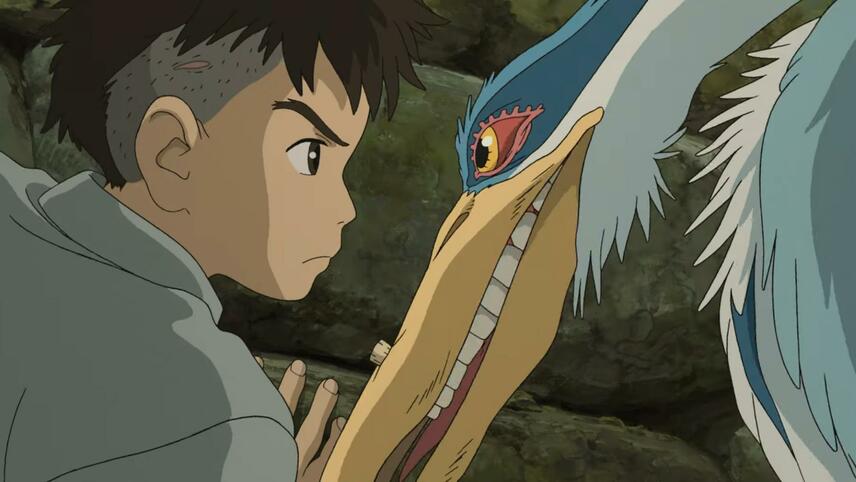
Director/Writer/Storyboard: Hayao Miyazaki · Cinematographer: Atsushi Okui · Composer: Joe Hisaishi · Editors: Rie Matsubara, Takeshi Seyama, Akane Shiraishi · Art Director: Yoji Takeshige · Producer: Toshio Suzuki · Key Cast (Japanese): Soma Santoki (Mahito), Masaki Suda (Grey Heron/Heron Man), Ko Shibasaki (Kiriko), Takuya Kimura (Shoichi), Yoshino Kimura (Natsuko/Young Himi), Aimyon (Lady Himi), Shinobu Otake (Old Kiriko) · Runtime: 124 minutes · Studio: Studio Ghibli · Distributor: Toho (Japan), GKIDS (US) · Country: Japan · Language: Japanese · Box Office: ~$175 million worldwide
The Dream That Refuses to Explain Itself
Hayao Miyazaki retired in 2013. He came back. He spent seven years making The Boy and the Heron. When a preview screening was held in early 2023, a message from the director was read aloud after the credits: “Perhaps you didn’t understand it. I myself don’t understand it.”
This is not false modesty. It is a declaration of method. The Boy and the Heron is Miyazaki’s most personal film, his most opaque, and his most stubbornly resistant to the interpretive frameworks that have been successfully applied to everything else he has made. Spirited Away has a legible structure: a girl enters a spirit world, completes tasks, rescues her parents, returns home transformed. The Boy and the Heron has a boy whose mother dies in a fire, a grey heron that is actually a man, a tower that contains a portal to a world between life and death, an ancient granduncle who maintains that world’s fragile equilibrium using stacked blocks, and an army of parakeets plotting a coup. It has a girl who is the boy’s dead mother as a child. It has pelicans that eat unborn souls. It has Miyazaki’s childhood, his mother’s illness, his ambivalence about his own legacy, and the question of whether anyone can inherit another person’s creative vision, stirred together and set loose as narrative without explanation.
The film is set during World War II. Twelve-year-old Mahito Maki loses his mother in a hospital fire during a Tokyo air raid. His father remarries his mother’s younger sister, Natsuko, and the family relocates to the countryside. Near the estate, a dilapidated tower built by a mysterious great-granduncle attracts Mahito’s attention, along with a grey heron that seems to speak. Mahito enters the tower and descends into a world where the dead persist, where time bends, and where the granduncle has been sustaining a precarious order by balancing magical blocks. The granduncle wants Mahito to inherit this responsibility. Mahito refuses. The world collapses. Everyone returns to reality.
This is, transparently, a film about Miyazaki’s relationship to his own art and to the question of succession. The granduncle, alone in his tower, arranging fragile structures that will fall apart without him, is Miyazaki at Studio Ghibli. The blocks are films. Mahito’s refusal to inherit the tower is Miyazaki’s acknowledgment that his vision cannot be transferred to another person, not even to his son Goro, who has directed Ghibli films with mixed results. The Boy and the Heron is a farewell that knows it is a farewell, and its strangeness is the strangeness of a man trying to say everything he has left to say in a single, sprawling, bewildering gesture.
Is it a masterpiece? It is a masterpiece of animation and a complicated achievement as narrative. The hand-drawn imagery is among the most beautiful Miyazaki has ever produced. The emotional core, Mahito’s grief and his tentative acceptance of a world that includes both loss and continuation, is genuinely moving. But the film’s narrative logic operates by association rather than causation, and its second half, in the tower world, unfolds with the disconnected intensity of a dream that is not yet willing to become a story. Some viewers will find this liberating. Others will find it frustrating. Both responses are correct, and Miyazaki, who does not understand it himself, would probably agree.
Verdict: 8/10
Mahito’s Wound and the Self-Inflicted Truth
Mahito Maki, voiced with careful restraint by Soma Santoki, is unlike any previous Miyazaki protagonist. He is not adventurous like Chihiro. He is not fierce like San. He is not dreamy like Kiki. He is angry, controlled, and damaged. His mother’s death has left him with a grief he cannot articulate and a fury he cannot direct. Early in the film, he smashes a rock against his own head, opening a wound that leaves a visible scar for the rest of the story.
The self-inflicted wound is the film’s most startling moment, and it operates on multiple levels. Within the narrative, it is a child’s desperate bid for attention and control: by hurting himself, Mahito forces the adults around him to respond to him rather than to the war, the move, or the new marriage. As autobiography, it is Miyazaki’s admission that his own creative obsessions have been, in some sense, self-destructive. The scar does not heal cleanly. It remains visible throughout the film, a reminder that the damage has been done and that going forward will mean carrying it.
Mahito does not undergo a conventional arc of healing. He does not learn to love Natsuko by the end of the film, though he agrees to call her “mother.” He does not conquer his grief. He survives it. The distinction matters. Miyazaki’s earlier films tend toward emotional resolution: Chihiro earns her parents’ freedom, Ashitaka finds a way to live in both worlds, Sophie breaks the curse. Mahito’s resolution is quieter and less satisfying. He walks out of the tower carrying a block that disintegrates in his hands. The magical world is gone. The real world, with its fires and its wars and its absent mother, is what remains. He accepts this. He does not celebrate it.
The Grey Heron, voiced by Masaki Suda, functions as Mahito’s trickster guide, a character drawn from myth who combines the roles of tempter, companion, and comic relief. The Heron lies constantly, shifts shape, and oscillates between menace and buffoonery. His relationship with Mahito echoes the dynamic between Miyazaki and his audience: a figure who promises wonders, delivers them in unexpected forms, and cannot be entirely trusted.
Seven Years, Sixty Animators, and the Hand That Still Draws
The Boy and the Heron took seven years to produce. Sixty animators drew it by hand. By May 2020, after three years of work, only 36 minutes had been completed. Producer Toshio Suzuki described the production as operating with no deadlines, a luxury afforded by Studio Ghibli’s financial reserves and streaming deals for its back catalog. According to Suzuki, it is the most expensive film ever produced in Japan.
These numbers represent more than logistical trivia. They represent a position. Miyazaki has always been an advocate of hand-drawn animation, and The Boy and the Heron is his most emphatic statement against the industry’s transition to digital methods. Every frame is drawn on paper. Every movement is animated by hand. The result has a texture that CGI cannot replicate: lines that breathe, backgrounds that feel painted rather than rendered, motion that carries the slight irregularities of human labor. The difference between hand-drawn and digital animation is not merely aesthetic. It is temporal. A hand-drawn film embeds human time in its images. You can feel the hours in every frame, the patience, the repetition, the physical commitment of a person sitting at a desk moving a pencil.
Atsushi Okui’s cinematography within the animation framework pushed the film into darker territory than any previous Ghibli production. Okui suggested darkening the color palette to reflect Mahito’s internal state, and the resulting images have a warmth that is perpetually shadowed. The real-world sequences use muted earth tones and the faded light of wartime Japan. The tower world is more vivid but also more volatile, its colors shifting between lush greens and unsettling purples as the magical ecosystem destabilizes. The wind, a constant presence in Miyazaki’s films, is rendered with particular attention: Okui and the animators distinguished between the windy threshold of the tower world and the eerie stillness beyond the golden gate, using grass movement and clothing physics to communicate a boundary that exists only in the air.
The fire sequences are the film’s most technically demanding achievement. The opening hospital fire, in which Mahito’s mother dies, is animated with a ferocity that exceeds anything in Miyazaki’s previous work. The flames are not beautiful. They are chaotic, greedy, and fast. Mahito runs toward the fire, not away from it, and the animation communicates the heat, the smoke, and the panic with a physicality that makes the audience flinch.
Hisaishi’s Last Collaboration: The Score as Memorial
Joe Hisaishi has scored every Miyazaki feature since Nausicaa of the Valley of the Wind in 1984. Their partnership spans forty years and twelve films. The Boy and the Heron is almost certainly their last collaboration, and Hisaishi composes as though he knows it.
The score is more restrained than his work on Spirited Away or Howl’s Moving Castle. There are no anthemic themes, no soaring melodies that embed themselves in the listener’s memory after a single hearing. Instead, Hisaishi works in quieter registers: solo piano, sparse strings, passages of near-silence that allow the animation to carry the emotional weight. The restraint is deliberate. In a film this visually dense, a more assertive score would compete with the images. Hisaishi cedes the foreground to Miyazaki’s drawings and occupies the space beneath them, providing emotional foundation without ornamentation.
The most effective passages accompany Mahito’s solitary moments: his walks through the countryside, his vigils beside his sleeping stepmother, his first glimpse of the tower. These cues have a melancholy delicacy that communicates what Mahito cannot say. The piano motif that accompanies his exploration of the tower world is built on descending intervals, each phrase stepping downward as though the music is sinking into the earth along with the boy.
Kenshi Yonezu’s theme song, “Spinning Globe,” plays over the end credits and provides the emotional release that the score has withheld for two hours. The transition from Hisaishi’s interiority to Yonezu’s pop warmth creates a tonal shift that functions almost as a return to the real world: the dream is over, the lights are coming up, and something accessible and human is playing you out of the theater. Whether this shift is graceful or jarring depends on the viewer, but its placement is structurally sound. The film needs an exit, and the song provides one.
The Tower, the Blocks, and the Architect Who Cannot Be Replaced
The granduncle is the key to The Boy and the Heron, and he is also its most transparent self-portrait. Voiced by Shigeru Kameyama in the Japanese version, he is an old man who lives alone in a world he has created, maintaining its precarious balance by stacking magical blocks. If the blocks fall, the world collapses. No one else can stack them correctly. He has been doing this for decades. He is exhausted. He wants someone to take over.
Miyazaki is the granduncle. Studio Ghibli is the tower. The blocks are the films. This reading is not subtext. It is text. The granduncle offers Mahito the chance to inherit the tower and continue the work, and Mahito refuses, choosing instead to return to the flawed, burning, grieving real world. The refusal is Miyazaki’s acknowledgment that his artistic vision is not transferable. Goro Miyazaki has directed three Ghibli features (Tales from Earthsea, From Up on Poppy Hill, Earwig and the Witch). None has matched his father’s standard. The Boy and the Heron does not address this directly, but the granduncle’s lonely, impossible vigil resonates with the reality of a studio whose identity is inseparable from its founder.
The blocks themselves are fascinating objects. They are smooth, luminous, and fragile. The granduncle stacks them with the concentration of a watchmaker, and the stack holds only through his specific knowledge of their weight, their balance, and their relationship to one another. When the parakeet king, a buffoonish militarist who wants to replace the granduncle’s careful equilibrium with his own crude order, attempts to stack the blocks himself, he fails immediately. The sequence is comic and pointed: authoritarian ambition cannot replicate the patience of genuine craft.
Whether this constitutes a satisfying climax depends on what you expect a climax to be. There is no battle. There is no triumph. There is a choice: inherit someone else’s world or return to your own. Mahito chooses his own. The tower falls. The fantasy dissolves. The parakeets become ordinary birds. Everyone goes home. The film ends with Mahito’s family preparing to return to Tokyo, the war nearing its end, the future uncertain but real.
Miyazaki at Eighty-Two: The Body of Work as Context
Hayao Miyazaki was born in 1941. He co-founded Studio Ghibli in 1985 with Isao Takahata. He has directed twelve feature films, several of which are considered among the greatest animated works ever made. Spirited Away (2001) won the Academy Award for Best Animated Feature and the Golden Bear at the Berlin Film Festival. He received an Honorary Oscar for lifetime achievement in 2014. He has retired and un-retired multiple times, each announcement received with the mixture of respect and skepticism that accompanies a figure who has repeatedly demonstrated that he cannot stop working.
The Boy and the Heron arrives at the end of this career, and it is shaped by that position. It is not a summation. A summation would be organized, retrospective, tidy. It is closer to a final improvisation: a musician who has played every song he knows sitting down for one more session and playing whatever comes, trusting that decades of craft will give shape to the spontaneity.
The film’s relationship to Miyazaki’s earlier work is allusive rather than systematic. The fire recalls the bombed landscapes of Howl’s Moving Castle and The Wind Rises. The portal to another world recalls Spirited Away’s tunnel. The ecological fragility of the tower world recalls Nausicaa’s toxic jungle. The old man alone with his life’s work recalls Porco Rosso’s melancholy. These echoes are not references in the fan-service sense. They are the natural recurrences of an artist who has spent forty years thinking about the same questions: How do you live in a world that is being destroyed? How do you create in the face of destruction? How do you let go?
Released Without a Trailer, Understood Without Consensus
The Boy and the Heron was released in Japan on July 14, 2023, with no trailers, no promotional stills, and no disclosed cast. Toshio Suzuki’s decision to forgo traditional marketing was controversial but effective: the film opened to Miyazaki’s highest debut in Japan, driven entirely by the director’s name and the audience’s curiosity. The absence of marketing created an unusual theatrical experience. Audiences entered the film knowing almost nothing about what they would see, and the resulting disorientation was, for many viewers, part of the experience.
Internationally, the film premiered as the Opening Night Gala at the Toronto International Film Festival, a first for both a Japanese and an animated film. GKIDS released it in North America in December 2023, where it opened to $12.8 million, the highest ever for a Miyazaki film in the US. Its worldwide gross reached approximately $175 million. It won the Academy Award for Best Animated Feature, Miyazaki’s second after Spirited Away.
Critical reception was warm but divided. The animation was universally praised. The narrative was not. Some critics embraced the film’s dreamlike logic as a fitting capstone to Miyazaki’s career, a final expression of the intuitive, associative storytelling that had always been his signature. Others found the second half incoherent, its fantasy world overstuffed with ideas that never coalesce into a satisfying structure. Rotten Tomatoes records a 95% approval rating, but the consensus masks significant disagreement about what the film means and whether its opacity is a strength or a limitation.
The honest assessment is that it is both. The Boy and the Heron is a great animated film that is also a flawed narrative film, and the flaw is inseparable from the greatness. Miyazaki made exactly the film he wanted to make, and the film he wanted to make does not care whether you understand it. That is either the privilege of genius or the indulgence of an artist who has earned the right to be indulged. The difference between those two things may not exist.
What the Dream Reveals on the Second Visit
The Boy and the Heron is a substantially different film on second viewing. The narrative confusion that may dominate a first encounter recedes, and the emotional architecture becomes visible.
Watch the fire sequence again with awareness that the mother’s younger self will appear later as Lady Himi. The film is structured so that Mahito’s journey through the tower world is also a journey toward his mother, and the fire that killed her is the event that, in the film’s mythological logic, sent her into the world between living and dead where he can find her. The fire is simultaneously destruction and portal, and on second viewing, every flame contains both meanings.
Track the wind. Miyazaki’s animators devoted extraordinary attention to distinguishing between different kinds of wind in different parts of the film. The real world has natural, inconsistent gusts. The threshold of the tower world has aggressive, swirling wind. The interior of the tower world, beyond the golden gate, has no wind at all. This absence is the first sign that the tower world is artificial, maintained rather than alive. The wind returns when the world collapses, and its return signals the return of natural disorder.
Pay attention to what Mahito carries out of the tower. He takes a single block. It disintegrates in his hands as he crosses back into the real world. The magical order cannot survive contact with reality. This is Miyazaki’s final statement about his own art: the worlds he built exist only inside the tower of cinema. They cannot be carried into the real world. They cannot be inherited. They can only be remembered.
Notice the heron’s final transformation. Throughout the film, the heron has been a trickster, shifting between menace and comedy. In the final sequence, he is simply a bird. The magic is gone. The performance is over. The heron flies away. If there is a more honest image of an artist stepping offstage, it has not been animated.
Film Trivia
No trailer, no stills, no cast list. Producer Toshio Suzuki decided to release the film in Japan with no marketing campaign whatsoever. No trailers were shown. No promotional images were released. The cast was not disclosed until after the premiere. The film opened to Miyazaki’s highest debut in Japan, proving that the director’s name alone was sufficient to fill theaters.
Seven years of hand-drawing. Sixty animators spent approximately seven years producing the film entirely by hand on paper. After three years, only 36 minutes had been completed. The production operated with no deadlines. According to Suzuki, the film is the most expensive ever produced in Japan, its costs offset by streaming deals for Ghibli’s existing catalog.
“Perhaps you didn’t understand it.” At a preview screening in early 2023, a message from Miyazaki was read aloud after the credits: “Perhaps you didn’t understand it. I myself don’t understand it.” The statement has been interpreted variously as humility, provocation, or an accurate description of the film’s relationship to conventional narrative logic.
The retirement that did not last. Miyazaki announced his retirement in September 2013 after completing The Wind Rises. He reversed his decision after directing the short film Boro the Caterpillar (2018) for the Ghibli Museum. He began storyboarding The Boy and the Heron in July 2016. He was 82 years old when the film was released.
This entry selects analytical dimensions from a pool. The five anchors are present: critical verdict, performances, visual craft (here encompassing both animation technique and Okui’s cinematographic approach), reception and legacy, and rewatchability guide. Earned sections cover Hisaishi’s score, Miyazaki’s body of work, and the film’s production history (absorbed into the hand-drawn animation discussion). Two wildcard sections address qualities specific to this film: Mahito’s self-inflicted wound as both narrative event and autobiographical confession, and the granduncle’s tower as Miyazaki’s most explicit self-portrait. An adaptation section is omitted because the film is not an adaptation of its namesake novel (Yoshino’s How Do You Live? serves as thematic reference, not source material). A cultural context section on wartime Japan is omitted because the war operates as emotional backdrop rather than as a subject the film engages with analytically.

Leave a Reply