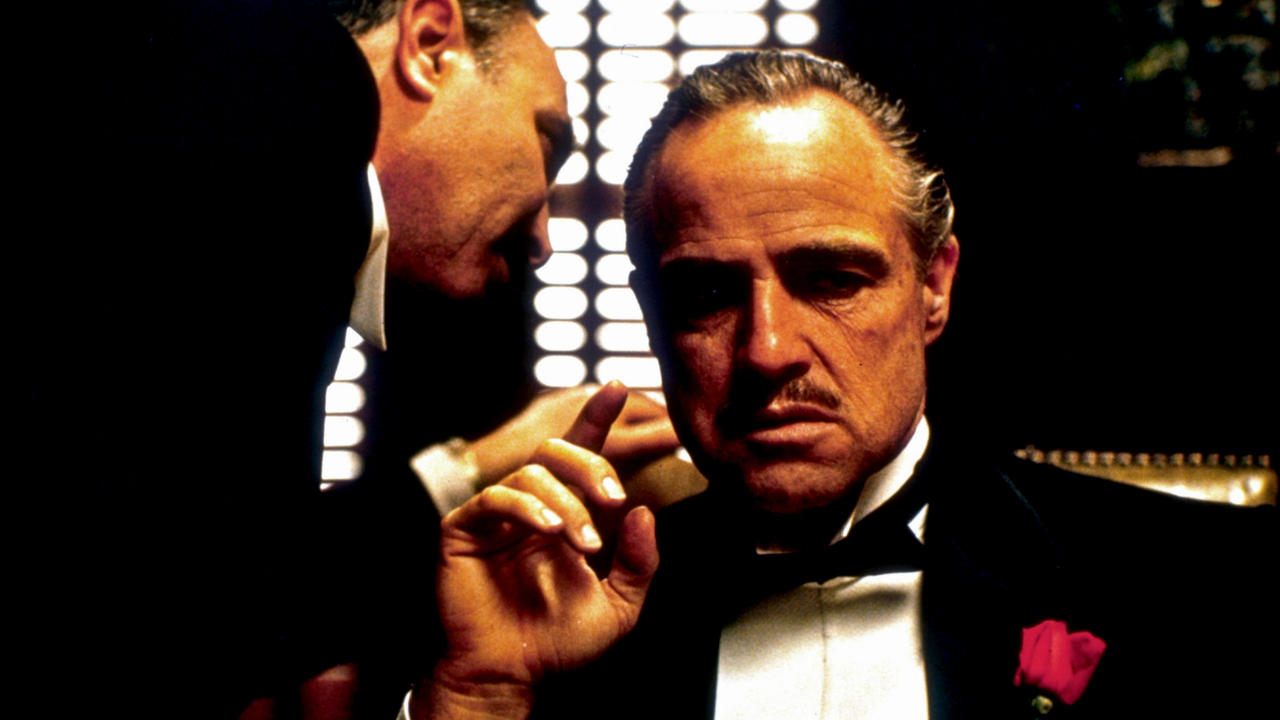
Director: Francis Ford Coppola · Cinematographer: Gordon Willis · Composer: Nino Rota · Starring: Marlon Brando, Al Pacino, James Caan, Robert Duvall, Diane Keaton, John Cazale, Talia Shire, Richard Castellano · Runtime: 175 minutes · Studio: Paramount Pictures · Budget: $6.2 million · Box Office: $250 million worldwide (1972 dollars)
1. The Godfather: The American Dream with a Body Count
Here is the most essential thing to understand about The Godfather: it is not a gangster film. It is a film about America that happens to use gangsters as its vocabulary.
The plot follows a Mafia family. The theme follows something much older: the promise that in America, a man can build an empire from nothing, protect his family, command respect, and pass his legacy to his children. The Corleones believe this. They have achieved it. And the film’s devastating argument is that this achievement and the violence required to sustain it are not contradictions. They are the same thing. The American Dream doesn’t get corrupted by crime in this film. Crime is the dream, executed with slightly less paperwork than its legitimate counterpart.
Michael Corleone’s arc is the spine of this argument. He begins as the family’s exception: a war hero, a college-educated outsider, a man who has chosen legitimacy. “That’s my family, Kay. It’s not me.” By the final frame, he has become his father’s truest heir, more ruthless than Vito ever was, and the door closing on Kay’s face is the door closing on every alternative life he might have lived. Coppola and Puzo constructed one of cinema’s great tragedies by making it look, at every single step, like a reasonable decision. Michael never makes a choice that doesn’t make sense in the moment. That is the horror.
The filmmaking is so accomplished that it has become almost invisible through familiarity. Fifty years of imitation have trained audiences to see its techniques as default, which obscures how radical many of its choices were in 1972. Gordon Willis’s cinematography was so dark that Paramount executives feared the film was unprojectable. Brando’s casting was resisted at every level. The pacing is novelistic in an era that rewarded tightness. Coppola trusted audiences to follow Italian dialogue without subtitles, to sit through a 175-minute running time, and to engage with a protagonist whose moral arc moves in only one direction: down.
Are there weaknesses? Minor ones. Diane Keaton’s Kay Adams is underwritten in this first installment, functioning more as a symbol of the legitimate world than as a fully realized character. (The sequel corrects this.) Some of the secondary mob negotiations in the middle act have a procedural density that requires concentration. And the film’s treatment of women generally confines them to the margins of rooms where men make decisions, which is historically accurate to the world depicted but still a limitation of perspective.
These are footnotes on a masterpiece. The Godfather is one of a handful of American films that operates simultaneously as popular entertainment and as serious art, as a genre landmark and as a cultural document, as a story about one family and as a parable about national identity. Fifty-plus years later, it has lost nothing.
Verdict: 10/10
2. Gordon Willis and the Darkness You Can’t See Into
Gordon Willis was nicknamed “The Prince of Darkness” by his peers, and The Godfather is the film that earned him the title. His work here remains one of the most distinctive and influential cinematographic achievements in American cinema, and it begins with a choice that nearly got him fired: he refused to light his actors’ eyes.
In conventional Hollywood cinematography, the eyes are sacred. A fill light ensures they are visible, expressive, readable. Willis eliminated the fill. He lit The Godfather’s interiors primarily from above, using overhead practicals and carefully controlled shafts of window light, so that the characters’ eye sockets fell into shadow. The result is that Vito Corleone’s eyes are often invisible. You see the jaw, the cheekbones, the gestures. But the eyes, the part of the face that communicates intention, remain in darkness.
This is not a decorative choice. It is a moral one. Willis understood that the Corleones’ power depends on opacity. You cannot read these men. You cannot see what they are thinking. The darkness in the frame mirrors the darkness of their interior lives, and it extends the same courtesy of concealment that the characters extend to each other. In this world, what you don’t show is more powerful than what you do.
The contrast between interior and exterior is systematic. The Corleone compound interiors are caves: amber, underlit, heavy with shadow and wood and cigar smoke. The wedding sequence that opens the film cuts continuously between these dark interiors (where business is conducted, favors are traded, power is exercised) and the blazing sunlight of the garden party outside (where the family performs its public face of celebration). Two worlds, two lighting schemes, one family. Willis never lets you forget which world holds the real power.
Color operates on a similarly principled axis. The film’s palette is dominated by warm amber and brown tones that evoke old money, old wood, old-world Europe. Willis and production designer Dean Tavoularis created rooms that look like Renaissance paintings: heavy drapery, polished surfaces, pools of candlelight. The visual reference is deliberate. The Corleones see themselves as an aristocracy, and Willis photographs them as one. The violence, when it comes, disrupts this palette: Sonny’s death at the tollbooth is a sudden eruption of daylight and red, a rupture in the visual order that mirrors the rupture in the family’s stability.
One specific technical detail illuminates Willis’s method. For the scene where Michael shoots Sollozzo and McCluskey in the restaurant, Willis lit the set with a single overhead source. Michael’s face moves in and out of the light as he leans forward and sits back. In the moment before the killing, his face is half-lit: one eye visible, one eye in shadow. The image captures the precise instant of his transformation, the last moment when Michael Corleone is half one thing and half another.
3. Brando’s Mumble, Pacino’s Stillness
The central performances of The Godfather form a dialogue between two acting philosophies, two generations, and two conceptions of power. Brando’s Vito is power that no longer needs to prove itself. Pacino’s Michael is power in the process of being born. Between them, the film dramatizes succession not just as a plot event but as an evolution in the nature of authority itself.
Marlon Brando as Vito Corleone. Brando was forty-seven when he played the aging Don, and the performance required a physical transformation that went far beyond the famous dental prosthetics and cotton-stuffed cheeks. Brando lowered his voice to a rasping whisper. He slowed his gestures to a deliberate, heavy-limbed tempo. He petted cats, smelled roses, tilted his head with an almost reptilian patience. Every physical choice communicates the same idea: this is a man who has moved past urgency. He does not need to raise his voice because the people around him are already listening. He does not need to move quickly because no one will start without him.
The voice is the performance’s most celebrated element, and rightly so. Brando’s whispery rasp forces everyone in the room to lean in, to quiet down, to attend. It is a vocal performance that turns softness into dominance. But watch his hands. Brando’s Vito touches everything: faces, shoulders, fabric, fruit. He is constantly establishing physical contact, and each touch is simultaneously affectionate and proprietorial. He touches the way a king touches his subjects: with tenderness that contains possession.
The greatest single moment in Brando’s performance is the scene with the undertaker Bonasera, which opens the film. Vito listens to a man’s grief, declines a request for murder, negotiates a bond of obligation, and accepts a supplicant’s allegiance. He does all of this in approximately five minutes, mostly while seated, mostly in shadow, and mostly in a whisper. It is a complete dramatization of how power works: not through force but through the architecture of indebtedness.
Al Pacino as Michael Corleone. Pacino’s challenge was the opposite of Brando’s. Where Brando played power at rest, Pacino had to play power emerging, and he had to do it through suppression rather than expression. Michael is the most dangerous person in every room he enters, and Pacino communicates this by doing almost nothing.
Watch Pacino’s face during the scenes before the restaurant killing. His features are composed, almost blank. But his eyes are working continuously, calculating trajectories, measuring distances, reading faces. When he excuses himself to use the bathroom and retrieves the gun, his hands shake. This is the last moment of Michael’s civilian life, the last time his body betrays him. After the killing, the trembling stops. For the rest of the film, and for the rest of the trilogy, Michael’s hands are steady.
The performance is structured as a subtraction. Scene by scene, Pacino removes warmth, humor, spontaneity, vulnerability. By the final act, Michael’s face has become a mask. The smile he offers Kay has no warmth behind it. The voice that once joked at the wedding now issues instructions in flat, measured tones. Pacino achieves something remarkable: he makes you watch a man hollow out from the inside while his exterior becomes increasingly polished and controlled. The Michael of the final scene is, by any external measure, more impressive than the Michael of the first scene. He is also, by every internal measure, less human.
The Supporting Ensemble. James Caan’s Sonny is all external combustion: loud, physical, sexually voracious, incapable of concealing anything. He is what Michael might have become if Michael lacked discipline, and Caan plays him with an explosive charisma that makes his death feel like a force of nature being extinguished. John Cazale’s Fredo, in his limited screen time, establishes the family’s tragedy in miniature: a gentle, inadequate man destroyed by the gap between what his family needs and what he can provide. Cazale communicates Fredo’s self-awareness of his own inadequacy through posture alone. He slumps. He stands slightly behind the others. He occupies the edge of frames where his brothers occupy the center.
Robert Duvall’s Tom Hagen is the family’s institutional memory, its legal superego. Duvall plays him as a man who has rationalized everything, who has converted violence into procedure, and whose calm is not peace but the absence of conscience. It is a performance so controlled that you can forget Duvall is acting, which is, of course, the highest form of the craft.
4. Nino Rota’s Waltz with Death
Nino Rota’s score for The Godfather is among the most recognized in cinema history, and its fame has paradoxically made it difficult to hear clearly. The main theme has been parodied, quoted, and repurposed so many times that it has calcified into cultural shorthand for “the Mafia.” Hearing it fresh requires effort. The effort is worth it.
The main theme, usually referred to as “Speak Softly Love” (though this title comes from the later vocal version, not Rota’s original composition), is a waltz. This is a crucial detail. A waltz is a dance of formal elegance, of old-world sophistication, of social ritual. Rota chose to score a story about organized crime with a melody that evokes Viennese ballrooms and Italian piazzas. The theme does not sound menacing. It sounds melancholy, noble, almost romantic. It treats the Corleones the way the Corleones treat themselves: as an aristocratic family whose business happens to involve murder.
This is Rota’s interpretive genius. He does not score the violence. He scores the family’s self-image. The music tells you what the Corleones believe about themselves, which is not the same as what they are. The gap between the nobility of the score and the brutality of the narrative is where the film’s irony lives.
The trumpet solo that opens the main theme has a specific tonal quality: thin, slightly mournful, deliberately unpolished. It sounds like a street musician in a small Italian town, not like a Hollywood orchestra. This choice roots the score in the Corleones’ immigrant origins, in the old country they carry inside themselves. When the full orchestral arrangement swells behind the trumpet, it mirrors the family’s American transformation: the same melody, the same soul, but louder, bigger, more powerful. More dangerous.
Rota’s score was controversial at the Academy Awards. He was initially nominated for Best Score but was disqualified when it was discovered that portions of the love theme bore resemblance to a melody Rota had used in the 1958 Italian film Fortunella. This disqualification remains contentious. Rota consistently used self-quotation across his career (he composed over 150 film scores, including extensive work with Fellini), and the thematic material in The Godfather, while sharing DNA with the earlier work, is developed and orchestrated in ways that constitute a substantially different composition. The Academy reversed its position for Part II, awarding Rota the Oscar. The initial snub remains a sore point in film music history.
5. From Pulp to Pantheon: Puzo’s Novel and Coppola’s Transformation
Mario Puzo’s The Godfather was published in 1969 and spent sixty-seven weeks on the New York Times bestseller list. It was also, by Puzo’s own cheerful admission, not great literature. He wrote it to make money. He succeeded spectacularly. The novel is entertaining, sprawling, and populated with vivid characters, but it is also padded with subplots (Sonny’s mistress and her anatomical situation; Johnny Fontane’s Hollywood career in granular detail; a lengthy Las Vegas digression) that read more like airport-novel detours than essential narrative architecture.
Coppola’s adaptation is a masterclass in compression, elevation, and omission. What he kept: the family structure, Michael’s arc from outsider to don, the inter-family war, the wedding opening, the Sicilian exile, the baptism finale. What he cut: virtually all of the novel’s pulpier material, the subplots that don’t serve the central tragedy, the passages where Puzo’s prose slips into melodrama.
What Coppola added is more interesting than what he cut. The novel tells you what characters are thinking. Puzo will narrate Michael’s internal calculations, his rationalizations, his strategy. Coppola eliminates all of this interiority and replaces it with Pacino’s face. The audience must read Michael the way Michael reads his enemies: by watching, by inferring, by never quite knowing for certain. This single adaptation decision transforms a readable thriller into a cinematic tragedy. In the novel, Michael is a character you understand. In the film, Michael is a character you study.
Puzo co-wrote the screenplay with Coppola, and the collaboration was reportedly complementary rather than competitive. Puzo brought structural instinct and dialogue (much of the film’s most quotable language originates in the novel). Coppola brought cinematic thinking: he understood which scenes played as images rather than words, which emotions could be communicated through editing rather than exposition, and where the novel’s explanations needed to be replaced with silence. The screenplay won them both the Academy Award, and it remains one of the finest novel-to-film adaptations ever produced.
One specific adaptation choice illuminates the difference between the two versions. In the novel, Michael’s decision to kill Sollozzo is narrated with extensive internal reasoning. We are inside his head. We understand his logic. In the film, the decision is communicated through a single scene: Michael at the family meeting, proposing the plan, his voice calm and certain. We see the other men’s faces register surprise, then assessment, then agreement. Michael’s interiority is replaced by the room’s reaction to him. This is the difference between literature and cinema, and Coppola understood it absolutely.
6. The War for the Film: How Paramount Nearly Destroyed Its Own Masterpiece
The production history of The Godfather is, in itself, a story about power, loyalty, and institutional hostility. It could almost be a Corleone family subplot.
Coppola was not Paramount’s first choice to direct. He was not their second choice. The studio approached several established directors, including Sergio Leone (who declined to pursue his own Mafia project, which eventually became Once Upon a Time in America) and Peter Yates. Coppola, a young director whose most notable credit was The Rain People, was selected partly because he was Italian-American (the studio wanted authenticity, or at least insulation from accusations of exploitation) and partly because he was cheap. A young, relatively powerless director would be easier to control. This calculation proved spectacularly wrong.
The fights began immediately. Paramount wanted the film set in contemporary Kansas City to save money on period production design. Coppola insisted on 1940s New York. Paramount wanted a tight, commercial 120-minute thriller. Coppola delivered a 175-minute epic. The studio wanted Robert Redford or Ryan O’Neal for Michael. Coppola wanted Pacino, who was then virtually unknown and had screen-tested badly. The studio wanted Danny Thomas for Vito. Coppola wanted Brando, who was considered unemployable due to a string of commercial failures and a reputation for being impossible on set.
The Brando battle was the most consequential. Paramount president Stanley Jaffe reportedly declared: “As long as I’m president of this company, Marlon Brando will not be in this picture, and I will no longer allow you to discuss it.” Coppola persuaded the studio to let Brando screen-test (framed as a “makeup test” to preserve the actor’s dignity). Brando stuffed his cheeks with cotton, slicked back his hair, and improvised the character on camera. The test was so convincing that even Jaffe relented. It is one of cinema’s great what-if moments: The Godfather without Brando is an entirely different, almost certainly lesser film.
Coppola was nearly fired during production. Multiple times. The studio assigned a replacement director (Elia Kazan was one name floated) who would shadow the production and take over if Coppola faltered. The crew’s initial loyalty was split. Coppola has spoken about the psychological toll: directing a film about family loyalty while experiencing institutional betrayal from the organization that employed him. The parallels were not lost on anyone involved.
The Italian-American Civil Rights League, led by Joseph Colombo (himself a reputed mob boss), organized protests against the production, demanding that the words “Mafia” and “Cosa Nostra” be removed from the script. Coppola and Puzo complied, and the finished film never uses either term. This is partly why the Corleones’ criminal enterprise feels so naturalized: without the label, the organization simply becomes “the family business,” which is precisely the framing the characters themselves prefer.
7. The Baptism: Cinema’s Greatest Piece of Parallel Editing
The baptism sequence near the film’s climax is frequently cited as one of the greatest scenes in cinema history, and the claim is justified. It is also a textbook in how parallel editing can function not merely as a storytelling technique but as a moral argument.
The sequence intercuts between two events. Michael stands in a church as godfather to his nephew, renouncing Satan and professing faith. Simultaneously, his men execute a coordinated series of murders across the city, eliminating the heads of the rival families. Coppola cuts between the sacrament and the slaughter with increasing speed, compressing the two realities into a single rhythmic experience.
The effect is not merely ironic (though the irony is devastating: “Do you renounce Satan?” / cut to a man being shot in an elevator). The editing creates a genuine argument about the relationship between ritual and violence. Both the baptism and the murders are rituals. Both follow scripts. Both involve preparation, costume, formal language, and predetermined outcomes. The parallel editing reveals that Michael’s spiritual performance and his criminal performance are structurally identical. The church and the assassination are not opposites. They are the same act conducted in different registers.
The pacing of the cuts is worth studying in detail. The sequence begins slowly, with long stretches inside the church. The murders are initially brief interruptions. As the sequence progresses, the cutting accelerates, the murder footage lengthens, and the church footage shortens. By the climax, the two streams are nearly equal in weight, cutting back and forth in rapid succession. This rhythmic structure mirrors Michael’s internal reality: the legitimate face is shrinking, the criminal reality is expanding, and they are converging into a single, indivisible identity.
The organ music that accompanies the baptism continues through the murder sequences. Coppola does not switch to a separate score for the killings. The sacred music scores the profane violence. This is the single most important audio decision in the film: it tells you that, in Michael’s world, the two spheres are no longer separable. The church music is the murder music. The murder music is the church music. Michael is, from this moment forward, both godfather and Godfather. The title’s double meaning, which has functioned as a clever pun throughout the film, here becomes a lived reality.
8. Food, Wine, and the Table as Battlefield
No standard analytical framework has a section for food. The Godfather demands one.
Food in this film is never incidental. It is never merely atmospheric Italian-American color. Food is how the Corleones conduct business, establish hierarchy, perform intimacy, and mark territory. Every significant scene in the film is either preceded by, accompanied by, or concluded with the preparation, serving, or consumption of food.
The wedding opens with an abundance that borders on excess: tables of food, flowing wine, a towering cake. This is the Corleone family at its most public and most generous. Food here signals prosperity, generosity, belonging. To eat at the Corleone table is to be inside the circle. To refuse the table is to be outside it.
Clemenza’s cooking lesson (“Leave the gun, take the cannoli”) is the film’s most compact demonstration of how food and violence coexist without friction. Clemenza teaches Michael to cook sauce for twenty people with the same matter-of-fact competence he brings to organizing a hit. The recipe instructions are genuine. The murder instructions are genuine. Both are household tasks. The cannoli that Clemenza retrieves from the car after a man has been shot in the front seat is not a joke, though audiences laugh. It is a statement about normalization. In this world, a good cannoli is worth salvaging from a murder scene. Priorities are priorities.
The Sollozzo restaurant scene transforms dining into assassination. Michael meets his enemies at a table. They eat. They talk. The conversation has the cadence of a business dinner. And then Michael kills them. The restaurant table is the site of the film’s pivotal moral crossing precisely because it is a space associated with civilization, negotiation, and shared humanity. By committing murder at a dinner table, Michael desecrates the one ritual that all cultures use to signal peace.
Vito’s death occurs in a garden, playing with his grandson among tomato plants. The old Don, who built an empire through violence, dies in a setting of organic growth, surrounded by the food he helped cultivate. It is the most peaceful death in the film, and the tomatoes are its visual signature: red, ripe, earthbound. Vito dies among vegetables. His enemies die in barbershops, on causeways, in revolving doors. The difference is the film’s final comment on who the Corleones believe they are versus what they have done.
9. 1972: Nixon, Vietnam, and the Family You Can’t Refuse
The Godfather premiered in March 1972. Richard Nixon was president. The Vietnam War was grinding toward its endgame. The Watergate break-in was three months away. The counterculture of the 1960s had soured into disillusionment, and the national mood was characterized by a specific kind of cynicism: the suspicion that the institutions running America were not merely flawed but fundamentally corrupt.
Into this moment arrived a film that depicted an immigrant family running a vast criminal enterprise with more honor, discipline, and internal coherence than the United States government was displaying on the nightly news. This was not coincidental. Audiences in 1972 were primed to receive the Corleones sympathetically because the legitimate alternatives had discredited themselves.
The film does not make this argument overtly. It does not reference Vietnam or Nixon or Watergate. It doesn’t need to. The resonance operates structurally. The Corleones’ organization functions as a shadow government: it has its own diplomacy (the meeting of the five families), its own judiciary (Vito’s dispensation of favors), its own military (the soldiers and enforcers), and its own code of conduct. Watching the Corleones in 1972 was, for many audience members, watching a more competent and more principled version of the governance they were living under.
Italian-American Identity. The film’s relationship to Italian-American culture is complex and remains contested. For many Italian-Americans, The Godfather perpetuated damaging stereotypes by conflating Italian identity with organized crime. The Italian-American Civil Rights League’s protests during production were genuine expressions of community concern. For others, the film represented the first time Italian-American family culture was depicted on screen with dignity and depth rather than as caricature. Both responses are legitimate, and the tension between them has never fully resolved.
The Corleone family’s immigrant story operates as a compressed version of the broader Italian-American experience: the old-world values carried across the Atlantic, the economic struggle, the gradual acquisition of American power, the second generation’s ambivalence about the culture that raised them. Michael’s arc is recognizable to any child of immigrants: the pull between assimilation and loyalty, between the world you choose and the world that chose you first.
10. The Oscars, the Refusal, and the Film That Changed the Industry
The Godfather’s awards history is inseparable from its cultural impact. The film did not merely win awards. It altered the economics and ambitions of an entire industry.
At the 45th Academy Awards, The Godfather won three Oscars: Best Picture, Best Actor (Brando), and Best Adapted Screenplay (Puzo and Coppola). It was nominated for eleven. Brando’s win is remembered primarily for his refusal to accept. He sent Sacheen Littlefeather, an Apache actress and activist, to decline the award on his behalf in protest of Hollywood’s treatment of Native Americans. The moment electrified the ceremony. It was booed by some in the audience and cheered by others. It remains one of the most politically significant moments in Oscar history, and it was consistent with Brando’s lifelong pattern of using his celebrity as a platform for causes he believed in, regardless of professional consequences.
The film’s box office performance reshaped Hollywood’s understanding of what a prestige film could earn. $250 million worldwide (equivalent to roughly $1.8 billion today, adjusted for inflation) on a $6.2 million budget was a return ratio that made every studio recalibrate its ambitions. Before The Godfather, the prevailing assumption was that serious, adult drama and massive commercial success were largely incompatible. The Godfather proved otherwise, and its commercial model influenced the development strategies that led to Jaws (1975) and Star Wars (1977): the idea that a well-made film with broad appeal could become not just a hit but a cultural event.
The film’s long-term legacy extends beyond its own commercial performance. It legitimized the director as an authorial figure in American studio filmmaking, paving the way for the New Hollywood generation (Scorsese, Spielberg, De Palma, Lucas) to negotiate for creative control. It established A-list acting as a component of commercial viability. It demonstrated that audiences would accept long, slow, morally complex narratives if the craft was sufficiently compelling. And it set the template for the modern American crime epic, a lineage that runs through Goodfellas, Heat, The Sopranos, and The Wire.
11. Coppola Before the Empire: A Young Director’s Gamble
Francis Ford Coppola was thirty-two years old when The Godfather was released, and the film’s triumph obscures how unlikely his involvement was and how precarious his position remained throughout.
Before The Godfather, Coppola’s career was a patchwork of art-house ambition and commercial disappointment. Dementia 13 (1963) was a low-budget horror film made for Roger Corman. You’re a Big Boy Now (1966) and The Rain People (1969) were personal, director-driven films that earned critical respect but negligible audiences. His biggest financial success was as a screenwriter: he co-wrote Patton (1970), which won the Academy Award for Best Original Screenplay. He was talented. He was not, by any conventional measure, the obvious choice to direct a major studio’s most commercially important property.
Coppola took the job, by his own account, partly for money. He was in debt. His production company, American Zoetrope (co-founded with George Lucas), needed capital. The Godfather was a commercial assignment more than a passion project, and Coppola’s genius lay in treating a hired job with the seriousness and personal investment of an independent film. He brought a European art-cinema sensibility to a Paramount genre picture: the long takes, the muted palette, the refusal to sentimentalize, the novelistic pacing. He treated the material not as pulp to be efficiently adapted but as raw material for a serious work of art.
The gamble paid off so completely that it effectively defined the next decade of Coppola’s career. The Godfather Part II followed in 1974 and surpassed the original in many critical assessments. The Conversation, also 1974, confirmed his range. And then Apocalypse Now consumed him. The trajectory from The Godfather to Apocalypse Now is the trajectory of a director whose early success gave him enough power to nearly destroy himself. But that is another entry.
12. Genre as Trojan Horse: How The Godfather Redefined the Crime Film
The Godfather did not invent the gangster film. It inherited a tradition stretching back to Little Caesar (1931), The Public Enemy (1931), and Scarface (1932). What it did, more than any film before it, was invert the genre’s moral architecture.
The classic Hollywood gangster film of the 1930s followed a rise-and-fall structure with a clear moral framework: the gangster rises through violence, enjoys a brief period of excess, and is destroyed. The audience experiences vicarious thrill followed by moralized punishment. The Production Code demanded it: crime must not pay.
The Godfather dismantles this structure entirely. The Corleones do not fall. Michael’s arc is not a rise followed by a collapse. It is a rise that continues, that succeeds, that consolidates. The film ends not with the protagonist in a gutter or a jail cell but in a leather chair, kissing his wife, receiving the pledges of his subordinates. Crime pays. Crime pays extraordinarily well. And the film does not punish Michael or the audience for this outcome. It simply shows you the cost, quietly, in the details: in Kay’s face as the door closes, in Michael’s eyes that no longer contain anything recognizable as warmth.
This was revolutionary. By refusing the genre’s traditional moral resolution, Coppola forced audiences to sit with their own complicity. You have spent 175 minutes hoping Michael will succeed. You have rooted for the murders. You have admired the strategy. And now you must confront what you were rooting for. The film’s moral power comes not from condemning the Corleones but from declining to condemn them, and letting the audience discover their own discomfort.
The genre lineage that follows from this innovation is vast. Scorsese’s Goodfellas (1990) and Casino (1995) extend the Godfather’s project by stripping away its aristocratic elegance and exposing the vulgarity beneath. Michael Mann’s Heat (1995) applies its structural symmetry between criminal and lawman. David Chase’s The Sopranos (1999) is essentially The Godfather’s moral experiment extended across six seasons: what happens when you ask an audience to live with a criminal protagonist not for three hours but for eighty-six? The answer, in every case, traces back to what Coppola established in 1972: the gangster as tragic protagonist, the audience as willing accomplice, and the absence of easy moral comfort.
13. The Corleone Rewatch: What to See When You Already Know Every Scene
The Godfather is probably the most-watched serious film in the English language. Most readers of this entry have seen it multiple times. Here is how to see it again as though you haven’t.
Watch the doors. Doors in The Godfather are a visual system. They open to admit people into power (Vito’s office). They close to exclude people from it (Kay, in the final shot). They frame conversations. They separate public and private space. On your next viewing, track every door: who opens them, who closes them, who is on which side. The film’s entire power structure is mapped in its doorways.
Watch Michael’s face, not his words. Pacino is doing something with microexpressions that most viewers miss because they are listening to dialogue. Ignore what Michael says. Watch what his face does in the half-second before he speaks. There is almost always a flash of calculation, a brief moment where the mask assembles itself before the performance begins. This is visible as early as the wedding sequence and becomes increasingly pronounced as the film progresses.
Listen for silence. Coppola uses silence strategically, and it is easy to miss in a film famous for its dialogue and its score. The moments between lines are often as important as the lines themselves. The pause before Vito agrees to help Bonasera. The silence after Michael proposes killing Sollozzo. The quiet in the hospital corridor before Michael realizes no one is guarding his father. These silences are where the characters think, and if you listen to them, you hear the film’s internal machinery.
Track who sits and who stands. Physical position in The Godfather is a power indicator. Vito almost always sits while others stand before him. When Michael begins his ascent, he increasingly occupies the seated position. In group scenes, note who gets the chair and who remains on their feet. The geography of sitting and standing mirrors the hierarchy of the family with remarkable consistency.
Watch the women watching the men. Kay, Connie, Mama Corleone, Apollonia. They are present in far more scenes than their dialogue suggests. Often they are visible in the background or at the edge of the frame, observing conversations they are excluded from. Their faces register reactions the men do not see. On a rewatch, these peripheral performances become a parallel narrative: the story of what the Corleone women know and cannot say.
The garden scene. Vito’s final conversation with Michael in the garden is the emotional heart of the film, and it is easy to focus on the dialogue (which is magnificent). On rewatch, watch Brando’s physical performance. He is playing with the light, with the tomato plants, with his grandson’s hair. His body is loose, unguarded. This is the only scene in the film where Vito Corleone is not performing authority. He is simply an old man in a garden, and Brando communicates this shift through nothing more than the relaxation of his shoulders and the rhythm of his breathing. It is one of the greatest pieces of physical acting ever filmed.
Film Trivia
The cat was a stray. The cat in Vito Corleone’s lap during the opening scene was not scripted. It was a stray that Brando found wandering around the Paramount lot and picked up before filming. The cat purred so loudly during the scene that several of Brando’s lines had to be re-recorded in post-production. One of the most iconic images in cinema history exists because an actor decided to pet a random animal.
Pacino’s screen test almost ended his career before it started. Al Pacino tested so poorly for the role of Michael that Paramount executives actively lobbied to replace him during the first weeks of shooting. They found him too short, too quiet, too still. Coppola protected him, reportedly staking his own position on the casting. The turning point was the restaurant scene. When the dailies from that sequence arrived, the studio went silent. Nobody suggested replacing Pacino again.
Coppola kept a notebook he called “The Prompt Book.” For every scene, Coppola created detailed notes in a massive binder, annotating the source novel with his own ideas about character motivation, visual approach, historical context, and thematic connections. This binder became legendary among the cast and crew. It was, in essence, the architectural blueprint of the film, and Coppola has cited it as the single most important tool he brought to the production.
The horse head was real. The severed horse head placed in Jack Woltz’s bed was not a prop. It was a genuine horse head obtained from a dog food company. Coppola wanted the reaction of the actor (John Marley) to be authentic, so Marley was not told what was under the sheets until the cameras were rolling. His scream in the finished film is not acting. The decision would almost certainly not survive modern production ethics, but the scene’s visceral impact is undeniable.
The budget ballooned from $2.5 million to $6.2 million. Paramount originally planned The Godfather as a modest, contemporary-set crime film with a budget under $3 million. Coppola’s insistence on period-accurate 1940s production design, New York location shooting, and extended runtime pushed costs to $6.2 million, a figure that caused near-constant friction with the studio. The film earned back its entire budget in the first week of release.

Leave a Reply