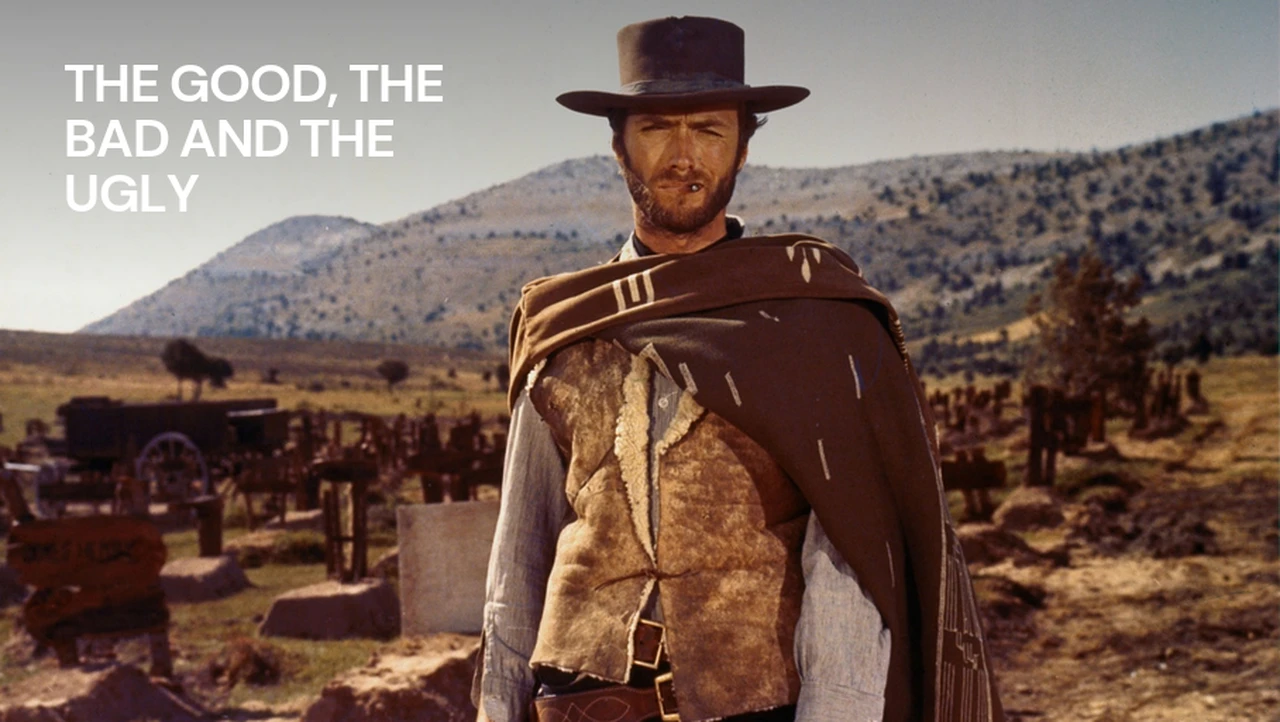
Director: Sergio Leone · Cinematographer: Tonino Delli Colli · Composer: Ennio Morricone · Editors: Eugenio Alabiso, Nino Baragli · Production Design/Costumes: Carlo Simi · Screenplay: Age & Scarpelli, Luciano Vincenzoni, Sergio Leone · Key Cast: Clint Eastwood, Lee Van Cleef, Eli Wallach · Runtime: 161 minutes (US theatrical) / 177 minutes (Italian premiere) · Producer: Alberto Grimaldi · Studio: Produzioni Europee Associati (PEA); distributed by United Artists (US) · Budget: ~$1.2 million · Box Office: ~$38.9 million worldwide
Three Scoundrels and the Invention of Cool
Strip away everything you know about this film. Forget the memes, the ringtones, the Hugo Montenegro cover version, the forty years of parodies. Forget that you can hum the theme without ever having seen the movie. Come to it fresh, if such a thing is still possible, and what you find is not the film you expected.
The Good, the Bad and the Ugly is not a celebration of gunfighters. It is a three-hour comedy about greed performed on a stage built from corpses. Its three protagonists are liars, thieves, and killers operating in the margins of the American Civil War, a conflict that kills thousands of men while they chase a box of gold coins buried in a cemetery. The war is not the backdrop. The war is the argument. Leone places his scoundrels inside the greatest catastrophe in American history and watches them ignore it entirely, because the gold is more important to them than any cause, any nation, any principle. The film’s moral vision is not cynical. It is clear-eyed. In a world this brutal, self-interest is not a vice. It is the only rational response.
What makes the film extraordinary is not its violence or its length or its famous score, though all three are remarkable. It is the tone. Leone found a register that had never existed in cinema before: operatic in scale, comic in texture, and deadly serious beneath both. The opening fifteen minutes establish this register perfectly. Three gunfighters are introduced through three sequences of escalating suspense, each scored to a different variation of the main theme, each ending in sudden violence that is simultaneously shocking and funny. Leone understood that laughter and dread occupy adjacent rooms in the audience’s mind, and he kept opening the door between them.
The performances are pitched to match. Eastwood, as the nameless bounty hunter called Blondie, barely moves. His stillness is the stillness of a predator conserving energy. Van Cleef, as the mercenary Angel Eyes, is a void: a man with no interiority, only appetite. And Wallach, as the bandit Tuco, is a force of nature, a clown and a survivor and a wounded animal, delivering what may be the most entertaining performance in the history of the Western. The film belongs to Tuco in every scene he enters. Eastwood is its icon. Van Cleef is its threat. Wallach is its beating heart.
Leone made five Westerns. This is the one that defined the genre he invented, the one whose influence is so vast that it has become invisible, absorbed into the grammar of action cinema, video games, graphic novels, and the collective understanding of what a standoff looks like. It is also, despite its reputation as a genre piece, one of the most formally accomplished films of the 1960s. The final twenty minutes, from “The Ecstasy of Gold” through the three-way standoff, constitute the greatest sustained sequence in the history of the Western, and a strong candidate for the greatest climax in all of cinema.
Verdict: 10/10
Wallach Steals the Film and the Film Lets Him
The conventional wisdom is that Clint Eastwood is the star of The Good, the Bad and the Ugly. The film’s poster centers him. His squint became a cultural icon. His Man with No Name defined a new archetype of screen masculinity: laconic, self-contained, morally ambiguous. All of this is true, and none of it matters as much as what Eli Wallach does.
Tuco Benedicto Pacifico Juan Maria Ramirez is one of the great characters in cinema. He is loud where Blondie is quiet. He is desperate where Blondie is composed. He is sentimental where Angel Eyes is hollow. In a film built on a triangle of competing interests, Tuco is the only vertex that generates genuine emotion. His scene with his brother, Padre Ramirez, is the only moment in the Dollars Trilogy where a character reveals something resembling a soul. Tuco entered the priesthood’s alternative: banditry. His brother chose the church. Neither choice was free. Both were responses to poverty. When Tuco leaves the monastery and pretends to Blondie that the visit was friendly, his lie is the most human gesture in the film.
Wallach, a classically trained stage actor from Brooklyn, was 51 years old when he shot this film. He had never made a Western. He was not a horseman. He could not shoot. He brought to Tuco the skills of a Method actor working in a genre that had no use for Method acting, and the collision produced something remarkable: a performance that is simultaneously broad and precise, cartoonish and heartbreaking. Watch Wallach in the bathtub scene, where a one-armed bounty hunter corners him mid-bath. Tuco kills the man and delivers a monologue about the futility of talking when you should be shooting. The scene is a joke. Wallach plays it as though his life depends on it, because within the scene, it does. That commitment to the reality of absurd situations is what separates Tuco from a caricature.
Eastwood, by contrast, works through subtraction. His performance is a series of removals: fewer words, fewer gestures, fewer expressions, until what remains is a silhouette. The poncho, the cigarillo, the squint. Eastwood understood, perhaps before Leone did, that a character who does less accumulates more presence. His stillness forces the camera to linger, and the lingering creates mystique. It is a brilliant screen strategy, though it cedes the film’s dramatic territory almost entirely to Wallach.
Van Cleef completes the triangle with a performance of clinical economy. Angel Eyes smiles. He is polite. He conducts his murders as transactions, completing them with the same professionalism he would bring to any contracted task. Van Cleef makes no attempt to humanize Angel Eyes, and the refusal is what makes the character terrifying. He is not evil because he enjoys killing. He is evil because killing is simply part of his job, and he does his job well.
Delli Colli and the Close-Up as Weapon
Tonino Delli Colli’s cinematography in The Good, the Bad and the Ugly operates on a principle of extremes. The frame is either impossibly wide or impossibly tight. A landscape that stretches to the horizon cuts to an eye filling the screen. A battlefield spanning miles cuts to a hand on a revolver. There is no middle distance. Leone and Delli Colli abolished it.
This technique, which has been imitated so often that it now feels like a natural grammar of action cinema, was radical in 1966. The classical Hollywood Western used the wide shot to establish geography and the medium shot to frame character interaction. Close-ups were reserved for moments of emotional intensity: a lover’s face, a dying man’s last words. Leone repurposed the close-up as a tool of confrontation. His close-ups are not intimate. They are aggressive. When the camera pushes into Angel Eyes’ face during the final standoff, the image feels like a threat. The eye is not a window to the soul. It is a gun barrel.
Delli Colli shot the film in Techniscope, a budget-friendly widescreen process that used half the normal amount of 35mm film per frame. The format produced images with more visible grain than standard anamorphic processes, and that grain became part of the film’s texture: rough, tactile, sun-blasted. The Techniscope frame is 2.35:1, wide enough to contain both the vast Spanish landscapes standing in for the American Southwest and the extreme close-ups that punctuate them. Delli Colli exploited the format’s width to create compositions where opposing characters occupy opposite edges of the frame, with empty space between them. That empty space is not dead. It is loaded. It is the distance a bullet must travel.
Leone asked Delli Colli to pay more attention to lighting than in the previous two Dollars films, and the difference is visible. The interiors have a chiaroscuro depth that the earlier films lacked. Angel Eyes’ first scene, in which he visits a homesteader for information, is lit with the precision of a Baroque painting: hard shadows, warm pools of light, darkness encroaching from the edges. The exteriors, by contrast, are bleached and merciless. The desert sequences have no shade, no relief, no color but ochre and white. When Blondie is marched through the desert without water, the overexposed sky becomes a physical presence, an enemy as dangerous as any gunslinger.
The final standoff at Sad Hill Cemetery is Delli Colli’s masterpiece within the masterpiece. Leone and Delli Colli designed the sequence as a visual escalation: the camera circles the three men, cutting from wide shots of the circular cemetery to progressively tighter close-ups. By the end of the sequence, the frame contains nothing but eyes. Three pairs of eyes, darting between two targets each, performing a calculation that will determine who lives and who dies. The cutting accelerates. The eyes narrow. And then, in one instant, it resolves. The geometry of the sequence is so precise that it feels choreographed, which it was. Leone spent three days filming it.
Morricone’s Coyotes, Trumpets, and the Sound of Myth Being Born
Ennio Morricone’s score for The Good, the Bad and the Ugly is not film music in the conventional sense. It is the film itself. Leone shot scenes to music that Morricone had already composed, extending takes until the score completed its phrase, letting the rhythm of the composition dictate the rhythm of the editing. The result is a film in which sound and image are so thoroughly fused that separating them is impossible. The music does not accompany the visuals. It generates them.
The main theme is the most recognizable piece of film music ever written, which has made it easy to overlook how strange it is. It begins with a two-note figure that mimics a coyote’s howl, played on different instruments for each character: flute for Blondie, an ocarina-like tone for Angel Eyes, human voices for Tuco. This is not melodic in any traditional sense. It is textural: whip cracks, electric guitar, guttural chanting, a jaw harp. Morricone constructed the theme from sounds that the Hollywood orchestral tradition would have considered noise, and in doing so, he invented a new musical language for the Western. Before Morricone, Westerns sounded like Dimitri Tiomkin or Elmer Bernstein: lush, orchestral, heroic. After Morricone, Westerns could sound like the desert itself.
“The Ecstasy of Gold,” which plays over Tuco’s frantic search through the cemetery for the grave containing the treasure, is the score’s peak. Edda Dell’Orso’s soprano voice rises above surging strings and triumphant brass, building from a whisper to a crescendo that matches the camera’s spinning motion through the headstones. The piece does something that very few film scores accomplish: it externalizes a character’s inner state so completely that the audience feels what Tuco feels. Not greed, exactly. Rapture. The possibility that the suffering might end. That there might, at last, be enough.
“The Trio,” which scores the final standoff, works on opposite principles. Where “The Ecstasy of Gold” soars, “The Trio” constricts. Guitars, trumpets, and castanets build a rhythm that tightens with each repetition, mirroring the closing circle of the camera. Leone asked Morricone to compose something that felt as though the dead were laughing from inside their tombs. What Morricone produced is more complex than that: it is music that treats death as a spectator sport, a piece that watches three men decide who will die with the detached fascination of an audience at a bullfight.
Morricone and Leone were elementary school classmates in Rome’s Trastevere neighborhood, though they reconnected as strangers when Leone was casting about for a composer for A Fistful of Dollars. The partnership that followed produced five films and some of the most celebrated music in cinema history. Morricone, who composed over 400 film scores before his death in 2020, was sometimes frustrated by the association. He felt it overshadowed his broader work. But the Dollars Trilogy scores, and this one in particular, are the foundation of his legend. Three million copies of the soundtrack were sold. Hugo Montenegro’s cover of the theme reached number one on the UK singles chart. The coyote howl entered the collective unconscious and never left.
Spain Plays America and Nobody Notices
The Good, the Bad and the Ugly is set during the American Civil War in the Southwestern United States. It was shot in Spain by an Italian crew with an American, an Italian-American, and a Dutch-American in the lead roles. The dialogue was performed in multiple languages and dubbed in post-production. The film’s America is a fiction built from Spanish deserts, Italian craftsmanship, and a European imagination that had never visited the places it was depicting.
This should have been a problem. It was not. It was a revelation.
Leone’s West is not John Ford’s Monument Valley, majestic and mythic, bathed in the golden light of American exceptionalism. Leone’s West is a wasteland. It is ugly, dusty, and cruel. The towns are collections of rotting wood and desperate faces. The military camps are hellholes. The landscape offers no shelter and no beauty, only distance that must be crossed at the cost of thirst, exhaustion, and the constant risk of being shot. By filming in Spain’s Tabernas Desert and the arid plateaus near Burgos, Leone created a version of the American West that Americans had never seen because Americans had been romanticizing it for decades.
Carlo Simi’s production design is integral to this vision. Simi, who also designed the costumes, built entire towns for the film: functional, weather-beaten structures that look as though they have been standing in the sun for decades. The prison camp at Betterville, where Tuco is tortured while prisoners sing “The Story of a Soldier,” is a masterpiece of physical world-building. It is muddy, overcrowded, and ringed with barbed wire. The guards are bored. The prisoners are broken. The scene where the camp orchestra plays at gunpoint while Angel Eyes beats Tuco is Leone’s most explicit statement about the Civil War: it is a machine for producing suffering, and the suffering serves no purpose that any character in the film can articulate.
The cemetery at Sad Hill was built specifically for the climax. Several hundred Spanish soldiers, provided by the government as part of the production agreement, constructed thousands of wooden crosses and gravestones arranged in a circular amphitheater that deliberately evokes a Roman arena. The visual reference is not accidental. Leone understood the standoff as gladiatorial combat, and he designed the arena accordingly. The circle forces the three gunfighters into a geometry from which there is no escape except through one another.
The Civil War as Background Noise for Men Who Are Not Listening
The American Civil War runs through The Good, the Bad and the Ugly like a wound that will not close. Battles rage. Bridges are fought over. Prisoner-of-war camps consume human beings. A soldier dies slowly on a cot while Blondie gives him his coat and a cigar. None of this matters to the three protagonists. They notice the war only when it obstructs their path to the gold.
This indifference is the film’s sharpest commentary, and it is one that few American Westerns of the era would have dared to make. Hollywood had traditionally treated the Civil War with reverence, as a tragic but necessary chapter in the national story. Leone, an Italian with no stake in that narrative, saw something different: a catastrophe driven by the same greed and tribalism that drives his three scoundrels, dressed up in uniforms and rhetoric. The Union captain at the bridge, played by Aldo Giuffre, delivers the film’s only explicit anti-war speech. He is a drunk. He is dying. He describes the bridge as a piece of strategic idiocy that men die for every day, and he begs Blondie and Tuco to destroy it so the killing will stop. They comply, not out of compassion, but because the bridge is in their way.
Leone is not making a pacifist film. He is not arguing against war from a position of moral authority. He is doing something more disorienting: he is showing war from the perspective of people who do not care about it. The Civil War is not tragedy in Leone’s framing. It is terrain. It is an obstacle. It generates confusion that can be exploited and corpses that can be searched for information. By refusing to grant the war its conventional dramatic weight, Leone reveals something uncomfortable about how wars are actually experienced by most of the people who live through them: not as grand historical events but as disruptions to personal survival.
The bridge sequence is the film’s structural center and its most expensive set piece. A real bridge was constructed over the Arlanza River near the village of Hortiguela, rigged with explosives, and detonated. According to multiple accounts, the detonation had to be repeated because the first explosion was triggered prematurely. The final version, captured on the third attempt, is one of the great practical effects in cinema: a structure collapsing in real time, sending debris into the river while the camera holds steady. It is destructive and beautiful, and the beauty is the point. Leone films violence the way Morricone scores it: as spectacle, as opera, as something you cannot look away from even when you know you should.
Leone and the Invention of the Spaghetti Western
Sergio Leone did not invent the spaghetti Western. Italian filmmakers had been producing low-budget Westerns since the late 1950s, filming in Spain with multinational casts and releasing them under Americanized pseudonyms to disguise their European origins. What Leone did was something more consequential: he made a spaghetti Western that was better than the Hollywood Westerns it was imitating, and in doing so, he revealed that the genre’s mythology was not the property of any single nation.
The Dollars Trilogy began as a commercial calculation. A Fistful of Dollars (1964) was a loose, unauthorized adaptation of Akira Kurosawa’s Yojimbo, transplanting a samurai story to the Mexican border. It was cheap, fast, and staggeringly successful. For a Few Dollars More (1965) expanded the formula. The Good, the Bad and the Ugly completed the evolution from genre exercise to art.
Leone’s directorial method was built on contradiction. He worshipped the classic Hollywood Western, particularly the work of John Ford, but he made films that systematically dismantled the assumptions Ford had built. Ford’s heroes are principled. Leone’s are mercenary. Ford’s West is a frontier being civilized. Leone’s is a wilderness that civilization has abandoned. Ford’s camera respects distance and decorum. Leone’s invades personal space, pushing into faces with an intimacy that feels predatory. The reverence and the subversion coexist in every frame, and the tension between them is what gives Leone’s films their peculiar energy: nostalgic and nihilistic at the same time.
Leone made only seven films in his career. After the Dollars Trilogy, he produced Once Upon a Time in the West (1968), which many critics consider his greatest achievement, and Once Upon a Time in America (1984), a four-hour gangster epic that was brutally re-edited by its American distributor. He died of a heart attack in 1989 at the age of 60, reportedly during pre-production on a film about the Siege of Leningrad. His output was small. His influence is incalculable. Quentin Tarantino, Robert Rodriguez, the Coen Brothers, Sam Raimi, George Lucas: the list of filmmakers who absorbed Leone’s grammar is essentially a list of everyone who made action cinema after 1970.
The Standoff as Formal Innovation: Three Minutes That Rewrote Cinema
The three-way standoff at Sad Hill Cemetery lasts approximately three minutes. Leone spent three days filming it. The disproportion tells you everything about his priorities.
The sequence works through a carefully calibrated escalation of visual tension. It begins with a wide shot of the circular cemetery, establishing the arena. The three men take their positions. Morricone’s “The Trio” begins. The camera starts to circle, moving around the perimeter of the standoff in a slow orbit that mirrors the circular layout of the graves. As the music tightens, the shots tighten with it. Wide shots give way to medium shots. Medium shots give way to close-ups. Close-ups give way to extreme close-ups: eyes, hands, holsters. The editing accelerates. The cuts come faster. By the final moments, the film is oscillating between six eyes and six hands at a rhythm that approaches the threshold of subliminal cutting.
What Leone understood, and what this sequence demonstrates with absolute clarity, is that tension is a function of time. The longer you delay a resolution, the more unbearable the anticipation becomes. But there is a limit to how long an audience can sustain anticipation before it converts to boredom. Leone navigated that limit by filling the delay with visual information that is simultaneously repetitive and intensifying. Each cut to a new pair of eyes tells the audience nothing new. We already know these faces. But each cut is slightly tighter, slightly faster, slightly more aggressive, and the accumulation of these microscopic escalations creates a physiological response that has almost nothing to do with narrative. It is closer to the experience of listening to a drum beat accelerate until the silence when it stops is deafening.
The resolution, when it comes, is almost anticlimactic in its speed. After three minutes of unbearable tension, the actual gunfire lasts perhaps two seconds. One man falls. One man was never armed. One man walks away. The contrast between the duration of the buildup and the brevity of the payoff is Leone’s final formal argument: violence in real life is fast and ugly. Only the anticipation of violence is beautiful.
This structure has been imitated thousands of times. Every Mexican standoff in cinema descends from this one. Every slow-motion shootout, every rhythmic escalation of cross-cutting before a burst of action, every sequence that manipulates editing pace to control physiological tension owes a debt to what Leone and his editors, Eugenio Alabiso and Nino Baragli, built in a cemetery in Spain in the summer of 1966.
From Critical Suspicion to Canonical Status
The Good, the Bad and the Ugly was released in Italy on December 23, 1966, and in the United States on December 29, 1967. The American release came last among the three Dollars Trilogy films, all of which arrived in US cinemas during the same calendar year, creating an unusual saturation effect. Audiences embraced them. Critics were less certain.
The initial critical response to Leone’s Westerns, and to spaghetti Westerns in general, was condescending when it was not hostile. American critics in particular viewed the Italian Western as a cheap imitation of a quintessentially American art form. The violence was considered excessive. The moral ambiguity was considered nihilistic. The dubbing was considered a distraction. Andrew Sarris, one of the most influential American critics of the era, dismissed Leone’s work as stylish but empty. Pauline Kael was unimpressed. The critical establishment had not yet developed the vocabulary to describe what Leone was doing, because what Leone was doing had no precedent.
The rehabilitation began slowly, driven by filmmakers rather than critics. Martin Scorsese was an early champion. John Carpenter cited the Dollars Trilogy as a formative influence. When Quentin Tarantino began listing his favorite films in interviews during the 1990s, Leone appeared near the top, and Tarantino’s own work demonstrated how thoroughly he had absorbed Leone’s approach to violence, music, tension, and the manipulation of genre expectations. By the time the Criterion-quality restorations and extended cuts were released on home video in the early 2000s, critical opinion had reversed. The Good, the Bad and the Ugly was not merely tolerated. It was canonized.
On Rotten Tomatoes, the film holds a 97% approval rating from 76 reviews. Its worldwide gross of nearly $39 million against a $1.2 million budget makes it one of the most profitable films of the 1960s. It appears regularly on lists of the greatest films ever made. More importantly, it appears on lists of the most influential films ever made, which is a different and more interesting distinction. Not every great film changes what comes after it. This one did.
What to Watch For on the Second Ride Through
The Good, the Bad and the Ugly is a different experience on second viewing. The plot tension dissolves, and what emerges is the craft: how Leone constructs suspense, how Morricone’s music functions as a structural element rather than mere accompaniment, and how the film’s comic and tragic registers interact.
Track the hat. Tuco’s hat changes throughout the film, sometimes between consecutive scenes. He acquires hats, loses hats, and steals hats with the same compulsive energy he brings to everything. The hats are not continuity errors. They are character notes: Tuco is a man who takes whatever is available and does not look back.
Listen to the silence. Leone is famous for his music, but his use of silence is equally precise. Pay attention to the moments when the score drops away entirely. The desert march. The bridge explosion’s aftermath. The seconds before the standoff begins. These silences function as negative space in a painting: they define the shape of what surrounds them.
Count the lies. Every character in the film lies constantly. Blondie lies to the authorities. Tuco lies to his brother. Angel Eyes lies to everyone. The film is built on deception, and the hierarchy of the three men is determined not by who is the best shot but by who is the best liar. Blondie wins the gold because he writes the wrong name on the stone. His final act in the film is a deception, and it is the deception that saves his life.
Watch the Civil War sequences with attention to the extras. Leone used 1,500 Spanish militia members as soldiers, and their faces tell stories that the main narrative ignores. The prisoner-of-war camp scenes are populated with men who look genuinely exhausted, genuinely thin, genuinely defeated. Whether this is acting or the reality of being a poorly paid Spanish conscript standing in the sun for twelve hours is an open question, and the ambiguity strengthens the film.
Film Trivia
Wallach nearly died three times. During the hanging scene, Wallach’s horse bolted into the desert with his hands tied behind his back; he managed to stay mounted until the crew caught up. During the train sequence, a protruding metal step on one of the cars nearly decapitated him as the train passed. And between takes, a bottle of acid had been placed next to his beverage. He took a sip before spitting it out. He was, understandably, furious. None of these incidents stopped production.
The bridge that blew up too soon. A real bridge was constructed over the Arlanza River and rigged with explosives for the destruction sequence. On the first attempt, a Spanish army captain who had been given the honorary duty of detonation triggered the charges prematurely, before the cameras were properly positioned. The bridge was rebuilt and the explosion was filmed successfully on the third attempt. The footage of that final detonation is in the finished film.
The classmates who changed cinema. Ennio Morricone and Sergio Leone were born two months apart in 1928 and 1929 respectively, grew up in the same Roman neighborhood of Trastevere, and attended the same elementary school. They did not reconnect until Leone was looking for a composer for A Fistful of Dollars. A childhood photograph of the two in the same class confirmed their forgotten connection. The partnership that followed produced five films and some of the most celebrated film music in history.
From Bicycle Thieves to the cemetery. Sergio Leone’s first appearance on film was not as a director. At age sixteen, he appeared as an uncredited extra in Vittorio De Sica’s Bicycle Thieves (1948), playing one of the seminary students that young Bruno sees on the street. Two decades later, he would reinvent cinema from the opposite direction, building spectacle where De Sica had built simplicity.
This entry selects analytical dimensions from a pool. The five anchors are present: critical verdict, performances, visual craft, reception and legacy, and rewatchability guide. Earned sections cover Morricone’s score (which in this film functions as a co-authorial element rather than mere accompaniment), Leone’s body of work and genre lineage, the Civil War as thematic counterweight, and production design as world-building. One wildcard section isolates the Sad Hill standoff as a formal innovation worthy of standalone analysis, examining its editing grammar as a contribution to cinema that extends far beyond the Western genre. Sections on awards history and source material are omitted because the film has no literary source and its award trajectory is adequately covered within the reception section.

Leave a Reply