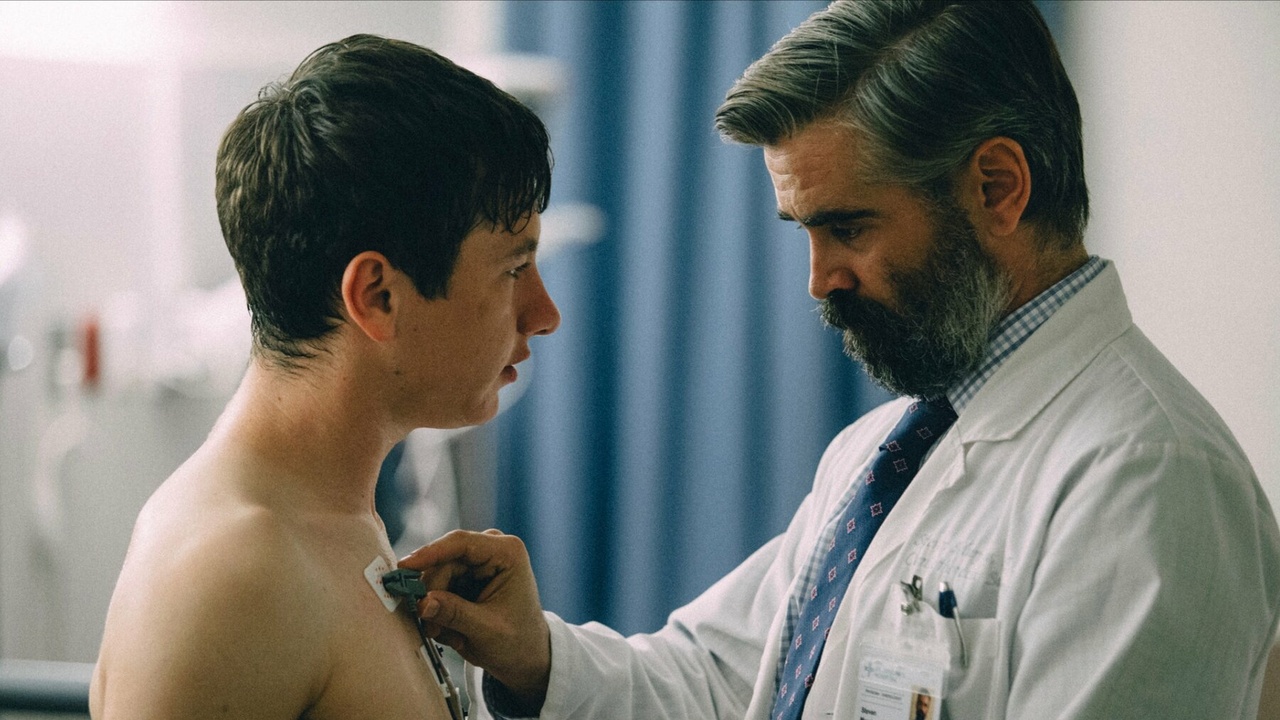
Director: Yorgos Lanthimos · Cinematographer: Thimios Bakatakis · Music: Compiled (Schubert, J.S. Bach, Ligeti, Sofia Gubaidulina, Janne Rättyä) · Sound Design: Johnnie Burn · Key Cast: Colin Farrell, Nicole Kidman, Barry Keoghan, Raffey Cassidy, Sunny Suljic, Alicia Silverstone, Bill Camp · Runtime: 121 minutes · Studio: Element Pictures / Film4 / New Sparta Films · Budget: $3 million · Box Office: $10.7 million worldwide
1. The Killing of a Sacred Deer: Justice Without Mercy, Mercy Without Justice
Yorgos Lanthimos’s most punishing film is also his most classical. Beneath the deadpan performances and the clinical suburban settings lies a structure borrowed directly from Euripides: a father must sacrifice one of his children to atone for a death he caused. The myth of Iphigenia, in which Agamemnon kills his daughter to appease the goddess Artemis and secure fair winds for the Greek fleet, is transplanted into twenty-first-century Cincinnati. The gods have been replaced by a teenager with dead eyes and a talent for eating spaghetti menacingly.
Dr. Steven Murphy is a cardiovascular surgeon. He is successful, handsome, married to an ophthalmologist, father to two bright children, and almost certainly responsible for the death of a patient on the operating table. The patient’s son, Martin, begins to orbit Steven’s life with the quiet persistence of a debt collector. When Steven fails to acknowledge his guilt, Martin delivers an ultimatum: one member of the family must die, or all of them will. The children begin to lose the use of their legs. They stop eating. Their eyes bleed. There is no medical explanation. There is no escape. The only question is which child Steven will choose.
The film is ruthless in its refusal to provide comfort. There is no twist that exonerates Steven. There is no loophole in Martin’s curse. There is no moment where the family rallies together against an external threat. Instead, each family member begins to campaign for their own survival, and the disintegration of domestic loyalty under pressure becomes the film’s true subject. The children plead, bargain, and eventually turn on each other. Kidman’s Anna conducts her own investigation, her own calculations. Farrell’s Steven retreats into denial, then rage, then a helpless lottery of violence.
What keeps the film from becoming an exercise in cruelty is the precision of its moral architecture. Martin is not a villain. He is an instrument of justice, or at least of a justice so ancient and so absolute that it recognizes no mitigating circumstances. Steven killed his father. Someone in Steven’s family must die. The equation is non-negotiable. Lanthimos frames this not as horror but as logic, and the horror comes from the fact that the logic is internally consistent. You cannot argue with it. You can only watch it play out.
The film is not without flaws. The pacing in the first act is deliberately, perhaps excessively, slow, and some of the provocation feels calculated rather than organic. The Kubrickian overtones occasionally tip from homage into imitation. But these are minor reservations about a film that accomplishes something genuinely rare: it makes the mechanisms of Greek tragedy feel urgent, contemporary, and inescapable.
Verdict: 8/10. A surgical instrument of a film, cold and precise and designed to cut. The Killing of a Sacred Deer is Lanthimos at his most disciplined and his least forgiving, and it features the single most unsettling performance of Barry Keoghan’s career, which is saying something.
2. Barry Keoghan and the Geometry of Menace
Keoghan was twenty-four when he made this film, and the performance announced him as one of the most distinctive screen presences of his generation. Martin is not a character in the traditional sense. He has no psychology. He has no backstory beyond the central fact (his father died on Steven’s operating table). He is a function, and Keoghan plays him as one.
The physical choices are meticulous. Martin walks with a slight forward lean, as though being pulled toward something. His face in repose is pleasant, open, almost gentle. When he smiles, the smile arrives a fraction of a second too late, as though it has been translated from another emotional language. When he speaks, his sentences are syntactically normal but rhythmically wrong, slightly too even, slightly too measured, as though each word has been selected from a list rather than generated spontaneously. Keoghan never breaks character. He never signals to the audience that Martin is dangerous. The danger is structural, built into the premise, and Keoghan trusts it completely.
The spaghetti scene is the film’s most quoted moment, and for good reason. Martin eats a plate of pasta with a focus and deliberateness that transforms a mundane act into something profoundly wrong. Nothing about the scene is overtly threatening. The lighting is ordinary. The angle is straightforward. But Keoghan’s concentration on the food, his methodical chewing, the way he stares at Steven between bites, produces an effect that no amount of jump-scare filmmaking could match. The menace is in the banality.
Farrell’s Steven operates in the opposite register. Where Keoghan is still, Farrell is restless. Where Keoghan is controlled, Farrell is increasingly desperate. The performance charts a recognizable arc of privileged disbelief: this cannot be happening to me. Farrell plays Steven’s denial not as stupidity but as entitlement. He is a surgeon. He is used to controlling outcomes. The idea that a consequence exists beyond his capacity to manage it is genuinely incomprehensible to him, and Farrell makes that incomprehension heartbreaking rather than contemptible.
Kidman’s Anna is the film’s most complex performance because she is the only character who tries to think her way out. She visits Martin’s mother (Alicia Silverstone, in a scene of quiet devastation). She interrogates the anesthesiologist. She weighs her children against each other with a practicality that is simultaneously maternal and monstrous. In the film’s most disturbing scene, she asks Steven: “Who would you prefer to lose? Think about it carefully.” Kidman delivers the line as though she is asking which restaurant he’d like for dinner. The domesticity of her tone is the horror.
Raffey Cassidy and Sunny Suljic as the children carry the film’s emotional weight with an eerie composure. Cassidy’s Kim is old enough to understand what is happening and young enough to believe she can survive it through strategy. Suljic’s Bob is young enough to intuit that his best chance is to make himself lovable, indispensable, the child too precious to sacrifice. Both performances are heartbreaking because both children know, at some level, that they are auditioning for their lives.
3. The Camera That Stalks: Bakatakis and the Architecture of Dread
This is the Lanthimos-Bakatakis collaboration where the visual language achieves its most extreme and coherent expression. The camera in The Killing of a Sacred Deer is not an observer. It is a presence. It watches the characters from positions that no human observer would occupy: from directly overhead, tracking them through hospital corridors as though conducting surveillance from the ceiling; from ground level, looking up at faces with the perspective of something crawling; from distances so great that the characters shrink to figures in an architectural drawing.
Bakatakis selected ultra-wide-angle lenses, ranging from 10mm to 17mm, for the film’s signature compositions. These lenses distort peripheral space, bending walls and corridors into curves that make the environment feel simultaneously vast and claustrophobic. The wide-angle effect also alters the relationship between foreground and background: figures close to the camera appear disproportionately large while those further away recede sharply. The visual result is a world in which scale and proportion are subtly, persistently wrong.
For close-ups, Bakatakis switched to longer focal lengths, 85mm to 150mm, which compress space and create extremely shallow depth of field. Eyes fill the frame. Skin texture becomes geological. These close-ups arrive without warning, cutting from the vast overhead shots to intimate portraits of facial features, and the tonal whiplash between the two modes produces a viewing experience that oscillates between clinical distance and suffocating proximity.
The film was shot on 35mm celluloid, a deliberate choice. Lanthimos has spoken about preferring the tactile quality of film stock and the discipline it imposes on a production. Bakatakis pushed the night and interior scenes by up to two stops, increasing grain and color saturation, and pulled the day scenes by a stop, lowering contrast and slightly desaturating the image. The practical effect is that the daytime world of the Murphy household looks faintly anemic, drained of vitality, while the darker scenes pulse with an unhealthy richness. The processing creates a visual anxiety that operates beneath conscious awareness, a world that is always slightly over- or under-exposed, never quite at rest.
The hospital corridors are the film’s visual signature. Bakatakis and Lanthimos turned these clinical spaces into something closer to Kubrick’s Overlook Hotel: long, symmetrical, gleaming with fluorescent light, stretching toward vanishing points that seem to recede as you approach them. The overhead tracking shots through these corridors, following characters from a god’s-eye perspective, produce the film’s most distinctive and unsettling imagery. The camera knows more than the characters. It sees the pattern they cannot see. It is the angle of fate itself.
4. Schubert, Ligeti, and the Accordion of Judgment
The film opens with a beating human heart. An exposed organ, wet and glistening, fills the screen in extreme close-up while Schubert’s Stabat Mater plays at full volume. The juxtaposition is the film’s thesis in miniature: beauty and viscera, the sacred and the surgical, overlaid until they become indistinguishable. This is how the soundtrack operates throughout: as a collision between devotional music and clinical horror.
The compiled score draws from three distinct registers. The sacred choral works, Schubert’s Stabat Mater and Bach’s St. John Passion, introduce a dimension of religious judgment. These are pieces about suffering, sacrifice, and divine wrath. Their presence in a suburban thriller is incongruous, and the incongruity is the meaning. The music says what the characters cannot: that what is happening in this house is not a medical mystery or a psychological game. It is an act of cosmic justice. The gods are watching. The debt must be paid.
György Ligeti’s Piano Concerto, familiar from Kubrick’s films, creates the opposite effect. Where the choral music reaches upward toward transcendence, Ligeti’s clusters and micropolyphony pull downward into dissonance and disorientation. The Ligeti passages accompany the film’s most psychologically destabilizing moments, and the Kubrickian association is not incidental. Lanthimos is deliberately invoking The Shining, 2001, Eyes Wide Shut, films in which the veneer of civilization cracks to reveal something ancient and terrible underneath. The musical citation is an act of lineage-claiming.
The most distinctive sonic presence is Janne Rättyä’s accordion performances of Sofia Gubaidulina’s compositions. The accordion is an instrument associated with folk music, with streets, with humble entertainment. Gubaidulina’s writing transforms it into something alien and threatening: extended techniques produce wheezing, gasping, breathing sounds that turn the instrument into a kind of mechanical lung. These passages accompany the film’s most ambiguous moments, scenes where the boundary between the natural and the supernatural is most porous. The accordion does not resolve the ambiguity. It inhabits it.
Johnnie Burn’s sound design fills the silences between the musical eruptions with a naturalism so precise it becomes oppressive. Hospital machinery hums. Air conditioning whispers. Cutlery scrapes plates. The everyday sounds of domestic and institutional life are captured at a fidelity that makes them feel present and inescapable, and when the music breaks through this naturalism, the contrast is physical. The soundtrack functions as a structure of anticipation and release, long stretches of real-world quiet interrupted by bursts of devotional or avant-garde intensity that leave the viewer’s nervous system unable to settle.
5. Iphigenia in the Suburbs: Greek Tragedy as Domestic Horror
This is the wildcard that the film demands. The Killing of a Sacred Deer is not inspired by Greek tragedy. It is a Greek tragedy, reconstructed in contemporary materials with an architect’s precision.
The myth of Iphigenia is the skeleton. Agamemnon, leader of the Greek forces, offends Artemis by killing one of her sacred deer. As punishment, Artemis becalms the winds, stranding the fleet. The oracle declares that only the sacrifice of Agamemnon’s daughter will restore the winds. Agamemnon, after agonizing, complies. The fleet sails. The war begins. The cost is absorbed.
Lanthimos and Filippou transpose every element. Steven is Agamemnon, a leader (of the operating room, of his household) whose professional arrogance has caused a death. Martin is Artemis, or perhaps her emissary, the force that demands payment. The paralysis of the children is the becalming of the fleet: a suspension of normal function that can only be lifted by sacrifice. The choice Steven must make, which child dies, is Agamemnon’s choice, stripped of its mythological grandeur and relocated to a house in Cincinnati.
What the transposition reveals is how little the moral structure of the myth depends on its setting. The question Euripides posed in the fifth century BC, can justice require the death of an innocent, does a leader’s sin demand blood payment from his family, is the universe fundamentally transactional, survives the move from ancient Greece to modern America without losing any of its force. If anything, the suburban context makes the questions sharper. Gods and oracles provide a framework for accepting the unacceptable. Without them, the demand for sacrifice is naked, and the characters must decide whether to comply with a justice system that has no court, no appeal, and no mercy.
The film’s most radical choice is that Martin’s curse works. The children do become paralyzed. Their eyes do bleed. These symptoms have no medical explanation, and the film does not provide a rational one. This is not ambiguous. The supernatural element is real within the world of the film, and by making it real, Lanthimos forecloses the interpretive escape route that would allow audiences to read the film as metaphor. The curse is literal. The sacrifice must be literal. The film operates under the moral logic of myth, not of modernity, and it asks whether we can tolerate a universe in which that logic obtains.
Kim writes a school paper on Iphigenia. She gets an A. It is read aloud to her class. This detail, mentioned in passing by the school principal during a parent-teacher conference, is one of the film’s most quietly devastating moments. Kim is studying her own fate. She has the text. She knows the ending. And she does not recognize herself in it.
6. Lanthimos’s Third Collaboration: The Filippou Trilogy Closes
The Killing of a Sacred Deer is the final original screenplay written by Lanthimos and Efthymis Filippou for a feature film. After this, Lanthimos would move to The Favourite, written by Tony McNamara, and to Poor Things, also McNamara’s script. He would return to Filippou for Kinds of Kindness in 2024, but that film marked a different phase. The three consecutive features they wrote together, Dogtooth, The Lobster, and The Killing of a Sacred Deer, form a coherent trilogy of closed systems, escalating in budget and polish while maintaining an unbroken tonal identity.
The evolution across the three films follows a clear trajectory. Dogtooth is a system built by parents. The Lobster is a system built by a state. The Killing of a Sacred Deer is a system built by the universe itself. The scope expands from the domestic to the social to the cosmic, but the underlying argument remains constant: all systems of order are, at their foundation, systems of coercion, and the individual’s only choices are compliance, rebellion, or destruction.
The dialogue style that Lanthimos and Filippou developed, flat, syntactically correct, emotionally muted, tonally uniform, reaches its most refined form in this film. The characters speak English with a formality that makes every sentence sound rehearsed. Even intimate conversations between husband and wife have the cadence of deposition testimony. This is sometimes described as “bad acting” by viewers unfamiliar with Lanthimos, but it is the opposite: it is extremely precise acting in a register that most cinema avoids. The actors are performing the absence of spontaneity, and the absence is the point. In a universe governed by inescapable rules, even language loses its freedom.
The shift to English-language filmmaking, which began with The Lobster, is complete here. Where The Lobster retained a faintly European sensibility through its Irish settings and international cast, The Killing of a Sacred Deer is aggressively American in its geography, its architecture, and its suburban affluence. Cincinnati’s hospitals and tract houses provide a visual backdrop so ordinary that the mythological superstructure imposed upon it becomes more jarring, not less. The normalcy of the setting is the film’s secret weapon.
7. Cincinnati, Celluloid, and the Discipline of Film Stock
Principal photography took place in August 2016, primarily at Christ Hospital in Cincinnati, with additional locations in the city’s Hyde Park and Northside neighborhoods. School scenes were shot at Roger Bacon High School. The choice of Cincinnati was driven by practical considerations: the city offered generous production incentives and architectural variety within a compact geographic radius. But the city’s visual character, Midwestern, prosperous, nondescript, gave the film an Anytown quality that served its universalizing ambitions.
The decision to shoot on 35mm film was non-negotiable for Lanthimos. He has spoken plainly about his preference for celluloid, valuing both its aesthetic properties and the behavioral effect it has on set. Film runs through the camera at a cost that demands concentration. Takes are finite. The crew works with the awareness that a precious material is being consumed, and this awareness, according to Lanthimos, produces a focus and intentionality that digital shooting does not. The claim is debatable. The results, in this case, are not.
The production was financed by Film4 and New Sparta Films, with support from the Irish Film Board and development by Element Pictures. A24 acquired North American distribution rights in May 2016, before photography had even begun. This early commitment from A24 reflected the distributor’s confidence in Lanthimos following The Lobster’s commercial success, and it gave the production a guaranteed theatrical platform before a single frame had been shot.
The exposed negative was shipped to London for processing, with the final color grade completed at Goldcrest. Bakatakis’s push-pull processing, baking the visual look into the film stock rather than applying it digitally in post-production, meant that the editing and grading processes began with an image that already carried the intended tonal character. Lanthimos has described this as one of celluloid’s key advantages: the look is a commitment, not a suggestion, and it cannot be undone by committee in post.
8. Cannes Screenplay Prize, Critical Division, and the Keoghan Effect
The film premiered at the 70th Cannes Film Festival in May 2017, competing for the Palme d’Or. It won the Best Screenplay award for Lanthimos and Filippou, their second Cannes prize following The Lobster’s Jury Prize two years earlier. The consecutive Cannes recognitions cemented Lanthimos as a fixture of the festival’s highest tier.
A24’s U.S. release in October 2017 positioned the film as a prestige horror title, and it performed solidly if not spectacularly: $2.3 million domestic, $10.7 million worldwide on a $3 million budget. The returns were healthy relative to cost, though lower than The Lobster’s, suggesting that the film’s severity limited its crossover potential.
Critical response was more divided than for any previous Lanthimos film. The Rotten Tomatoes score of 79% from 281 reviews marks it as his lowest-rated English-language feature. The division fell along a predictable fault line: critics who valued formal ambition and tonal control praised the film as horror in its purest form, while those who prioritized emotional engagement found it cold, calculated, and self-consciously provocative.
The praise centered on two elements. First, Bakatakis’s cinematography, which multiple reviewers described as the most unsettling visual work of 2017. Second, Keoghan’s performance, which was universally recognized as the film’s most potent element. Joey Keogh of Wicked Horror described it as horror freed from the conventions of jump scares and exposition. Zhuo-Ning Su of Awards Daily noted that Keoghan shone brightest in the cast. Trace Thurman, writing for Bloody Disgusting, called the film the most unsettling of the year.
The dissenting view was represented most forcefully by critics who felt the film borrowed too heavily from Kubrick without earning the comparison. The overhead tracking shots, the symmetrical compositions, the Ligeti cues: these were read by some as citations rather than innovations. The criticism has some merit. Lanthimos’s visual language in this film does lean more heavily on Kubrickian precedent than in any of his other works. Whether this constitutes homage or dependence is a question the film’s admirers and detractors answer differently.
Keoghan’s career trajectory confirms the film’s lasting impact. Within six years of Sacred Deer, he would star in The Banshees of Inisherin, Saltburn, and Bird, each performance building on the unsettling charisma he first demonstrated here. Lanthimos did not launch Keoghan’s career. But he gave him the role that defined the kind of actor he would become.
9. The Myth Beneath the Mortgage: What the Iphigenia Framework Misses
Much of the critical conversation around The Killing of a Sacred Deer has focused on the Iphigenia parallel, and rightly so: it is the film’s structural backbone. But an overemphasis on the myth can obscure what the film is actually doing with it, which is not faithful adaptation but selective demolition.
In Euripides, Agamemnon’s sacrifice of Iphigenia is, depending on the version, either averted by divine intervention (Artemis substitutes a deer at the last moment) or carried out with tragic necessity. In either case, the sacrifice has a purpose: the fleet sails, the war begins, history moves forward. The death, however terrible, purchases something. In Lanthimos’s version, the sacrifice purchases nothing except the end of the curse. There is no fleet waiting. There is no war to fight. There is no divine plan being served. The death of a child restores only the status quo ante: a family, diminished by one member, returns to functionality. The sacrifice is not tragic in the classical sense because it does not produce meaning. It produces only continuation.
This distinction is the film’s most quietly radical idea. Classical tragedy offers suffering in exchange for significance. Lanthimos offers suffering in exchange for nothing more than the cessation of suffering. The universe of the film is transactional, but the transaction is empty. You pay the price and receive only the right to go on living. There is no catharsis. There is no wisdom gained. The surviving family members will return to their routines, diminished and haunted, and the world will not notice.
The final scene, in which the surviving family sits in a diner, eating in silence, while Martin sits at a nearby table watching them, confirms this reading. The curse is lifted. The debt is paid. Life continues. And Martin is still there, still watching, still present, because the system that demanded the sacrifice is permanent. There will always be a debt. There will always be a price. The question is never whether you will pay but when.
10. What the Second Viewing Reveals About the First
The Killing of a Sacred Deer is a different film the second time. The first viewing is dominated by dread: what will happen? The second viewing is dominated by recognition: how was it always going to happen?
Watch Steven’s hands during surgery. The opening sequence shows a real heart surgery in clinical close-up. On first viewing, this is atmosphere. On second viewing, it is evidence. Steven’s hands are steady. His technique is confident. His control is absolute. The film opens with the image of a man who believes his competence makes him invulnerable, and everything that follows is the systematic destruction of that belief.
Track Martin’s affect against the information he possesses. In early scenes, Martin is pleasant, eager, slightly awkward. He brings Steven gifts. He compliments Anna’s cooking. On second viewing, you know that every one of these gestures is a performance, and the performance is flawless. Martin is not pretending to be nice. He is nice. He simply also knows what is coming, and his niceness is not a contradiction of the coming horror but its precondition. He gives the family every chance to acknowledge the debt voluntarily. They do not.
Listen to how the children talk about each other. Before the curse manifests, Kim and Bob interact as normal siblings. After, the language changes. They begin evaluating each other’s worth to the family. Kim argues she is older, more talented, more useful. Bob argues he is younger, more in need of protection. These arguments are not spoken to the parents. They are spoken to the audience, and to the camera, which has become the judge they know is watching.
Notice the color of Martin’s clothing. He is dressed in earth tones throughout: browns, dark greens, muted colors that blend with natural environments. The Murphy family wears clinical whites and institutional blues. The color coding is subtle but consistent: Martin belongs to the world of nature and myth. The Murphys belong to the world of medicine and modernity. The visual argument is that nature will always win.
Revisit the spinning scene. Steven, blindfolded, turns in circles in his living room, gun raised, while his family sits bound to chairs around him. The roulette of violence. On first viewing, the suspense is almost unbearable. On second viewing, notice how the spinning recalls the wheel of fortune in medieval iconography, the arbitrary mechanism by which fate distributes suffering. The scene is not just a climax. It is an emblem.
Film Trivia
The open-heart surgery is real. The film’s opening shot shows an actual cardiac procedure filmed during a real operation. Lanthimos secured permission to place a camera in an operating theater and used the footage without digital alteration. The exposed, beating heart that fills the screen is not a prop. It is someone’s life, continuing.
Keoghan’s spaghetti method. Barry Keoghan has discussed the spaghetti scene in interviews, noting that Lanthimos gave him no specific direction for the moment. He was told to eat, and to maintain eye contact with Farrell between bites. The menace that viewers read into the scene was generated entirely by Keoghan’s instincts about rhythm and stillness. Multiple takes were shot. Lanthimos selected the one where Keoghan was most calm.
Kim’s Iphigenia essay is a planted clue. During the parent-teacher conference, the school principal mentions that Kim wrote a paper on Iphigenia that earned an A and was read to the class. The detail is mentioned once and never revisited. It is the only moment in the film where the mythological source text is named explicitly, and it passes so quickly that many first-time viewers miss it entirely.
Lanthimos prefers not knowing the ending. In interviews during the Cannes premiere, Lanthimos stated that he was not interested in whether Steven goes through with the sacrifice. He was interested in the machinery that brings a person to the point where sacrifice becomes thinkable. The film’s construction reflects this: the first two acts are about the tightening of the trap, and the final act is about what happens after escape becomes impossible.
The last Lanthimos-Filippou original for seven years. The Killing of a Sacred Deer was the final original feature screenplay Lanthimos co-wrote with Efthymis Filippou until Kinds of Kindness in 2024. The intervening films, The Favourite and Poor Things, were written by Tony McNamara. The shift in screenwriter produced a corresponding shift in tone: McNamara’s scripts are warmer, funnier, and more emotionally generous than anything Lanthimos and Filippou wrote together.
This entry selects analytical dimensions from a pool. The five anchors are present: critical verdict, performances, visual craft, reception and legacy, and rewatchability guide. Earned sections cover the compiled soundtrack, the director’s body of work, and production history. One wildcard section, “Iphigenia in the Suburbs,” examines the film’s reconstruction of Greek tragedy within domestic architecture, and a second analytical section explores what the Iphigenia framework reveals and conceals. Sections on cultural context and genre lineage are omitted: the film’s mythological framework supersedes any specific cultural moment, and its genre position is sufficiently addressed within the verdict and sound sections.

Leave a Reply