Director/Writer: Jonathan Glazer · Cinematographer: Łukasz Żal · Sound Designer: Johnnie Burn · Composer: Mica Levi · Editor: Paul Watts · Production Designer: Chris Oddy · Key Cast: Christian Friedel (Rudolf Höss), Sandra Hüller (Hedwig Höss) · Runtime: 105 minutes · Studio: A24 / Film4 / JW Films · Shot on: Sony Venice with Leica M 0.8 lenses · Box Office: $52 million worldwide
1. The Zone of Interest: The Most Devastating Film About What You Refuse to See
Rudolf Höss tends his garden. His wife Hedwig arranges flowers. Their children splash in a swimming pool. The family picnics by a river in the sunshine. On the other side of the wall, people are being gassed, shot, and incinerated by the thousand. You know this because you can hear it: the distant crack of gunfire, the low rumble of furnaces, the sound of screaming that might be wind or might not. You never see it. The camera never crosses the wall. The extermination of European Jewry takes place entirely in the audio track.
Jonathan Glazer’s The Zone of Interest is built on a single, annihilating formal decision: to film the daily life of the commandant of Auschwitz and his family without showing the camp. The atrocity exists at the edge of every frame, audible but invisible, present but unacknowledged. Glazer described his approach as making two films simultaneously: the film you see, a domestic drama about a bourgeois German family, and the film you hear, a record of industrialised murder. The gap between the two is where the horror lives.
This is not a conventional Holocaust film. It does not depict suffering. It does not solicit tears. It does not offer redemption or catharsis or the consolation of a survivor’s testimony. What it offers instead is something much more disturbing: a sustained, forensic observation of people who have decided not to notice. The Hösses are not monsters. They are homemakers, parents, gardeners. They discuss curtains. They worry about promotions. They complain about the help. The extermination of a people proceeds a few metres away, and they pour coffee.
The film’s power derives from this cognitive dissonance, and it is relentless. There is no scene of reckoning, no moment where a character confronts the truth. The closest the film comes is a scene near the end where Höss, walking down a stairwell after a meeting about the logistics of the Hungarian deportations, stops and dry-heaves repeatedly. His body rebels. His mind does not. He composes himself and continues. Christian Friedel took thirty takes to produce this moment, and its precision is terrible: the body knows what the person refuses to acknowledge. This is the film’s thesis, compressed into a convulsion.
Verdict: 9/10. One of the essential films of the 2020s and one of the most formally innovative works about the Holocaust ever made. Its deliberate refusal of psychological access to its characters is both its greatest strength and its one limitation: the film observes with devastating clarity but occasionally risks making its own austerity feel like a position rather than a discovery.
2. Johnnie Burn’s Second Film: The Horror That Lives in Your Ears
Glazer told his sound designer Johnnie Burn, approximately a year before filming began: “I’m going to go and film a family drama, and I’ll see you in about a year. In the meantime, you need to figure out how to make the sound of the camp.” The brief was terrifyingly simple. The film would not show the Holocaust. Sound would carry the entire weight of the atrocity. Every scream, every gunshot, every rumble of the crematorium would need to be credible, historically accurate, and present without being sensationalised. Burn compiled a 600-page research document before recording a single sound.
His process was exhaustive. He interviewed survivors. He scoured the Auschwitz archive. He read witness testimonies for any reference to sound: the bugle at roll call, the buzz and rattle of the electrified fence, the cadence of voices in pain versus voices acting pain. He learned that the camp’s weapons were older models (modern guns had been sent to the front), so he sourced period-appropriate firearms. He recreated the sound of the crematorium by placing a microphone inside the chimney above his fireplace, using cardboard to manipulate the rhythm of the flames, then layering in footsteps and the sounds of textile machinery. For human vocal sounds, he found that actors sounded “awfully hammy.” The final vocal samples were harvested from the real world: the streets of Berlin at three in the morning, the entrance to hospital emergency departments, riots in Paris.
The result is a soundscape of staggering moral complexity. The sounds of the camp are always present but never foregrounded. They sit beneath the domestic noise of the Höss household: beneath the birdsong, beneath the splash of children in the pool, beneath the clatter of dishes. The audience hears gunshots during lunch. Screams drift in while the children are being tucked into bed. The crematorium’s rumble persists as a constant bass note, so low that you feel it in your chest before you identify it with your ears. The genius of Burn’s design is that it replicates the Hösses’ experience precisely: the horror is audible but backgrounded, present but processed into ambient noise. You can ignore it if you choose to. The film is watching to see whether you will.
Burn and Glazer did not want music to “sweeten or dramatise” this soundscape. Most of Mica Levi’s originally composed score was cut during the edit. What remains is concentrated at the film’s edges: the black-screen prologue, the infrared night sequences, and the epilogue. The interior of the film is governed almost entirely by Burn’s sound. This decision makes the domestic scenes more disturbing, not less. Without a score to guide emotion, the audience must navigate the gap between image and sound alone, and that navigation is the film’s primary experience.
3. Łukasz Żal, Ten Cameras, and the Refusal to Look Beautiful
Glazer proposed something to cinematographer Łukasz Żal that had no precedent in narrative filmmaking: what if they shot the interior scenes with no crew on set? No camera operators. No lighting technicians. No focus pullers visible. Just the actors, moving through a house rigged with hidden cameras.
Żal, a two-time Oscar nominee known for the precise, luminous black-and-white compositions of Ida and Cold War, had to abandon everything he knew about beautiful images. He embedded ten Sony Venice cameras throughout the replica Höss house: in walls, cupboards, behind bushes in the garden. All ten ran simultaneously. The actors moved freely through the space for hours at a time, unobserved except by the cameras and by Żal and his team monitoring from outside the building, with focus pullers operating from the basement. The result looks less like cinema and more like surveillance footage. The framing is functional, even ugly. Characters drift in and out of frame. Focus occasionally softens. The light is whatever the day provides: harsh midday sun, flat overcast, dim period-accurate lightbulbs in the evening. No supplemental lighting was used. No flags, no diffusion, no cinematic enhancement of any kind.
This is not laziness. It is the most carefully considered visual strategy in Żal’s career. The surveillance aesthetic achieves two things simultaneously. First, it strips the film of the visual grammar that conventional cinema uses to create empathy, suspense, and emotional orientation. Without close-ups that invite identification, without lighting that flatters or dramatises, the audience is denied the tools with which cinema normally tells you how to feel. You are left to feel for yourself, and what you feel is deeply uncomfortable. Second, the surveillance framing implicates the viewer as an observer. You are watching the Hösses the way a security camera watches: without judgment, without intervention, with a passive completeness that records everything and prevents nothing.
Production designer Chris Oddy chose a derelict building a few hundred metres from the actual Höss house (which still stands but has deteriorated too much for filming) and spent months converting it into a historically accurate replica. He began planting the garden in April 2021 so that it would be in full bloom when filming started in the summer. The camp buildings visible beyond the wall were added digitally, but the house and garden are real. You can see real flowers, real grass, real sunlight. The beauty is not artificial. It is merely beside the point.
4. Christian Friedel, Sandra Hüller, and the Terror of Normalcy
Christian Friedel’s Rudolf Höss is one of the most unsettling performances in recent cinema, and its unsettling quality comes from its refusal to be dramatic. Friedel does not play Höss as a villain. He does not play him as a man suppressing guilt. He plays him as a competent middle manager: methodical, slightly stiff, focused on logistics. When Höss discusses the Hungarian deportations in a meeting, Friedel delivers the dialogue with the bored efficiency of someone reviewing quarterly targets. There is no gleam in his eye. There is no tension in his jaw. He is simply a man doing his job. The horror is not in what Friedel shows. It is in what he withholds. Beneath the competent surface, the audience searches for signs of the monstrous, and finds nothing. Glazer’s intention was to demystify the perpetrators of the Holocaust, to refuse the comfortable fiction that they were “mythologically evil.” Friedel’s performance is the instrument of that refusal.
Sandra Hüller’s Hedwig is, in some ways, even more disturbing. Where Höss is a bureaucrat, Hedwig is an enthusiast. She loves the house. She loves the garden. She calls herself “the queen of Auschwitz.” When she tries on a fur coat taken from a Jewish woman, she examines herself in the mirror with the uncomplicated pleasure of someone who has found a good deal. Hüller plays these moments without irony, without self-awareness, without any signal that the character recognises what she is doing. The result is a portrait of complicity that is all the more devastating for being completely natural. Hedwig is not performing indifference. She is not suppressing guilt. She is simply living her life, in her house, in her garden, and the fact that the garden shares a wall with a death camp is, for her, a geographical detail rather than a moral one.
The actors lived in the village of Oświęcim (the Polish name for Auschwitz) during filming, a few hundred metres from the real camp. They performed for hours at a time in the rigged house, without a director visible, without a crew present, without the usual structure of takes and resets. Glazer monitored from outside and communicated through a system of discreet signals. The result is a quality of behaviour, not performance: the actors are not hitting marks or delivering lines to camera. They are inhabiting a domestic space, and the cameras are catching what they do. This method produces moments of astonishing naturalism that conventional coverage would destroy.
5. Hedwig’s Paradise: The Garden Wall as Moral Architecture
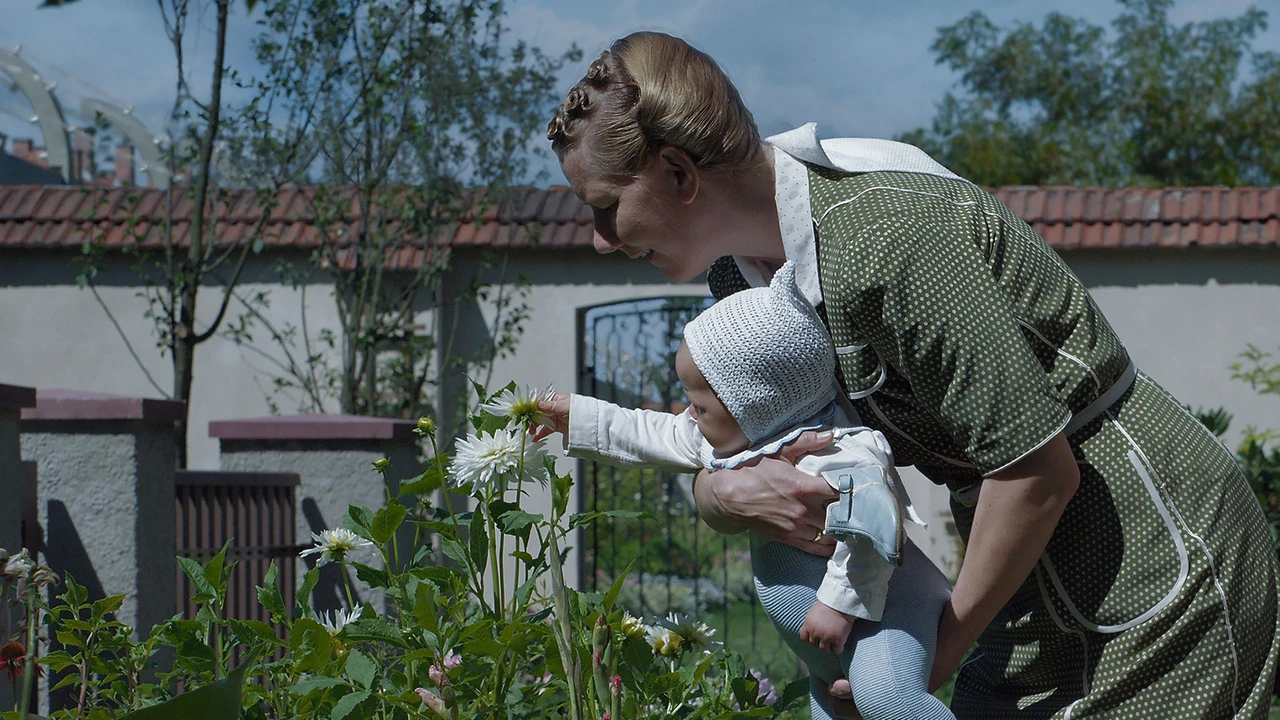
The garden is the film’s central image. Hedwig Höss has built a domestic paradise: flowers in meticulous beds, a greenhouse, a swimming pool, vegetable patches, a riverside picnic spot. It is beautiful. It is tended with pride and genuine horticultural skill. It is, in every sense except the geographic, an ordinary upper-middle-class European garden of the period.
It shares a wall with Auschwitz.
Glazer holds this juxtaposition without commentary. The camera observes Hedwig planting, weeding, arranging. Behind her, above the wall, you can see the chimneys. Smoke rises. The children play in the pool. The sound of the camp drifts over the wall like weather. Hedwig does not look up. She does not react. She gardens.
The garden is not a metaphor. It is the thing itself. This is what complicity looks like: not a dramatic choice, not a Faustian bargain, but a woman tending roses while people are murdered on the other side of the fence. The film insists that you look at the roses and the chimneys in the same frame, and the cognitive dissonance this produces is the film’s most powerful effect. The image is beautiful because gardens are beautiful. The image is obscene because of what is behind the garden. Both responses are correct. Neither cancels the other.
When Höss is informed that he will be transferred away from Auschwitz, Hedwig fights the decision with a ferocity that reveals her priorities with devastating clarity. She does not want to leave her garden. She does not want to leave her house. She has built something here, and she intends to keep it. The scene does not require the audience to decode any symbolism. It requires only that the audience register what Hedwig is defending: not a garden. A life built on a foundation of murder, which she has decided not to see, and which she will fight to preserve because seeing it would require her to give everything up.
6. Darkness, Descent, and the Music That Frames the Void
The film opens on a black screen. It holds there for over a minute. On the soundtrack, Mica Levi’s overture begins: a wash of synthesised voices and electronic tones that descend steadily in pitch, as if something is falling, slowly and without hope of stopping. The sound is dense, formless, vertiginous. It offers the audience nothing to hold onto. When the darkness finally breaks, it gives way to the bright, chirping sunshine of a family picnic, and the juxtaposition is so violent that the birdsong itself sounds like an assault.
Levi began working on the score in 2016, years before filming started. She spent a year in the studio alongside Glazer and editor Paul Watts during post-production, exploring every possible approach to how music might function in a film about the Holocaust. They tried electronic, modern, orchestral, American. Nothing worked as expected. In the end, most of Levi’s composed material was cut. Glazer and Burn did not want the interior of the film scored at all: music would provide emotional guidance that the film’s design deliberately withholds.
What survived is concentrated at three points: the black-screen prologue, the infrared night sequences, and the epilogue. In each case, Levi’s music accompanies moments of formal abstraction, moments where the film breaks from its observational mode and enters a different register entirely. The night sequences, filmed on high-resolution thermal cameras, follow a young Polish girl hiding food for camp prisoners in the dark. She glows white against a black landscape. Levi scores these sequences with a deep electronic rumble the team nicknamed “yums”: digitally manipulated human voices that sound like the earth groaning. The girl was based on the real resistance fighter Aleksandra Bystroń-Kołodziejczyk, to whom Glazer dedicated the film in his Oscar speech.
Levi described her approach as “technical rather than emotive.” The music does not tell you what to feel. It tells you that you have left the domestic surface and entered a space where the film’s usual rules do not apply. The darkness of the prologue, the infrared glow of the night sequences, the black screen that closes the film: these are the moments where The Zone of Interest acknowledges that what is happening on the other side of the wall is too large for domestic observation to contain. Levi’s music is the sound of that largeness pressing against the frame.
7. From Martin Amis’s Satire to Glazer’s Silence
Martin Amis’s 2014 novel The Zone of Interest is a darkly comic work told from three perspectives: a Nazi officer pursuing the commandant’s wife, the commandant himself, and a Jewish prisoner. It is satirical, literary, and intentionally grotesque, using the conventions of romantic comedy and social farce to illuminate the absurdity of civilised behaviour in an extermination camp.
Glazer kept the title, the setting, and almost nothing else. Where Amis uses three voices, Glazer uses none: there is no voiceover, no interior monologue, no access to the characters’ thoughts. Where Amis deploys satire, Glazer deploys observation. Where Amis invents fictional characters, Glazer tells the story of the real Hösses, using historical records and architectural plans to reconstruct their domestic life with forensic accuracy. The adaptation is so loose that it constitutes a separate work: the novel is a literary performance about evil, and the film is a refusal of performance altogether.
Glazer’s choice to focus on the real Höss family rather than Amis’s fictional characters was driven by his desire to “demystify” the perpetrators. Amis’s satire, however brilliant, still operates within a framework of exceptionalism: these characters are monstrous enough to be funny, extreme enough to be absurd. Glazer’s approach strips away the exceptionalism. His Hösses are not absurd. They are not even interesting. They are normal, and that normalcy is the point. The banality of evil, a phrase so overused it has nearly lost its meaning, is rendered in The Zone of Interest with a literalness that restores the concept’s original shock. These are banal people. This is what banal people can do.
8. Building a House Three Hundred Metres from Auschwitz
Development began in 2014, when Glazer first read the Amis novel. He visited Auschwitz with producer James Watson, and the visit changed the project’s direction entirely. The proximity of the commandant’s house to the camp, the shared wall between the garden and the killing grounds, became the film’s conceptual foundation.
Production designer Chris Oddy could not use the original Höss house (still standing but deteriorated beyond the film’s needs). He found a derelict postwar building a few hundred metres away, architecturally similar enough to serve as the basis for a historically accurate reconstruction. Months of work transformed the structure into a precise replica of the Höss residence as it appeared in the early 1940s, using archival photographs, architectural plans, and research conducted with the Auschwitz Museum. Oddy began planting the garden in April 2021, months before filming started, so that the flowerbeds would be in bloom and the vegetables growing when cameras rolled that summer. Period-accurate paint colours (unsettlingly close to skin tones), period lightbulbs, period furnishings: every detail was calibrated to eliminate the patina of historical distance. Glazer and Burn wanted the house to feel not like a historical recreation but like a place you could walk into today.
Principal photography lasted approximately fifty-five days in the summer of 2021, with additional shooting in Jelenia Góra in January 2022. The ten-camera, no-crew-on-set approach produced enormous volumes of footage: hours of simultaneous recording from multiple angles for every scene. The edit, conducted by Paul Watts in close collaboration with Glazer, Burn, and Levi, took over a year. Nothing was locked early. The relationships between image, sound, and music were developed simultaneously, each element informing the others.
9. From Sexy Beast to the Wall: Glazer’s Four Films in Twenty-Three Years
Jonathan Glazer makes films very slowly. In twenty-three years, he has directed four features: Sexy Beast (2000), Birth (2004), Under the Skin (2013), and The Zone of Interest (2023). Each is radically different from the others. Each is brilliant. The gap between them suggests a filmmaker who will not make a film until he has found the form that the subject demands, and who would rather wait a decade than compromise.
Sexy Beast is a gangster thriller driven by Ben Kingsley’s volcanic performance. Birth is a psychological drama about a woman who believes a child may be the reincarnation of her dead husband. Under the Skin is a science fiction film in which Scarlett Johansson plays an alien predator driving a van around Glasgow. These films share no genre, no setting, no tonal register. What they share is an interest in surfaces and what lies beneath them, in the gap between what is visible and what is felt, and in the use of sound as a primary storytelling medium.
Under the Skin, in particular, established the working method that would produce The Zone of Interest. Glazer and Burn developed their collaborative approach on that film, building soundscapes that carry narrative weight independent of the image. Levi’s score for Under the Skin, with its alien drones and disorienting string work, anticipates her approach to The Zone of Interest. And Glazer’s use of hidden cameras in Under the Skin (real Glaswegians were filmed by concealed cameras in Johansson’s van, unaware they were in a movie) prefigures the surveillance-style shooting of the Höss house. The Zone of Interest is the culmination of a method Glazer has been refining across two decades: the creation of films that function as environments rather than narratives, spaces the audience enters and must navigate without the usual cinematic guidance.
10. The Banality of Evil, Revisited
Hannah Arendt coined the phrase “the banality of evil” in 1963 to describe Adolf Eichmann, whom she observed during his trial in Jerusalem. Eichmann was not a fanatic. He was a bureaucrat. He organised transportation schedules. The evil he participated in was not the product of monstrous ideology but of ordinary careerism, of a man who did his job without considering what the job entailed. The phrase has been repeated so often in the six decades since that it has become a cliché, invoked reflexively whenever someone wants to indicate that evil is not always spectacular.
The Zone of Interest does something that decades of repetition could not: it makes the concept frightening again. By filming the Höss family’s domestic routine with no dramatic enhancement, no score, no close-ups designed to provoke identification or revulsion, Glazer forces the audience to sit with banality in real time. You watch a woman try on a stolen fur coat. You watch a man discuss deportation logistics over breakfast. You watch children play in a garden while smoke rises behind them. Nothing is emphasised. Nothing is underlined. The camera observes, and the observation is relentless.
The film’s moral complexity lies in what it asks of the viewer. It does not ask you to identify with the Hösses. It does not ask you to judge them. It asks you to watch them, and in watching them, to consider your own capacity for compartmentalisation. Glazer’s Oscar speech, in which he spoke about dehumanisation and its contemporary consequences, drew both fierce praise and fierce condemnation. The speech revealed what the film embeds in its form: that the wall between the garden and the camp is not a historical artefact. It is a structure that exists in every society that permits atrocity to continue at the margins of its comfort. The Zone of Interest does not tell you this. It shows you a family having a pleasant day, and lets the screaming do the rest.
11. Cannes, the Oscars, Gaza, and the Speech That Split a Room
The Zone of Interest premiered at the 2023 Cannes Film Festival on May 19 and received a six-minute standing ovation. It won the Grand Prix, the festival’s second-highest prize. Johnnie Burn won the CST Artist-Technician Prize for sound. Mica Levi won the Cannes Soundtrack Award.
At the 96th Academy Awards, the film won two Oscars from five nominations: Best International Feature Film and Best Sound. It was also nominated for Best Picture, Best Director, and Best Adapted Screenplay. The Best Sound win was a particular validation: the Academy recognised that Burn’s soundscape was not merely technical support but the film’s primary artistic instrument.
Glazer’s acceptance speech became one of the most debated moments in recent Oscar history. Speaking as a Jewish filmmaker who had made a film about the Holocaust, he said: “Right now, we stand here as men who refute their Jewishness and the Holocaust being hijacked by an occupation which has led to conflict for so many innocent people.” The speech was delivered during the escalation of Israel’s military operations in Gaza and provoked sharply divided responses. An open letter signed by over a thousand Jewish professionals in Hollywood denounced the speech. A counter-letter signed by over 450 Jewish creatives, including Joel Coen, Joaquin Phoenix, and Levi herself, defended it. The film’s themes of complicity, compartmentalisation, and the ethics of spectatorship had collided with a contemporary crisis in a way that made the art and its political context inseparable.
The film’s critical reputation has continued to build. Sight & Sound ranked it second on their 2023 films list. IndieWire placed it second among the best films of the 2020s so far. The New York Times ranked it twelfth on their 2025 list of the greatest films of the twenty-first century. These rankings reflect a consensus that has formed rapidly: The Zone of Interest is not merely a good film about the Holocaust. It is a film that has changed what is possible in the depiction of historical atrocity.
12. What the Wall Reveals the Second Time: A Rewatchability Guide
The Zone of Interest is not a film most viewers will want to rewatch quickly. Its effect is cumulative and draining. But a second viewing, approached with different attention, reveals the precision of its design. Here is where to listen and look.
Close your eyes for thirty seconds during a domestic scene. This is the most important thing you can do on a rewatch. Pick a scene of Hedwig in the garden or the family eating. Close your eyes and listen. Without the image, the sound design becomes primary: the distant cracks, the low rumble, the screams that register as ambient texture when your eyes are open. This exercise replicates, in miniature, what Glazer has done with the entire film: it separates what you see from what you hear and forces you to confront the gap.
Watch Hedwig, not Rudolf. On a first viewing, Höss’s role as commandant draws the eye. On a rewatch, shift your attention to Hüller’s Hedwig. Track the moments when sounds from the camp are loudest and watch her face for any flicker of response. In nearly every case, there is none. The one exception, which occurs so briefly it is easy to miss, is worth finding.
Follow the smoke. The chimneys of Auschwitz are visible above the garden wall in many exterior shots, and the smoke they produce varies in density and colour across the film. On a rewatch, track the smoke as a visual constant. It is the camp’s only persistent visual intrusion into the domestic frame, and Glazer positions it with the same care that Hedwig positions her flowers. The composition places beauty in the foreground and murder in the background, and the audience’s eye, trained by centuries of landscape painting, gravitates to the beauty. Notice this. Notice what you are choosing to look at.
Listen for the transition between Levi and Burn. The boundary between Mica Levi’s score and Johnnie Burn’s sound design is deliberately blurred. The prologue’s synthesised voices descend into birdsong. The infrared night sequences emerge from and dissolve back into the ambient soundscape. On a second viewing, try to identify the exact moments where music becomes sound and sound becomes silence. In most cases, you will not succeed. This is the design: the horror and the beauty occupy the same frequency, and the film will not separate them for you.
Notice the cut to the present-day Auschwitz Museum. Near the film’s end, Glazer cuts from the 1940s to the contemporary Auschwitz Memorial, where cleaners mop floors and arrange exhibits. The cut is jarring and deliberate. On a rewatch, consider what it means: the past has not ended. It has been institutionalised, preserved, displayed. The cleaners tend the museum the way Hedwig tended her garden. Whether this parallel is comforting or devastating depends on what you believe institutions are for.
Film Trivia
A chimney, a fireplace, and cardboard. To recreate the sound of the Auschwitz crematorium, Johnnie Burn placed a microphone inside the chimney above his fireplace at home. He manipulated the rhythm of the flames using pieces of cardboard, then layered in footsteps, the sounds of machinery, and processed textile-factory recordings. The resulting sound, a low, persistent rumble that Glazer kept as a near-constant background presence, is one of the most quietly devastating audio achievements in film. Burn’s research for the entire sound design filled a 600-page document that he compiled over a year before filming began.
The garden that grew for months. Production designer Chris Oddy began planting the Höss garden in April 2021, a full four months before principal photography started, so that the flowers would be in bloom and the vegetable patches growing naturally when cameras rolled. The garden’s beauty is real, not art-directed in the conventional sense: real sunlight, real soil, real growth. Oddy used archival photographs of the actual Höss garden to determine plant varieties and placement. The result is a domestic paradise that was historically accurate down to the species of rose.
The girl who glowed. The infrared night sequences follow a young Polish girl hiding food in the fields around Auschwitz for prisoners to find. She was based on the real resistance fighter Aleksandra Bystroń-Kołodziejczyk, who as a teenager smuggled food into the camp at enormous personal risk. Glazer dedicated the film to her in his Oscar acceptance speech. The thermal camera renders her as a white figure against a black landscape, and Levi’s deep electronic score gives these sequences a quality that is simultaneously documentary and spectral.
No crew on set. For the interior scenes, no camera operators, no lighting technicians, no sound recordists, and no director were physically present in the Höss house. The actors performed for hours at a time, moving through the space as they wished, while Żal and Glazer monitored from outside. Focus pullers operated from the basement. The result is footage that looks less like a film and more like a found document, which is precisely what Glazer intended. As Burn put it: “No patina, no sepia edge. It could be now.”
This entry selects analytical dimensions that The Zone of Interest earns through its radical formal strategy, its sound design innovation, and its engagement with the ethics of representation. Three wildcard sections exist because the film demands them: “Johnnie Burn’s Second Film” (because the sound design is not a supporting element but the film’s primary narrative instrument, carrying the entire weight of the unseen atrocity), “Hedwig’s Paradise” (because the garden is not a setting but a sustained visual argument about complicity that functions as the film’s moral centrepiece), and “Darkness, Descent, and the Music That Frames the Void” (because Mica Levi’s sparse, concentrated contributions create the formal architecture that separates the film’s observational interior from its moments of existential reckoning). An awards section is folded into reception because the Oscar controversy is inseparable from the film’s broader cultural impact. A genre-lineage section is omitted because The Zone of Interest’s relationship to Holocaust cinema is better understood as a repudiation than a continuation.

Leave a Reply