Director/Writer: Paul Thomas Anderson · Cinematographer: Robert Elswit · Composer: Jonny Greenwood · Editor: Dylan Tichenor · Production Designer: Jack Fisk · Key Cast: Daniel Day-Lewis (Daniel Plainview), Paul Dano (Eli Sunday / Paul Sunday), Dillon Freasier (H.W. Plainview), Kevin J. O’Connor (Henry), Ciarán Hinds (Fletcher) · Runtime: 158 minutes · Studio: Paramount Vantage / Miramax Films · Budget: $25 million · Box Office: $76.2 million worldwide
1. There Will Be Blood: A Film About a Man Who Drains Everything, Including Himself
Daniel Plainview digs silver from a hole in the ground. He breaks his leg at the bottom of a mine shaft and drags himself across the desert to sell what he has found. He adopts an orphaned baby and uses the child as a prop to convince landowners that he is a family man. He drills for oil, builds a pipeline, destroys a preacher, abandons his son, murders a man who pretended to be his brother, and ends the film in a bowling alley in a mansion, drunk and screaming. These are the facts of his life. They do not explain him.
There Will Be Blood is Paul Thomas Anderson’s attempt to locate the point in American history where ambition became pathology, where the drive to extract and accumulate crossed the line from enterprise into something indistinguishable from madness. It is loosely based on the first 150 pages of Upton Sinclair’s 1927 novel Oil!, but Anderson jettisons Sinclair’s socialist politics and replaces them with something harder to name. Not a critique of capitalism, exactly. A portrait of what capitalism does to a particular kind of soul. Plainview does not fail because the system fails him. The system rewards him lavishly. He fails because there is nothing inside him that the system cannot buy, and by the time he discovers this, he has bought everything except a reason to be alive.
The film’s craft matches its ambition. Robert Elswit’s widescreen cinematography turns the California oil fields (filmed in Marfa, Texas) into a landscape of biblical desolation. Jonny Greenwood’s score, built on dissonant strings and ominous percussion, essentially invented a new vocabulary for film music. Daniel Day-Lewis delivers a performance so total, so physically and vocally committed, that it raises uncomfortable questions about the boundary between acting and possession. The supporting cast, the production design by Jack Fisk, the editing by Dylan Tichenor: every element operates at the highest level of craft.
The film has one genuine vulnerability. The final act, set decades after the main action in Plainview’s cavernous mansion, shifts the register from austere historical epic to something closer to Grand Guignol. The bowling alley scene, in which Plainview humiliates and then murders Eli Sunday, is so tonally extreme that it divides audiences who have been riveted by everything that preceded it. Some see it as the inevitable eruption of forces the film has been building for two and a half hours. Others see it as Anderson losing control of his instrument. Both readings are defensible, and the fact that the scene provokes this level of disagreement is itself a mark of the film’s power.
Verdict: 10/10. The most commanding American film of the 2000s. It does not ask you to understand Daniel Plainview. It asks you to watch him, without flinching, as he becomes the thing that America rewards and America fears.
2. Robert Elswit and the Desert That Looks Like the End of the World
Robert Elswit has shot every Paul Thomas Anderson film except The Master, but There Will Be Blood is where their collaboration reached its apex. Shot on Panavision XL 35mm with anamorphic lenses, the film is overwhelmingly a day-exterior production, set in landscapes of such blinding, empty brightness that they feel less like scenery and more like judgment.
The production chose Marfa, Texas, for its remoteness. Elswit described it as one of the few places in America where you can stand on a hill and see nothing in all directions. Jack Fisk built the town of Little Boston from scratch on a ranch: wooden structures, a church, a functioning oil derrick, all arranged so that the camera could capture the church, the railroad, and the drilling site in a single wide shot. The geography of the set encodes the film’s argument. Religion, commerce, and industry are not separate spheres. They occupy the same visual field, competing for the same horizon.
Elswit’s compositions favour extreme width. Characters are often dwarfed by the landscape, positioned at the edges of the frame or buried in negative space. This is not the widescreen of spectacle. It is the widescreen of isolation. When Plainview stands alone on a hillside surveying his domain, Elswit frames him so that the land extends endlessly behind him, and the effect is not of ownership but of something closer to consumption. The man and the land are in a relationship, but it is not a healthy one.
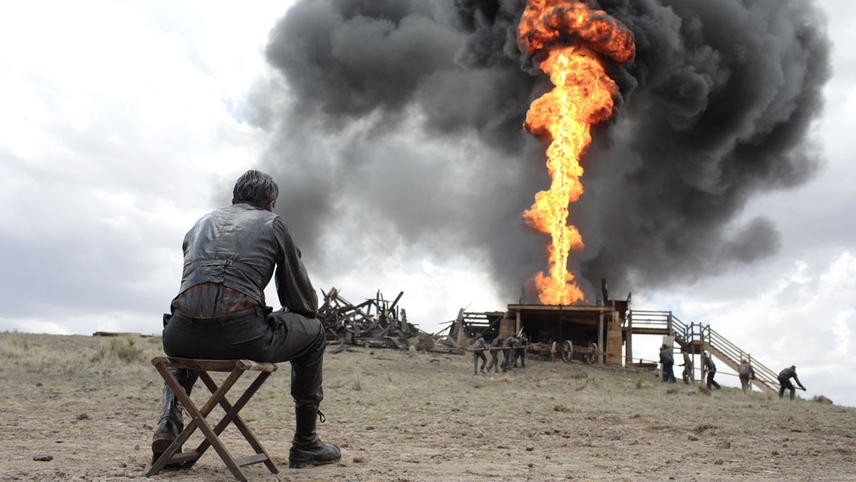
The oil derrick fire sequence is the film’s visual centrepiece. Shot practically, using real fire, over multiple days, Elswit captures the eruption and the blaze with a clarity that makes the screen feel hot. Flames paint the night sky orange. Oil rains down in black curtains. H.W., deafened by the blast, lies on the ground as the fire roars behind him. Plainview, covered in oil, looks up at the burning derrick with an expression that is not horror but something closer to ecstasy. He has found what he was looking for. It is destroying everything around him. He does not care. Elswit holds the shot long enough for the audience to register that this is not a disaster scene. It is a love scene.
3. Daniel Day-Lewis and the Most Terrifying Voice in American Cinema
There are performances in film that are studied. There are performances that are admired. And then there is Daniel Day-Lewis in There Will Be Blood, which is something else entirely: a performance that seems to have been excavated rather than constructed, pulled up from some deep, unclean place and deposited on screen still dripping.
Day-Lewis built Daniel Plainview from the outside in. The voice came first: a baritone rasp modelled partly on the filmmaker John Huston, partly on records of early twentieth-century American speech patterns, and partly on something Day-Lewis found in the character’s specific geography and social position. It is a voice of enormous authority and barely suppressed violence. When Plainview says “I have a competition in me,” the sentence sounds like it was cut from stone. When he says “I drink your milkshake,” it sounds like a man who has been rehearsing this humiliation for decades and is finally, gloriously, delivering it.
The physical performance is equally totalising. Day-Lewis changed his gait, his posture, the way he held tools. His Plainview walks with the limp he acquired falling in the mine shaft, and the limp becomes a signature: it is the first injury in a life that will be defined by the damage it inflicts and absorbs. In the baptism scene, where Plainview must submit to Eli Sunday’s religious authority to secure an oil lease, Day-Lewis plays the humiliation as a full-body experience. His face contorts. His fists clench. When he screams “I’ve abandoned my child,” the cry seems to bypass acting technique altogether and arrive at something rawer. It is the sound of a man who has just told the truth for the first time and cannot stand it.
Paul Dano’s Eli Sunday provides the necessary counterweight. Dano was not originally cast in the role; he replaced actor Kel O’Neill two weeks into production. The late casting gives his performance a quality of improvisation that works for the character: Eli is making himself up as he goes along, performing spiritual authority without the substance to back it. Dano plays him as a young man who is simultaneously sincere and fraudulent, who believes in God and also believes in the power that God’s name gives him over other people. The Sunday-Plainview dynamic is the engine of the film, and it works because both actors commit fully to their characters’ mutual contempt.
Dillon Freasier, a local boy from Marfa with no acting experience, plays the young H.W. with a naturalism that grounds the film’s more operatic elements. His quiet, watchful presence reminds the audience that a child is observing all of this, and the cost of Plainview’s ambition is measured most accurately in the expression on his son’s face.
4. Fifteen Minutes Without a Word: The Opening as Silent Film
There Will Be Blood begins with approximately fifteen minutes of near-total silence. No dialogue. No voiceover. Just a man in a mine shaft, breaking rock with a pickaxe, by the light of a candle.
Anderson shoots this sequence as if he were making a film in 1910. The camera observes. The only sounds are tools striking stone, the man’s breathing, and Greenwood’s score, which enters with low, sustained string tones that feel less like music and more like the sound the earth makes when you press your ear to it. Plainview breaks his leg in a fall. He hauls himself out of the shaft. He discovers oil on his hands. He crawls to a settlement, sells his silver, and returns to drill. A worker dies. Plainview takes the dead man’s infant son. He uses the baby to present himself as a family man. None of this is explained through dialogue. It is shown.
This opening is not merely a stylistic choice. It is a thesis statement. Anderson is telling the audience that this film will trust images over words, that its protagonist will be defined by what he does rather than what he says, and that the spoken language, when it finally arrives, will be untrustworthy. Plainview’s first extended speech, delivered to a group of landowners, is a masterpiece of persuasion and deception. Having watched him in silence for fifteen minutes, the audience knows exactly what lies behind the words. The effect is devastating: every sentence Plainview speaks for the rest of the film is shadowed by the knowledge of who he was before he learned to talk.
Greenwood’s scoring of this sequence deserves special attention. He composed for what was essentially a silent film, and the music becomes narrative in a way that conventional film scores rarely attempt. The strings do not underscore emotion. They generate it. The opening cue, “Open Spaces,” passes deep chords between violins, basses, and cellos, with nearly subliminal electric guitars sustaining drones beneath. It sounds like the romance of the American West and its dark underside simultaneously. This dual register, beauty and menace in the same chord, defines the entire film.
5. Jonny Greenwood’s Dissonance as Prophecy
Paul Thomas Anderson had been a fan of Radiohead’s music for years before hearing Greenwood’s orchestral piece “Popcorn Superhet Receiver,” a dissonant, Penderecki-influenced work for string orchestra. The piece electrified Anderson, who recognised in its unsettling textures exactly what his film about oil and obsession required: music that sounded like the ground itself was wrong.
Greenwood was given a cut of the film and returned three weeks later with two hours of music recorded at Abbey Road Studios. The score uses traditional orchestral instruments played in non-traditional ways: strings bowed with excessive pressure to produce a gritty, almost industrial texture, percussion that sounds like machinery, sustained tones that build beneath the action like subsurface pressure. The effect is of a score that does not illustrate the story but exists alongside it, a parallel narrative told entirely in sound.
What makes Greenwood’s work revolutionary, and the word is justified, is its refusal to align emotionally with the image. In a conventional film, the score tells the audience what to feel. Greenwood’s music tells the audience what to fear. During scenes of apparent triumph, the strings screech with dissonance. During scenes of stillness, the percussion throbs with subliminal aggression. The score is always slightly ahead of the film, anticipating violence before it arrives, creating dread in scenes that contain no visible threat.
The film also incorporates pre-existing classical works: the third movement of Brahms’s Violin Concerto and Arvo Pärt’s “Fratres” for cello and piano. These pieces function as counterpoints to Greenwood’s original material. Where Greenwood is angular and ominous, Brahms is lush and assured. The juxtaposition creates a temporal dislocation: the classical pieces sound like the world Plainview is destroying, and Greenwood’s score sounds like the one he is building.
Greenwood’s score was disqualified from Oscar consideration because it incorporated pre-existing compositions. The Academy later revised its rules, partly in response to the outcry. The score won the Silver Bear for Outstanding Artistic Contribution at the Berlin Film Festival and has since been recognised as one of the most influential film scores of the twenty-first century.
6. Capital and God: The Twin Engines of American Expansion
Daniel Plainview and Eli Sunday despise each other from the moment they meet. Their mutual contempt is immediate, instinctive, and permanent. And yet they need each other. Plainview cannot drill on the Sunday ranch without the family’s cooperation. Sunday cannot build his church without the donations that oil money generates. Capital needs religion’s social permission. Religion needs capital’s resources. They are locked together, each feeding the other, each convinced that the other is a parasite.
This dynamic is not subtext. Anderson makes it the film’s structural spine. Every major confrontation between Plainview and Sunday is a negotiation over which force will dominate: the economic or the spiritual. When Plainview refuses to let Eli bless the oil well at the opening ceremony, he is asserting that commerce does not require religion’s sanction. When Eli humiliates Plainview during the baptism, forcing him to confess before the congregation that he has abandoned his child, he is asserting that spiritual authority can compel even the most powerful man to kneel. Each victory is temporary. Each humiliation breeds revenge.
Anderson has positioned this rivalry as a foundational myth. Plainview and Sunday are not just two men in early twentieth-century California. They are the twin engines of American expansion, the forces that built the country and continue to fight over its soul: the oilman who believes in nothing except what he can extract, and the preacher who believes in everything except his own sincerity. Neither is presented sympathetically. Neither is presented without sympathy. The film’s moral position is that they are both correct about each other and both wrong about themselves.
The bowling alley scene, in which Plainview finally destroys Sunday, works because the entire film has been building toward this confrontation. Sunday arrives at Plainview’s mansion years later, broken, asking for money. Plainview forces him to renounce his faith. “I am a false prophet,” Eli says, “and God is a superstition.” Plainview then murders him. It is not enough to defeat the preacher. It is necessary to make him deny his own identity first. The symmetry with the baptism scene is precise: in both cases, a man is forced to say something he cannot bear, in front of someone who hates him, as the price of survival. Sunday does not survive his confession. Plainview does not survive his victory. “I’m finished,” he says, sitting beside the body. The line is the film’s last word. It means exactly what it says.
7. Oil as Blood, as Baptism, as America
Oil in There Will Be Blood is never merely a commodity. It is a substance that Anderson has charged with so many associations that it functions as a kind of liquid metaphor, changing meaning depending on what it touches.
When Plainview first finds oil on his hands in the mine shaft, it is a promise. Dark, viscous, staining his skin, it represents everything he wants: wealth, power, the ability to never depend on another person. When the derrick blows and oil rains down on the town, it is an anointing. Plainview stands in the shower of black crude with his arms slightly raised, and the image deliberately echoes baptism. The substance that the preacher uses for spiritual cleansing is water. The substance that Plainview uses for material transformation is oil. Both are fluids that fall from above. Both mark the person they touch. The film draws a direct equivalence between the two and then asks which one is real.
When H.W. is deafened by the blowout, oil becomes blood. The explosion that enriches Plainview also wounds his son. The substance that gives the father power takes the son’s hearing. This transaction, prosperity for damage, wealth for innocence, is the film’s central moral equation, and oil is the medium of exchange. Every barrel that comes out of the ground costs something human. The film never lets you forget this.
The milkshake speech in the final act extends the metaphor to its ultimate conclusion. Plainview explains drainage to Sunday: “I drink your milkshake. I drink it up.” He is describing the process by which one oil well can drain a neighbouring property’s reservoir through underground lateral drilling. But he is also describing what he has done to every person in the film. He has drained them. Their resources, their faith, their love, their identity: all of it sucked dry through a straw he laid beneath them while they were not watching. Oil is not a metaphor for greed. Oil is greed, made visible and combustible.
8. From Sinclair’s Socialism to Anderson’s Nihilism
Upton Sinclair’s Oil! (1927) is a sprawling social novel about the California oil boom, told through the eyes of “Bunny” Ross, the idealistic son of a self-made oil magnate. The novel is explicitly socialist in its politics. It charts labour strikes, corporate bribery, political corruption, and the emergence of radical politics among the working class. It is a book with a thesis: that capitalism is a system of organised theft, and that the only solution is collective action.
Anderson kept almost none of this. He drew from the first 150 pages, which depict the elder Ross’s early prospecting days, and discarded the rest. The characters are transformed beyond recognition. Ross, a morally ambiguous but essentially social figure, becomes Plainview, a misanthrope who says, with apparent honesty, “I don’t like most people.” The novel’s political framework vanishes. In its place, Anderson installs something that is closer to character study than social critique: a portrait of a single consciousness consumed by its own appetites.
This transformation is revealing. Sinclair believed that capitalism’s evils were systemic and could be addressed through political action. Anderson appears to believe that capitalism’s evils are personal, rooted in the specific pathologies of the individuals who succeed within it. There is no collective action in There Will Be Blood. There is no working class, no union, no alternative to Plainview’s vision of the world. The film takes place in a moral vacuum, and that vacuum is the point. Plainview does not destroy a system. He is the system, fully realised, stripped of any social context that might explain or excuse him.
Whether this is a deeper or a shallower reading of American capitalism than Sinclair’s is an open question. Anderson does not answer it. He gives you Plainview and lets you decide whether this man is an aberration or a distillation.
9. From Boogie Nights to the End of History: Anderson’s Fifth Film
Paul Thomas Anderson’s first four films are exercises in ensemble energy: Hard Eight’s small-scale noir, Boogie Nights’ panoramic 1970s excess, Magnolia’s intersecting Los Angeles narratives, Punch-Drunk Love’s anxious romantic comedy. They share a fascination with damaged people seeking connection, and they move with a restless, tracking-shot fluidity that betrays Anderson’s debt to Robert Altman and Martin Scorsese.
There Will Be Blood broke cleanly from all of this. The ensemble evaporated. The camera slowed down. The emotional temperature dropped from fevered to glacial. Where Boogie Nights and Magnolia are warm, generous, and interested in the messy web of human relationships, There Will Be Blood is cold, austere, and interested in one man’s systematic destruction of every relationship he has. The break was so complete that some critics accused Anderson of abandoning his strengths. Others recognised that he was maturing into something more formidable.
The film that There Will Be Blood most resembles in Anderson’s filmography is not one of his own earlier works but a film by one of his mentors: Stanley Kubrick’s Barry Lyndon. Both are period films about men who rise through a combination of talent, ruthlessness, and luck. Both use their historical settings not as decoration but as moral architecture. Both are shot with a formal precision that makes the human drama feel simultaneously intimate and cosmic. Anderson has cited Kubrick as an influence, but the connection with There Will Be Blood runs deeper than citation: both films are about the loneliness of getting everything you want.
Anderson’s subsequent films, The Master and Phantom Thread, continue the trajectory that Blood initiated: smaller casts, slower rhythms, more oblique emotional registers. Each film since has been a study of a single dominant personality and the damage it inflicts on the people closest to it. Plainview was the prototype. Lancaster Dodd, Reynolds Woodcock, and the characters that followed are all variations on the same theme: the cost of brilliance when it is not tempered by love.
10. Marfa, Madness, and a Replaced Actor
Principal photography began in June 2006 on a ranch in Marfa, Texas, and lasted three months. Marfa had a quality that the production needed: emptiness. Elswit described it as a place where you could stand on a hilltop and see nothing in any direction. Jack Fisk built the town of Little Boston from scratch on the ranch, constructing functional wooden buildings, a church, and a working oil derrick that could be filmed from every angle. Anderson shot as much as possible in sequence, building the town as Plainview’s empire expanded.
Two weeks into production, Anderson made a decision that could have destroyed the film. He replaced Kel O’Neill, the actor originally cast as Eli Sunday, with Paul Dano, who had been hired for the much smaller role of Eli’s brother, Paul. The reasons for the switch have been debated: a profile in The New York Times suggested that O’Neill was intimidated by Day-Lewis’s intensity and method-acting habits (Day-Lewis remained in character throughout the shoot, refusing to break between takes). Anderson, Day-Lewis, and O’Neill all denied this account. Whatever the cause, the replacement required Dano to step into a lead role with minimal preparation, which gives his performance its quality of nervous improvisation.
Day-Lewis’s commitment to the role was, by all accounts, total and occasionally alarming. He spent months in preparation, studying the mechanics of oil drilling, developing the voice, and refusing to answer to anything other than “Daniel” on set. Whether this level of immersion constitutes genius or pathology is a question the film itself seems to pose through its protagonist: what does it mean to give yourself so completely to a single pursuit that nothing else remains?
The production coincided with the filming of the Coen Brothers’ No Country for Old Men on a neighbouring ranch in Marfa. The two films, both released in 2007, both set in the American West, both starring men of terrifying focus, became the twin pillars of that year’s Oscar race. They split the major awards: No Country took Best Picture, Director, and Supporting Actor. There Will Be Blood took Best Actor and Best Cinematography. The rivalry between the two films became, itself, a kind of mythology.
11. The Film That Drank the Decade’s Milkshake: Reception and Legacy
There Will Be Blood premiered at Fantastic Fest in Austin on September 29, 2007, and opened theatrically in New York and Los Angeles on December 26. It expanded gradually, reaching nearly 1,800 theatres during awards season, and grossed $76.2 million worldwide against its $25 million budget.
The critical response was immediate and emphatic. Richard Schickel in Time called it “one of the most wholly original American movies ever made.” Tom Charity at CNN called it the only “flat-out masterpiece” of 2007. Peter Travers at Rolling Stone ranked it the best film of the decade. When Metacritic compiled “best of the decade” lists from over forty publications, There Will Be Blood appeared more frequently than any other film.
The film’s standing has only grown. It regularly appears in the top five of “best films of the 21st century” rankings. Sight & Sound’s 2022 poll placed it among the highest-ranked films of its era. Its influence on subsequent filmmaking is pervasive: Greenwood’s scoring approach has been imitated by a generation of composers, Elswit’s landscape work has become a reference point for period cinematography, and Day-Lewis’s Plainview has joined the canon of great screen villains alongside Charles Foster Kane, Travis Bickle, and Anton Chigurh.
What makes the film’s legacy distinctive is its durability as an object of interpretation. Plainview has been read as a portrait of American capitalism, of psychopathy, of the immigrant experience, of toxic masculinity, of the death of the frontier, and of the eternal conflict between material and spiritual authority. Each reading is supported by the text. None exhausts it. This is the mark of a film that has entered the permanent conversation: it generates more meaning than any single viewing can contain.
12. What the Derrick Reveals the Second Time: A Rewatchability Guide
There Will Be Blood is a film that reveals its architecture on the second viewing. Here is what to watch for.
Listen to Plainview’s voice shift. Day-Lewis does not play Plainview at a single register throughout the film. His voice in the early scenes, when he is pitching himself to landowners, is warmer and more measured than it becomes later. By the final act, the warmth is gone entirely. Track the change scene by scene. The voice erodes the way a coastline does: gradually, imperceptibly, and then all at once. The first scene where the warmth is completely absent marks the moment Plainview stops pretending to be a person.
Watch H.W.’s face. Dillon Freasier, the non-professional child actor who plays young H.W., is in most scenes a silent observer. His face registers everything that the other characters are too busy or too compromised to notice. On a rewatch, watch H.W. during the scenes between Plainview and Eli, between Plainview and Henry. The boy sees what is happening. The audience, on first viewing, is too focused on Day-Lewis to notice. On a second viewing, Freasier’s quiet, watchful performance becomes the film’s moral compass.
Count the baptisms. There are two explicit baptism scenes in the film (Plainview’s humiliation in Sunday’s church, and Sunday’s humiliation in Plainview’s bowling alley), but the motif of immersion and cleansing recurs throughout. The oil blowout that covers Plainview in crude. The water that Plainview drinks from the ground when he crawls from the mine. The ocean where H.W. is eventually sent away. Each instance of a character being covered or immersed in liquid marks a transformation that is not redemptive but transactional. Something is gained. Something else is lost.
Notice the silence after H.W.’s deafening. After the explosion that takes H.W.’s hearing, the film’s sound design shifts. Scenes with H.W. present occasionally adopt his perspective: the ambient sound drops, voices become muffled, and the score recedes. This is subtle and easy to miss on a first viewing. On a rewatch, note which scenes use H.W.’s sonic perspective and which do not. The pattern reveals something about Plainview’s relationship to his son: when the sound design adopts H.W.’s deafness, the film is asking you to pay attention to what Plainview has stopped hearing.
Revisit the milkshake. On a first viewing, the bowling alley scene plays as a shocking eruption of violence. On a second viewing, it plays as an inevitability. Every beat of the final confrontation was prepared hours earlier: Plainview’s contempt for religion, Sunday’s need for money, the symmetry with the baptism. The surprise is not that it happens but that it took this long. The scene also contains the film’s thesis in compressed form: one man forces another to deny his identity, and then destroys him. This is what Plainview has been doing to everyone for the entire film. The bowling alley is just the first time he does it without pretending it is business.
Film Trivia
The neighbouring masterpiece. While There Will Be Blood filmed on a ranch in Marfa, Texas, the Coen Brothers were shooting No Country for Old Men on a neighbouring property. The two productions operated in parallel, each creating a vision of American violence in the same desert landscape, unaware that they would become the twin titans of the 2007 Oscar race. Anderson reportedly visited the Coens’ set at one point. Both films premiered at festivals within weeks of each other and proceeded to dominate the awards season together.
The actor who disappeared. Two weeks into production, Anderson replaced Kel O’Neill, the actor originally cast as Eli Sunday, with Paul Dano. Dano had been hired only for the small role of Eli’s brother Paul, who appears briefly in the film’s first act. The switch forced Dano to prepare for a leading role opposite Daniel Day-Lewis with almost no warning. O’Neill’s departure has been attributed variously to creative differences, the intensity of Day-Lewis’s method acting, and Anderson’s instincts about the chemistry the film needed. All parties have declined to confirm any single explanation.
The score that changed the rules. Jonny Greenwood’s score was declared ineligible for the Academy Award for Best Original Score because it incorporated pre-existing classical works (Brahms’s Violin Concerto, Arvo Pärt’s “Fratres”). The disqualification provoked widespread criticism from composers and critics who considered the score the most innovative film music of the year. The Academy subsequently revised its eligibility rules to prevent similar disqualifications. Greenwood won the Silver Bear at Berlin for the same work the Oscars refused to nominate.
“I’m finished.” The film’s final line was improvised by Day-Lewis. After Plainview murders Eli Sunday in the bowling alley, he sits on the floor beside the body and says, simply, “I’m finished.” Anderson kept the take. The line, which can be read as Plainview acknowledging the end of his last human connection, the end of his story, or simply the end of a meal, has become one of the most quoted and debated final lines in twenty-first-century cinema. Day-Lewis later said he was not sure whether Plainview was speaking to the camera, to himself, or to no one.
This entry selects analytical dimensions that There Will Be Blood earns through its formal rigour, its historical scope, and its searing central performance. Three wildcard sections exist because the film demands them: “Fifteen Minutes Without a Word” (because the near-silent opening constitutes a formal gesture so radical it requires its own analysis), “Capital and God” (because the Plainview-Sunday rivalry is not merely a character conflict but a structural argument about American power), and “Oil as Blood, as Baptism, as America” (because the film’s central substance carries so many associations that it functions as a metaphor engine requiring standalone examination). Sections on genre lineage and cultural/political context are folded into other discussions rather than isolated, because the film’s relationship to genre and politics is inseparable from its characters and its source material.



Leave a Reply