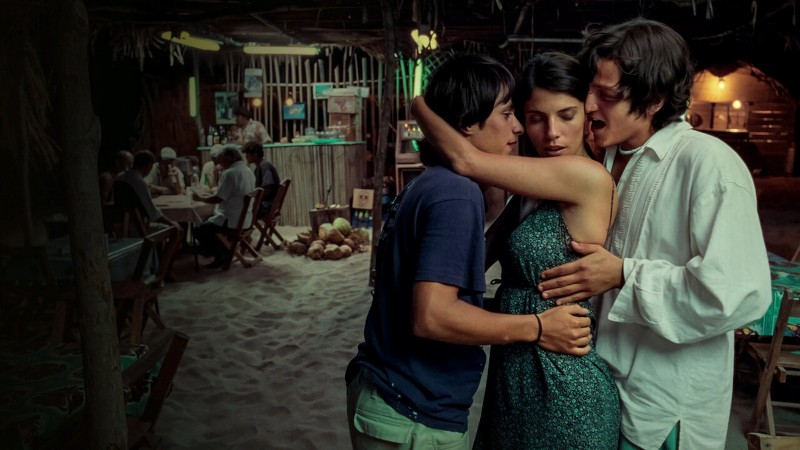
Director: Alfonso Cuarón · Cinematographer: Emmanuel Lubezki · Narrator: Daniel Giménez Cacho · Key Cast: Gael García Bernal, Diego Luna, Maribel Verdú · Screenplay: Alfonso Cuarón, Carlos Cuarón · Runtime: 106 min · Studio: Anhelo Producciones / Producciones Anhelo · Budget: $2 million · Box Office: $33.6 million worldwide
1. A Sex Comedy That Is Secretly About Everything Else
Y Tu Mamá También presents itself as a sun-drenched road trip comedy about two horny teenagers and an older woman driving to a beach that may or may not exist. It is that, and it is very good at being that. But the film Cuarón actually made is something considerably larger: a portrait of a country at a political turning point, a study of how class shapes desire, a meditation on friendship’s fragility, and, in its quietly devastating final minutes, an elegy for the version of yourself that dies when adolescence ends.
The two teenagers are Tenoch (Diego Luna) and Julio (Gael García Bernal), best friends from different social classes who share a vocabulary of sexual bravado, a manifesto of adolescent entitlement they call the “Charolastra” code, and a profound inability to say anything that matters to each other honestly. The woman is Luisa (Maribel Verdú), a Spaniard married to Tenoch’s cousin, who agrees to join them on their road trip for reasons they cannot fathom and that the film will reveal only gradually. The three drive south through a Mexico the boys have never bothered to see, and the journey strips away, layer by layer, the performances of masculinity, friendship, and control that have defined their young lives.
Cuarón and his brother Carlos wrote the screenplay as a return to Mexico after Cuarón’s Hollywood detours, and the film vibrates with the specificity of homecoming. The dialogue is fast, profane, and local in ways that resist translation. The sex is explicit and unglamorous and functions as character revelation rather than titillation. And the narrator, a cool, omniscient voice that periodically interrupts the action to tell you things the characters do not know about themselves or the country they are driving through, transforms what could have been a conventional coming-of-age story into something structurally radical.
The flaws are minor and mostly pacing-related. The first act in Mexico City establishes the boys’ world with thorough but occasionally redundant detail. Some of the political digressions, while thematically essential, feel more essayistic than dramatic. These are small costs for what the film achieves.
Verdict: 9/10. A film that smuggles a political essay, a class critique, and a genuine tragedy inside the body of a bawdy road comedy, and makes all of it feel effortless.
2. Luna, Bernal, and the Chemistry of Adolescent Fraud
The performances at the center of Y Tu Mamá También work because all three actors understand that their characters are performing for each other, and the film’s drama lies in watching those performances collapse.
Diego Luna’s Tenoch is the more privileged of the two boys, the son of a powerful PRI politician, raised in a world of country clubs and private pools. Luna plays him with a confidence that reads as natural charisma on first viewing and as inherited entitlement on second. Tenoch has never had to earn anything, including his best friend’s loyalty, and Luna communicates this through a physical ease that borders on carelessness. He takes up space. He interrupts. He assumes.
Gael García Bernal’s Julio is from a lower-middle-class family, and Bernal gives him a slightly harder edge: funnier, more watchful, more aware of the social gap that Tenoch can afford to ignore. Bernal plays Julio’s bravado as a performance he has learned from Tenoch’s world but does not quite own. The sexual bragging, the casual cruelty, the Charolastra code: these are borrowed clothes, and Bernal lets you glimpse the effort of wearing them.
Maribel Verdú’s Luisa is the film’s secret weapon and its emotional center. She arrives in the boys’ car as a fantasy figure (the beautiful older woman who will initiate them into adult sexuality) and gradually reveals herself as something entirely different: a woman with a terminal diagnosis who is using this trip as her own private farewell to physical pleasure, to beauty, to life. Verdú plays this duality with extraordinary control. In the early scenes, she is wry and slightly amused by the boys’ posturing, a woman who has seen enough of male performance to find it more entertaining than threatening. In the later scenes, as the trip progresses and her knowledge of what awaits her deepens the screen with unspoken weight, Verdú allows grief to surface in increments: a lingering look at the ocean, a sudden tenderness toward a stranger, a willingness to be fully present in moments that the boys are too young to understand as precious.
3. Lubezki’s Handheld Honesty: The Camera That Refuses to Flatter
Emmanuel Lubezki’s cinematography on Y Tu Mamá También is the deliberate negation of everything he and Cuarón had done on their previous Hollywood collaborations. Where A Little Princess and Great Expectations used the camera to create heightened, beautiful, subjective worlds, Y Tu Mamá También uses the camera to observe, to document, to maintain distance.
The approach is handheld, naturalistic, and defiantly unglamorous. Lubezki shoots the sex scenes with the same matter-of-fact attention he gives to the landscape. Bodies are shown in available light, without flattering angles or strategic shadows. The effect is radical, particularly for a film released in 2001: the sex looks like sex, not like a cinematic representation of sex. This is important because the film’s argument depends on the audience seeing these bodies as real rather than performative. When the performance finally drops (in the film’s climactic threesome, where the boys’ bravado crumbles into something raw and frightened), the visual continuity is essential. The camera has not changed. The lighting has not changed. What has changed is the characters’ relationship to their own bodies, and Lubezki’s consistency makes that change legible.
The road trip sequences are shot with a similar refusal of beauty for its own sake. Mexico’s Pacific coastline is gorgeous, but Lubezki does not compose postcards. He shoots through the car’s dirty windshield. He lets the camera drift away from the characters to observe the roadside: a construction crew, a roadblock, a funeral procession. These drifts are not random. They correspond to the narrator’s political observations, and together they create a visual argument: the boys are driving through a country they have never learned to see, and the camera sees it for them.
The long takes, which would become Lubezki and Cuarón’s signature in Children of Men and Gravity, are already present here in embryonic form. Several dialogue scenes play out in unbroken shots that allow the actors to build rhythm and the audience to watch the social dynamics unfold in real time. The effect is immersive without being showy: you forget you are watching a film and begin to feel like a passenger in the back seat.
4. The Voice That Knows What the Characters Do Not
The narrator (Daniel Giménez Cacho, whose dry baritone perfectly suits the role) is Y Tu Mamá También’s most radical structural element and the device that separates it from every other road trip comedy ever made.
The narration functions as a parallel text. While the characters drive, argue, flirt, and have sex, the narrator periodically takes over the soundtrack to deliver information that exists entirely outside the characters’ awareness. A roadside accident will prompt the narrator to tell us, calmly, that a man died at this location six months earlier. A fisherman waving from a beach will trigger a passage about how his village will be destroyed by a resort development within two years. A character’s surname will occasion a brief political genealogy connecting them to Mexico’s ruling class.
These interruptions do several things simultaneously. They widen the film’s scope from personal to national: the boys’ road trip becomes a cross-section of Mexico at a specific historical moment (1999, the last year of seventy unbroken years of PRI rule). They create dramatic irony: the narrator knows Luisa’s secret before the audience does, and his tonal consistency (the same calm delivery whether discussing a car accident or a cancer diagnosis) forces the audience to register all information with equal weight. And they establish an emotional distance that makes the film’s private moments more devastating by contrast. When the narrator falls silent, when the film trusts the characters and the camera to carry a scene without commentary, the intimacy feels earned.
The narrator also reveals things the characters have hidden from each other. Each boy has slept with the other’s girlfriend. Luisa has received a phone call that will determine the rest of her short life. Tenoch’s family wealth comes from political corruption. These revelations arrive with the same measured tone as every other observation, which makes them more, not less, shattering. The narrator does not judge. He simply knows.
5. The Road as Class Map: Mexico Between the Boys and the Beach
Y Tu Mamá También is set in 1999, during the final months of the PRI’s seven-decade monopoly on Mexican political power. This is not background. It is the film’s second subject, and the road trip serves as a device for traversing the class geography that Mexican cinema had largely ignored.
Tenoch and Julio begin the film in the bubble of upper-middle-class Mexico City: country clubs, swimming pools, European travel. Their journey south takes them progressively further from this world and into a Mexico of roadside vendors, impoverished fishing villages, indigenous communities, and police checkpoints. They do not notice. They are too busy arguing about sex and fighting over Luisa to register the country they are driving through, which is precisely the point. The narrator registers it for them, and for the audience, and the accumulating details create a portrait of economic disparity that the boys’ privilege renders invisible.
The characters’ surnames are political signals legible to Mexican audiences. Tenoch Iturbide carries the name of the last Aztec emperor and the name of Mexico’s first post-independence ruler; he is, symbolically, the heir to power. Julio Zapata carries the name of the revolutionary who fought for the dispossessed. Their friendship, affectionate but structurally unequal, is a microcosm of Mexico’s class relations: genuine connection across a divide that neither of them has the vocabulary or the honesty to acknowledge.
Luisa, the Spaniard, occupies an interesting position in this class geography: she is European, which gives her a certain mobility between the boys’ worlds, but she is also an outsider whose presence exposes what the boys take for granted. She is the one who stops to talk to local people. She is the one who notices the beauty of the places the boys drive through without seeing. And she is the one who understands, because she knows what they do not, that every moment of contact with the world is finite.
6. Cuarón’s Return: From Hollywood to the Camera in the Back Seat
Y Tu Mamá También was the film that transformed Alfonso Cuarón from a talented Hollywood craftsman into one of the most important directors of the twenty-first century. Without it, neither Children of Men nor Gravity nor Roma would exist in their current forms.
Cuarón’s Hollywood work (A Little Princess, Great Expectations) was accomplished and visually distinguished but operated within conventional studio frameworks. Both films used Lubezki’s camera to create subjective, aestheticized realities that served their stories’ emotional needs. Y Tu Mamá También rejected this approach completely. Cuarón and Lubezki decided, consciously, to adopt an objective visual style: handheld, naturalistic, willing to let the camera wander away from the characters to observe the world around them.
This decision changed both of their careers. The long-take methodology that Lubezki would refine on Children of Men, Gravity, The Revenant, and Birdman begins here, in the back seat of a car on a Mexican highway. Cuarón’s subsequent commitment to extended takes as his primary storytelling tool, his interest in the relationship between foreground drama and background reality, and his use of the camera as a patient, observational presence rather than an expressive instrument: all of this originates in Y Tu Mamá También.
The film also restored Cuarón to the Spanish language and to Mexican subject matter, a return that would culminate seventeen years later in Roma, his most personal film. The two works form a diptych of sorts: Y Tu Mamá También is Mexico seen through the eyes of privileged young men who do not understand what they are looking at; Roma is Mexico seen through the eyes of a domestic worker who understands everything but is never asked.
7. What the Sex Scenes Actually Show
The sex in Y Tu Mamá También is frequently cited as the film’s most controversial element, and it is certainly explicit by mainstream standards. But the explicitness is purposeful. Every sex scene in the film is a character study, and what the scenes reveal has almost nothing to do with physical pleasure.
The early sex scenes between the boys and their respective girlfriends are fast, performative, and filmed with Lubezki’s characteristic detachment. The boys are having sex at each other: the narration informs us that each fantasizes about a different partner. The act is less about connection than about establishing status within their friendship. They are performing masculinity for an audience of one (each other), and the sex is the loudest part of that performance.
Luisa’s entrance changes the sexual dynamic entirely. Her early encounters with each boy individually are initiated by her, on her terms, with a specificity of desire that neither teenager knows how to process. She is not performing. She is experiencing. And the contrast between her physical directness and the boys’ bravado exposes how much of their sexuality is theatre.
The threesome near the film’s end is the scene that demolishes everything that has come before. In the dark, drunk, with Luisa between them, the boys’ carefully maintained boundaries dissolve. They kiss each other. The kiss is brief, shocked, and immediately followed by both boys passing out. It is the most honest physical moment in the film, and it is the one the characters cannot integrate into their understanding of themselves. The narrator tells us, in the film’s final scene, that Tenoch and Julio never see each other again. Their friendship, built on a shared performance of heterosexual masculinity, cannot survive the revelation that the performance had a lie at its center.
8. The Ending the Characters Cannot Face
The final scene of Y Tu Mamá También is one of the most quietly devastating endings in twenty-first-century cinema, and it earns its devastation through information withheld.
Months after the road trip, Tenoch and Julio run into each other by chance at a coffee shop. They are awkward, distant, performing a version of friendship that both know has ended. Tenoch mentions, almost as an afterthought, that Luisa died. The narrator confirms: she was diagnosed with cancer before the trip. The road trip was her farewell, and neither boy knew.
This revelation retroactively transforms every scene Luisa appears in. Her spontaneous decisions, her tenderness, her willingness to be present: these were not the whims of a free spirit. They were the choices of a woman who knew her time was finite and decided to spend what remained experiencing the world with the intensity that finitude demands.
The boys sit across from each other. They cannot discuss what happened between them. They cannot discuss Luisa’s death. They cannot discuss the kiss. They finish their coffee and leave, and the narrator tells us they will not meet again. The friendship is over, not because of a dramatic rupture but because the boys have arrived at the border of adulthood where the performances of adolescence can no longer be sustained, and they have nothing to replace them with.
Cuarón holds this final scene in a single, static shot. No music. No camera movement. Just two young men sitting with the weight of what they cannot say. It is, in its restraint, the most powerful scene in the film.
9. “We Were in It Together”: Reception and the Mexican New Wave
Y Tu Mamá También was a commercial and cultural earthquake in Mexican cinema. It set a new opening weekend record in Mexico, earned $33.6 million worldwide on a $2 million budget, and received an Academy Award nomination for Best Original Screenplay, a rare recognition for a Spanish-language film at the time.
The film’s impact extended beyond its own success. Together with Amores Perros (Alejandro González Iñárritu, 2000) and El Crimen del Padre Amaro (Carlos Carrera, 2002), it constituted the vanguard of what critics called the Mexican New Wave: a generation of filmmakers (Cuarón, Iñárritu, Guillermo del Toro) who would go on to reshape Hollywood and international cinema. All three directors have since won the Academy Award for Best Director, a trajectory that begins, in Cuarón’s case, with the confidence and creative freedom that Y Tu Mamá También provided.
The ratings controversy in Mexico was significant and revealing. The film received an 18+ rating from the government-controlled ratings board, which the Cuarón brothers sued, arguing that the rating constituted political censorship. Their legal challenge prompted the transformation of Mexico’s ratings board from a government agency into an autonomous organization. The film was political in its content and in its institutional consequences.
Critics have compared the film to Italian neorealism, to the French New Wave, and to Terrence Malick’s Badlands, but these comparisons, while useful, obscure what is most original about it: the narrator. No other film has used voiceover to create such a systematic counterpoint between private drama and public reality. The technique is borrowed from literature (the omniscient narrator is a novelistic device that cinema rarely employs with this kind of authority), and it gives Y Tu Mamá También a structural depth that none of its obvious influences possess.
10. The Trip You Cannot Take Twice: A Rewatch Guide
Y Tu Mamá También is a fundamentally different film on second viewing, because Luisa’s secret changes everything.
Watch Luisa’s face in every scene. On first viewing, Verdú’s performance reads as spontaneous and free-spirited. On second viewing, knowing the diagnosis, every smile carries a different weight. Track the moments where she pauses, where she looks at the ocean a beat too long, where she touches someone with a tenderness that seems excessive for the context. These are not the gestures of a carefree woman. They are the gestures of someone memorizing.
Listen to the narrator differently. On first viewing, the political and historical digressions feel like context. On second viewing, they function as memento mori: the fisherman whose village will be destroyed, the roadside crosses marking deaths, the country itself in transition. Everything is passing. The narrator knows this. The boys do not.
The Charolastra manifesto. The boys’ adolescent code of conduct (“truth is cool but unattainable,” among other maxims) reads as comedy on first viewing. On second, it reads as a diagnosis: these are young men who have built their entire friendship on the principle that honesty is impossible. The film then tests this principle to destruction.
The kiss, again. The threesome is the scene most viewers remember, but the kiss between the boys is the scene that matters. On second viewing, ask whether the film is suggesting that suppressed desire was always the subtext of their friendship, or whether the kiss is simply the most honest thing that has ever happened between them and therefore the thing they cannot survive. The film supports both readings.
The final coffee. Two boys who were inseparable sit across a table with nothing to say. The friendship is over, not because of betrayal or anger but because adulthood has arrived and the masks no longer fit. Watch how Luna and Bernal play this scene: the effort of politeness, the avoidance of eye contact, the relief of leaving. It is one of the truest scenes about the end of a friendship that cinema has produced.
Film Trivia
The beach was real, the name was invented. “Boca del Cielo” (Heaven’s Mouth) was a fictional destination the boys improvise to impress Luisa. Cuarón and his team scouted the Pacific coast of Oaxaca and found a beach that matched the name’s promise. The location became so identified with the film that it now appears in some Mexican tourism materials under the film’s invented name.
Lubezki’s reinvention began here. Both Cuarón and Lubezki have described Y Tu Mamá También as the film where they deliberately rejected their own previous visual style. After the glossy, controlled aesthetics of Great Expectations, they committed to handheld naturalism, available light, and a camera that observed rather than directed. The methodology they developed on this $2 million film would become the foundation for Children of Men, Gravity, and The Revenant.
The pig incident was autobiographical. Carlos Cuarón confirmed that several incidents in the film were drawn from real experiences. The scene involving pigs invading the boys’ tent actually happened to Lubezki during a trip. Other details, including a specific scene where one character questions another about sleeping with his girlfriend, came directly from Carlos Cuarón’s adolescence.
A lawsuit changed Mexico’s film ratings system. The Mexican government’s ratings board gave the film an 18+ classification, which the Cuarón brothers challenged in court as illegal political censorship. Their lawsuit exposed the board’s lack of legal authority and prompted its transformation into an autonomous body free from government control. The film was political both on screen and in its institutional afterlife.
Luna and Bernal were already friends. Diego Luna and Gael García Bernal had been close friends since childhood, having attended the same acting school in Mexico City. Their pre-existing chemistry is visible on screen: the shorthand, the competitiveness, the physical comfort between them required no manufacturing. The friendship’s authenticity makes the film’s final scene, where that friendship ends, considerably more painful to watch.
This entry selects analytical dimensions from a pool. All five anchors are present: critical verdict, performances, visual craft, reception and legacy, and the rewatchability guide. Earned sections cover the director’s body of work, the cultural and political context of turn-of-the-millennium Mexico, and the film’s ending as a separate analytical dimension (because its revelations retroactively transform the entire preceding film). Two wildcard sections address elements unique to this film: the omniscient narrator as political counterpoint, a structural device borrowed from literature that no other road trip film has employed with comparable authority, and the sex scenes as character X-rays, where physical intimacy functions as the mechanism that exposes every lie the characters have told about themselves. Sound and score sections are omitted because the film uses no original score, and its sonic landscape is naturalistic rather than designed.


Leave a Reply