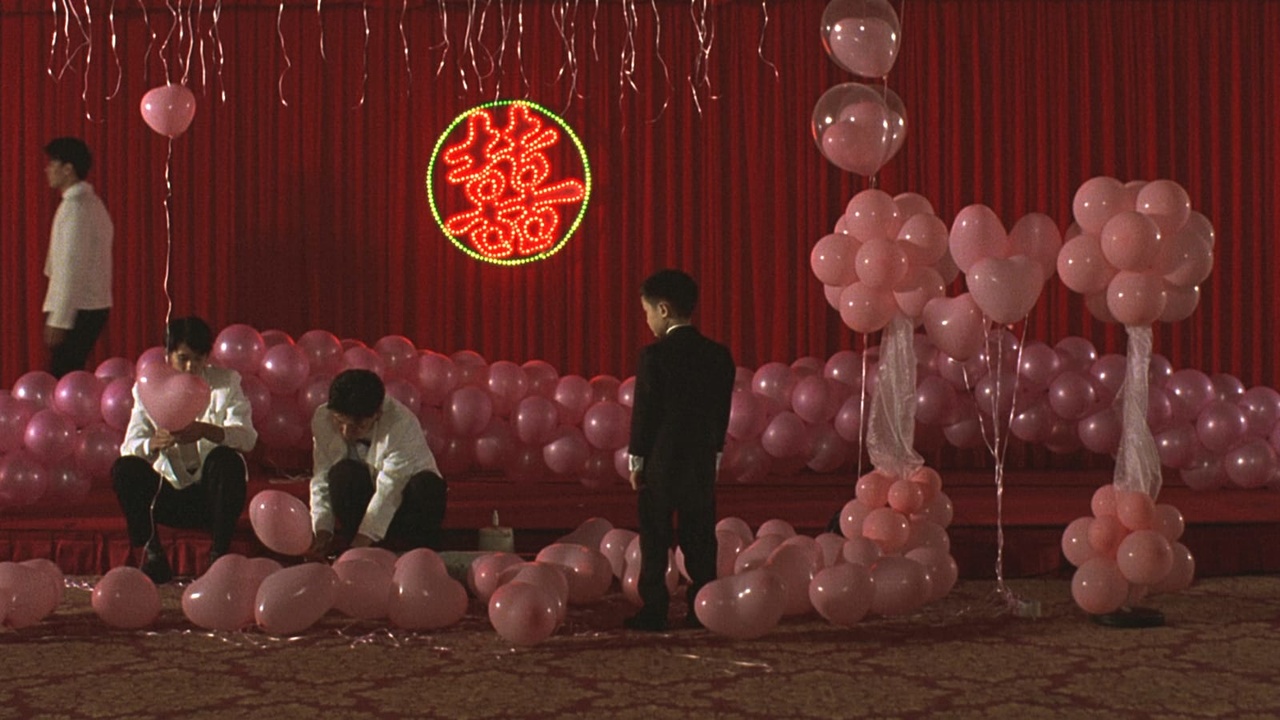
Director/Writer: Edward Yang · Cinematographer: Yang Wei-han · Composer/Production Designer: Peng Kai-li · Editor: Chen Po-wen · Key Cast: Wu Nien-jen (NJ), Elaine Jin (Min-Min), Issei Ogata (Ota), Kelly Lee (Ting-Ting), Jonathan Chang (Yang-Yang), Ko Su-yun (Sherry) · Runtime: 173 minutes · Studio: 1+2 Seisaku Iinkai / Atom Films / Pony Canyon · Country: Taiwan/Japan · Language: Mandarin, Min Nan, Japanese, English
A Film About Everything, Told Quietly
Yi Yi opens with a wedding and closes with a funeral. Between those two ceremonies, an eight-year-old boy takes photographs of the backs of people’s heads, a teenager falls in love for the first time, a middle-aged man revisits the woman he should have married, and a grandmother lies in a coma while her family takes turns talking to her, desperate and uncertain about whether she can hear them. Nothing extraordinary happens. Everything happens.
Edward Yang’s final film is 173 minutes long, and not one of those minutes is wasted. It covers approximately one year in the life of the Jian family, a middle-class household in Taipei, and in doing so it covers the full span of human experience: childhood wonder, adolescent confusion, adult compromise, marital erosion, professional ambiguity, spiritual crisis, illness, death. The scope is novelistic. The texture is specific. Yang films ordinary Taiwanese life with such patient attention that the ordinary reveals itself as bottomless.
The title, 一一, means “one one” or “one by one” or “individually.” Written vertically, the two strokes of 一一 form the character 二 (two). This is not an accident. The film is about individuals who are also pairs, about separate experiences that mirror each other across generational lines. NJ’s tentative reunion with his old girlfriend Sherry parallels his daughter Ting-Ting’s first romance. Yang-Yang’s philosophical curiosity about what people cannot see echoes his grandmother’s comatose silence, her inability to respond to the world that is narrating itself to her bedside. Every story in the film rhymes with another story, and the rhymes are never forced. They emerge from the architecture of family life, where the same emotions recur in different bodies, decades apart.
Yang is sometimes compared to Ozu, and the comparison is not wrong but it is incomplete. Ozu observed Japanese family life with a serene acceptance that borders on the religious. Yang observes Taiwanese family life with a warmth that never quite suppresses an undertow of melancholy. His families are not falling apart. They are doing something subtler and more universal: they are discovering that the lives they have built are not quite the lives they wanted, and that this discovery changes nothing, because the lives continue anyway.
Yi Yi is the rare film that earns its length by earning your trust. It asks for patience and repays it with recognition. By the final scene, when Yang-Yang delivers his eulogy at his grandmother’s funeral, the audience has spent three hours inside a family’s private world, and the boy’s words land not as sentiment but as truth. He tells his grandmother that he is sorry he could not show her what she had already seen. He tells her he misses her. He tells her he is old.
He is eight years old, and he is right.
Verdict: 10/10
Five Lives, One Household, No Protagonist
Yi Yi has no main character. It has five. Each member of the Jian family carries a strand of the narrative, and Yang weaves these strands together without subordinating any of them to the others.
NJ, played by the screenwriter Wu Nien-jen (who had collaborated with Yang since the 1980s), is an engineer and mid-level executive at a software company. He is decent, tired, and quietly trapped. His performance is defined by what it withholds. NJ does not explode, does not confess, does not make grand decisions. He moves through his professional and personal crises with a composed exhaustion that any middle-aged viewer will recognize. His trip to Tokyo, where he reconnects with Sherry and revisits the roads not taken, is one of cinema’s great portraits of adult regret: not dramatic, not cathartic, simply present.
Min-Min, played by Elaine Jin, undergoes the film’s most visible crisis. When she realizes that her nightly talks with her comatose mother consist of the same repetitive content, she breaks down. Her life, she discovers, is empty. She retreats to a Buddhist monastery, seeking meaning. Jin plays this collapse with a restraint that makes it devastating. Min-Min is not melodramatic. She is simply honest, and her honesty terrifies her family because no one knows what to do with it.
Ting-Ting, the teenage daughter, navigates first love and first guilt. Her storyline involves a neighbor, a boyfriend, and a moment of indirect responsibility for her grandmother’s stroke. Kelly Lee, who had never acted before, brings a naturalism to the role that trained performers rarely achieve. Ting-Ting does not understand her own emotions. She acts on them and then spends the rest of the film trying to understand what she has done. Yang films her confusion with a gentleness that never condescends to youth.
Yang-Yang, played by Jonathan Chang, is the film’s philosophical center disguised as comic relief. He is eight. He takes photographs of the backs of people’s heads because, as he explains, people cannot see what is behind them. He conducts experiments. He asks questions that adults dismiss but cannot answer. He is the character who most resembles Yang himself, a filmmaker whose career was built on showing people what they could not see from where they were standing.
And the grandmother, silent in her coma, is the film’s absent presence. She hears everything (or perhaps hears nothing), and her unresponsiveness becomes a kind of test. What do you say to someone who cannot reply? Min-Min discovers she has nothing to say. NJ discovers he has too much. Yang-Yang discovers that speaking to someone who cannot hear you is, in its own way, the most honest form of communication.
Reflections, Glass, and the Camera That Shows What Taipei Cannot See
Yang Wei-han’s cinematography in Yi Yi operates through a visual strategy so consistent that it becomes a language: reflection. Glass surfaces, windows, mirrors, the polished facades of corporate towers, the screens of televisions and computer monitors. Taipei, as Yang Wei-han photographs it, is a city of transparent barriers. You can see through them, but you cannot pass through them. People are visible to each other and unreachable at the same time.
The most characteristic shots in the film frame characters through windows, with the city’s lights and traffic reflected on the glass between the character and the camera. The effect is layered: the person and the city exist in the same frame, superimposed, neither fully occluding the other. These compositions say something precise about urban life. In Taipei, as in any modern city of comparable density, private life and public life are not separate domains. They bleed into each other. You have a conversation in an apartment, and the headlights of passing cars track across the wall behind you. You stand on a balcony, and the building opposite shows you forty other lives stacked in illuminated rectangles.
Yang Wei-han frequently places the camera at a distance from the action, filming through doorways, across rooms, from the far side of a street. This distancing is not cold. It is respectful. It creates the feeling that we are observing these lives rather than intruding on them, that the film has the good manners to keep a step back even when the emotions on screen are raw. The effect is paradoxical: the physical distance generates emotional closeness, because the viewer must lean in, must pay attention, must fill the space between the camera and the character with empathy.
The film’s color palette is muted but not drab. Taipei is rendered in soft greys, warm ambers, cool blues from fluorescent office lighting, the greenish tint of hospital corridors. There is no visual spectacle. The beauty of the cinematography lies in its consistency: every frame is composed with care, but the care is invisible. You do not notice the cinematography while watching Yi Yi. You feel it afterward, when you realize that the film’s visual world has lodged itself in your memory with the permanence of a place you have actually visited.
The Boy with the Camera: Yang-Yang and the Philosophy of Seeing
Yang-Yang takes photographs of the backs of people’s heads. When his father asks why, he explains: they cannot see what is behind them, so he is showing them.
This is the film’s thesis, stated by an eight-year-old with total clarity. What Yi Yi does, across three hours and five interlocking stories, is show its characters (and its audience) what they cannot see from where they are standing. NJ cannot see that his trip to Tokyo is a rehearsal of a life he has already declined. Ting-Ting cannot see that her guilt about her grandmother is misplaced. Min-Min cannot see that the emptiness she feels at the monastery is the same emptiness she felt at home. Each character is trapped inside their own perspective, and the film, by cross-cutting between their stories, reveals the connections and parallels that no individual life can perceive from within.
Yang-Yang’s photography is also a commentary on cinema itself. A photograph of the back of someone’s head is an image of what they cannot see. A film, in its ideal form, does the same thing. It shows its audience perspectives they cannot access from their own position in the world. When Yang-Yang develops his photos and his father flips through them, the moment is quiet and comic, but it contains the film’s deepest conviction: that art exists to reveal what life, lived from the inside, necessarily obscures.
The character is also Yang’s self-portrait, though the identification is gentle rather than programmatic. Edward Yang was an engineer before he became a filmmaker. He studied electrical engineering in Taiwan and at the University of Florida. He worked in a physics laboratory designing submarine navigation systems. He came to cinema late, and he came to it from the outside, from a discipline that valued precision, observation, and the empirical investigation of phenomena. Yang-Yang shares this disposition. He does not feel what happens around him. He studies it. He photographs it. He tries, with the tools available to an eight-year-old, to understand.
NJ in Tokyo: The Architecture of Regret
The Tokyo sequences, in which NJ travels for business and reconnects with Sherry, the woman he loved decades ago, constitute the film’s emotional center. They are also among the most restrained love stories in cinema, precisely because they refuse to become a love story.
NJ and Sherry walk through Tokyo. They visit the places where they spent time as young people. They talk about what went wrong. Sherry asks why NJ never came for her. NJ does not have an adequate answer. They do not kiss. They do not sleep together. They do not decide to leave their respective lives. They spend a few days in each other’s company, and then NJ goes home to Taipei.
What makes these scenes extraordinary is their refusal to offer the consolation of drama. A lesser film would have NJ face a choice: his family or his lost love. Yang denies him the choice because life, as Yang understood it, rarely offers such clean alternatives. NJ is not torn. He is simply sad. He sees the life he might have had. He sees the life he does have. Neither is wrong. Neither is enough. The two lives exist simultaneously in his mind, superimposed like the reflections on Taipei’s glass, and the film does not insist that he resolve them.
During these sequences, Yang cross-cuts between NJ in Tokyo and Ting-Ting in Taipei, who is experiencing her first romance. The parallel is structural and thematic: father and daughter are both navigating intimacy, both discovering the gap between what they feel and what they can express, both learning that connection with another person is always partial, always temporary, always shadowed by the awareness that it could have been otherwise. The intercutting is not didactic. Yang never underlines the parallel. He trusts the audience to feel it.
Issei Ogata, as the Japanese businessman Ota, provides a counterpoint. Ota is warm, eccentric, and unguarded, qualities that NJ admires precisely because he cannot access them in himself. Ota’s business philosophy, which values human creativity over algorithmic efficiency, mirrors Yang’s own approach to filmmaking: personal, intuitive, resistant to formula. Their professional relationship becomes the film’s most unlikely friendship, and Ota’s card trick, performed in a single unbroken take, is one of Yi Yi’s most quietly magical moments.
Taipei at the Turn of the Century: A City Learning to Want
Yi Yi is set in Taipei in 1999 or 2000, at the threshold of a new century, and the city operates as both setting and subject. This is a Taipei of high-rise apartments, software companies, karaoke bars, traffic jams, and Buddhist temples. It is a city where tradition and modernity are not in conflict but in uncomfortable coexistence, where a family can attend a wedding ceremony steeped in ritual and then argue about stock options at the reception.
Taiwan’s economic transformation over the preceding decades was among the most rapid in Asia. The island had moved from agricultural poverty to technological prosperity in a single generation, and the cultural dislocations that accompanied this transformation are visible in every corner of Yi Yi. NJ’s software company is navigating a deal with a Japanese gaming firm, and the business sequences, which might seem like filler in a different film, are essential. They show a society that has learned to produce wealth but has not yet learned to produce meaning. NJ is good at his job. His job does not make him happy. The gap between competence and fulfillment is the film’s central wound.
The Taiwan New Cinema movement, of which Yang was a founding figure alongside Hou Hsiao-hsien and others, had spent the 1980s and 1990s documenting this transformation. Yang’s earlier films, particularly Taipei Story (1985) and A Brighter Summer Day (1991), examined the human costs of modernization with an analytical precision that reflected his engineering background. Yi Yi is softer than those films. It is warmer. It has more humor, more tenderness, more willingness to let its characters be confused rather than representative. This softness is not a retreat from social observation. It is its refinement. Yang understood that the most revealing portrait of a society is not its conflicts but its silences: the things a family does not discuss, the emotions a culture has not developed language for, the questions a child asks that no adult can answer.
Edward Yang: The Engineer Who Watched Movies at Night
Edward Yang was born in Shanghai in 1947 and raised in Taipei after his family moved to Taiwan in 1949. He studied electrical engineering, earned a master’s degree from the University of Florida, and took a job at the University of Washington’s Applied Physics Laboratory, designing navigation systems for military submarines. He watched films in the evenings. He dreamed of making them. He could not quite justify the leap.
One night, he saw Werner Herzog’s Aguirre, the Wrath of God at a repertory screening. The experience was, by his own account, transformative. He quit his engineering career and returned to Taiwan, where he began writing screenplays and eventually directing. His filmography is small (seven features in twenty years) and formidable. That Day, on the Beach (1983) announced a new voice in Taiwanese cinema. A Brighter Summer Day (1991), a four-hour epic about youth gangs in 1960s Taipei, is considered by many critics to be the greatest Taiwanese film ever made. Mahjong (1996) was a commercial and critical disappointment.
Yi Yi was his comeback, and it was also his farewell. Yang won Best Director at the Cannes Film Festival in 2000, and the film was embraced internationally as one of the defining works of the new century. He began work on The Wind, an ambitious animated martial arts feature co-produced with Jackie Chan. He never finished it. He was diagnosed with colon cancer and died on June 29, 2007, at his home in Beverly Hills, California. He was 59.
Yang’s body of work shares certain qualities with his engineering training: structural precision, systematic observation, a preference for evidence over assertion. But Yi Yi reveals something that his earlier, more rigorous films sometimes suppressed: a deep and uncomplicated love for the people he filmed. The Jian family is not a case study. They are not symbols of Taiwanese modernity or victims of globalization. They are a family. Yang loved them, and by the end of three hours, so do we.
Birth to Death in 173 Minutes: The Film’s Hidden Chronology
Yi Yi opens with a wedding and closes with a funeral. The structure is deliberate, and Yang identified it explicitly: his original intention was to trace a human life from birth to death. The finished film does not follow a single life from infancy to old age. Instead, it distributes the stages of life across its five protagonists, so that the full arc of human experience unfolds simultaneously rather than sequentially.
Yang-Yang, at eight, embodies the childhood stage: curiosity, play, bewilderment, the first encounters with cruelty (he is bullied) and with beauty (he discovers the swimming pool). Ting-Ting, at thirteen, embodies adolescence: first love, first guilt, the dawning awareness that your actions have consequences you cannot control. NJ, in his forties, embodies midlife: professional obligation, marital stasis, the revisiting of old desires. Min-Min embodies spiritual crisis: the moment when the accumulated routine of adult life collapses and the question of meaning can no longer be deferred. The grandmother embodies mortality: the silent, horizontal presence that reminds the family, and the audience, that every story ends.
By arranging these stages simultaneously, Yang achieves something that chronological storytelling cannot. He shows that all the stages of life coexist within a single household. At any given moment, someone in the Jian family is falling in love, someone is losing faith, someone is dying, and someone is trying to understand what the back of a head looks like. The family is a cross-section of human time. Each member is living through a different chapter of the same book, and none of them can read the chapters that belong to the others.
This structure also explains the film’s length. Yi Yi is long because life is long, and because the recognition the film offers depends on duration. You cannot understand what Yang is doing in twenty minutes. You need to live with the Jian family for three hours before the rhymes between their stories become audible, before the wedding and the funeral reveal themselves as the same ceremony viewed from opposite ends of the same hall.
A Masterwork the World Saw and Taiwan Did Not
Yi Yi premiered at the Cannes Film Festival on May 14, 2000, where Yang won the Best Director award and the film was nominated for the Palme d’Or. It went on to win Best Foreign Film from the New York Film Critics Circle, the Los Angeles Film Critics Association, and the National Society of Film Critics. A. O. Scott, reviewing the film for The New York Times, described watching the final credits through tears and struggling to identify the feeling that overwhelmed him. He settled on something like the sensation of having lived an entire life in three hours.
The film was not submitted as Taiwan’s official entry for the Academy Awards. That distinction went to Crouching Tiger, Hidden Dragon, a commercially safer choice that went on to win Best Foreign Language Film. Yi Yi received no Oscar nominations. The omission has become one of those footnotes that film historians cite when discussing the Academy’s blind spots regarding non-English-language cinema.
In Taiwan, the film was met with relative indifference. Yang’s work had always been more celebrated abroad than at home, where audiences favored commercial entertainment over the contemplative rhythms of art cinema. Yi Yi did not receive a formal theatrical release in Taiwan until years after its international success. This absence is both ironic and fitting: a film about a family’s inability to see itself clearly was itself unseen by the society it depicted.
The film’s stature has only grown. It ranked 96th in the 2012 Sight & Sound critics’ poll. The BBC named it one of the greatest films of the 21st century. In 2025, a 4K restoration premiered at Cannes’s Classics section, marking the film’s 25th anniversary and honoring Yang’s legacy.
What Three Hours Reveals on the Second Viewing
Yi Yi changes profoundly on rewatch, not because its meaning shifts but because its details multiply.
On a first viewing, attention gravitates toward the narrative arcs: NJ’s trip to Tokyo, Ting-Ting’s romance, Min-Min’s breakdown. On a second viewing, the connective tissue between arcs becomes visible. Watch for the moments when Yang cuts from one storyline to another at a point of thematic echo. A shot of NJ staring out a hotel window in Tokyo cuts to Yang-Yang staring at a window in Taipei. Ting-Ting’s face after her first kiss cuts to NJ’s face after he sees Sherry for the first time in decades. These transitions are not motivated by narrative continuity. They are motivated by emotional resonance, and once you see the pattern, the film reveals itself as a symphony of parallel feelings.
Listen to what the family members say to the grandmother. Each monologue reveals more about the speaker than the listener. Min-Min’s repetitiveness tells us she has stopped growing. NJ’s silences tell us he has things he cannot say to anyone conscious. Yang-Yang’s final eulogy, written by a child with the seriousness of an old man, tells us that wisdom is not a function of age.
Track the backgrounds. Yang Wei-han’s compositions consistently place significant information at the edges of the frame or in reflected surfaces. A television in the background of a family dinner is showing a news broadcast that comments, obliquely, on the scene in the foreground. A window reflection reveals a character who is physically absent from the room but emotionally present in the conversation.
Pay attention to Ota. His scenes with NJ are the warmest in the film, and on second viewing, they function as a mirror for what NJ’s life might look like if he allowed himself to be curious rather than responsible. Ota’s card trick, performed once, is a moment of genuine magic. On second viewing, it is also a thesis statement: the world contains wonders, but you have to be willing to look.
Film Trivia
Fifteen years in the writing. Yang began drafting what would become Yi Yi during the production of Taipei Story in 1985. The script evolved over fifteen years, changing shape as Yang’s own life changed. By the time filming began in April 1999, the script had been through so many iterations that it bore little resemblance to its origins. The children’s ages were adjusted after Yang found Jonathan Chang and Kelly Lee, neither of whom had acted before.
The engineer who almost was not a filmmaker. Before becoming a director, Yang worked as an electrical engineer at the University of Washington’s Applied Physics Laboratory, designing navigation technology for U.S. military submarines. He watched films at night. The screening that changed his life was Werner Herzog’s Aguirre, the Wrath of God, seen at a Seattle repertory theater. He later said that seeing Herzog’s film “turned me around.”
The film Taiwan did not see. Despite winning Best Director at Cannes and sweeping critics’ awards across the United States, Yi Yi did not receive a proper theatrical release in Taiwan for years after its international premiere. Taiwan submitted Crouching Tiger, Hidden Dragon as its Oscar entry that year instead. The film that most critics consider the defining portrait of modern Taiwanese life was largely unseen by the society it portrayed.
An unfinished farewell. At the time of his death in 2007, Yang was developing The Wind, an animated martial arts feature co-produced with Jackie Chan. The project was never completed. Yi Yi, intended as a creative resurgence, became his final work. He died of colon cancer at 59, leaving behind seven features and a reputation that continues to grow.
This entry selects analytical dimensions from a pool. The five anchors are present: critical verdict, performances, visual craft, reception and legacy, and rewatchability guide. Earned sections cover the cultural context of millennial Taipei, Edward Yang’s body of work, and the film’s hidden birth-to-death structure (which absorbs what would otherwise be a separate section on screenplay architecture). Two wildcard sections address qualities unique to this film: Yang-Yang’s photography as the film’s philosophical thesis about the purpose of art, and the Tokyo sequences as a standalone essay on the architecture of regret. A separate score section is omitted because Peng Kai-li’s compositions, while lovely, serve an ambient function that does not generate enough standalone analytical substance. An awards section is similarly absorbed into the reception discussion.

Leave a Reply